
Comparative Evaluation of Antioxidant Activity and Phytochemical Composition of Bentong Ginger Extracts and Kelulut Honey
DOI:
https://doi.org/10.11113/mjfas.v22n3.5373Keywords:
Bentong ginger, Kelulut honey, synergy, antioxidant activity, LCMS/MS QTOF analysisAbstract
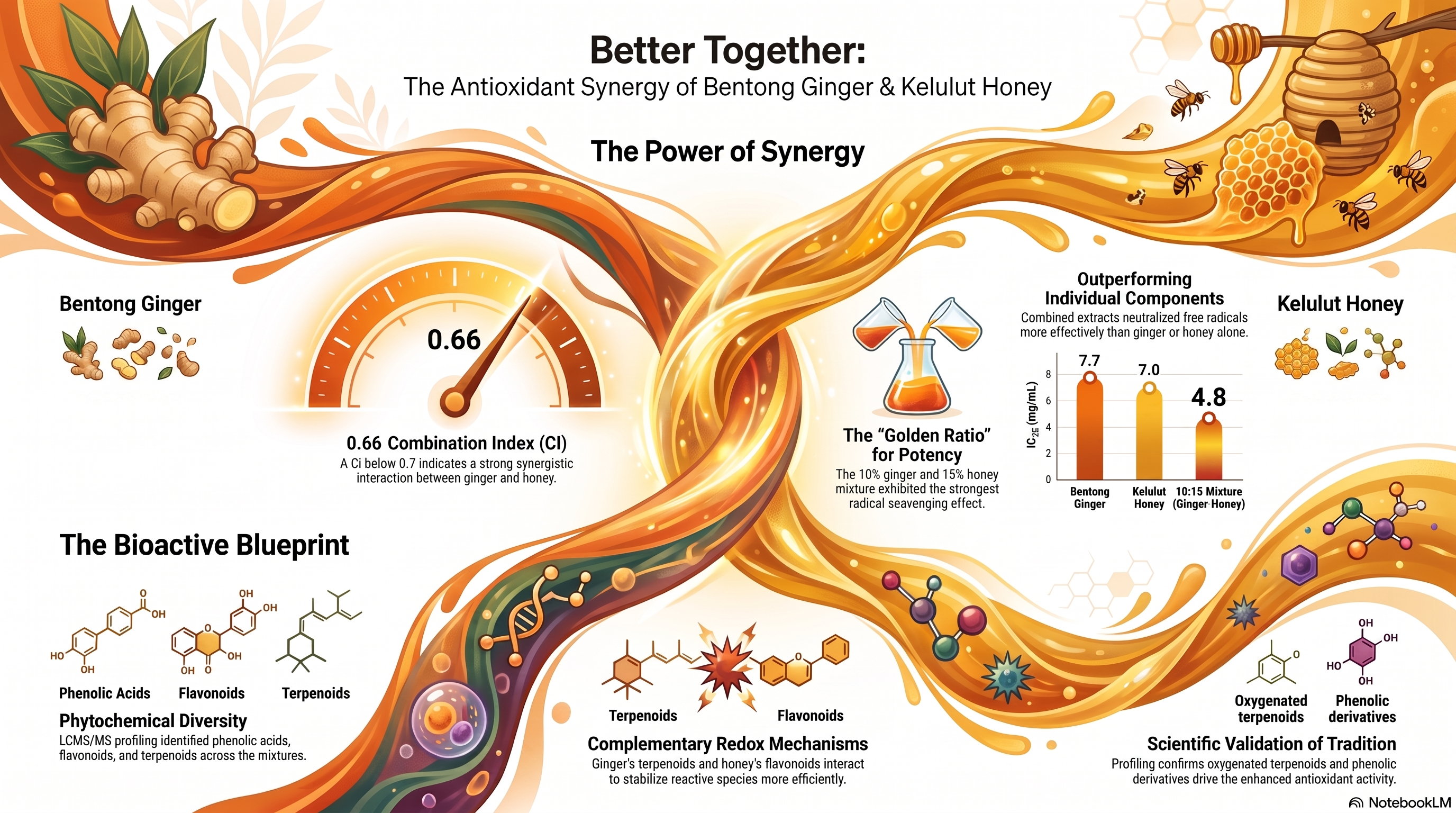
Bentong ginger (Zingiber officinale Roscoe var. Bentong) and Kelulut honey (Heterotrigona itama) are recognized natural antioxidants, yet their synergistic potential remains underexplored. This study evaluated the antioxidant activities of Bentong ginger, Kelulut honey, and their combinations (10% ginger with 15% or 20% honey) using DPPH and ABTS radical scavenging assays, alongside LCMS/MS QTOF profiling to identify key contributing phytochemicals. Both assays demonstrated concentration-dependent antioxidant activity, with the 10% ginger and 15% honey mixture exhibiting the strongest effect and a pronounced synergistic interaction (CI = 0.66). LCMS/MS QTOF analysis revealed diverse bioactive constituents across samples, including phenolic acids, oxygenated terpenoids, flavonoids, fatty acid derivatives, and flavin-related metabolites, supporting the enhanced radical-scavenging capacity observed in the mixtures. Overall, the findings demonstrate that combining Bentong ginger with Kelulut honey significantly augments antioxidant potency and provides a strong scientific basis for the development of natural health products or functional formulations utilizing their synergistic antioxidant properties.
References
Shaukat, M. N., Nazir, A., & Fallico, B. (2023). Ginger bioactives: A comprehensive review of health benefits and potential food applications. Antioxidants (Basel), 12(11), 2015. https://doi.org/10.3390/antiox12112015
Arcusa, R., Villaño, D., Marhuenda, J., Cano, M., Cerdà, B., & Zafrilla, P. (2022). Potential Role of Ginger (Zingiber officinale Roscoe) in the Prevention of Neurodegenerative Diseases. Front Nutr, 9, 809621. https://doi.org/10.3389/fnut.2022.809621.
Zoni Fasli, F. A., Mat Hussin, N. S. S., Farinordin, F. A., Midin, M. R., Ahmed Qareerah, N. M., Sulayman Ahmeedah, S. A., & Ridzuan, R. (2024). Genus Zingiber: A review on botanical, major bioactivities and genetic diversity. Malaysian Journal of Fundamental and Applied Sciences, 20(5), 1192-1211. https://doi.org/10.11113/mjfas.v20n5.3553
Mohd Sahardi, N. F. N., Jaafar, F., Zakaria, S. N. A., Tan, J. K., Mad Nordin, M. F., & Makpol, S. (2021). Comparison of the antioxidant activity of Malaysian ginger (Zingiber officinale Roscoe) extracts with that of selected natural products and its effect on the viability of myoblast cells in culture. Sains Malaysiana, 50(5), 1445-1456. https://doi.org/10.17576/jsm-2021-5005-23
Becerril-Sánchez, A. L., Quintero-Salazar, B., Dublán-García, O., & Escalona-Buendía, H. B. (2021). Phenolic Compounds in Honey and Their Relationship with Antioxidant Activity, Botanical Origin, and Color.
Antioxidants, 10(11), 1700. https://www.mdpi.com/2076-3921/10/11/1700
Zainal-Abidin, Z., Mohd Juffry, J. I., MD Najib, N. A., Sulaiman, W. N., Shafiei, Z., & Mohd Said, M. (2025). Antibacterial effect of Halia Bentong ethanolic extract on Porphyromonas gingivalis: A preliminary investigation. Malaysian Journal of Medicine and Health Sciences, 21(Suppl 9), 41–48. https://doi.org/10.47836/mjmhs.21.s9.6.
Singh, J. P., Mishra, P. K., Siddiqui, M. W., Ahmad, M. S., Aftab, M. A., & Kumar, V. (2014). Development of Nutraceutical Ready-to-Serve Blends of Ginger and Honey. Journal of Postharvest Technology, 2(4), 188-194. https://acspublisher.com/journals/index.php/jpht/article/view/15774
Gulcin, İ., & Alwasel, S. H. (2023). DPPH Radical Scavenging Assay. Processes, 11(8), 2248.
https://www.mdpi.com/2227-9717/11/8/2248
Ilyasov, I. R., Beloborodov, V. L., Selivanova, I. A., & Terekhov, R. P. (2020). ABTS/PP Decolorization Assay of Antioxidant Capacity Reaction Pathways. International journal of molecular sciences, 21(3), 1131. https://www.mdpi.com/1422-0067/21/3/1131
Ismail, C. M. K. H., Khong, N. M. H., Ahmad, A., Mokhtar, K. I., Lestari, W., Mustafa Alahmad, B. E., . . . Ismail,
A. (2023). LC-MS/MS-QTOF dataset of compounds detected in kelulut honey of the stingless bees, Heterotrigona itama and Tetrigona binghami from Kuantan, Pahang, Malaysia. Data in brief, 49, 109409. https://doi.org/https://doi.org/10.1016/j.dib.2023.109409
Kind, T., Tsugawa, H., Cajka, T., Ma, Y., Lai, Z., Mehta, S. S., Wohlgemuth, G., Barupal, D. K., Showalter, M. R., Arita, M., & Fiehn, O. (2017). Identification of small molecules using accurate mass MS/MS search. Mass Spectrom Rev., 37(4), 513–532. https://doi.org/10.1002/mas.21535
Chou, T., & Martin, N. (2005). CompuSyn for drug combinations: PC software and user’s guide: a computer program for quantitation of synergism and antagonism in drug combinations, and the determination of IC50 and ED50 and LD50 values. ComboSyn, Paramus, NJ
Chou, T. C. (2010). Drug combination studies and their synergy quantification using the Chou-Talalay method.
Cancer Res, 70(2), 440-446. https://doi.org/10.1158/0008-5472.Can-09-1947
Sakika, K. A., Saiman, M. Z., Zamakshshari, N. H., Ahmed, I. A., Nasharuddin, M. N. A., & Hashim, N. M. (2022). Analysis of Antioxidant Properties and Volatile Compounds of Honeys from Different Botanical and Geographical Origins. Sains Malaysiana, 51(4), 1111-1121. https://doi.org/10.17576/jsm-2022-5104-13.
Schymanski, E. L., Jeon, J., Gulde, R., Fenner, K., Ruff, M., Singer, H. P., & Hollender, J. (2014). Identifying Small Molecules via High Resolution Mass Spectrometry: Communicating Confidence. Environmental Science & Technology, 48(4), 2097-2098. https://doi.org/10.1021/es5002105
Ahmad, Z., Rauf, A., Orhan, I. E., Mubarak, M. S., Akram, Z., Islam, M. R., Imran, M., Edis, Z., Kondapavuluri,
B. K., Thangavelu, L., & Thiruvengadam, M. (2025). Antioxidant potential of polyphenolic compounds, sources, extraction, purification and characterization techniques: A focused review. Food Sci Nutr., 13(12), e71259. https://doi.org/10.1002/fsn3.71259
Li, T., Lu, Z., Peng, W., Liu, J., Yuan, J., Zhu, L., Zhou, Y., Yang, C., & Zhu, Y. (2026). Oatmeal-based fiber diet outperforms resistant starch-based fiber diet in lowering serum uric acid via gut microbiota-metabolite interactions: A randomized controlled trial. Food & Function, 17(11), 5118–5129. https://doi.org/10.1039/d5fo05505a
Kalinowska, M., Gołębiewska, E., Świderski, G., Męczyńska-Wielgosz, S., Lewandowska, H., Pietryczuk, A., .
. . Lewandowski, W. (2021). Plant-Derived and Dietary Hydroxybenzoic Acids-A Comprehensive Study of Structural, Anti-/Pro-Oxidant, Lipophilic, Antimicrobial, and Cytotoxic Activity in MDA-MB-231 and MCF-7 Cell Lines. Nutrients, 13(9). https://doi.org/10.3390/nu13093107
Boubker, A., El Ouardi, A., El Kamli, T., Kaicer, M., Kichou, F., Errafii, K., El Hamidi, A., Ben Aakame, R., & Sifou, A. (2025). Integrated phytochemical profiling, UPLC-HRMS characterization, and bioactivity evaluation of Zingiber officinale and Piper nigrum. International Journal of Molecular Sciences, 26(16), 7782. https://doi.org/10.3390/ijms26167782
Kantakul, J., Nilsuwan, K., Kotcharat, C., Chuecheen, K., Saetang, J., Prodpran, T., Hong, H., Zhang, B., & Benjakul, S. (2024). Properties of antioxidant film based on protein isolate and seed coat extract from Bambara groundnut. Foods, 13(21), 3424. https://doi.org/10.3390/foods13213424
Moncy, S. H., Waghole, S. S., & Marelli, U. K. (2026). Chemical and antioxidant characterisation of Karvi (Strobilanthes callosa) honey, a rare monofloral honey from the Western Ghats of India: Metabolomic insights and lumichrome as a distinctive fluorescent marker. Food Chemistry Advances, 12, 101343. https://doi.org/10.1016/j.focha.2026.101343
Al-Kafaween, M. A., Alwahsh, M., Mohd Hilmi, A. B., & Abulebdah, D. H. (2023). Physicochemical characteristics and bioactive compounds of different types of honey and their biological and therapeutic properties: A comprehensive review. Antibiotics, 12(2), 337. https://doi.org/10.3390/antibiotics12020337
Kumar, N., & Goel, N. (2019). Phenolic acids: Natural versatile molecules with promising therapeutic applications. Biotechnology Reports, 24, e00370. https://doi.org/https://doi.org/10.1016/j.btre.2019.e00370
Li, C.-S., Liu, L.-T., Yang, L., Li, J., & Dong, X. (2022). Chemistry and bioactivity of marine-derived bisabolane sesquiterpenoids: A review. Frontiers in Chemistry, 10, 881767. https://doi.org/10.3389/fchem.2022.881767
Bar, S., & Kara, M. (2024). Linalool exerts antioxidant activity in a rat model of diabetes by increasing catalase activity without antihyperglycemic effect. Experimental and Therapeutic Medicine, 28(3), 359. https://doi.org/10.3892/etm.2024.12648
Downloads
Published
Issue
Section
License
Copyright (c) 2026 Nur Nasyitah Santuaw, Muhammad Helmi Nadri, Abdul Fatah A. Samad

This work is licensed under a Creative Commons Attribution-NonCommercial 4.0 International License.