
Anti-Inflammatory Potential of Momordica charantia through Integrative Network Pharmacology and Molecular Docking Analysis
DOI:
https://doi.org/10.11113/mjfas.v22n4.5424Keywords:
Momordica charantia, Inflammation, Type 2 Diabetes Mellitus, Network pharmacology, Molecular docking.Abstract
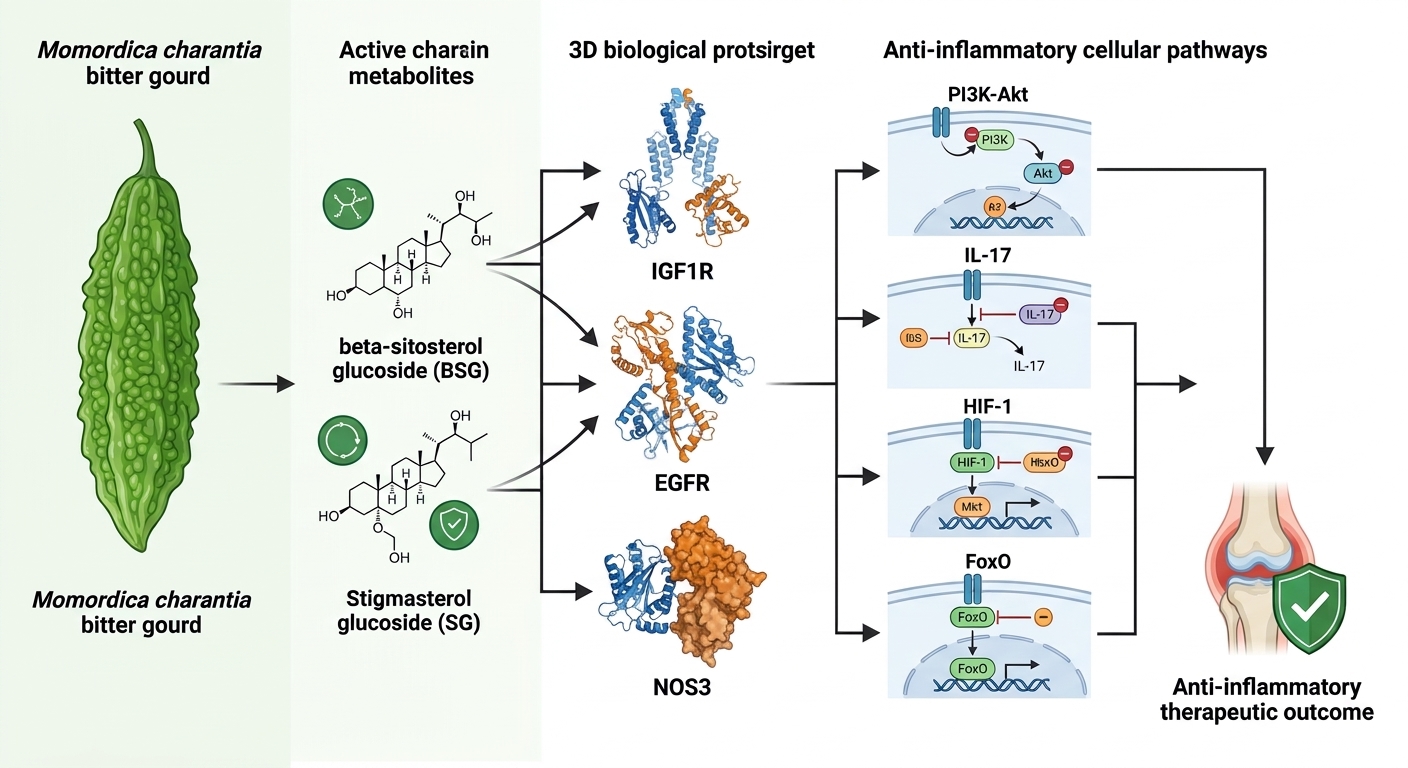
Recent studies have demonstrated the therapeutic potential of Momordica charantia (bitter gourd) against inflammation. However, the specific biological targets and molecular mechanisms underlying these effects remain to be fully elucidated. This study aimed to characterize the anti-inflammatory potential of bioactive compounds from Momordica charantia. Specifically, the objectives were to: (i) evaluate the drug-likeness and ADMET (absorption, distribution, metabolism, excretion, and toxicity) profiles of its bioactive constituents, (ii) map multi-target regulatory network through network pharmacology, and (iii) analyze binding interactions with key inflammatory targets using molecular docking. An integrative computational framework combining Lipinski’s Rule of Five assessment, ADMET profiling, network pharmacology, and molecular docking was employed. Eight major bioactives were analyzed: beta-sitosterol glucoside (BSG), stigmasterol glucoside (SG), trigonelline, galactonic acid, gamma-aminobutyric acid (GABA), isoleucine, leucine, and valine. All eight selected M. charantia bioactive compounds adhere to Lipinski’s Rule of Five and were predicted to be non-toxic, except for trigonelline, which exhibited moderate toxicity. Subsequent network pharmacology analysis identified 28 potential therapeutic targets associated with inflammation, from which five core targets, alongside the closely associated receptor IGF1R, were prioritized for molecular docking analysis. Molecular docking revealed that the charantin metabolites, BSG and SG, exhibited higher predicted multi-target binding affinities compared to other constituents. Notably, SG displayed exceptional affinity for IGF1R (−10.9 kcal/mol) and EGFR (−10.2 kcal/mol), while BSG showed strong interaction with NOS3 (−10.5 kcal/mol) and PPARG (−8.8 kcal/mol). Mechanistically, the compounds are predicted to modulate the PI3K–Akt signaling axis via key targets (IGF1, EGFR, NOS3, HSP90AA1), while concurrently influencing the IL-17, HIF-1, and FoxO signaling pathways to suppress inflammation. This study identifies beta-sitosterol glucoside and stigmasterol glucoside as potential multi-target modulators of inflammatory pathways, which warrant subsequent experimental validation to confirm clinical efficacy. Taken together, these findings provide structural insights into the anti-inflammatory properties of M. charantia and support its potential as a source of natural therapeutic agents.
References
[1] L. Chen, H. Deng, H. Cui, J. Fang, Z. Zuo, J. Deng, Y. Li, X. Wang, L. Zhao, Oncotarget 9 (2017) 7204.
[2] Y. Oishi, I. Manabe, Int. Immunol. 30 (2018) 511.
[3] K. R. M. Swamy, Int. J. Dev. Res. 13 (2023) 61294.
[4] C. Zhang, M. Huang, R. Hong, H. Chen, Int. J. Biol. Macromol. 122 (2019) 619.
[5] G. A. Bhat, H. A. Khan, A. S. Alhomida, P. Sharma, R. Singh, B. A. Paray, BMC Complement. Altern. Med. 18 (2018) 162.
[6] S. Y. Lee, W. F. Wong, J. Dong, K. K. Cheng, Molecules 25 (2020) 3783.
[7] W. S. Yang, E. Yang, M. J. Kim, D. Jeong, D. H. Yoon, G. H. Sung, K. Y. Lee, J. Y. Cho, Am. J. Chin. Med. 46 (2018) 435.
[8] C. Y. Chao, P. J. Sung, W. H. Wang, Y. H. Kuo, Molecules 19 (2014) 12777.
[9] C. C. Liaw, H. T. Huang, H. K. Liu, Y. C. Lin, L. J. Zhang, W. C. Wei, S. H. Wang, Y. H. Kuo, Phytochemistry 195 (2022) 113026.
[10] A. Daina, O. Michielin, V. Zoete, Sci. Rep. 7 (2017) 42717.
[11] M. Bitew, T. Desalegn, T. B. Demissie, A. Belayneh, M. Endale, R. Eswaramoorthy, PLoS ONE 16 (2021) e0260853.
[12] X. Wang, Y. Shen, S. Wang, S. Li, W. Zhang, X. Liu, L. Lai, H. Li, Nucleic Acids Res. 45 (2017) W356.
[13] X. Liu, S. Ouyang, B. Yu, Y. Liu, K. Huang, J. Gong, S. Zheng, H. Jiang, Nucleic Acids Res. 38 (2010) W609.
[14] L. Yang, H. Li, M. Yang, W. Zhang, M. Li, Y. Xu, H. Zhang, S. Guo, BioMed Res. Int. 2020 (2020) 5891016.
[15] A. Daina, O. Michielin, V. Zoete, Nucleic Acids Res. 47 (2019) W357.
[16] J. Tong, Y. Ding, D. Zhang, Medicine 104 (2025) e43560.
[17] A. Gangwal, I. Ansari, J. A. Sawale, A. Ansari, In Silico Res. Biomed. 2 (2026) 100247.
[18] G. M. Basavarajappa, A. Rehman, P. N. Shiroorkar, N. Sreeharsha, M. K. Anwer, B. Aloufi, Front. Pharmacol. 14 (2023) 1187079.
[19] G. Stelzer, N. Rosen, I. Plaschkes, S. Zimmerman, M. Twik, S. Fishilevich, T. I. Stein, R. Nudel, I. Lieder, Y. Mazor, S. Kaplan, D. Dahary, D. Warshawsky, Y. Guan-Golan, A. Kohn, N. Rappaport, M. Safran, D. Lancet, in: Current Protocols in Bioinformatics, John Wiley & Sons, Hoboken, NJ, 2016, p. 1.30.1.
[20] J. Piñero, J. M. Ramírez-Anguita, J. Saüch-Pitarch, F. Ronzano, E. Centeno, F. Sanz, L. I. Furlong, Nucleic Acids Res. 48 (2020) D845.
[21] J. Piñero, À. Bravo, N. Queralt-Rosinach, A. Gutiérrez-Sacristán, J. Deu-Pons, E. Centeno, J. García-García, L. I. Furlong, Nucleic Acids Res. 45 (2017) D833-D839.
[22] Y. Wang, S. H. Yang, K. Zhong, T. Jiang, M. Zhang, H. Y. Kwan, T. Su, Front. Pharmacol. 11 (2020) 572387.
[23] S. Batool, M. R. Javed, S. Aslam, F. Noor, H. M. F. Javed, R. Seemab, M. I. Khan, A. Gulnaz, Pharmaceuticals 15 (2022) 654.
[24] G. D. Bader, C. W. Hogue, BMC Bioinformatics 4 (2003) 2.
[25] Z. Zhai, X. Tao, M. M. Alami, S. Shu, X. Wang, Curr. Issues Mol. Biol. 43 (2021) 6.
[26] C. Tao, J. Wang, Z. Gu, H. Ni, Y. Luo, J. Ling, H. Fan, T. Xu, J. Ethnopharmacol. 317 (2023) 116695.
[27] S. Huang, F. Mu, F. Li, W. Wang, H. Chen, L. Lei, J. Zhang, J. Wang, J. Diabetes Res. 2020 (2020) 7867245.
[28] Y. X. Liu, X. L. Ding, S. Y. Cui, J. J. Liu, G. Ding, Biomed. Environ. Sci. 35 (2022) 674.
[29] M. Deodhar, S. B. Al Rihani, M. J. Arwood, L. Darakjian, P. Dow, J. Turgeon, V. Michaud, Pharmaceutics 12 (2020) 846.
[30] T. C. Beck, K. R. Beck, J. Morningstar, M. M. Benjamin, R. A. Norris, Pharmaceuticals 14 (2021) 472.
[31] J. Warwick, J. Holness, Semin. Nucl. Med. 52 (2022) 453.
[32] M. Acosta-Martinez, M. Z. Cabail, Int. J. Mol. Sci. 23 (2022) 15330.
[33] Z. Zhang, L. Wang, X. Li, Y. Miao, D. Li, Int. J. Med. Sci. 21 (2024) 2837.
[34] X. Gong, D. Xue, H. Meng, B. Xie, L. Zhao, C. Zang, J. Kong, PLoS ONE 20 (2025) e0335139.
[35] F. Tang, P. Zhang, W. Zhao, G. Zhu, G. Shen, H. Chen, X. Xu, H. Ren, Evid.-Based Complement. Altern. Med. 2022 (2022) 6741995.
[36] H. Liu, H. Lu, X. Fan, S. Chen, X. Chen, W. Gao, Sci. Rep. 15 (2025) 12645.
[37] W. Wei, J. X. Yao, T. T. Zhang, J. Y. Wen, Z. Zhang, Y. M. Luo, X. Y. Liu, H. Li, Front. Neurosci. 17 (2023) 1059496.
[38] K. Wang, J. Yin, J. Chen, J. Ma, H. Si, D. Xia, Phytomedicine 128 (2024) 155258.
[39] S. S. Azam, S. W. Abbasi, Theor. Biol. Med. Model. 10 (2013) 63.
[40] F. Ballante, A. J. Kooistra, S. Kampen, C. de Graaf, J. Carlsson, Pharmacol. Rev. 73 (2021) 1698.
[41] M. I. Choudhary, M. Shaikh, A. tul-Wahab, A. ur-Rahman, PLoS ONE 15 (2020) e0235030.
[42] Y. Gao, S. Zhou, Y. Xu, S. Sheng, S. Y. Qian, X. Huo, Nitric Oxide 83 (2019) 33.
[43] X. Ju, X. Yang, T. Yan, H. Chen, Z. Song, Z. Zhang, Z. Lin, Y. Wang, Clin. Exp. Pharmacol. Physiol. 46 (2019) 75.
[44] D. Liang, H. Chen, L. Zhao, W. Zhang, J. Hu, Z. Liu, X. Sheng, G. Liang, Biochim. Biophys. Acta Mol. Basis Dis. 1864 (2018) 133.
[45] R. Watkins, E. Buckarma, J. Tomlinson, G. Gores, R. Smoot, HPB 25 (2023) S53.
[46] S. Jiang, X. Wei, Y. Zhang, L. Wang, L. Wang, M. Wang, J. Sun, H. Zhao, Biomed. Pharmacother. 168 (2023) 115640.
[47] R. Kapadia, J. H. Yi, R. Vemuganti, Front. Biosci. 13 (2008) 1813.
[48] P. Barata, M. Cooney, A. Tyler, J. Wright, R. Dreicer, J. A. Garcia, Invest. New Drugs 36 (2018) 451.
[49] A. Gulbins, M. Horstmann, A. Daser, U. Flögel, M. Oeverhaus, N. E. Bechrakis, A. K. Eckstein, G. E. Görtz, Front. Endocrinol. 14 (2023) 1211473.
[50] Y. Fukuyo, C. R. Hunt, N. Horikoshi, Cancer Lett. 290 (2010) 24.
[51] R. R. Kitson, D. Kitsonová, D. Siegel, D. Ross, C. J. Moody, J. Med. Chem. 67 (2024) 17946.
[52] G. H. Oliveira-Paula, R. Lacchini, J. E. Tanus-Santos, Gene 575 (2016) 584.
[53] N. Singh, M. K. Rai, V. Agarwal, V. Agarwal, Indian J. Rheumatol. 19 (2024) 100.
[54] A. Pautz, H. Li, H. Kleinert, Front. Biosci.-Landmark 26 (2021) 85.
[55] S. N. Villegas, R. Gombos, L. García-López, I. Gutierrez-Perez, J. García-Castillo, D. M. Vallejo, B. Da-Silva, M. Dominguez, Cell Rep. 22 (2018) 2541.
[56] S. Cao, Y. Pan, J. Tang, A. S. Terker, J. P. Arroyo Ornelas, G. N. Jin, S. Y. Chen, M. Z. Zhang, Nat. Commun. 13 (2022) 4684.
[57] H. D. Londres, J. J. Armada, A. H. Martínez, A. A. Abdo Cuza, Y. H. Sánchez, A. G. Rodríguez, B. E. G. Pérez, T. C. Ramos, Immunotherapy 14 (2022) 521.
[58] E. England, D. G. Rees, I. C. Scott, S. Carmen, D. T. Chan, C. E. Chaillan Huntington, R. D. May, E. S. Cohen, Sci. Rep. 13 (2023) 9825.
[59] D. Han, D. Lu, S. Huang, J. Pang, Y. Wu, J. Hu, X. Chen, J. Wang, Redox Biol. 58 (2022) 102558.
[60] R. Zhao, S. Chen, W. Cui, C. Xie, A. Zhang, L. Yang, H. Dong, Front. Immunol. 14 (2023) 1232047.
[61] X. Xu, X. Wang, Y. Guo, Y. Bai, S. He, N. Wang, F. Wang, Y. Yao, Front. Immunol. 10 (2019) 1930.
[62] F. Luo, J. Zhang, Y. Miao, D. Wu, H. Shen, M. Lu, Int. J. Biochem. Cell Biol. 176 (2024) 106675.
[63] Q. Geng, J. Xu, X. Cao, Z. Wang, Y. Jiao, W. Diao, J. Meng, C. Xiao, J. Autoimmun. 146 (2024) 103214.
[64] S. Piñeiro-Hermida, I. P. López, E. Alfaro-Arnedo, R. Torrens, M. Iñiguez, L. Alvarez-Erviti, J. A. Esteban, J. G. Pichel, Sci. Rep. 7 (2017) 4290.
[65] P. Wang, V. C. Mak, L. W. Cheung, Genes Dis. 10 (2023) 199.
[66] R. Nederlof, S. Reidel, A. Spychala, S. Gödecke, A. Heinen, T. Lautwein, J. W. Fischer, A. Gödecke, Front. Immunol. 13 (2022) 908023.
[67] Y. Zhang, J. Liang, N. Cao, J. Gao, L. Song, X. Tang, Cell Death Discov. 8 (2022) 500.
[68] J. Li, R. Dong, J. Yu, S. Yi, J. Da, F. Yu, Y. Zha, Drug Des. Devel. Ther. 12 (2018) 2887.
Downloads
Published
Issue
Section
License
Copyright (c) 2026 Kian-Kai Cheng, Renee Xuan-Pin Lam, Hong-Yeng Leong; Muhammad Helmi Nadri

This work is licensed under a Creative Commons Attribution-NonCommercial 4.0 International License.