
Ginger Extract Exhibits Systemic Antifibrotic Potential through miR-21-5p and miR-29b Modulation in BALB/c Mice
DOI:
https://doi.org/10.11113/mjfas.v21n5.4344Keywords:
Ginger extracts, miR-21-5p, miR-29b, Smad7, Col1a1Abstract
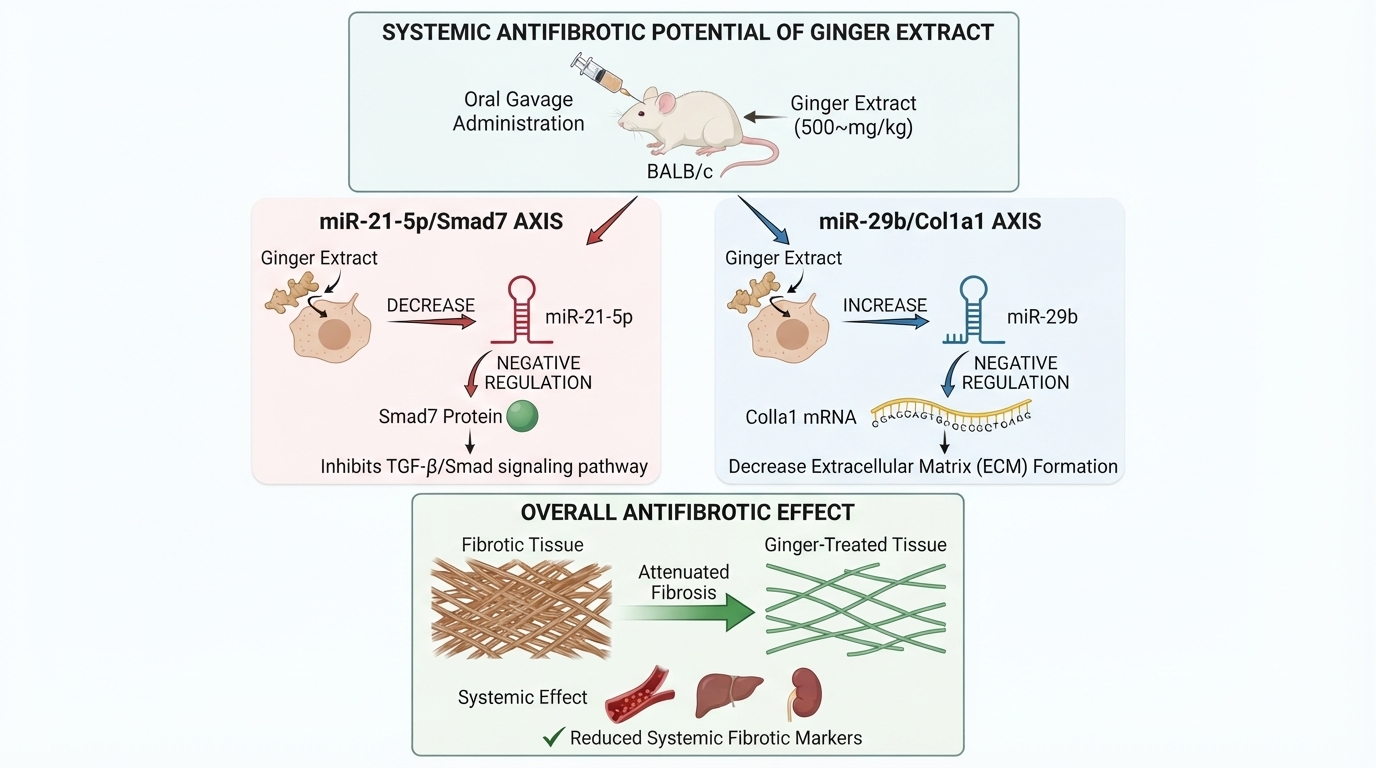
Ginger is rich in various phytochemicals known for their potential antifibrotic properties, largely attributed to their anti-inflammatory effects. Although the anti-inflammatory benefits of ginger are well established, the underlying molecular mechanisms, particularly those involving microRNAs (miRNAs) at the post-transcriptional level, remain inadequately understood. This study investigated the antifibrotic effects of ginger extract in mice by examining its influence on the modulation of miR-21-5p and miR-29b, along with their respective target genes. The BALB/c mice were allocated into two separate groups at random, with each group consisting of six mice: one serving as the control group and the other as the treatment group. Both groups received standard chow and water; the treatment group was additionally given ginger extract via oral gavage, while the control group received water. Throughout the treatment period, two mice from each group succumbed. The remaining animals were subsequently utilized for downstream analyses. After three weeks, blood samples were collected for miRNA expression analysis. TargetScan was utilized to identify the target genes of both miRNAs, and their expression levels were confirmed through real time quantitative PCR (RT-qPCR). Smad7 and Col1a1 were confirmed as target genes of miR-21-5p and miR-29b, respectively. Smad7 is recognized for its antifibrotic role, while Col1a1 is a key marker associated with extracellular matrix formation. RT-qPCR results showed that ginger treatment led to the upregulation of miR‑21‑5p accompanied by increased Smad7 expression, while miR‑29b levels were also elevated, suggesting activation of antifibrotic regulatory pathways. Although changes in Col1a1 expression were less pronounced, the observed modulation of key antifibrotic miRNAs highlights ginger’s potential as a natural modulator of fibrosis‑related pathways and supports further investigation of its therapeutic benefits in fibrotic disorders.
References
Lee, R. C., Feinbaum, R. L., & Ambros, V. (1993). The C. elegans heterochronic gene lin-4 encodes small RNAs with antisense complementarity to lin-14. Cell, 75(5), 843–854.
Samad, A. F. A., & Kamaroddin, M. F. (2023). Innovative approaches in transforming microRNAs into therapeutic tools. WIREs RNA, 14(1), e1768.
Samad, A. F. A., Kamaroddin, M. F., & Sajad, M. (2021). Cross-kingdom regulation by plant microRNAs provides novel insight into gene regulation. Advances in Nutrition, 12(1), 197–211.
Surina, S., Fontanella, R. A., Scisciola, L., Marfella, R., Paolisso, G., & Barbieri, M. (2021). miR-21 in human cardiomyopathies. Frontiers in Cardiovascular Medicine, 8, 767064.
Horita, M., Farquharson, C., & Stephen, L. A. (2021). The role of miR-29 family in disease. Journal of Cellular Biochemistry, 122(7), 696–715.
Villegas-Mirón, P., Gallego, A., Bertranpetit, J., Laayouni, H., & Espinosa-Parrilla, Y. (2022). Signatures of genetic variation in human microRNAs point to processes of positive selection and population-specific disease risks. Human Genetics, 141(10), 1673–1693.
Ferrero, G., Carpi, S., Polini, B., Pardini, B., Nieri, P., Impeduglia, A., Grioni, S., Tarallo, S., & Naccarati, A. (2021). Intake of natural compounds and circulating microRNA expression levels: Their relationship investigated in healthy subjects with different dietary habits. Frontiers in Pharmacology, 11, 582345.
Khorraminezhad, L., & Rudkowska, I. (2022). Dairy product intake modifies microRNA expression among individuals with hyperinsulinemia: A post-intervention cross-sectional study. Lifestyle Genomics, 15(3), 77–86.
Mao, Q. Q., Xu, X. Y., Cao, S. Y., Gan, R. Y., Corke, H., Beta, T., & Li, H. B. (2019). Bioactive compounds and bioactivities of ginger (Zingiber officinale Roscoe). Foods, 8(6), 185.
Keivanpour, H., Zamzam, R., Mojtahedzadeh, M., Delnavazi, M.-R., Sharifan, A., & Sabzevari, O. (2024). 6-Gingerol anti-inflammatory and antioxidant properties protect against heart and liver dysfunction in rats with sepsis. Pharmacological Research – Modern Chinese Medicine, 12, 100470.
Huang, R., Fu, P., & Ma, L. (2023). Kidney fibrosis: From mechanisms to therapeutic medicines. Signal Transduction and Targeted Therapy, 8(1), 129.
Charan, J., & Kantharia, N. D. (2013). How to calculate sample size in animal studies? Journal of Pharmacology & Pharmacotherapeutics, 4(4), 303–306.
Kim, M. S., & Kim, J. Y. (2018). Ginger attenuates inflammation in a mouse model of dextran sulfate sodium-induced colitis. Food Science and Biotechnology, 27(5), 1493–1501.
Ball, C. G., Lee, A., Kaminsky, M., & Hameed, S. M. (2022). Technical considerations in the management of penetrating cardiac injury. Canadian Journal of Surgery, 65(5), E580–E592.
Samadishadlou, M., Rahbarghazi, R., Piryaei, Z., Esmaeili, M., Avcı, Ç. B., Bani, F., & Kavousi, K. (2023). Unlocking the potential of microRNAs: Machine learning identifies key biomarkers for myocardial infarction diagnosis. Cardiovascular Diabetology, 22(1), 247.
Samad, A. F. A., Nazaruddin, N., Murad, A. M. A., Jani, J., Zainal, Z., & Ismail, I. (2018). Deep sequencing and in silico analysis of small RNA library reveals novel miRNA from leaf Persicaria minor transcriptome. 3 Biotech, 8(3), 136.
McGeary, S. E., Lin, K. S., Shi, C. Y., Pham, T. M., Bisaria, N., Kelley, G. M., & Bartel, D. P. (2019). The biochemical basis of microRNA targeting efficacy. Science, 366(6472), eaav1741.
Agarwal, V., Bell, G. W., Nam, J. W., & Bartel, D. P. (2015). Predicting effective microRNA target sites in mammalian mRNAs. eLife, 4, e05005.
Swahari, V., Nakamura, A., Hollville, E., Stroud, H., Simon, J. M., Ptacek, T. S., Beck, M. V., Flowers, C., Guo, J., & Plestant, C. (2021). MicroRNA-29 is an essential regulator of brain maturation through regulation of CH methylation. Cell Reports, 35(1), 108946.
Fang, S., Wang, L., Luo, C., Yi, H., Wang, X., & Ning, B. (2022). Curcumol inhibits the growth of xenograft tumors in mice and the biological activities of pancreatic cancer cells by regulating the miR-21-5p/SMAD7 axis. Cell Cycle, 21(12), 1249–1266.
Wang, C., Wang, Y., Fu, Z., Huang, W., Yu, Z., Wang, J., Zheng, K., Zhang, S., Li, S., & Chen, J. (2022). MiR-29b-3p inhibits migration and invasion of papillary thyroid carcinoma by downregulating COL1A1 and COL5A1. Frontiers in Oncology, 12, 923775.
Livak, K. J., & Schmittgen, T. D. (2001). Analysis of relative gene expression data using real-time quantitative PCR and the 2(−ΔΔCT) method. Methods, 25(4), 402–408.
Jones, C. P., Boyd, K. L., & Wallace, J. M. (2016). Evaluation of mice undergoing serial oral gavage while awake or anesthetized. Journal of the American Association for Laboratory Animal Science, 55(6), 805–810.
Sayed, S., Ahmed, M., El-Shehawi, A., Alkafafy, M., Al-Otaibi, S., El-Sawy, H., Farouk, S., & El-Shazly, S. (2020). Ginger water reduces body weight gain and improves energy expenditure in rats. Foods, 9(1), 38.
Vrânceanu, M., Hegheş, S. C., Cozma-Petruţ, A., Banc, R., Stroia, C. M., Raischi, V., Miere, D., Popa, D. S., & Filip, L. (2023). Plant-derived nutraceuticals involved in body weight control by modulating gene expression. Plants, 12(12), 2278.
Samad, A. F. A., Ali, N. M., & Ismail, I. (2015). Illumina® TruSeq® vs NEBNext® small RNA library preparation kit for miRNA profiling in Persicaria minor: Which better? Proceedings of the Conference, 2015.
Toni, L. S., Garcia, A. M., Jeffrey, D. A., Jiang, X., Stauffer, B. L., Miyamoto, S. D., & Sucharov, C. C. (2018). Optimization of phenol-chloroform RNA extraction. MethodsX, 5, 599–608.
M., Derenkó, J., Rademacher, A., Helbig, S., Munk, B., Pechtl, A., Stolze, Y., Prowe, S., Schwarz, W. H., & Schlüter, A. (2016). DNA and RNA extraction and quantitative real-time PCR-based assays for biogas biocenoses in an interlaboratory comparison. Bioengineering, 3(1), 7.
Sikora, M., Śmieszek, A., Pielok, A., & Marycz, K. (2023). MiR-21-5p regulates the dynamic of mitochondria network and rejuvenates the senile phenotype of bone marrow stromal cells (BMSCs) isolated from osteoporotic SAM/P6 mice. Stem Cell Research & Therapy, 14(1), 54.
Widlansky, M. E., Jensen, D. M., Wang, J., Liu, Y., Geurts, A. M., Kriegel, A. J., Liu, P., Ying, R., Zhang, G., & Casati, M. (2018). miR-29 contributes to normal endothelial function and can restore it in cardiometabolic disorders. EMBO Molecular Medicine, 10(3), e8046.
Hu, Y., He, J., He, L., Xu, B., & Wang, Q. (2021). Expression and function of Smad7 in autoimmune and inflammatory diseases. Journal of Molecular Medicine, 99(9), 1209–1220.
Claeys, L., Storoni, S., Eekhoff, M., Elting, M., Wisse, L., Pals, G., Bravenboer, N., Maugeri, A., & Micha, D. (2021). Collagen transport and related pathways in osteogenesis imperfecta. Human Genetics, 140(8), 1121–1141.
Fathi, R., Akbari, A., Nasiri, K., & Chardahcherik, M. (2021). Ginger (Zingiber officinale Roscoe) extract could upregulate the renal expression of NRF2 and TNFα and prevents ethanol-induced toxicity in rat kidney. Avicenna Journal of Phytomedicine, 11(2), 134–145.
Yu, X.-Y., Sun, Q., Zhang, Y.-M., Zou, L., & Zhao, Y.-Y. (2022). TGF-β/Smad signaling pathway in tubulointerstitial fibrosis. Frontiers in Pharmacology, 13, 829189.
Fukasawa, H., Yamamoto, T., Togawa, A., Ohashi, N., Fujigaki, Y., Oda, T., Uchida, C., Kitagawa, K., Hattori, T., Suzuki, S., & Uchida, K. (2004). Down-regulation of Smad7 expression by ubiquitin-dependent degradation contributes to renal fibrosis in obstructive nephropathy in mice. Proceedings of the National Academy of Sciences, 101(23), 8687–8692.
Wu, W., Huang, X. R., You, Y., Xue, L., Wang, X. J., Meng, X., Lin, X., Shen, J., Yu, X., & Lan, H. Y. (2021). Latent TGF-β1 protects against diabetic kidney disease via Arkadia/Smad7 signaling. International Journal of Biological Sciences, 17(13), 3583–3594.
Downloads
Published
Issue
Section
License
Copyright (c) 2025 Nurul Sarinih Hanan, Rabiatul Adawiyah Mohd Sapri, Mohd Aizuddin Mohd Lazaldin, Azlina Zulkapli, Abdul Fatah A. Samad

This work is licensed under a Creative Commons Attribution-NonCommercial 4.0 International License.