
Pomegranate Peel Extract and Hyaluronic Acid-Integrated Water-in-oil-in-water Double Emulsion and its Sensory Analysis for Topical Application
DOI:
https://doi.org/10.11113/mjfas.v22n2.4888Keywords:
Pomegranate peels, ethanolic-water extract, double emulsion, Water-in-oil-in-water, hyaluronic acid, topicalAbstract
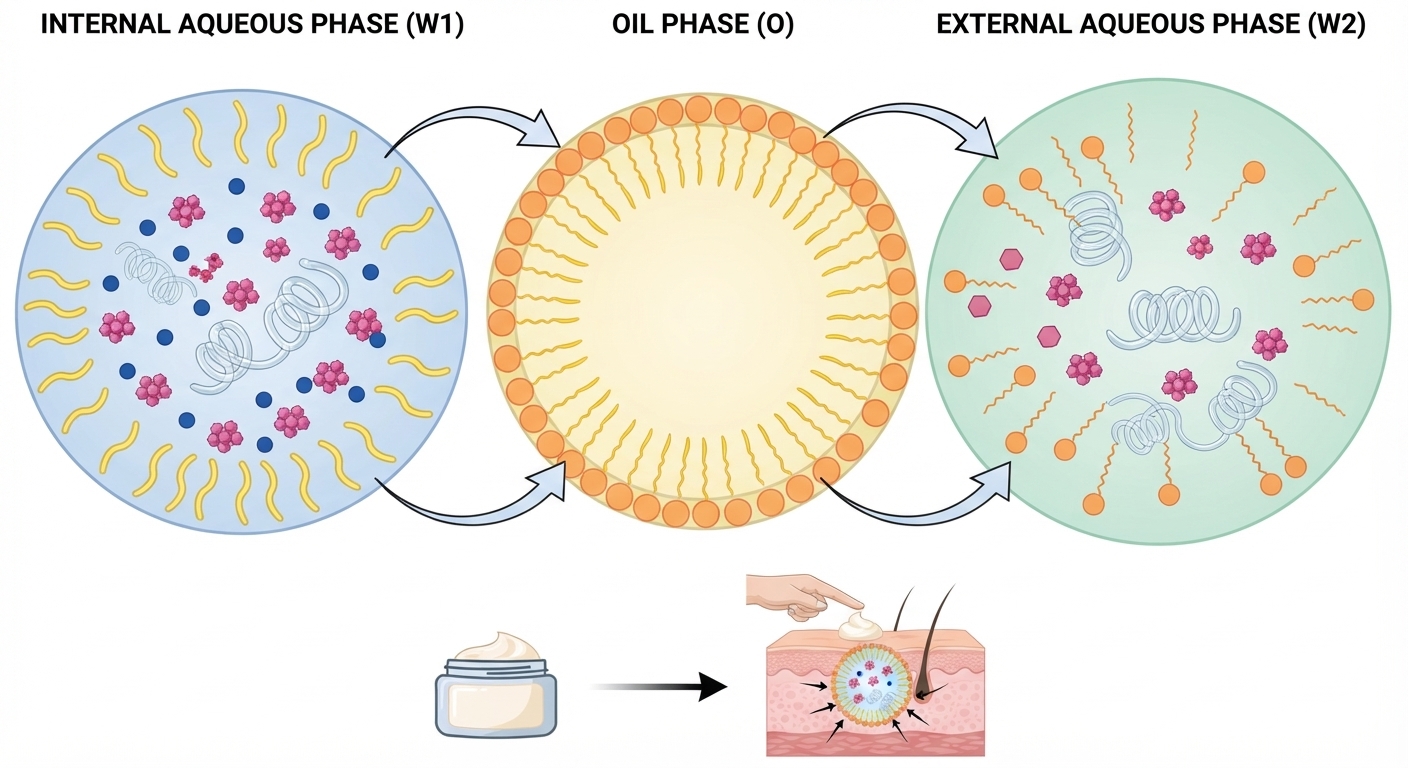
Pomegranate peel extract (PPE) offers a rich source of natural polyphenols for cosmetic applications, yet its incorporation into stable topical formulations remains challenging due to poor bioactive stability and skin permeability. This study aimed to develop a stable water-in-oil-in-water (W/O/W) double emulsion co-loaded with PPE and hyaluronic acid (HA) using a high-energy two-step emulsification method, and to evaluate its physicochemical properties and consumer acceptability. The optimal formulation, identified through systematic screening of oil and xanthan gum concentrations, consisted of 15% grapeseed oil and 1.0% xanthan gum. Physicochemical characterization revealed that the emulsion possessed a mean droplet size of approximately 155 nm with a narrow size distribution (polydispersity index < 0.3), indicating a homogeneous system conducive to topical delivery. The formulation exhibited pseudoplastic (shear-thinning) rheological behavior, favorable for skin application, and maintained a skin-compatible pH (approximately 5.0) over 7 weeks of storage at 25°C. Stability studies demonstrated that the double emulsion resisted coalescence and Ostwald ripening throughout the storage period, with conductivity measurements confirming the structural integrity of the multiple emulsion system. Sensory evaluation by untrained panelists (n = 40) using a 9-point hedonic scale showed that the formulation achieved overall acceptance comparable to that of a commercial reference product, with particular preference noted for its fragrance and spreadability. These findings establish a foundational formulation strategy for incorporating PPE and HA into a physically stable W/O/W double emulsion with acceptable sensory properties. The systematic optimization approach and demonstration of resistance to key destabilization mechanisms distinguish this work from prior studies, though further biological and efficacy testing are required to substantiate any dermatological applications.
References
Alnuqaydan, A. M. (2024). The dark side of beauty: An in-depth analysis of the health hazards and toxicological impact of synthetic cosmetics and personal care products. Frontiers in Public Health, 12. https://doi.org/10.3389/fpubh.2024.1439027.
Araujo, A., Santos, A. C., Veiga, F., Ribeiro, A. J., & Silva, C. (2022). New-generation nanotechnology for development of cosmetics using plant extracts. In Nanotechnology for the preparation of cosmetics using plant-based extracts (pp. 301–325). Elsevier.
Barradas, T. N., & de Holanda e Silva, K. G. (2020). Nanoemulsions as optimized vehicles for essential oils. In Sustainable agriculture reviews 44 (pp. 115–167). Springer.
Berdey, I., & Voyt, O. (2016). Rheological properties of emulgel formulations based on different gelling agent. The Pharma Innovation Journal, 5(4), 76.
Bond, M. (2024). A quantitative analysis of cosmeceuticals: Business service quality and client satisfaction. Management Matters, 21(1), 54–77. https://doi.org/10.1108/MANM-01-2024-0003.
Chen, X., Ning, X., & Yang, X. (2019). Fabrication of novel hierarchical multicompartment highly stable triple emulsions for the segregation and protection of multiple cargos by spatial co-encapsulation. Journal of Agricultural and Food Chemistry, 67(39), 10904–10912. https://doi.org/10.1021/acs.jafc.9b03509.
Chigira, Y., Oshima, H., & Kanda, Y. (2017). Application of consumer hedonic testing in cosmetic emulsions: Understanding acceptability of multi-phase products. International Journal of Cosmetic Science, 39(2), 123–131. https://doi.org/10.1111/ics.12358.
Fateh, M. V., Saeed, S., Sadiq, A., & Jan, A. (2013). A review on the medicinal importance of pomegranate. Journal of Pharmaceutical Sciences, 3(4), 23–25.
Finelli, I., Chiessi, E., Galesso, D., Renier, D., & Paradossi, G. (2011). A new viscosupplement based on partially hydrophobic hyaluronic acid: A comparative study. Biorheology, 48(5–6), 263–275. https://doi.org/10.3233/BIR-2011-0596.
Gharehbeglou, P., Jafari, S. M., Homayouni, A., Hamishekar, H., & Mirzaei, H. (2019). Fabrication of double W1/O/W2 nano-emulsions loaded with oleuropein in the internal phase (W1) and evaluation of their release rate. Food Hydrocolloids, 89, 44–55. https://doi.org/10.1016/j.foodhyd.2018.10.020.
Gilbert, L., Picard, C., Savary, G., & Grisel, M. (2012). Impact of polymers on texture properties of cosmetic emulsions: A methodological approach. Journal of Sensory Studies, 27(5), 392–402. https://doi.org/10.1111/joss.12001.
Gonçalves, M., Brito, S., Song, C. J., Han, Y., Bin, B., & Weon, B. M. (2025). Age-tailored artificial skin model for cosmetic film development. Materials Today Bio, 31, 101618. https://doi.org/10.1016/j.mtbio.2025.101618.
Hawkins, S., Dasgupta, B. R., & Ananthapadmanabhan, K. P. (2021). Role of pH in skin cleansing. International Journal of Cosmetic Science, 43(4), 474–483. https://doi.org/10.1111/ics.12703.
Ho, T. M., Abik, F., & Mikkonen, K. S. (2022). An overview of nanoemulsion characterization via atomic force microscopy. Critical Reviews in Food Science and Nutrition, 62(18), 4908–4928. https://doi.org/10.1080/10408398.2021.1879727.
Juncan, A. M., Moisă, D. G., Santini, A., Morgovan, C., Rus, L. L., Vonica-Țincu, A. L., & Loghin, F. (2021). Advantages of hyaluronic acid and its combination with other bioactive ingredients in cosmeceuticals. Molecules, 26(15), 4429. https://doi.org/10.3390/molecules26154429.
Kaci, M., Belhaffef, A., Meziane, S., Dostert, G., Menu, P., Velot, E., Desobry, S., & Arab-Tehrany, E. (2018). Nanoemulsions and topical creams for the safe and effective delivery of lipophilic antioxidant coenzyme Q10. Colloids and Surfaces B: Biointerfaces, 167, 165–175. https://doi.org/10.1016/j.colsurfb.2018.04.010.
Khan, H., Ali, M., Ahsan, H., & Muhammad, S. (2016). Physical and chemical stability analysis of cosmetic multiple emulsions loaded with ascorbyl palmitate and sodium ascorbyl phosphate salts. Acta Poloniae Pharmaceutica, 73(5), 1339–1349.
Lampakis, D., Skenderidis, P., & Leontopoulos, S. (2021). Technologies and extraction methods of polyphenolic compounds derived from pomegranate (Punica granatum) peels: A mini review. Processes, 9(2), 236. https://doi.org/10.3390/pr9020236.
Leister, N., & Karbstein, H. P. (2020). Evaluating the stability of double emulsions—A review of the measurement techniques for the systematic investigation of instability mechanisms. Colloids and Interfaces, 4(1), 8. https://doi.org/10.3390/colloids4010008.
Liu, Q., Huang, H., Chen, H., Lin, J., & Wang, Q. (2019). Food-grade nanoemulsions: Preparation, stability and application in encapsulation of bioactive compounds. Molecules, 24(23), 4242. https://doi.org/10.3390/molecules24234242.
Malekian, S., Ahmadlouydarab, M., & Najjar, R. (2021). Effects of zero-shear rate viscosity and interfacial tension on immiscible Newtonian-Non-Newtonian fluids morphology in radial displacement inside the Hele-Shaw cell. Journal of the Taiwan Institute of Chemical Engineers, 127, 46–55. https://doi.org/10.1016/j.jtice.2021.08.013.
Manful, M. E., Ahmed, L., & Barry-Ryan, C. (2024). Cosmetic formulations from natural sources: Safety considerations and legislative frameworks in the European Union. Cosmetics, 11(3), 72. https://doi.org/10.3390/cosmetics11030072.
Mansoor, K., Aburjai, T., Al-Mamoori, F., & Schmidt, M. (2023). Plants with cosmetic uses. Phytotherapy Research, 37(12), 5755–5768. https://doi.org/10.1002/ptr.7991.
Mashhadian, A., Afjoul, H., & Shamloo, A. (2022). An integrative method to increase the reliability of conventional double emulsion method. Analytica Chimica Acta, 1197, 339523. https://doi.org/10.1016/j.aca.2022.339523.
McClements, D. J., Tokura, J., & Decker, E. A. (2012). Structured emulsions: Multiple emulsions (W/O/W). Current Opinion in Colloid & Interface Science, 17(3), 135–140. https://doi.org/10.1016/j.cocis.2012.03.002.
Meng, Y., Liang, Z., Zhang, C., Zhang, S., & Wang, Z. (2022). Utilization of xanthan to stabilize water in water emulsions and modulate their viscosity. Carbohydrate Polymers, 277, 118812. https://doi.org/10.1016/j.carbpol.2021.118812
Merga, W., Abtew, W. G., & Garedew, W. (2022). Organoleptic quality attributes and their association with morphological traits in Arabica coffee (Coffea arabica L.) genotypes. Journal of Food Quality, 2022, Article 2906424. https://doi.org/10.1155/2022/2906424.
Navarro-Pérez, Y. M., Radillo-Juárez, M., Chavarría-Hernández, N., & Tecante, A. (2021). Prediction of the physical stability and quality of O/W cosmetic emulsions using full factorial design. Journal of Pharmacy & Pharmacognosy Research, 9(2), 98–112.
Pavoni, L., Perinelli, D. R., Bonacucina, G., Cespi, M., & Palmieri, G. F. (2020). An overview of micro- and nanoemulsions as vehicles for essential oils: Formulation, preparation and stability. Nanomaterials, 10(1), 135. https://doi.org/10.3390/nano10010135.
Pinho, L. S., Souza, M. T., Almeida, D. T., & Costa, J. M. (2021). Guaraná (Paullinia cupana) by-product as a source of bioactive compounds and as a natural antioxidant for food applications. Journal of Food Processing and Preservation, 45(10), e15854. https://doi.org/10.1111/jfpp.15854.
Plassard, L., Mouret, A., Nieto-Draghi, C., Dalmazzone, C., Langévin, D., & Argillier, J. (2024). Comparison of methods used to investigate coalescence in emulsions. Langmuir, 40(21), 10847–10855. https://doi.org/10.1021/acs.langmuir.3c02561.
Prasad, J., Das, S., Maurya, A., Pradhan, A., Kumar, D., & Tripathi, A. (2022). Synthesis, characterization and in situ bioefficacy evaluation of Cymbopogon nardus essential oil impregnated chitosan nanoemulsion against fungal infestation and aflatoxin B1 contamination in food system. International Journal of Biological Macromolecules, 205, 240–252. https://doi.org/10.1016/j.ijbiomac.2022.02.037.
Rai, V. K., Mishra, N., Yadav, K. S., & Yadav, N. P. (2018). Nanoemulsion as pharmaceutical carrier for dermal and transdermal drug delivery: Formulation development, stability issues, basic considerations and applications. Journal of Controlled Release, 270, 203–225. https://doi.org/10.1016/j.jconrel.2017.11.049.
Rhee, K.-H., Kim, J.-S., & Lee, S.-J. (2002). Physical stability of W/O/W emulsions: Coalescence, Ostwald ripening, and drainage. Journal of Colloid and Interface Science, 252(2), 351–360. https://doi.org/10.1006/jcis.2002.8462.
Romes, N. B., Salim, N., Ahmad, N., Ma'amor, A., & Naeem, M. (2021). Thermodynamic stability, in-vitro permeability, and in-silico molecular modeling of the optimal Elaeis guineensis leaves extract water-in-oil nanoemulsion. Scientific Reports, 11(1), 22380. https://doi.org/10.1038/s41598-021-01803-4.
Salvia-Trujillo, L., Verkempinck, S. H., Sun, L., Van Loey, A. M., Grauwet, T., & Hendrickx, M. E. (2017). Lipid digestion, micelle formation and carotenoid bioaccessibility kinetics: Influence of emulsion droplet size. Food Chemistry, 229, 653–662. https://doi.org/10.1016/j.foodchem.2017.02.146.
Schuch, A., Deiters, P., Henne, J., Kohler, K., & Schuchmann, H. P. (2014). Influence of the second emulsification step during production of W/O/W multiple emulsions: Comparison of different methods to determine encapsulation efficiency. The Canadian Journal of Chemical Engineering, 92(2), 203–209. https://doi.org/10.1002/cjce.21846.
Sharma, S., Cheng, S.-F., Bhattacharya, B., & Chakkaravarthi, S. (2019). Efficacy of free and encapsulated natural antioxidants in oxidative stability of edible oil: Special emphasis on nanoemulsion-based encapsulation. Trends in Food Science & Technology, 91, 305–318. https://doi.org/10.1016/j.tifs.2019.07.030.
Silvestre, M. P. C., Chaiyasit, W., Brannan, R. G., McClements, D. J., & Decker, E. A. (2000). Ability of surfactant headgroup size to alter lipid and antioxidant oxidation in oil-in-water emulsions. Journal of Agricultural and Food Chemistry, 48(6), 2057–2061. https://doi.org/10.1021/jf991160l.
Sripanidkulchai, B., Chaiittianan, R., & Suttanut, K. (2020). Safety and efficacy assessment of skin gel containing nanoemulsion of Phyllanthus emblica extract: A randomized, double-blind, placebo-controlled study. Songklanakarin Journal of Science & Technology, 42(2), 266–273.
Vinshtok, Y., & Cassuto, D. (2020). Biochemical and physical actions of hyaluronic acid delivered by intradermal jet injection route. Journal of Cosmetic Dermatology, 19(10), 2505–2512. https://doi.org/10.1111/jocd.13674.
Zhu, Q., Gao, J., Han, L., Zhang, J., & Wang, Y. (2018). Preparation and characterization of W/O/W double emulsions containing MgCl₂. Journal of Dispersion Science and Technology, 39(3), 349–355. https://doi.org/10.1080/01932691.2017.132022036.
Downloads
Published
Issue
Section
License
Copyright (c) 2026 Roswanira Abdul wahab, Ms, Prof Dr.

This work is licensed under a Creative Commons Attribution-NonCommercial 4.0 International License.