
Multi-Plane Biomechanical Analysis of Lower Limb Joints: Implications for Rehabilitation and Fall Prevention
DOI:
https://doi.org/10.11113/mjfas.v22n2.4389Keywords:
Slope walking, Gait analysis, Motion capture, Locomotion mechanics, Ergonomic interventions.Abstract
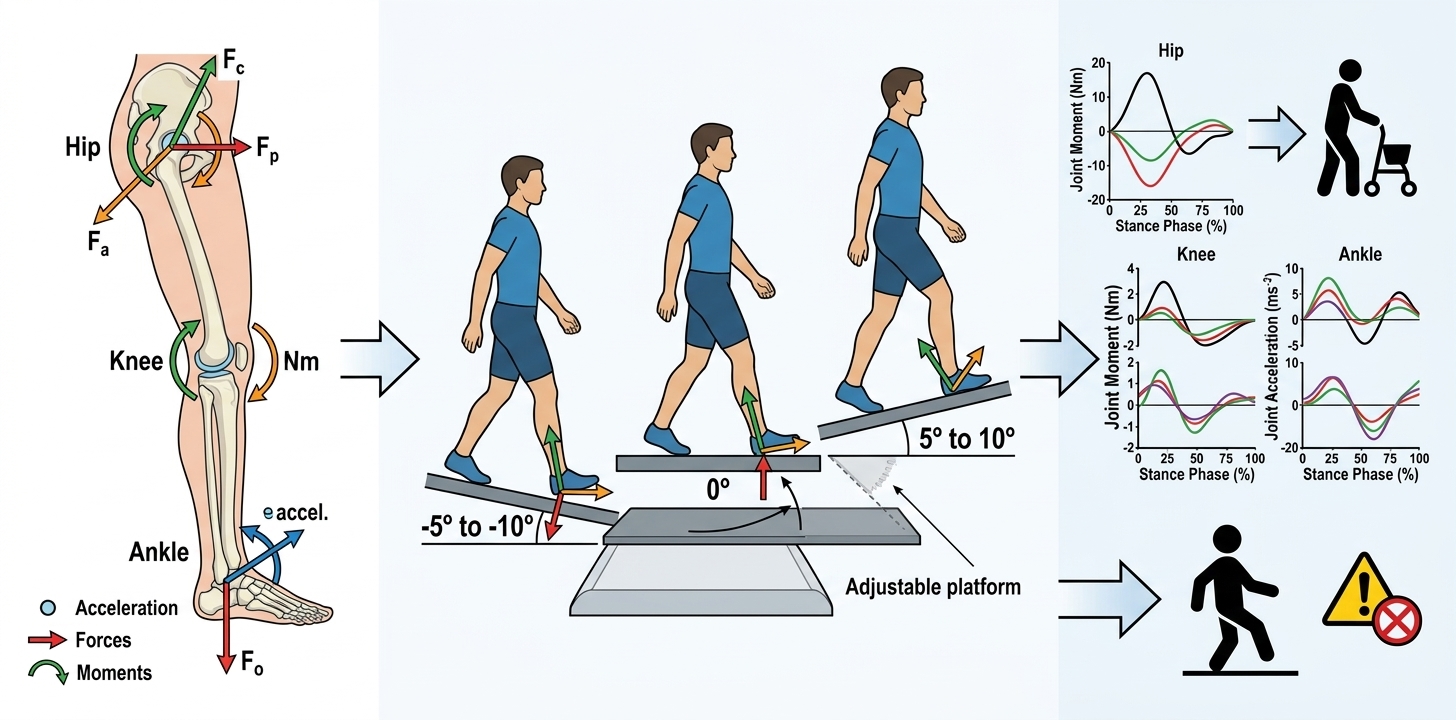
This study examines the biomechanical responses of the ankle, knee, and hip joints during walking on varying slopes to understand how different inclinations affect joint loading and movement mechanics. While previous research has explored slope walking, many studies lack detailed multi-plane analyses of joint moments and accelerations, limiting their applicability in rehabilitation and injury prevention. To address these gaps, we employed advanced motion capture and force plate measurements to quantify joint moments and accelerations at inclinations of 0°, 5°, 7.5°, and 10°. Our results indicate that steeper slopes significantly increase joint moments and accelerations, particularly in the knee and hip during incline walking and in the ankle during decline walking. These findings highlight the increased biomechanical demands on lower limb joints, emphasizing the need for tailored rehabilitation programs, training strategies, and ergonomic interventions. By providing a more comprehensive understanding of slope-related mechanical stresses, this study contributes valuable insights for injury prevention, rehabilitation, and performance optimization in both clinical and athletic settings. The findings suggest that to decrease the risk of falling and manage the demands of inclined walking, appropriate walking strategies and improved safety measures should be implemented, especially during decline and anterior-posterior orientations. This study also offers additional understanding of optimal incline walking techniques for secure and practical locomotion.
References
Deng, R., Li, B., Qin, M., Yu, X., Sun, J., Jiao, F., & Huang, Y. (2024). The characteristics and risk factors of fatal falls among adults aged 60 and above in Southwest China. Scientific Reports, 14(1), 7020.
Long, S., Hu, L., Luo, Y., Li, Y., & Ding, F. (2023). Incidence and risk factors of falls in older adults after discharge: A prospective study. International Journal of Nursing Sciences, 10(1), 23–29.
Suhendra, N., Gustiono, D., & Masmui, G. N. (2015). Anatomical data analysis and normal femur bone reconstruction for designing titanium alloys total hip joint femoral stem. Malaysian Journal of Fundamental and Applied Sciences, 11(4), 152–158.
Yang, Z., Qu, F., Liu, H., Jiang, L., Cui, C., & Rietdyk, S. (2019). The relative contributions of sagittal, frontal, and transverse joint works to self-paced incline and decline slope walking. Journal of Biomechanics, 92, 35–44.
Kafetzakis, I., Konstantinou, I., & Mandalidis, D. (2024). Effects of hiking-dependent walking speeds and slopes on spatiotemporal gait parameters and ground reaction forces: A treadmill-based analysis in healthy young adults. Applied Sciences, 14(11), 4383.
Nuckols, R. W., Takahashi, K. Z., Farris, D. J., Mizrachi, S., Riemer, R., & Sawicki, G. S. (2020). Mechanics of walking and running up and downhill: A joint-level perspective to guide design of lower-limb exoskeletons. PLOS ONE, 15(8), e0231996.
Vernillo, G., Giandolini, M., Edwards, W. B., Morin, J. B., Samozino, P., Horvais, N., & Millet, G. Y. (2017). Biomechanics and physiology of uphill and downhill running. Sports Medicine, 47, 615–629.
Veerman, Q. W., Ten Heggeler, R. M., Tuijthof, G. J., de Graaff, F., Fluit, R., & Hoogeslag, R. A. (2024). High variability exists in 3D leg alignment analysis, but underlying principles that might lead to agreement on a universal framework could be identified: A systematic review. Knee Surgery, Sports Traumatology, Arthroscopy. https://doi.org/10.1002/ksa.12512
Zhuang, H., Wang, J., Wang, N., Li, W., Li, N., Li, B., & Dong, L. (2024). A review of foot–terrain interaction mechanics for heavy-duty legged robots. Applied Sciences, 14(15), 6541.
Yamin, N. A. A. A., Basaruddin, K. S., Ijaz, M. F., Mat Som, M. H., Shahrol Aman, M. N. S., & Takemura, H. (2024). Stress analysis on the ankle joint during incline and decline standing. Applied Sciences, 14(18), 8168.
Belal, M., Alsheikh, N., Aljarah, A., & Hussain, I. (2024). Deep learning approaches for enhanced lower-limb exoskeleton control: A review. IEEE Access, 12, 43884.
Emery, C. A. (2018). Injury prevention in kids' adventure and extreme sports: Future directions. Research in Sports Medicine, 26(sup1), 199–211.
Chodkowska, K., Borkowski, R., & Błażkiewicz, M. (2024). Perturbations during gait on a split-belt treadmill: A scoping review. Applied Sciences, 14(21), 9852.
Barzyk, P., Zimmermann, P., Stein, M., Keim, D., & Gruber, M. (2024). AI-smartphone markerless motion capturing of hip, knee, and ankle joint kinematics during countermovement jumps. European Journal of Sport Science, 24(10), 1452–1462.
Lin, Y., Rankin, J. W., Lamas, L. P., Moazen, M., & Hutchinson, J. R. (2024). Hindlimb kinematics, kinetics, and muscle dynamics during sit-to-stand and sit-to-walk transitions in emus (Dromaius novaehollandiae). Journal of Experimental Biology, jeb-247519.
Higgins, S., Dickin, D. C., Hankemeier, D., Wells, M. D., & Wang, H. (2024). The effect of incline walking on lower extremity and trunk mechanics in older adults. Sports Medicine and Health Science, 7(1), 56–60.
Zhang, Z., Xu, D., Gao, X., Liang, M., Baker, J. S., & Gu, Y. (2024). The effect of different degrees of ankle dorsiflexion restriction on the biomechanics of the lower extremity in stop-jumping. Applied Bionics and Biomechanics, 2024(1), 9079982.
Patti, A., Gervasi, M., Giustino, V., Figlioli, F., Canzone, A., Drid, P., Thomas, E., Messina, G., Vicari, D. S. S., Palma, A., & Bianco, A. (2024). The influence of ankle mobility and foot stability on jumping ability and landing mechanics: A cross-sectional study. Journal of Functional Morphology and Kinesiology, 9(3), 160.
Jie, T., Li, J., & Teo, E. C. (2024). Limb biomechanical difference between bounced and alternating jumping rope. International Journal of Biomedical Engineering and Technology, 45(2), 150–163.
Raitor, M., Ruggles, S., Delp, S. L., Liu, C. K., & Collins, S. H. (2024). Lower-limb exoskeletons appeal to both clinicians and older adults, especially for fall prevention and joint pain reduction. IEEE Transactions on Neural Systems and Rehabilitation Engineering, 32, 1577–1585.
Lin, J., Thomas, G. C., Divekar, N. V., Peddinti, V., & Gregg, R. D. (2024). A modular framework for task-agnostic, energy shaping control of lower limb exoskeletons. IEEE Transactions on Control Systems Technology, 32(6), 2359–2375.
Teater, R. H., Zelik, K. E., & McDonald, K. A. (2024). Biomechanical effects of adding an articulating toe joint to a passive foot prosthesis for incline and decline walking. PLOS ONE, 19(5), e0295465.
Namayeshi, T., Lee, P. V. S., & Ackland, D. (2024). Gait balance recovery during tripping: The influence of walking speed and ground inclination on muscle and joint function. Journal of Biomechanics, 172, 112178.
Wang, W. F., Lien, W. C., Liu, C. Y., & Yang, C. Y. (2018). Study on tripping risks in fast walking through cadence-controlled gait analysis. Journal of Healthcare Engineering, 2018(1), 2723178.
Leardini, A., Benedetti, M. G., Catani, F., Simoncini, L., & Giannini, S. (1999). An anatomically based protocol for the description of foot segment kinematics during gait. Clinical Biomechanics, 14(8), 528–536.
Schut, I. M., Engelhart, D., Pasma, J. H., Aarts, R. G., & Schouten, A. C. (2017). Compliant support surfaces affect sensory reweighting during balance control. Gait & Posture, 53, 241–247.
Xie, H., & Chien, J. H. (2024). Walking on different inclines affects gait symmetry differently in the anterior-posterior and vertical directions: Implication for future sensorimotor training. PeerJ, 12, e18096.
Ramlee, M. H., Wahab, A. H. A., Wahab, A. A., Latip, H. F. M., Daud, S., & Kadir, M. (2017). The effect of stress distribution and displacement of open subtalar dislocation in using titanium alloy and stainless steel Mitkovic external fixator—A finite element analysis. Malaysian Journal of Fundamental and Applied Sciences, 13, 477–482.
Walker, R. L., O’Brien, T. D., Barton, G. J., Carter, B., Wright, D. M., & Foster, R. J. (2025). Are challenging walking environments linked to falls or risk of falling in children with cerebral palsy? A systematic review. Gait & Posture.
Li, W., Zhang, Y., & Chien, J. H. (2025). Applying bilateral mastoid vibration changes the margin of stability in the anterior–posterior and medial–lateral directions while walking on different inclines. European Journal of Medical Research, 30(1), 108.
Schoenwether, B., Ripic, Z., Nienhuis, M., Signorile, J. F., Best, T. M., & Eltoukhy, M. (2025). Reliability of artificial intelligence-driven markerless motion capture in gait analyses of healthy adults. PLOS ONE, 20(1), e0316119.
Saini, S., Shikalgar, A., Tejani, N., Palekar, T. J., & Kumar, P. (2025). Effectiveness of a gait assessment model in enhancing understanding and learning in healthcare education. Internet Journal of Allied Health Sciences and Practice, 23(2), 3.
Downloads
Published
Issue
Section
License
Copyright (c) 2026 Md Ashequl Islam, Noor Arifah Azwani Abdul Yamin, Khairul Salleh Basarudin, Muhammad Nazrin Shah Shahrol Aman, Hiroshi Takemura

This work is licensed under a Creative Commons Attribution-NonCommercial 4.0 International License.