
Mixed Convective Flow of Williamson Ternary Hybrid Ferrofluid Through a Moving Vertical Flat Plate
DOI:
https://doi.org/10.11113/mjfas.v22n2.4743Keywords:
Williamson ternary hybrid ferrofluid, blood based, vertical moving plate, Williamson fluid modelAbstract
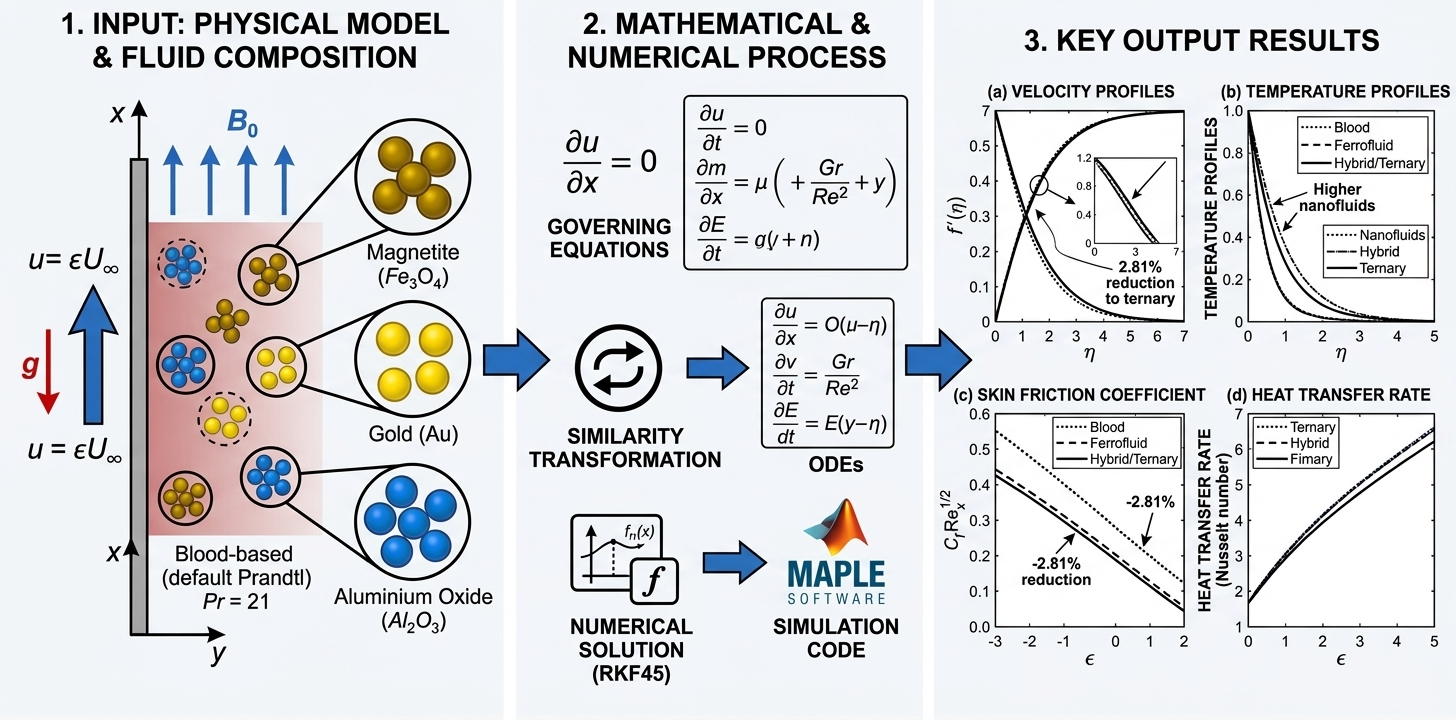
Present paper studies the characteristics of an upgraded fluid called Williamson ternary hybrid ferrofluid. This fluid comprises three types of nanoparticles which are magnetite, gold and aluminium oxide in a Williamson based fluid in hopes to improve the fluidity and heat transfer of based fluid. Thus, the objective of this research is to understand the capabilities of this upgraded fluid and to determine whether it performs better than the less nanoparticles hybrid fluid. The blood is taken as a based fluid to integrate the pseudoplastic behaviour of Williamson fluid. The physical model developed is interpreted into non-linear partial differential equations then transformed into ordinary differential equations using similarity transformations. Using Runge-Kutta-Fehlberg (RKF45) method, the transformed equations then coded in Maple software. Parameter used to study the behaviour of the fluid are the nanoparticles volume fraction, the magnetic parameter, the moving plate parameter and buoyancy parameter. Comparison with different types of ferroparticle volume fractions are also included in this research. In summary, the Williamson ternary hybrid ferrofluid demonstrates a 2.81% enhancement in fluidity relative to the Williamson hybrid ferrofluid, with both showing comparable heat transfer characteristics when evaluated using the same value moving plate parameter. Magnetic parameter as predicted do reduced the thermal and velocity boundary layer. Buoyancy parameter also showed similar result with magnetic parameter.
References
Bouzidi, M., et al. (2025). Simulation of conjugate free convection heat transfer of NEPCM/Al₂O₃–kerosene non-Newtonian hybrid nanoliquid between a double-pipe space. Case Studies in Thermal Engineering, 71, Article 71.
Thenmozhi, D., et al. (2025). The significance of magnetized thermal radiation on the magnetohydrodynamic (MHD) behavior of Williamson hybrid ferrofluids over a stretching sheet. International Journal of Thermofluids, 25, Article 25.
Rosli, W. M. H., et al. (2024). Convective boundary layer flow of Williamson hybrid ferrofluid over a moving flat plate with viscous dissipation. Journal of Advanced Research in Fluid Mechanics and Thermal Sciences, 112(1), 176–188.
Rosli, W. M. H., et al. (2023). Boundary layer flow of Williamson hybrid ferrofluid over a permeable stretching sheet with thermal radiation effects. CFD Letters, 15(3), 112–122.
Rosli, W. M. H., et al. (2022). Blood conveying ferroparticle flow on a stagnation point over a stretching sheet: Non-Newtonian Williamson hybrid ferrofluid. Journal of Advanced Research in Fluid Mechanics and Thermal Sciences, 97(2), 175–185.
Yasin, S. H. M. Y., et al. (2022). Magnetite water-based ferrofluid flow and convection heat transfer on a vertical flat plate: Mathematical and statistical modelling. Case Studies in Thermal Engineering, 40, Article 40.
Ramachandran, N., Chen, T. S., & Armaly, B. F. (1988). Mixed convection in stagnation flows adjacent to vertical surfaces. Journal of Heat Transfer, 110(2), 373–377.
Pradhan, T., Jena, S., & Mishra, S. R. (2025). Laplace transformation technique for free convective time-dependent MHD flow over a vertical porous flat plate with heat sink and chemical reaction: An analytical approach. Hybrid Advances, 8, Article 8.
Zainodin, S., et al. (2023). Effects of higher order chemical reaction and slip conditions on mixed convection hybrid ferrofluid flow in a Darcy porous medium. Alexandria Engineering Journal, 68, 111–126.
Ullah, H., et al. (2025). Thermal radiation effects of ternary hybrid nanofluid flow with activation energy: Numerical computational approach. Results in Engineering, 25, Article 25.
Mahanta, C., & Sharma, R. P. (2025). A nonlinear stratification paradigm for squeezing flow between parallel plates incorporating ternary hybrid nanoparticles with Soret–Dufour effects. Hybrid Advances, 9, Article 9.
Abu Bakar, S., et al. (2025). Optimizing a ternary hybrid ferrofluid slip flow with magnetic dipole and viscous dissipation by response surface methodology (RSM). Applied Thermal Engineering, 269, Article 269.
Priyadharshini, P., et al. (2023). Ternary hybrid nanofluid flow over a symmetrically stretching sheet: Optimization with a machine learning prediction scheme. Symmetry, 15(6), Article 15.
Mohamed, M. K. A., et al. (2017). Buoyancy effect on stagnation point flow past a stretching vertical surface with Newtonian heating.
Mahmood, Z., et al. (2023). Numerical analysis of MHD tri-hybrid nanofluid over a nonlinear stretching/shrinking sheet with heat generation/absorption and slip conditions. Alexandria Engineering Journal, 76, 799–819.
Mohamed, M. K. A., et al. (2019). Mixed convection boundary layer flow of engine oil nanofluid on a vertical flat plate with viscous dissipation.
Mohamed, M. K. A., et al. (2014). Effects of heat generation/absorption on a stagnation point flow over a stretching surface in a porous medium with convective boundary conditions.
Mohamed, M. K. A., et al. (2021). Boundary layer flow on permeable flat surface in Ag–Al₂O₃/water hybrid nanofluid with viscous dissipation. Data Analytics and Applied Mathematics (DAAM), 2(1), 11–19.
Mohamed, M. K. A., Yasin, S. H. M. Y., & Salleh, M. Z. (2021). Slip effects on MHD boundary layer flow over a flat plate in Casson ferrofluid. Journal of Advanced Research in Fluid Mechanics and Thermal Sciences, 88(1), 49–57.
Makinde, O. D., & Olanrewaju, P. O. (2010). Buoyancy effects on thermal boundary layer over a vertical plate with a convective surface boundary condition. Journal of Fluids Engineering, 132(4).
Aziz, A. (2009). A similarity solution for laminar thermal boundary layer over a flat plate with a convective surface boundary condition. Communications in Nonlinear Science and Numerical Simulation, 14(4), 1064–1068.
Ishak, A. (2010). Similarity solutions for flow and heat transfer over a permeable surface with convective boundary condition. Applied Mathematics and Computation, 217(2), 837–842.
Farah Nadzirah, J., Iskandar, W., & Anuar, I. (2024). Time-dependent flow of ternary hybrid nanofluid past a stretching sheet with suction and magnetohydrodynamic (MHD) effects. Journal of Advanced Research in Fluid Mechanics and Thermal Sciences, 117(2), 15–27.
Chu, Y.-M., et al. (2020). Numerical simulations of time-dependent micro-rotation blood flow induced by a curved moving surface with conduction of gold particles and non-uniform heat sink/source. Arabian Journal for Science and Engineering, 46(3), 2413–2427.
Subbarayudu, K., Suneetha, S., & Bala Anki Reddy, P. (2020). Time-dependent flow of Williamson fluid with radiative blood flow over a wedge. Propulsion and Power Research, 9(1), 87–99.
Bachok, N., Ishak, A., & Pop, I. (2012). Flow and heat transfer characteristics on a moving plate in a nanofluid. International Journal of Heat and Mass Transfer, 55(4), 642–648.
Anuar, N. S., Bachok, N., & Pop, I. (2021). Influence of buoyancy force on Ag–MgO/water hybrid nanofluid flow in an inclined permeable stretching/shrinking sheet. International Communications in Heat and Mass Transfer, 123, Article 123.
Jamaludin, A., et al. (2020). Thermal radiation and MHD effects in the mixed convection flow of Fe₃O₄–water ferrofluid towards a nonlinearly moving surface. Processes, 8(1), Article 8.
Kamal, M., et al. (2025). Mixed convective flow caused by a porous vertical sheet with Fourier heat fluxes for Darcy–Forchheimer biomedical simulation of Au–Cu/blood hybrid nanofluid. Case Studies in Thermal Engineering, 72, Article 72.
Mohamed, M. K. A., Salleh, M. Z., & Ishak, A. (2020). Effects of viscous dissipation on mixed convection boundary layer flow past a vertical moving plate in a nanofluid. Journal of Advanced Research in Fluid Mechanics and Thermal Sciences, 69(2), 1–18.
Prasannakumara, B. C., Shashikumar, N. S., & Venkatesh, P. (2017). Boundary layer flow and heat transfer of fluid particle suspension with nanoparticles over a nonlinear stretching sheet embedded in a porous medium. Nonlinear Engineering, 6(3).
Zhao, Q., Xu, H., & Fan, T. (2015). Analysis of three-dimensional boundary-layer nanofluid flow and heat transfer over a stretching surface using the homotopy analysis method. Boundary Value Problems, 2015(1).
Zainodin, S., et al. (2024). Impact of heat source on mixed convection hybrid ferrofluid flow across a shrinking inclined plate subject to convective boundary conditions. Alexandria Engineering Journal, 87, 662–681.
Downloads
Published
Issue
Section
License
Copyright (c) 2026 Wan Muhammad Hilmi Bin Wan Rosli, Muhammad Khairul Anuar Mohamed, Norhafizah Md Sarif, Huei Ruey Ong, Hamzeh Taha Alkasasbeh

This work is licensed under a Creative Commons Attribution-NonCommercial 4.0 International License.