
MHD Free Convection Boundary Layer Flow on a Horizontal Circular Cylinder in a Williamson Hybrid Ferrofluid
DOI:
https://doi.org/10.11113/mjfas.v21n6.3366Abstract
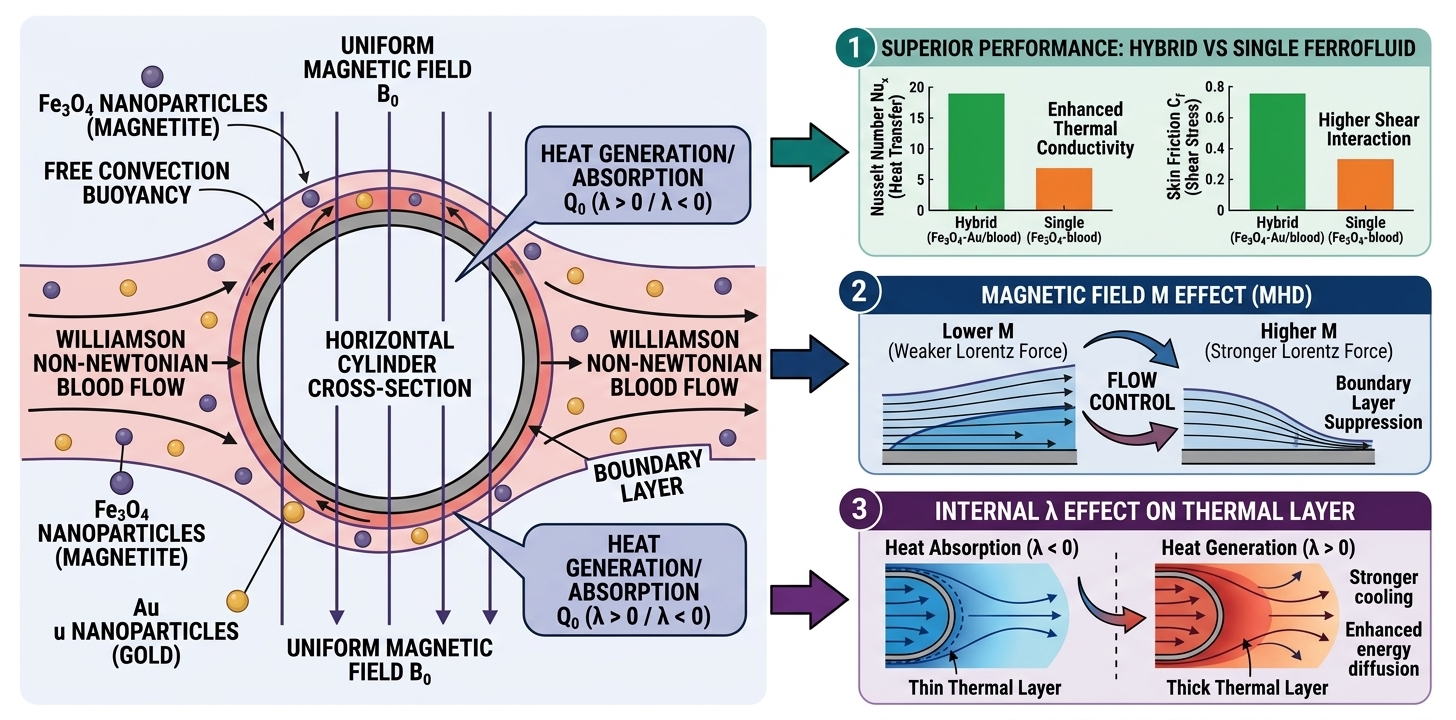
This study investigated the free convection boundary layer flow of a horizontal circular cylinder submerged in Williamson hybrid ferrofluid. With the presence of viscous dissipation and magnetohydrodynamic (MHD) effects, the governing partial differential equations are constructed to model the fluid flow problem. These dimensional equations are reduced to a non-dimensional form before being transformed to a more convenient partial differential equation. These fewer dependent variables equations then are solved numerically using Keller-box method. MATLAB software is used to acquire graphical depictions, and the effects of various parameters examined. The gold nanoparticles and ferrite ferroparticles are blend together to form a hybrid ferrofluid with blood acted as a based fluid. Results shows that the hybrid ferrofluid provided higher convective heat transfer abilities and skin friction compared to ferrofluid with the same particle volume fraction.
References
Abd Elgawad, H., Zinta, G., Hegab, M. M., Pandey, R., Asard, H., & Abuelsoud, W. (2016). High salinity induces different oxidative stress and antioxidant responses in maize seedling organs. Frontiers in Plant Science, 7, Article 276. https://doi.org/10.3389/fpls.2016.00276.
Ajayi, E. O., Akin-Idowu, P. E., Aderibigbe, O. R., Ibitoye, D. O., Afolayan, G., Adewale, O. M., Adesegun, E. A., & Ubi, B. E. (2016). The response of maize physiology under salinity stress and its coping strategies. In IntechOpen. https://doi.org/10.5772/65736.
Alho, C., Snethlage, J., Stavaren, M. van, Agterbos, R., & Verberne, F. (2021). This paper serves as input material for the thematic session on saline water & food systems at the Amsterdam International Water Week to be held on November 3: Salinisation Threatens food security, biodiversity, and livelihoods (pp. 1–7).
Aravind, J., Rinku, S., Pooja, B., Shikha, M., Kaliyugam, S., Mallikarjuna, M. G., Kumar, A., Rao, A. R., & Nepolean, T. (2017). Identification, characterization, and functional validation of drought-responsive microRNAs in subtropical maize inbreds. Frontiers in Plant Science, 8, 1–14. https://doi.org/10.3389/fpls.2017.00941.
Ashraf, M., & Harris, P. J. C. (2004). Potential biochemical indicators of salinity tolerance in plants. Plant Science, 166(1), 3–16. https://doi.org/10.1016/j.plantsci.2003.10.024.
Azeem, M., Pirjan, K., Qasim, M., Mahmood, A., Javed, T., Muhammad, H., Yang, S., Dong, R., Ali, B., & Rahimi, M. (2023). Salinity stress improves antioxidant potential by modulating physio-biochemical responses in Moringa Oleifera Lam. Scientific Reports, 13(1), 1–17. https://doi.org/10.1038/s41598-023-29954-6.
Bagues, M., Hafsi, C., Yahia, Y., Souli, I., Boussora, F., & Nagaz, K. (2019). Modulation of photosynthesis, phenolic contents, antioxidant activities, and grain yield of two barley accessions grown under deficit irrigation with saline water in an arid area of Tunisia. Polish Journal of Environmental Studies, 28(5), 3071–3080. https://doi.org/10.15244/pjoes/92814.
Baker, N. R. (2008). Chlorophyll fluorescence: A probe of photosynthesis in vivo. Annual Review of Plant Biology, 59, 89–113. https://doi.org/10.1146/annurev.arplant.59.032607.092759.
Batool, T., Ali, S., Seleiman, M. F., Naveed, N. H., Ali, A., Ahmed, K., Abid, M., Rizwan, M., Shahid, M. R., Alotaibi, M., Al-Ashkar, I., & Mubushar, M. (2020). Plant growth-promoting rhizobacteria alleviates drought stress in potato by suppressing oxidative stress and enhancing antioxidant enzyme activities. Scientific Reports, 10(1), 1–19. https://doi.org/10.1038/s41598-020-73489-z.
Carrasco-Ríos, L., & Pinto, M. (2014). Effect of salt stress on antioxidant enzymes and lipid peroxidation in leaves of two contrasting corn cultivars, “Lluteño” and “Jubilee.” Chilean Journal of Agricultural Research, 74(1), 89–95. https://doi.org/10.4067/S0718-58392014000100014.
Cha-Um, S., & Kirdmanee, C. (2009). Effect of salt stress on proline accumulation, photosynthetic ability and growth characters in two maize cultivars. Pakistan Journal of Botany, 41(1), 87–98.
Chaves, M. M., Flexas, J., & Pinheiro, C. (2009). Photosynthesis under drought and salt stress: Regulation mechanisms from whole plant to cell. Annals of Botany, 103(4), 551–560. https://doi.org/10.1093/aob/mcn125.
Chen, J., Xu, B., Sun, J., Jiang, X., & Bai, W. (2022). Anthocyanin supplement as a dietary strategy in cancer prevention and management: A comprehensive review. Critical Reviews in Food Science and Nutrition, 62(26), 7242–7254. https://doi.org/10.1080/10408398.2021.1913092.
Chugh, V., Kaur, N., & Gupta, A. K. (2011). Evaluation of oxidative stress tolerance in maize (Zea Mays L.) seedlings in response to drought. Indian Journal of Biochemistry and Biophysics, 48(1), 47–53.
Dang, D., Guan, Y., Zheng, H., Zhang, X., Zhang, A., Wang, H., Ruan, Y., & Qin, L. (2023). Genome-wide association study and genomic prediction on plant architecture traits in sweet corn and waxy corn. Plants, 12(2), 1–17. https://doi.org/10.3390/plants12020303.
Dong, L., Qi, X., Zhu, J., Liu, C., Zhang, X., Cheng, B., Mao, L., & Xie, C. (2019). Supersweet and waxy: Meeting the diverse demands for specialty maize by genome editing. Plant Biotechnology Journal, 17(10), 1853.
Duangpapeng, P., Dermail, A., & Suriharn, K. (2023). Phenolics, anthocyanins, and antioxidant capacity in the tassels of purple waxy corn: Effects of temperature and time during storage. Aims Agriculture and Food, 9(1), 69–83. https://doi.org/10.3934/AGRFOOD.2024005.
El Sabagh, A., Çiğ, F., Seydoşoğlu, S., Battaglia, M. L., Javed, T., Iqbal, M. A., Mubeen, M., Ali, M., Ali, M., Bengisu, G., Konuşkan, Ö., Barutcular, C., Erman, M., Açikbaş, S., Hossain, A., Islam, M. S., Wasaya, A., Ratnasekera, D., Arif, M., … Awad, M. (2021). Salinity stress in maize: Effects of stress and recent developments of tolerance for improvement. In Cereal Grains (Vol. 1). https://doi.org/10.5772/intechopen.98745.
FAO. (2021). Global Map of Salt-Affected Soils: Gsasmap V1.0 (p. 20). https://www.fao.org/documents/card/en/c/cb7247en.
Flowers, T. J. (2004). Improving crop salt tolerance. Journal of Experimental Botany, 55(396), 307–319. https://doi.org/10.1093/jxb/erh003.
Fujita, M., & Hasanuzzaman, M. (2022). Approaches to enhancing antioxidant defense in plants. Antioxidants, 11(5), 1–5. https://doi.org/10.3390/antiox11050925.
Haj-Amor, Z., Araya, T., Kim, D. G., & Bouri, S. (2023). Climate change effects on soil salinity in rainfed maize areas: A case study from South Africa. Water Supply, 23(6), 2447–2465. https://doi.org/10.2166/ws.2023.138.
Hossain, M. S., & Dietz, K. J. (2016). Tuning of redox regulatory mechanisms, reactive oxygen species and redox homeostasis under salinity stress. Frontiers in Plant Science, 7. https://doi.org/10.3389/fpls.2016.00548.
Hu, D., Li, R., Dong, S., Zhang, J., Zhao, B., Ren, B., Ren, H., Yao, H., Wang, Z., & Liu, P. (2022). Maize (Zea Mays L.) responses to salt stress in terms of root anatomy, respiration and antioxidative enzyme activity. BMC Plant Biology, 22(1), 1–17. https://doi.org/10.1186/s12870-022-03972-4.
Huseynova, I. M. (2012). Photosynthetic characteristics and enzymatic antioxidant capacity of leaves from wheat cultivars exposed to drought. Biochimica ET Biophysica Acta – Bioenergetics, 1817(8), 1516–1523. https://doi.org/10.1016/j.bbabio.2012.02.037.
Hussain, S. S., Rasheed, M., Saleem, M. H., Ahmed, Z. I., Hafeez, A., Jilani, G., Alamri, S., Hashem, M., & Ali, S. (2023). Salt tolerance in maize with melatonin priming to achieve sustainability in yield in salt-affected soils. Pakistan Journal of Botany, 55(1), 19–35. https://doi.org/10.30848/PJB2023-1(27).
Iftikhar, N., Perveen, S., Ali, B., Saleem, M. H., & Al-Sadoon, M. K. (2024). Physiological and biochemical responses of maize (Zea Mays L.) cultivars under salinity stress. Turkish Journal of Agriculture and Forestry, 48(3), 332–343. https://doi.org/10.55730/1300-011X.3185.
Jack, C. N., Rowe, S. L., Porter, S. S., & Friesen, M. L. (2019). A high-throughput method of analyzing multiple plant defensive compounds in minimized sample mass. Applications in Plant Sciences, 7(1), 1–10. https://doi.org/10.1002/aps3.1210.
Jia, R., Cui, C., Gao, L., Qin, Y., Ji, N., Dai, L., Wang, Y., Xiong, L., Shi, R., & Sun, Q. (2023). A review of starch swelling behavior: Its mechanism, determination methods, influencing factors, and influence on food quality. Carbohydrate Polymers, 321, 121260. https://doi.org/10.1016/j.carbpol.2023.121260.
Khan, T., Mazid, M., & Mohammad, F. (2012). A review of ascorbic acid potentialities against oxidative stress induced in plants. Journal of Agrobiology, 28(2), 97–111. https://doi.org/10.2478/v10146-011-0011-x.
Khondoker, M., Mandal, S., Gurav, R., & Hwang, S. (2023). Freshwater shortage, salinity increase, and global food production: A need for sustainable irrigation water desalination—A scoping review. Earth, 4(2), 223–240. https://doi.org/10.3390/earth4020012.
Lapčík, L., Řepka, D., Lapčíková, B., Sumczynski, D., Gautam, S., Li, P., & Valenta, T. (2023). A physicochemical study of the antioxidant activity of corn silk extracts. Foods, 12(11), 2159. https://doi.org/10.3390/foods12112159.
Li, J., Zhu, Q., Jiao, F., Yan, Z., Zhang, H., Zhang, Y., Ding, Z., Mu, C., Liu, X., Li, Y., Chen, J., & Wang, M. (2023). Research progress on the mechanism of salt tolerance in maize: A classic field that needs new efforts. Plants, 12(12), 2356. https://doi.org/10.3390/plants12122356.
Logan, B. A. (2006). Oxygen metabolism and stress physiology. In The structure and function of plastids (pp. 539–553). Springer. https://doi.org/10.1007/1-4020-4061-x_27.
Luo, H., Dong, F., Wang, Q., Li, Y., & Xiong, Y. (2021). Construction of porous starch-based hydrogel via regulating the ratio of amylopectin/amylose for enhanced water retention. Molecules, 26(13), 3999. https://doi.org/10.3390/molecules26133999.
Matkovic Stojsin, M., Petrovic, S., Dimitrijevic, M., Sucur Elez, J., Malencic, D., Zecevic, V., Banjac, B., & Knezevic, D. (2022). Effect of salinity stress on antioxidant activity and grain yield of different wheat genotypes. Turkish Journal of Field Crops, 27(1), 33–40. https://doi.org/10.17557/tjfc.1002061.
Melo-Silveira, R. F., Fidelis, G. P., Viana, R. L. S., Soeiro, V. C., Da Silva, R. A., Machado, D., Costa, L. S., Ferreira, C. V., & Rocha, H. A. O. (2014). Antioxidant and antiproliferative activities of methanolic extract from a neglected agricultural product: Corn cobs. Molecules, 19(4), 5360–5378. https://doi.org/10.3390/molecules19045360.
Merecz-Sadowska, A., Sitarek, P., Kowalczyk, T., Zajdel, K., Jęcek, M., Nowak, P., & Zajdel, R. (2023). Food anthocyanins: Malvidin and its glycosides as promising antioxidant and anti-inflammatory agents with potential health benefits. Nutrients, 15(13), 3016. https://doi.org/10.3390/nu15133016.
Mittler, R. (2002). Oxidative stress, antioxidants and stress tolerance. Trends in Plant Science, 7(9), 405–410. https://doi.org/10.1016/S1360-1385(02)02312-9.
Munns, R., & Tester, M. (2008). Mechanisms of salinity tolerance. Annual Review of Plant Biology, 59, 651–681. https://doi.org/10.1146/annurev.arplant.59.032607.092911.
Mutlu-Durak, H., Arikan, Y., & Kutman, B. Y. (2023). Willow (Salix babylonica) extracts can act as biostimulants for enhancing salinity tolerance of maize grown in soilless culture. Plants, 12(4), 856. https://doi.org/10.3390/plants12040856.
Nik Shanita, S., Hasnah, H., & Khoo, C. W. (2011). Amylose and amylopectin in selected Malaysian foods and their relationship to glycemic index. Sains Malaysiana, 40(8), 865–870.
Park, Y.-I., Chow, W., & Anderson, J. (1995). Light inactivation of functional photosystem II in leaves of peas grown in moderate light depends on photon exposure. Planta, 196(3), 401–410. https://doi.org/10.1007/BF00203636.
Pedreschi, R., & Cisneros-Zevallos, L. (2007). Phenolic profiles of Andean purple corn (Zea mays L.). Food Chemistry, 100(3), 956–963. https://doi.org/10.1016/j.foodchem.2005.11.004.
Pegler, J. L., Grof, C. P. L., & Eamens, A. L. (2018). Profiling of the differential abundance of drought- and salt-stress-responsive microRNAs across grass crop and genetic model plant species. Agronomy, 8(7), 118. https://doi.org/10.3390/agronomy8070118.
Qing, D. J., Lu, H. F., Li, N., Dong, H. T., Dong, D. F., & Li, Y. Z. (2009). Comparative profiles of gene expression in leaves and roots of maize seedlings under conditions of salt stress and the removal of salt stress. Plant and Cell Physiology, 50(4), 889–903. https://doi.org/10.1093/pcp/pcp038.
Rao, K. V. M., Raghavendra, A. S., & Reddy, K. J. (2006). Physiology and molecular biology of stress tolerance in plants (Vol. 86). Springer. https://doi.org/10.1007/1-4020-4225-6.
Rasheed, A., Jie, H., Ali, B., He, P., Zhao, L., Ma, Y., Xing, H., Qari, S. H., Hassan, M. U., Hamid, M. R., & Jie, Y. (2023). Breeding drought-tolerant maize (Zea mays) using molecular breeding tools: Recent advancements and future prospective. Agronomy, 13(6), 1459. https://doi.org/10.3390/agronomy13061459.
Rizk, M. S., Assaha, D. V. M., Mekawy, A. M. M., Shalaby, N. E., Ramadan, E. A., El-Tahan, A. M., Ibrahim, O. M., Metwelly, H. I. F., Okla, M. K., Maridueña-Zavala, M. G., AbdElgawad, H., & Ueda, A. (2024). Comparative analysis of salinity tolerance mechanisms in two maize genotypes: Growth performance, ion regulation, and antioxidant responses. BMC Plant Biology, 24(1), 55. https://doi.org/10.1186/s12870-024-05533-3.
Sari, K. R. P., Ikawati, Z., Danarti, R., & Hertiani, T. (2023). Micro-titer plate assay for measurement of total phenolic and total flavonoid contents in medicinal plant extracts. Arabian Journal of Chemistry, 16(9), 105003. https://doi.org/10.1016/j.arabjc.2023.105003.
Shan, X., Li, Y., Jiang, Y., Jiang, Z., Hao, W., & Yuan, Y. (2013). Transcriptome profile analysis of maize seedlings in response to high-salinity, drought, and cold stresses by deep sequencing. Plant Molecular Biology Reporter, 31(6), 1485–1491. https://doi.org/10.1007/s11105-013-0622-z.
Tanumihardjo, S. A., McCulley, L., Roh, R., Lopez-Ridaura, S., Palacios-Rojas, N., & Gunaratna, N. S. (2020). Maize agro-food systems to ensure food and nutrition security in reference to the Sustainable Development Goals. Global Food Security, 25, 100327. https://doi.org/10.1016/j.gfs.2019.100327.
Trehan, S., Singh, N., & Kaur, A. (2018). Characteristics of white, yellow, purple corn accessions: Phenolic profile, textural, rheological properties and muffin making potential. Journal of Food Science and Technology, 55(6), 2334–2343. https://doi.org/10.1007/s13197-018-3171-5.
Vazquez-Olivo, G., López-Martínez, L. X., Contreras-Angulo, L., & Heredia, J. B. (2019). Antioxidant capacity of lignin and phenolic compounds from corn stover. Waste and Biomass Valorization, 10(1), 95–102. https://doi.org/10.1007/s12649-017-0028-5.
Wang, F. (2021). Environmental toxicology and toxicogenomics. In X. Pan & B. Zhang (Eds.), Methods in Molecular Biology (Vol. 2326). Springer. https://doi.org/10.1007/978-1-0716-1514-0.
Zaidi, F., Shahzad, A., Ahsan, M., Gul, H., Shahzad, M., Gul, S., & Mohamed, S. (2022). Evaluation of genetic variation among maize inbred lines for salinity stress at seedling stage through salt-stress-responsive traits. Acta Universitatis Sapientiae, Agriculture and Environment, 14(1), 62–84. https://doi.org/10.2478/ausae-2022-0005.
Zhang, L., Gao, M., Hu, J., Zhang, X., Wang, K., & Ashraf, M. (2012). Modulation role of abscisic acid (ABA) on growth, water relations and glycinebetaine metabolism in two maize (Zea mays L.) cultivars under drought stress. International Journal of Molecular Sciences, 13(3), 3189–3202. https://doi.org/10.3390/ijms13033189.
Zhang, X., Huang, C., Meng, Y., Liu, X., Gao, Y., Liu, Z., & Ma, S. (2023). Physiological mechanism of waterlogging stress on yield of waxy maize at the jointing stage. Plants, 12(17), 3034. https://doi.org/10.3390/plants12173034.
Alam, Z., Akter, S., Hossain Khan, M. A., Alam, M. S., Sultana, S., Akhter, S., Rahman, M. M., & Islam, M. M. (2023). Yield performance and trait correlation of BARI released sweet potato varieties studied under several districts of Bangladesh. Heliyon, 9(7), e18203. https://doi.org/10.1016/j.heliyon.2023.e18203.
Doğanay, K., Kurunc, A., & Dincer, C. (2023). Salinity stress effects on the growth yield and quality performance of two sweet potato varieties. ACS Agricultural Science & Technology, 3. https://doi.org/10.1021/acsagscitech.3c00069.
Hameed, A., Ahmed, M. Z., Hussain, T., Aziz, I., Ahmad, N., Gul, B., & Nielsen, B. L. (2021). Effects of salinity stress on chloroplast structure and function. Cells, 10(8), 2023. https://doi.org/10.3390/cells10082023.
Jat, M., Ray, M., Ahmad, M. A., & Prakash, P. (2024). Unravelling the photosynthetic dynamics and fluorescence parameters under ameliorative effects of 24-epibrassinolide in wheat (Triticum aestivum L.) grown under heat stress regime. Scientific Reports, 14(1), 1–14. https://doi.org/10.1038/s41598-024-79676-6.
Özdemir, E., Cengiz, R., & Sade, B. (2022). Characterization of white, yellow, red and purple corns (Zea mays indentata L.) according to bio-active compounds and quality traits. Anadolu Journal of Agricultural Sciences, 38, 131–144. https://doi.org/10.7161/omuanajas.1128834.
Wang, X., Dai, W. W., Liu, C., Zhang, G. X., Song, W. H., Li, C., Yangchen, Y. C., Gao, R. F., Chen, Y. Y., Yan, H., Tang, W., Kou, M., Zhang, Y. G., Yuan, B., & Li, Q. (2022). Evaluation of physiological coping strategies and quality substances in purple sweet potato under different salinity levels. Genes, 13(8), 1350. https://doi.org/10.3390/genes13081350.
Downloads
Published
Issue
Section
License
Copyright (c) 2025 Marjan Mohd Daud, Muhammad Khairul Anuar Mohamed, Norhafizah Md Sarif, Huei Ruey Ong

This work is licensed under a Creative Commons Attribution-NonCommercial 4.0 International License.