
Immobilization of Laccase on Graphene-Support Material: A Molecular Dynamic Study
DOI:
https://doi.org/10.11113/mjfas.v22n2.4955Keywords:
Molecular docking, Molecular Dynamic Simulation, Laccase, Graphene-oxide, Reduced graphene-oxide, ImmobilizationAbstract
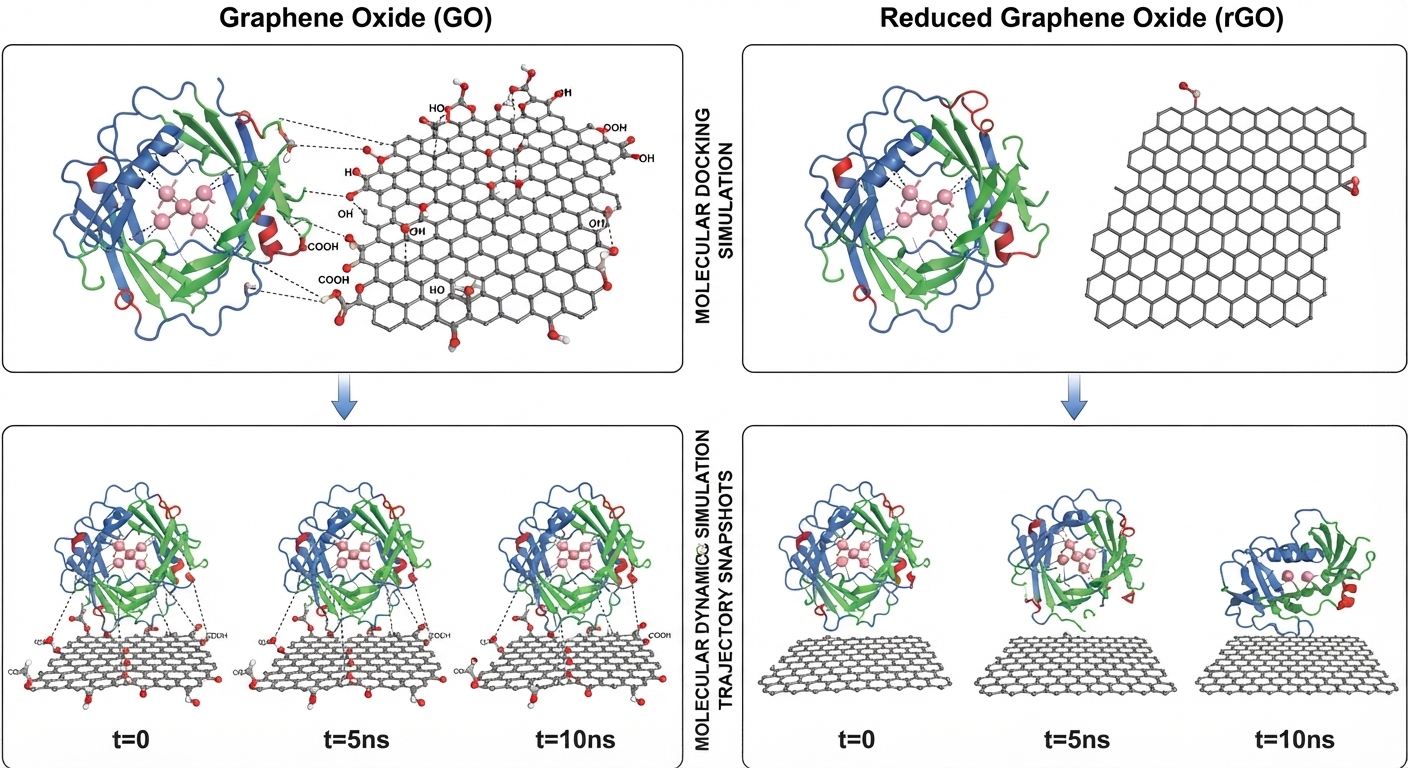
Laccase is a versatile oxidative enzyme widely applied in the degradation of various environmental pollutants. However, its practical application is often limited by poor operational stability and reusability in free form. Immobilization onto suitable support materials has therefore emerged as an effective strategy to enhance enzyme stability and performance. Among carbon-based supports, graphene and its derivatives have attracted considerable attention due to their high surface area, abundant functional groups, and excellent physicochemical properties. This study investigates the intermolecular interactions between laccase and graphene-based supports to elucidate the structural stability, flexibility, and compactness of enzyme-support complexes at the molecular level. Molecular docking and molecular dynamics (MD) simulations were employed to evaluate graphene oxide (GO) and reduced graphene oxide (rGO) as immobilization supports. Docking results revealed that the laccase-GO (Lac–GO) complex exhibited the strongest binding affinity (-14.4 kcal/mol), forming three hydrogen bonds with bond lengths of 2.03 Å, 2.52 Å, and 3.13 Å, whereas weaker interactions were observed for laccase-rGO. MD simulations further demonstrated that free laccase exhibited the lowest root mean square deviation (RMSD), reflecting inherent structural stability, while the Lac-GO complex maintained lower RMSD values than Lac-rGO, indicating improved structural stability among immobilized systems. Root mean square fluctuation (RMSF) analysis showed moderate residue-level flexibility for Lac-GO compared to higher fluctuations in Lac-rGO, suggesting better conformational preservation upon GO binding. Additionally, the radius of gyration (Rg) analysis revealed that Lac-GO retained greater compactness than Lac-rGO while allowing slight structural expansion relative to free laccase, which may facilitate enhanced enzyme loading and reduced mass transfer limitations. Overall, the computational findings indicate that graphene oxide provides a superior immobilization platform for laccase compared to reduced graphene oxide, offering favourable interaction stability and structural characteristics.
References
Adamian, Y., Lonappan, L., Alokpa, K., Agathos, S. N., & Cabana, H. (2021). Recent developments in the immobilization of laccase on carbonaceous supports for environmental applications: A critical review. Frontiers in Bioengineering and Biotechnology, 9, 1–29.
Adeel, M., Bilal, M., Rasheed, T., Sharma, A., & Iqbal, H. M. N. (2018). Graphene and graphene oxide: Functionalization and nano-bio-catalytic system for enzyme immobilization and biotechnological perspective. International Journal of Biological Macromolecules, 120, 1430–1440.
Avornyo, A., & Chrysikopoulos, C. V. (2024). Application of graphene oxide (GO) in oily wastewater treatment: Recent developments, challenges, and opportunities. Journal of Environmental Management, 353, 1–18.
Ba, S., Arsenault, A., Hassani, T., Jones, J. P., & Cabana, H. (2012). Critical Reviews in Biotechnology, 1–15.
Ba, S., & Vinoth Kumar, V. (2017). Recent developments in the use of tyrosinase and laccase in environmental applications. Critical Reviews in Biotechnology, 1–15.
Banaganapalli, B., Morad, F. A., Khan, M., Kumar, C. S., Elango, R., Awan, Z., & Shaik, N. A. (2019). Molecular docking. In I. Vol (Ed.), Essential bioinformatics (pp. 335–353). Springer.
Barbhuiya, N. H., Misra, U., & Singh, S. P. (2022). Biocatalytic membranes for combating the challenges of membrane fouling and micropollutants in water purification: A review. Chemosphere, 286, 1–23.
Bhattacharjee, N., Alonso-Cotchico, L., & Lucas, M. F. (2023). Enzyme immobilization studied through molecular dynamic simulation. Frontiers in Bioengineering and Biotechnology. https://doi.org/10.3389/fbioe.2023.1200293.
Brugnari, T., Braga, D. M., Santos, C. S. A., Torres, B. H. C., Modkovski, T. A., Haminiuk, C. W. I., & Maciel, G. M. (2021). Laccase as green and versatile biocatalyst: From lab to enzyme market—An overview. Bioresources and Bioprocessing, 8, 1–29.
Catania, F., Marras, E., Giorcelli, M., Jagdale, P., Lavagna, L., Tagliaferro, A., & Bartoli, M. (2021). A review on recent advancement of graphene and graphene-related materials in biological applications. Applied Sciences, 614, 1–21.
Daneshmandi, L., Barajaa, M., Rad, A. T., Sydlik, S. A., & Laurencin, C. Y. (2020). Graphene-based biomaterials for bone regenerative engineering: A comprehensive review. Advanced Healthcare Materials, 1–25.
Datta, S., Christena, L. R., & Rajaram, Y. R. S. (2013). Enzyme immobilization: An overview on technique and support materials. 3 Biotech, 3, 1–9.
Datta, S., Veena, R., Samual, M. S., & Selvarajan, E. (2021). Immobilization of laccase and application for the detection and remediation of pollutants: A review. Environmental Chemistry Letters, 19, 521–538.
Hwang, E. T., & Gu, M. B. (2012). Enzyme stabilization by nano/microsized hybrid materials. Enzyme and Life Science, 1–13.
Jailani, N., Jaafar, N. R., Suhaimi, S., Mohaman Mackeen, M. M., Abu Bakar, F. D., & Md Illias, R. (2022). International Journal of Biological Macromolecules, 213, 516–533.
Jahan, N., Roy, H., Reaz, A. H., Arshi, S., Rahman, E., Firoz, A. H., & Islam, M. S. (2022). A comparative study on sorption behavior of graphene oxide and reduced graphene oxide towards methylene blue. Case Studies in Chemical and Environmental Engineering, 6, 1–10.
Jayakumar, K., Zhong, Y., Camarada, M. B., Lu, X., Chen, T., Zhang, W., & Wen, Y. (2024). One-step electrochemical preparation of platinum nanoparticle decorated self-healing reduced graphene oxide nanoarray. Journal of Environmental Chemical Engineering, 12, 1–11.
Karthik, V., Senthil Kumar, P., Vo, D. V. N., Selvakumar, P., Gokulakrishnan, M., Keerthana, P., Audilakshmi, V., & Jeyanthi, J. (2021). Enzyme-loaded nanoparticles for wastewater contaminant degradation: A review. Environmental Chemistry Letters. https://doi.org/10.1007/s10311-020-01158-8.
Liu, Y., Liu, Z., Zeng, G., Chen, M., Jiang, Y., Shao, B., Li, Z., & Liu, Y. (2018). Effect of surfactants on phenol interaction with laccase. Journal of Hazardous Materials, 357, 10–18.
Olabi, A. G., Abdelkareem, M. A., Wilberforce, T., & Sayed, E. T. (2021). Application of graphene in energy storage devices: A review. Renewable and Sustainable Energy Reviews, 135, 1–20.
Osma, J. F., Toca-Herrera, J. L., & Rodríguez-Couto, S. (2011). Cost analysis in laccase production. Journal of Environmental Management, 92, 2907–2912.
Patel, S. K. S., Choi, H., & Lee, J. K. (2019). Multimetal-based inorganic-protein hybrid system for enzyme immobilization. ACS Sustainable Chemistry & Engineering, 7, 13633–13638.
Pagadala, N. S., Syed, K., & Tuszynski, J. (2017). Software for molecular docking: A review. Biophysical Reviews, 9, 91–102.
Shokri, Z., Seidi, F., Karami, S., Li, C., Saeb, M. R., & Xiao, H. (2021). Laccase immobilization onto natural polysaccharide. Carbohydrate Polymers, 262, 1–15.
Sigg, S. J., Seidi, F., Renggli, K., Silva, T. B., Kali, G., & Bruns, N. (2012). ATRPases: Enzymes as catalyst for atom transfer radical polymerization. Polymer and Colloid Highlights, 66(1), 66.
Xiao, W., Jiang, X., Liu, X., Zhou, W., Garba, Z. N., Lawan, I., Wang, L., & Yuan, Z. (2021). Journal of Cleaner Production, 284, 1–20.
Yang, S., Yang, J., Wang, T., Li, L., Yu, S., Jia, R., & Chen, P. (2020). Combined enzyme system of graphene oxide and manganese peroxidase. Nanoscale. https://doi.org/10.1039/D0NR00408A
Yu, D., Li, Z., Wang, W., Wang, L., Liu, T., & Du, J. (2022). Modification of magnetic graphene oxide and immobilized lipase. International Journal of Biological Macromolecules, 216, 498–509.
Zhang, Y., Hu, P., Muhammad, Y., Tang, Y., Shao, S., Gao, Z., Wang, J., Wang, R., Hu, Y., Kuang, L., Zhao, Z., & Zhao, Z. (2021). High-density immobilization of laccase on NH2-MIL88 (Fe). Chemical Engineering Journal, 405, 1–14.
Zdarta, J., Meyer, A. S., Jesionowski, T., & Pinelo, M. (2018a). Overview of support materials for enzyme immobilization. Catalysts, 8, 1–27.
Zhang, W., Yang, Q., Luo, Q., Shi, L., & Meng, S. (2020). Laccase-carbon nanotube nanocomposites. Journal of Cleaner Production, 242, 1–11.
Zhang, W., Zhang, Y., Lu, Z., Nian, B., Yang, S., & Hu, Y. (2023). Enhanced stability of laccase immobilized on graphene oxide. Journal of Environmental Management, 346, 1–12.
Zhao, D., Li, L., & Zhou, J. (2018). Cytochrome c adsorption on graphene surfaces. Applied Surface Science, 428, 825–834.
Zhou, W., Zhang, W., & Cai, Y. (2021). Laccase immobilization for water purification. Chemical Engineering Journal, 403, 1–15.
Zhou, W., Zhang, W., & Cai, Y. (2022). Enzyme-enhanced adsorption of laccase immobilized graphene oxide. Separation and Purification Technology, 294, 1–10.
Pace, C. N., Fu, H., Fryar, K. L., Landua, J., Trevino, S. R., Schell, D., Thurkill, R. L., Imura, S., Scholtz, J. M., Gajiwala, K., et al. (2014). Contribution of hydrogen bonds to protein stability. Protein Science, 23, 652–661.
Downloads
Published
Issue
Section
License
Copyright (c) 2026 Noor Idayu Nashiruddin, PROF IR TS DR Roshanida A. Rahman, DR Nardiah Rizwana Jaafar, PROF. DR. Rosli Md. Illias

This work is licensed under a Creative Commons Attribution-NonCommercial 4.0 International License.