
Effect of Degree Substitution on the Viscosity and Solubility of Carboxymethylated Amorphophallus muelleri Glucomannan
DOI:
https://doi.org/10.11113/mjfas.v22n1.4985Keywords:
Carboxymethylated Amorphophallus muelleri glucomannan, sodium hydroxide, monochloroacetic acid, solubility, viscosity, degree substitutionAbstract
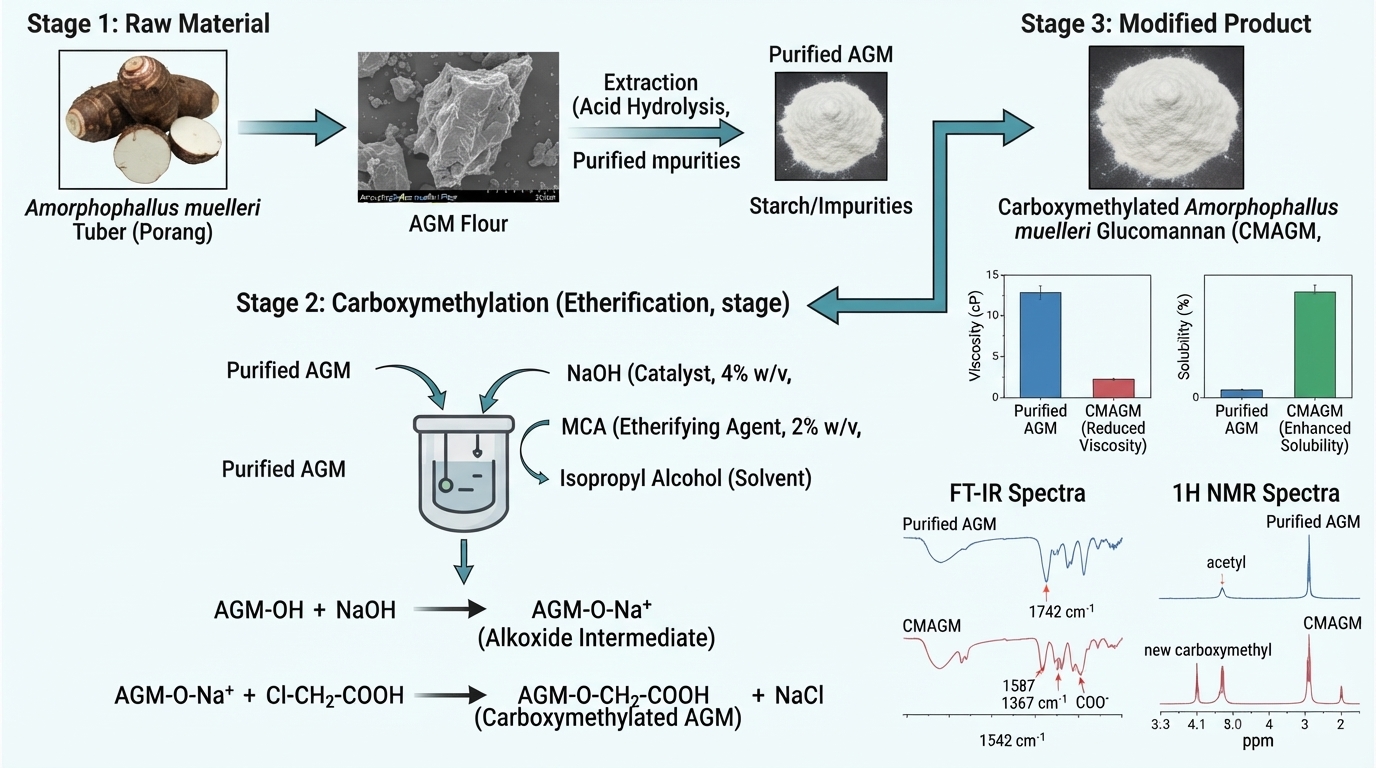
Glucomannan, derived from Amorphophallus muelleri (AGM), is a highly viscous natural polysaccharide with reduced solubility, which has yet to be fully developed, hence constraining its application across numerous industries. Among the numerous modifications applied to AGM, carboxymethylation via the etherification process has garnered considerable interest owing to its straightforward methodology and its ability to reduce viscosity while enhancing the solubility of glucomannan. This study aims to examine the modification of Amorphophallus muelleri glucomannan by carboxymethylation (CMAGM) through the variation of sodium hydroxide (NaOH) and monochloroacetic acid (MCA) to ascertain the degree of substitution and its effects on viscosity and solubility. The degree of substitution was verified by titration methods, which corroborate the findings from Fourier Transform Infrared (FT-IR) and Nuclear Magnetic Resonance (NMR) analyses. The glucomannan yield achieved through acid hydrolysis with hydrochloric acid was 52.4%. The AGM was effectively altered and validated by the emergence of a new peak at 1587–1369 cm⁻¹ in the FT-IR spectra and δ = 3.3-4.1, δ = 8.057 ppm in the NMR spectra, indicative of the COOH functional group due to the modification process. The modification process indicated that the maximum degree of substitution achieved with a NaOH: MCA ratio of 4:2 % w/v was 0.577. It was found that a lower MCA corresponds to a higher degree of substitution. Overall, the carboxymethylation effectively reduced the viscosity and enhanced the solubility of glucomannan.
References
Xu, R., Zheng, X., Chen, C., Li, M., Li, J., Zhou, H., et al. (2024). Effects of different substrates on the growth and yield of Amorphophallus muelleri. Heliyon, 10, e31501. https://doi.org/10.1016/j.heliyon.2024.e31501
Wang, L. H., Huang, G. Q., Xu, T. C., & Xiao, J. X. (2019). Characterization of carboxymethylated konjac glucomannan for potential application in colon-targeted delivery. Food Hydrocolloids, 94, 354–362. https://doi.org/10.1016/j.foodhyd.2019.03.045.
Zhu, C., Zhang, X., Gan, J., Geng, D., Bian, X., Cheng, Y., et al. (2023). A pH-sensitive hydrogel based on carboxymethylated konjac glucomannan crosslinked by sodium trimetaphosphate: Synthesis, characterization, swelling behavior and controlled drug release. International Journal of Biological Macromolecules, 232. https://doi.org/10.1016/j.ijbiomac.2023.123392.
Hu, Q., Huang, G., & Huang, H. (2025). Extraction, structure, activity and application of konjac glucomannan. Ultrasonics Sonochemistry, 116. https://doi.org/10.1016/j.ultsonch.2025.107315.
Hikmat, R., Resdiana, R., & Tasfiyati, A. N. (2021). Carboxymethyl glucomannan from Amorphophallus oncophyllus as an alternative heavy metal removal from wastewater: Adsorption of cadmium and zinc. Molekul, 16, 57–66. https://doi.org/10.20884/1.jm.2021.16.1.682.
Aanisah, N., Wardhana, Y. W., Chaerunisaa, A. Y., & Budiman, A. (2022). Review on modification of glucomannan as an excipient in solid dosage forms. Polymers (Basel), 14, 2550. https://doi.org/10.3390/polym14132550.
Lohani, A., Saxena, R., & Khan, S., Mascarenhas-Melo, F. (2024). pH-responsive IPN beads of carboxymethyl konjac glucomannan and sodium carboxymethyl cellulose as a controlled release carrier for ibuprofen. International Journal of Biological Macromolecules, 278, 134676. https://doi.org/10.1016/j.ijbiomac.2024.134676.
Xie, Y., Yi, Z. X., Wang, J. X., Hou, T. G., & Jiang, Q. (2018). Carboxymethyl konjac glucomannan-crosslinked chitosan sponges for wound dressing. International Journal of Biological Macromolecules, 112, 1225–1233. https://doi.org/10.1016/j.ijbiomac.2018.02.075.
Ding, X., Zhang, L., Jiang, C., Liu, S., Li, H., Xi, J., et al. (2024). Building covalent crosslinks of carboxymethyl konjac glucomannan with boronic ester bonds for fabricating multimodal hydrogel sensor. International Journal of Biological Macromolecules, 277, 134286. https://doi.org/10.1016/j.ijbiomac.2024.134286.
Niu, C., Wu, W., Wang, Z., Li, S., & Wang, J. (2007). Adsorption of heavy metal ions from aqueous solution by crosslinked carboxymethyl konjac glucomannan. Journal of Hazardous Materials, 141, 209–214. https://doi.org/10.1016/j.jhazmat.2006.06.114.
Liang, L., Lin, X., Liu, Y., Sun, S., Chu, H., Chen, Y., et al. (2020). Carboxymethyl konjac glucomannan mechanically reinforcing gellan gum microspheres for uranium removal. International Journal of Biological Macromolecules, 145, 535–546. https://doi.org/10.1016/j.ijbiomac.2019.12.188.
Wu, C., Sun, J., Jiang, H., Li, Y., & Pang, J. (2021). Construction of carboxymethyl konjac glucomannan/chitosan complex nanogels as potential delivery vehicles for curcumin. Food Chemistry, 362, 130242. https://doi.org/10.1016/j.foodchem.2021.130242.
Xiao, M., Jiang, M., Wu, K., Yang, H., Ni, X., Yan, W., et al. (2017). Investigation on curdlan dissociation by heating in water. Food Hydrocolloids, 70, 57–64. https://doi.org/10.1016/j.foodhyd.2017.03.018
Guo, L., Yokoyama, W., Chen, L., Liu, F., Chen, M., & Zhong, F. (2021). Characterization and physicochemical properties analysis of konjac glucomannan: Implications for structure-properties relationships. Food Hydrocolloids, 120, 106818. https://doi.org/10.1016/j.foodhyd.2021.106818.
Aprilia, V., Murdiati, A., Hastuti, P., & Harmayani, E. (2017). Carboxymethylation of glucomannan from porang tuber (Amorphophallus oncophyllus) and the physicochemical properties of the product. Pakistan Journal of Nutrition, 16, 835–842. https://doi.org/10.3923/pjn.2017.835.842.
Kumoro, A. C., Yuganta, T. H. A., Ratnawati, R., & Retnowati, D. S. (2016). Effect of catalyst concentration and reaction time on the extraction of glucomannan from porang (Amorphophallus oncophyllus) flour via acid hydrolysis. IOP Conference Series: Materials Science and Engineering, 162, 012020. https://doi.org/10.1088/1757-899X/162/1/012020.
Chua, M., Chan, K., Hocking, T. J., Williams, P. A., Perry, C. J., & Baldwin, T. C. (2012). Methodologies for the extraction and analysis of konjac glucomannan from corms of Amorphophallus konjac K. Koch. Carbohydrate Polymers, 87, 2202–2210. https://doi.org/10.1016/j.carbpol.2011.10.053.
Wang, S., Wu, X., Wang, Y., Li, Y., Wang, L., Chen, Y., et al. (2014). Dissolution behavior of deacetylated konjac glucomannan in aqueous potassium thiocyanate solution at low temperature. RSC Advances, 4, 21918–21923. https://doi.org/10.1039/c4ra01491j.
Kumoro, A., Yuganta, T., Retnowati, D., & Ratnawati, R. (2018). Acid hydrolysis and ethanol precipitation for glucomannan extraction from crude porang (Amorphophallus oncophyllus) tuber flour. Chemistry & Chemical Technology, 12, 101–108. https://doi.org/10.23939/chcht12.01.101.
Plermjai, K., Mekprasart, W., Boonyarattanakalin, S., & Boonyarattanakalin, K. (2023). Enhancing saccharide extraction from konjac by microwave-assisted acid hydrolysis. Thai Journal of Nano Science and Technology, 8, 11–17. https://doi.org/10.55003/tjnn8120232.
Harijati, N., Mastuti, R., Chairiyah, N., Roosdiana, B., & Rohmawati, S. A. (2018). Effects of seeding material age, storage time, and tuber tissue zone on glucomannan content of Amorphophallus muelleri Blume. International Journal of Plant Biology, 9, 34–38. https://doi.org/10.4081/pb.2018.7626.
Nurlela, N., Ariesta, N., Santosa, E., & Muhandri, T. (2022). Physicochemical properties of glucomannan isolated from fresh tubers of Amorphophallus muelleri Blume by a multilevel extraction method. Food Research, 6, 345–353. https://doi.org/10.26656/fr.2017.6(4).580.
Haryani, K., Prasetyaningrum, A., Handayani, A., Kevin, F., & Nadya, T. (2023). Extraction of glucomannan from porang (Amorphophallus oncophyllus) flour using enzymatic hydrolysis pretreatment. International Journal of Chemical and Biological Sciences, 24, 362–368.
Haryani, K., Handayani, N. A., & Alkautsar, A. A. (2024). Purification of glucomannan from porang (Amorphophallus oncophyllus) tuber flour through hydrolysis of hydrochloric acid. International Journal of Chemical and Biological Sciences, 26, 110–119.
Tatirat, O., & Charoenrein, S. (2011). Physicochemical properties of konjac glucomannan extracted from konjac flour by a simple centrifugation process. LWT – Food Science and Technology, 44, 2059–2063. https://doi.org/10.1016/j.lwt.2011.07.019.
Guo, Y., Wu, M., Li, R., Cai, Z., & Zhang, H. (2022). Thermostable physically crosslinked cryogel from carboxymethylated konjac glucomannan fabricated by freeze-thawing. Food Hydrocolloids, 122. https://doi.org/10.1016/j.foodhyd.2021.107103.
Wade, L. G. (2013). Organic Chemistry (8th ed.). Pearson Education.
Xie, L., Shen, M., Wang, Z., & Xie, J. (2021). Structure, function and food applications of carboxymethylated polysaccharides: A comprehensive review. Trends in Food Science & Technology, 118, 539–557. https://doi.org/10.1016/j.tifs.2021.09.016.
Li, J., Shang, W., Si, X., Bu, D., Strappe, P., Zhou, Z., et al. (2017). Carboxymethylation of corn bran polysaccharide and its bioactive property. International Journal of Food Science & Technology, 52, 1176–1184. https://doi.org/10.1111/ijfs.13382.
Kobayashi, S., Tsujihata, S., Hibi, N., & Tsukamoto, Y. (2002). Preparation and rheological characterization of carboxymethyl konjac glucomannan. Food Hydrocolloids, 16, 289–294. https://doi.org/10.1016/S0268-005X(01)00101-1.
Xiao, M., Dai, S., Wang, L., Ni, X., Yan, W., Fang, Y., et al. (2015). Carboxymethyl modification of konjac glucomannan affects water binding properties. Carbohydrate Polymers, 130, 1–8. https://doi.org/10.1016/j.carbpol.2015.05.001
Cao, G., Bu, N., Zeng, T., Sun, R., Mu, R., Pang, J., et al. (2022). Development of pH-responsive konjac glucomannan/pullulan films incorporated with acai berry extract to monitor fish freshness. International Journal of Biological Macromolecules, 219, 897–906. https://doi.org/10.1016/j.ijbiomac.2022.08.030
Chen, N., Zhu, P., Du, T., Han, K., Wang, D., Ye, J., et al. (2018). Preparation of modified konjac glucomannan nanoparticles and their application as vaccine adjuvants to promote ovalbumin-induced immune response in mice. Pharmaceutical Research, 35, 1–13. https://doi.org/10.1007/s11095-018-2381-x.
Downloads
Published
Issue
Section
License
Copyright (c) 2026 Risa Yunita, Roshanida A. Rahman, Nardiah Rizwana Jaafar, Mohammad Nashriq Jailani, Nur Aizura Mat Alewi, Rosli Md. Illias, Abdul Halim Mohd Yusof, Ni Nyoman Tri Puspaningsih, Mohd Faizal Ahmad Jaafar, Azura Aziz

This work is licensed under a Creative Commons Attribution-NonCommercial 4.0 International License.