
Evaluating Morpho-Physiological and Antioxidative Mechanisms of Salinity Tolerance in Contrasting Maize Varieties
DOI:
https://doi.org/10.11113/mjfas.v21n6.4514Keywords:
Purple waxy maize, salt stress, oxidative stress, antioxidant, plant physiologyAbstract
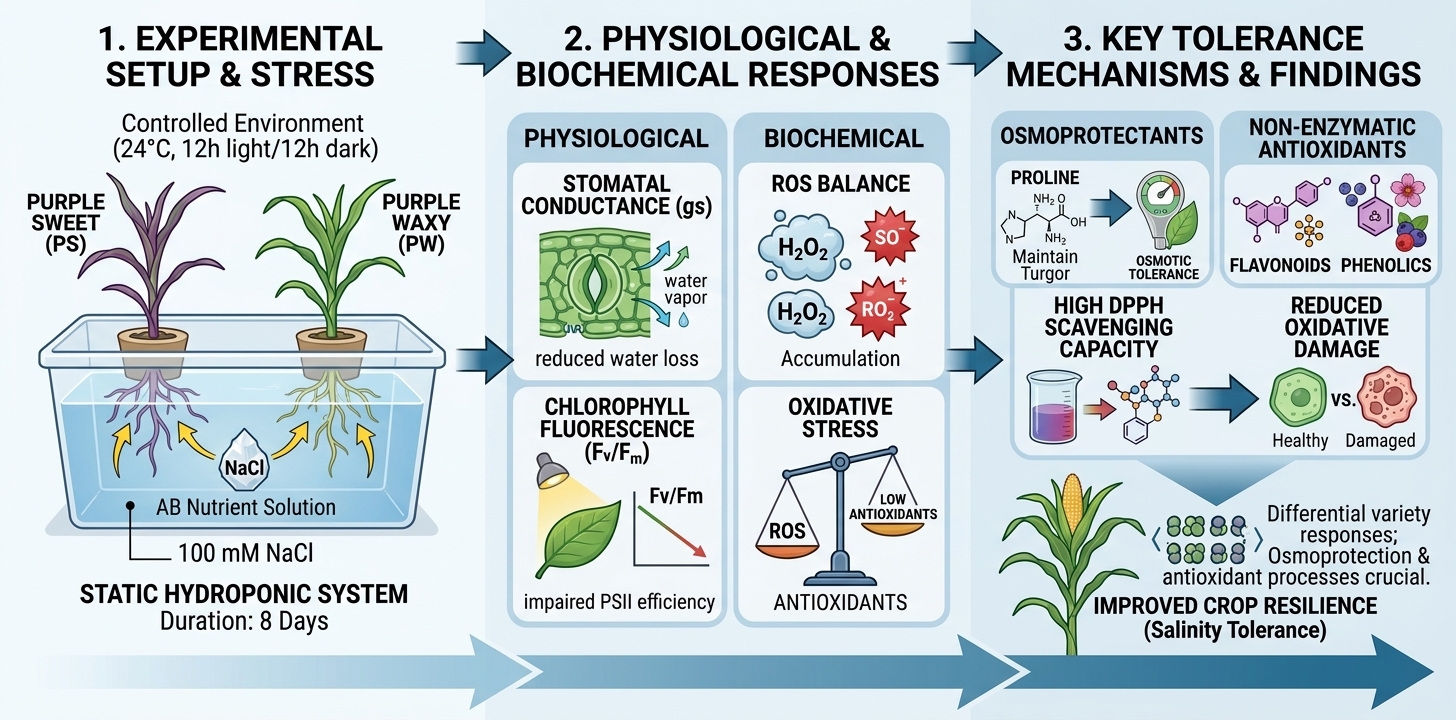
High soil salinity greatly impacts maize productivity, especially in regions with high salinity levels. This research examines how purple sweet (PS) maize and purple waxy (PW) maize react physically and biochemically to salty environments. Both maize varieties were grown hydroponically and subjected to salinity treatments (0-200 mM NaCl) under controlled growth conditions. We evaluated physiological parameters including growth, chlorophyll content, length, and stomatal conductance, along with their stress markers and antioxidant activity in leaf and root samples, in triplicate. PS maize showed a positive response to salinity by maintaining stable proline and hydrogen peroxide (H₂O₂) and non-significant changes in superoxide dismutase (SOD), peroxidase (POD) and catalase (CAT) activities particularly in roots. On the other hand, the PW genotype exhibited significant increases in antioxidant enzyme levels, indicating a strong reaction to oxidative stress, though this could suggest decreased natural tolerance. Meanwhile, PW showed better performance in physiological parameters compared to PS. Under 100 mM NaCl salt stress, the levels of flavonoids in both genotypes rose considerably, protecting them from oxidative damage. Strong positive correlations among proline, flavonoid content, and 2,2-diphenyl-1-picrylhydrazyl (DPPH) scavenging activity were found using Pearson’s correlation analysis, indicating that these markers are essential for salt tolerance. On the other hand, a negative relationship between proline and SOD activity indicated that osmoprotection and antioxidant processes may involve a trade-off. These results provide important information for breeding initiatives that aim to develop maize variants capable of withstanding salinity.
Downloads
Published
Issue
Section
License
Copyright (c) 2025 NIK MAISYA SYUHADA ZOLAIMI, MOHAMAD SYAMIL CHOO MOHAMAD SHAIFUL BAHRI, NAZMI HARITH FADZILAH, NOR HASIMA MAHMOD, NUR FATIHAH HASAN NUDIN, MOHD FAHMI ABU BAKAR, AIZI NOR MAZILA RAMLI, ROSLI MD ILLIAS, NADIAWATI ALIAS

This work is licensed under a Creative Commons Attribution-NonCommercial 4.0 International License.