
Pollination Efficiency of Abundant Insect Species of Lentil Lens culinaris Medik. in the Northeastern Algeria (Constantine)
DOI:
https://doi.org/10.11113/mjfas.v21n6.4315Keywords:
Fabaceae, Hymenoptera, Lentil, PollinationAbstract
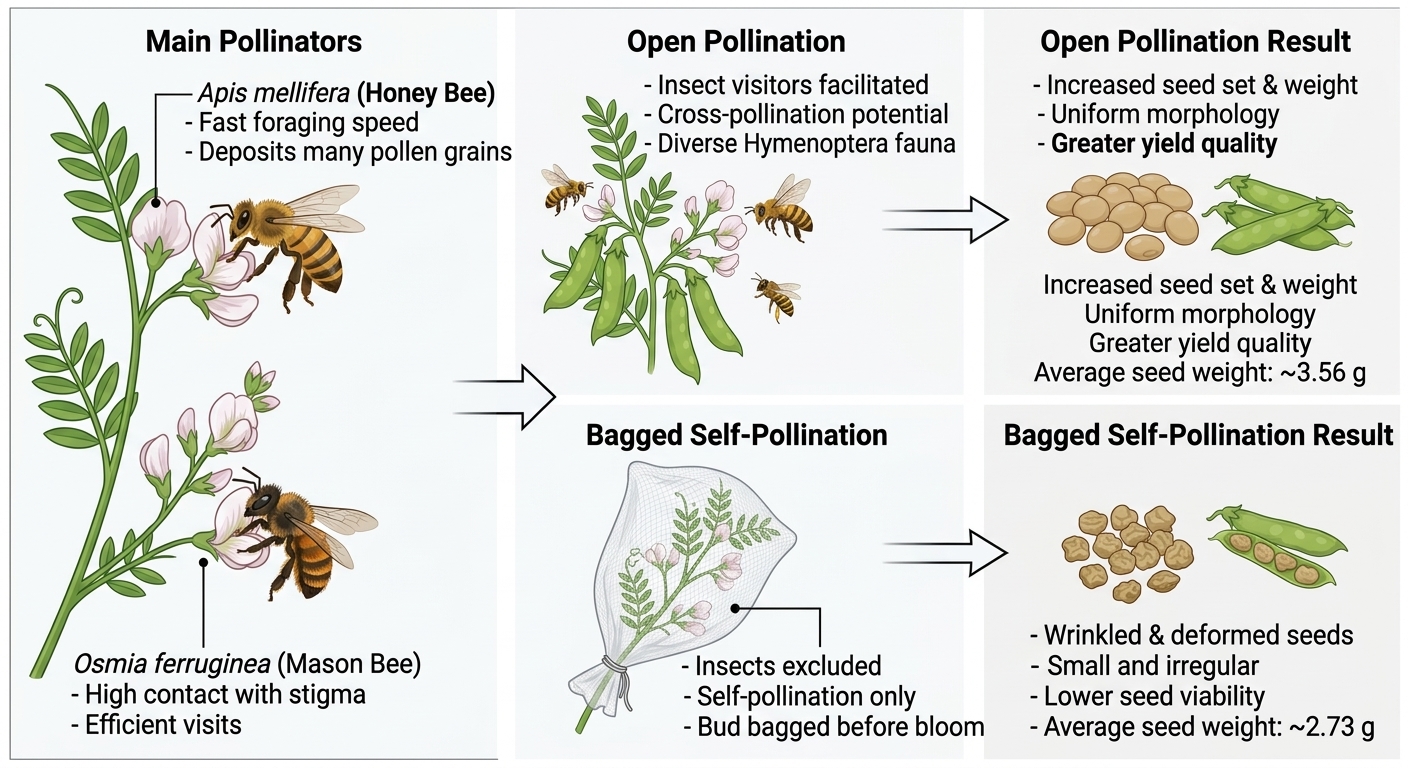
This study was conducted in the Baaraouia region (Constantine, northeastern Algeria) during the 2022 flowering season. The objective was to examine the variety of insect pollinators in the lentil crop during its flowering phase. The Hymenoptera order was the predominant insect group recorded, comprising six families and twelve species, notably including two principal pollinators: Apis mellifera (Linnaeus, 1758) and Osmia ferruginea (Latreille, 1811). The findings indicate that the honey bee (Apis mellifera) forages at a quicker pace and transports a greater quantity of pollen grains, while the mason bee (Osmia ferruginea) conducts more efficient visits. Flora, with unrestricted access to pollinating insects yielded a greater quantity and superior quality of seeds compared to those enclosed in bags.
References
Ricketts, T. H., Regetz, J., Steffan-Dewenter, I., Cunningham, S. A., Kremen, C., Bogdanski, A., Gemmill-Herren, B., Greenleaf, S. S., Klein, A. M., Mayfield, M. M., Morandin, L. A., Ochieng, A., & Viana, B. F. (2008). Landscape effects on crop pollination services: Are there general patterns? Ecology Letters, 11(5), 499–515.
Klein, A. M., Steffan-Dewenter, I., & Tscharntke, T. (2007). Foraging trip duration and density of honey bees in relation to flower resources in a mass flowering crop. Ecological Entomology, 28(5), 577–585.
Ollerton, J., Winfree, R., & Tarrant, S. (2011). How many flowering plants are pollinated by animals? Oikos, 120(3), 321–326.
Schneider, A. V. C. (2002). Overview of the market and consumption of puises in Europe. British Journal of Nutrition, 88(S3), 243–250.
Food and Agriculture Organization of the United Nations (FAO). (2016). Pulses: Nutritious seeds for a sustainable future. Rome: FAO.
Johnson, N., Johnson, C. R., Thavarajah, P., Kumar, S., & Thavarajah, D. (2020). The roles and potential of lentil prebiotic carbohydrates in human and plant health. Plants People Planet, 2(4), 310–319.
Tabti, D., Laouar, M., Rajendran, K., Kumar, S., & Abdelguerfi, A. (2018). Analysis of gamma rays induced variability in lentil (Lens culinaris Medik). Agronomy Research, 16(5), 2169–2178.
Zemouli-Benfreha, F., Henni., D., & Merzoug, A. (2014). Fusarium wilt of Chickpea (Cicer arietinum L.) in North-west Algeria. African Journal of Agricultural Research, 9(1), 168–175.
Benachour, K., Louadi, K., & Terzo, M. (2007). Rôle des abeilles sauvages et domestiques (Hymenoptera : Apoidea) dans la pollinisation de la fève (Vicia faba L. var. major) (Fabaceae) en région de Constantine (Algérie). Annales de la Société entomologique de France (N.S.) 43(2), 213219.
Garibaldi, L. A., Steffan-Dewenter, I., Winfree, R., et al. (2013). Wild pollinators enhance fruit set of crops regardless of honey bee abundance. Science, 339(6127), 1608–1611.
Haedo, A. S., Tylianakis, J. M., & Laliberté, E. (2022). Pollinator diversity improves pollination service and stability in agricultural landscapes. Agriculture, Ecosystems & Environment, 335, 108034.
Amiet, F., Herrmann, M., Müller, A., & Neumeyer, R. (2004). Fauna Helvetica Apidae 4: Anthidium, Chelostoma, Coelioxys, Dioxys, Heriades, Lithurgus, Megachile, Osmia, Stelis (Fauna Helvetica 9). Neuchâtel, Switzerland: CSCF/SEG.
Benachour, K. (2017). Insect visitors of lavender (Lavandula officinalis L.): Comparison of quantitative and qualitative interactions of the plant with its main pollinators. African Entomology, 25(2), 435–444.
Benachour, K., & Louadi, K. (2011). Comportement de butinage des abeilles (hymenoptera : Apoidea) sur les fleurs mâles et femelles du concombre (Cucumis sativus l.) (Curbitaceae) en région de Constantine (Algérie). Annales de La Societe Entomologique de France, 47(1–2), 63–70.
Michez, D., Patiny, S., Rasmont, P., Timmermann, K., & Vereecken, N. J. (2008). Phylogeny and host-plant evolution in Melittidae s.l. (Hymenoptera: Apoidea). Apidologie, 39(1), 146–162.
Abou-Shaara, H. F. (2014). The foraging behaviour of honey bees, Apis mellifera: a review. Veterinarni Medicina, 59(1), 1–10.
Pacini, E., & Nepi, M. (2007). Nectar production and presentation. In S. W. Nicolson, M. Nepi, & E. Pacini (Eds.), Nectaries and nectar (pp. 167–214). Dordrecht, Netherlands: Springer. https://doi.org/10.1007/978-1-4020-5937-7_5.
Hall, D. M., Camilo, G. R., Tonietto, R. K., Ollerton, J., Ahrné, K., Arduser, M., Ascher, J. S., Baldock, K. C. R., Fowler, R., Frankie, G., Goulson, D., Gunnarsson, B., Hanley, M. E., Jackson, J. I., Langellotto, G., Lowenstein, D., Minor, E. S., Philpott, S. M., Potts, S. G., & Threlfall, C. G. (2017). The city as a refuge for insect pollinators. Conservation Biology, 31(1), 24–29.
Seeley, T. D. (1995). The wisdom of the hive: The social physiology of honey bee colonies. Harvard University Press.ù
Free, J. B. (1993). Insect pollination of crops (2nd ed.). Academic Press.
Dafni, A., Kevan, P. G., & Husband, B. C. (2005). Practical pollination biology. Cambridge, Ontario, Canada: Enviroquest Ltd.
Abrol, D. P. (2012). Pollination biology: Biodiversity conservation and agricultural production. Springer.
Dag, A., Eisikowitch, D., & Stern, R. A. (2006). Pollination of different almond (Prunus amygdalus L.) cultivars by honey bees. Acta Horticulturae, 726, 399–404.
Udayakumar, A., & Shivalingaswamy, T. M. (2022). Leafcutter bees (Hymenoptera: Megachilidae) as pollinators of pigeon pea (Cajanus cajan (L.) Millsp., Fabaceae): Artificial trap nests as a strategy for their conservation. Sociobiology, 69(1), e7202. https://doi.org/10.13102/sociobiology.v69i1.7202.
Michener, C. D. (2007). The bees of the world (2nd ed.). Baltimore, MD: Johns Hopkins University Press.
Gibbs, J., Elle, E., Bobiwash, K., Haapalainen, T., & Isaacs, R. (2016). Contrasting pollinators and pollination in native and non-native regions of highbush blueberry production. PLOS ONE, 11(7), 1–24.
Downloads
Published
Issue
Section
License
Copyright (c) 2025 sirine abderrezak, Aguib sihem, Derradj lotfi

This work is licensed under a Creative Commons Attribution-NonCommercial 4.0 International License.