
Boundary Preserving with Attention-Guided Filtering Network for Retinal Vessel Segmentation
DOI:
https://doi.org/10.11113/mjfas.v22n2.4949Keywords:
Retinal vessel segmentation, deep learning, U-Net, attention guided filtering, medical image analysisAbstract
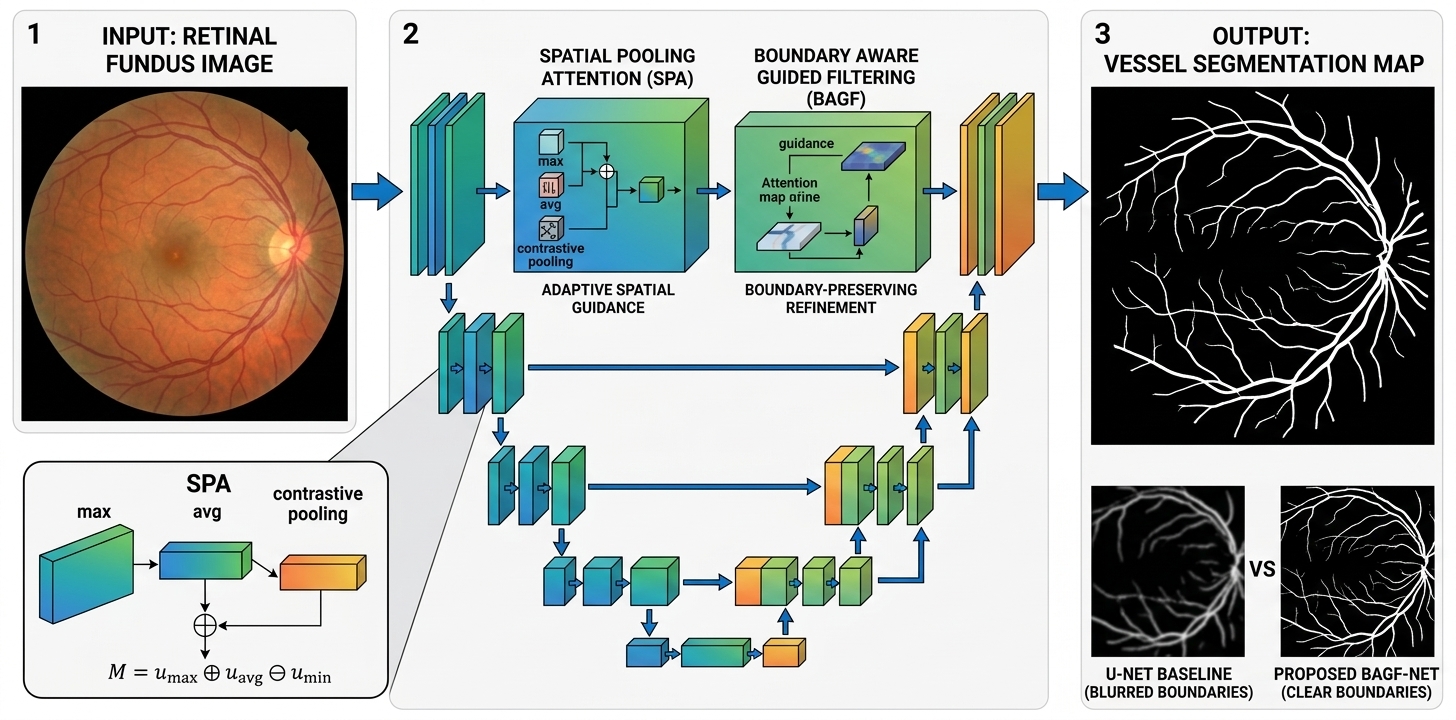
Accurate segmentation of retinal vessels is critical for the early detection of vision-threatening diseases. Although U-Net-based methods have shown strong performance, they often fail to capture thin vessels and preserve boundary details due to repeated downsampling. To overcome these limitations, we propose an enhanced U-shaped network that incorporates a multi-scale attention guided filtering module, allowing the model to retain edge details and suppress noise more effectively. Experiments conducted on the DRIVE, STARE, CHASE_DB1, and HRF datasets demonstrate that the proposed method consistently achieves the best results across multiple metrics. The improvements in F1 score and sensitivity confirm its capability to recover fine vascular structures and its potential for clinical application.
References
Liu, Z., Sunar, M. S., Tan, T. S., & Hitam, W. H. W. (2025). Deep learning for retinal vessel segmentation: A systematic review of techniques and applications. Medical & Biological Engineering & Computing, 63(8), 2191–2208.
Verma, P. K., & Kaur, J. (2024). Systematic review of retinal blood vessels segmentation based on AI-driven technique. Journal of Imaging Informatics in Medicine, 37(4), 1783–1799.
Sule, O. O. (2022). A survey of deep learning for retinal blood vessel segmentation methods: Taxonomy, trends, challenges and future directions. IEEE Access, 10, 38202–38236.
Wu, H., Wang, W., Zhong, J., Lei, B., Wen, Z., & Qin, J. (2021). SCS-Net: A scale and context sensitive network for retinal vessel segmentation. Medical Image Analysis, 70, 102025.
Li, T., Bo, W., Hu, C., Kang, H., Liu, H., Wang, K., & Fu, H. (2021). Applications of deep learning in fundus images: A review. Medical Image Analysis, 69, 101971.
Ronneberger, O., Fischer, P., & Brox, T. (2015). U-Net: Convolutional networks for biomedical image segmentation. In Medical image computing and computer-assisted intervention (MICCAI) (pp. 234–241). Springer. https://doi.org/10.1007/978-3-319-24574-4_28.
He, Y., Yi, Y., Zheng, C., & Kong, J. (2024). BGF-Net: Boundary guided filter network for medical image segmentation. Computers in Biology and Medicine, 171, 108184.
Tan, Y., Yang, K. F., Zhao, S. X., Wang, J., Liu, L., & Li, Y. J. (2024). Deep matched filtering for retinal vessel segmentation. Knowledge-Based Systems, 283, 111185.
Zhang, S., Fu, H., Yan, Y., Zhang, Y., Wu, Q., Yang, M., & Xu, Y. (2019). Attention guided network for retinal image segmentation. In Medical image computing and computer-assisted intervention (MICCAI) (pp. 797–805). Springer. https://doi.org/10.1007/978-3-030-32239-7_88.
Zhang, X., Zhao, W., Zhang, W., Peng, J., & Fan, J. (2022). Guided filter network for semantic image segmentation. IEEE Transactions on Image Processing, 31, 2695–2709.
Yin, P., Yuan, R., Cheng, Y., & Wu, Q. (2020). Deep guidance network for biomedical image segmentation. IEEE Access, 8, 116106–116116.
Jin, Q., Meng, Z., Pham, T. D., Chen, Q., Wei, L., & Su, R. (2019). DUNet: A deformable network for retinal vessel segmentation. Knowledge-Based Systems, 178, 149–162.
Wu, Y., Xia, Y., Song, Y., Zhang, Y., & Cai, W. (2020). NFN+: A novel network followed network for retinal vessel segmentation. Neural Networks, 126, 153–162.
Wei, J., Zhu, G., Fan, Z., Liu, J., Rong, Y., Mo, J., & Chen, X. (2021). Genetic U-Net: Automatically designed deep networks for retinal vessel segmentation using a genetic algorithm. IEEE Transactions on Medical Imaging, 41(2), 292–307.
Zhang, Y., He, M., Chen, Z., Hu, K., Li, X., & Gao, X. (2022). Bridge-Net: Context-involved U-Net with patch-based loss weight mapping for retinal blood vessel segmentation. Expert Systems with Applications, 195, 116526.
Jiang, M., Zhu, Y., & Zhang, X. (2024). CoVi-Net: A hybrid convolutional and vision transformer neural network for retinal vessel segmentation. Computers in Biology and Medicine, 170, 108047.
He, K., Sun, J., & Tang, X. (2012). Guided image filtering. IEEE Transactions on Pattern Analysis and Machine Intelligence, 35(6), 1397–1409.
Seo, S., Yoo, S., & Yoon, H. (2025). Full-scale representation guided network for retinal vessel segmentation. BMC Medical Imaging, 25(1), 484.
Li, J., Gao, G., Yang, L., & Liu, Y. (2024). A retinal vessel segmentation network with multiple-dimension attention and adaptive feature fusion. Computers in Biology and Medicine, 172, 108315.
Hu, J., Shen, L., & Sun, G. (2018). Squeeze-and-excitation networks. In Proceedings of the IEEE Conference on Computer Vision and Pattern Recognition (CVPR) (pp. 7132–7141). https://doi.org/10.1109/CVPR.2018.00745
Woo, S., Park, J., Lee, J. Y., & Kweon, I. S. (2018). CBAM: Convolutional block attention module. In European Conference on Computer Vision (ECCV) (pp. 3–19). https://doi.org/10.1007/978-3-030-01234-2_1.
Wang, Q., Wu, B., Zhu, P., Li, P., Zuo, W., & Hu, Q. (2020). ECA-Net: Efficient channel attention for deep convolutional neural networks. In Proceedings of the IEEE/CVF Conference on Computer Vision and Pattern Recognition (CVPR) (pp. 11534–11542).
Yu, M., Han, M., Li, X., Wei, X., Jiang, H., Chen, H., & Yu, R. (2022). Adaptive soft erasure with edge self-attention for weakly supervised semantic segmentation: Thyroid ultrasound image case study. Computers in Biology and Medicine, 144, 105347.
Fu, Y., Liu, J., & Shi, J. (2024). TSCA-Net: Transformer-based spatial-channel attention segmentation network for medical images. Computers in Biology and Medicine, 170, 107938.
Staal, J., Abràmoff, M. D., Niemeijer, M., Viergever, M. A., & van Ginneken, B. (2004). Ridge-based vessel segmentation in color images of the retina. IEEE Transactions on Medical Imaging, 23(4), 501–509.
Hoover, A., Kouznetsova, V., & Goldbaum, M. (2000). Locating blood vessels in retinal images by piecewise threshold probing of a matched filter response. IEEE Transactions on Medical Imaging, 19(3), 203–210.
Owen, C. G., Rudnicka, A. R., Mullen, R., Barman, S. A., Monekosso, D., Whincup, P. H., & Paterson, C. (2009). Measuring retinal vessel tortuosity in 10-year-old children: Validation of the CAIAR program. Investigative Ophthalmology & Visual Science, 50(5), 2004–2010.
Budai, A., Bock, R., Maier, A., Hornegger, J., & Michelson, G. (2013). Robust vessel segmentation in fundus images. International Journal of Biomedical Imaging, 2013, 154860.
Yin, P., Cai, H., & Wu, Q. (2022). DF-Net: Deep fusion network for multi-source vessel segmentation. Information Fusion, 78, 199–208.
Li, D., Peng, L., Peng, S., Xiao, H., & Zhang, Y. (2023). Retinal vessel segmentation by using AFNet. The Visual Computer, 39(5), 1929–1941.
Zhang, H., Zhong, X., Li, G., Liu, W., Liu, J., Ji, D., & Wu, J. (2023). BCU-Net: Bridging ConvNeXt and U-Net for medical image segmentation. Computers in Biology and Medicine, 159, 106960.
Panchal, S., & Kokare, M. (2024). ResMU-Net: Residual multi-kernel U-Net for blood vessel segmentation in retinal fundus images. Biomedical Signal Processing and Control, 90, 105859.
Song, P., & Wu, Y. (2025). WFL-VNet: Retinal vessel segmentation method using whole-process feature localization. Signal, Image and Video Processing, 19(5), 356.
Wang, J., Li, X., & Ma, Z. (2025). Multi-scale three-path network (MSTP-Net): A new architecture for retinal vessel segmentation. Measurement, 250, 117100.
Cao, J., Chen, J., Gu, Y., & Liu, J. (2023). MFA-UNet: A vessel segmentation method based on multi-scale feature fusion and attention module. Frontiers in Neuroscience, 17, 1249331.
Oliveira, A., Pereira, S., & Silva, C. A. (2018). Retinal vessel segmentation based on fully convolutional neural networks. Expert Systems with Applications, 112, 229–242.
Li, Z., Wang, H., Tang, N., Lan, R., Li, B., & Luo, X. (2026). A dual-layer semantic fusion network for retinal vessel segmentation. Biomedical Signal Processing and Control, 112, 108463.
Downloads
Published
Issue
Section
License
Copyright (c) 2026 zhihui liu, Mohd Shahrizal Sunar, Tian Swee tan, Hazabbah Wan Hitam wan

This work is licensed under a Creative Commons Attribution-NonCommercial 4.0 International License.