
The Effect of Carbonization Method on Local Poultry Waste-Derived Carbon as Potential Carbon Capture Adsorbent
DOI:
https://doi.org/10.11113/mjfas.v22n4.5395Keywords:
Chicken feather; Carbon material, Urea-assisted carbonization, CO2 capture; Adsorption.Abstract
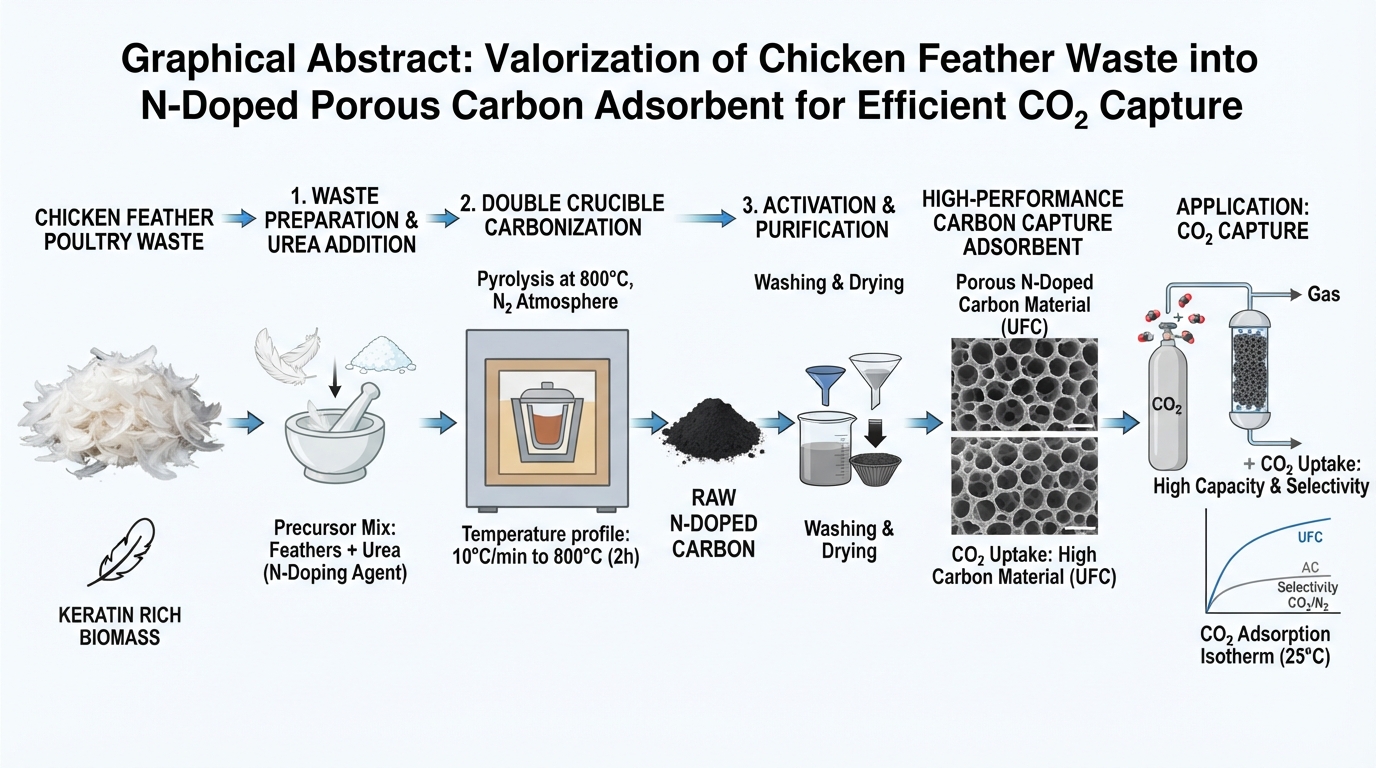
The valorisation of poultry waste into functional carbonaceous materials represents a sustainable strategy to address both waste management and environmental challenges associated with greenhouse gas emissions. In this study, chicken feathers, a keratin-rich biowaste, were utilized as a precursor for the synthesis of high-performance carbon material through urea-assisted pyrolysis using a double crucible method. Urea generates a semi-inert gaseous environment that promotes controlled thermal decomposition of the precursor during the modified carbonization process. Carbonization was carried out at three different temperatures: 650°C, 750°C, and 850°C with the same ramp rate (9°C/min) and dwell time (2 hours) to investigate the effect of urea on physicochemical properties such as the Brunauer–Emmett–Teller (BET) surface area and CO2 adsorption capacity of the resulting carbon materials. The synthesized carbon material was characterized using Carbon Hydrogen Nitrogen Sulphur (CHNS) elemental analysis to quantify the carbon content and presence of nitrogen after the usage of urea in the sample and scanning electron microscopy (SEM) to elucidate morphological transformations and pore development. The results indicated that the modified method via urea significantly influenced the surface structure and porosity, with higher pyrolysis temperatures promoting more developed microporosity and larger specific surface areas, while also modifying the distribution of mesopores. At elevated temperatures, the enhanced decomposition of urea and volatilization of unstable species facilitated pore formation and structural rearrangement, leading to more accessible adsorption sites and improved textural properties. The carbon material carbonized at 850°C for 2 h with a ramp rate of 9°C/min exhibited a CO2 adsorption capacity of 2.8 mmol g-1 at 1 bar and 273.15 K, which is comparable to that of the commercial activated carbon 3.64 mmol g-1 under the same conditions. This result suggests that the urea-modified carbon approaches the performance of commercial activated carbon, showing a significant CO2 uptake despite being derived from waste-based precursors. These findings suggest that poultry feather-derived activated carbon represents a promising low-cost and sustainable adsorbent for biogas upgrading applications, contributing to cleaner energy production and advancing circular economy practices in the Malaysian context.
References
Z. Usmani et al., “Bioprocessing of waste biomass for sustainable product development and minimizing environmental impact,” Feb. 01, 2021, Elsevier Ltd. doi: 10.1016/j.biortech.2020.124548.
A. A. Alhamidi, T. Partuti, and D. Rachmawati, “Production of Activated Carbon from Chicken Feathers As An Alternative Hydrogen Storage,” in Journal of Physics: Conference Series, Institute of Physics Publishing, Nov. 2019. doi: 10.1088/1742-6596/1376/1/012034.
Z. Mohammed, S. Jeelani, N. S. Korivi, and V. Rangari, “Synthesis and characterization of N-doped porous carbon from chicken feathers for 3D printed electrode applications,” 2022, doi: 10.21203/rs.3.rs-2230929/v1.
N. de A. Pedrosa, C. J. de Andrade, J. C. C. Petrus, and A. R. Monteiro, “Sequential hydrolysis of chicken feathers composed of ultrasound and enzymatic steps: an enhanced protein source with bioactive peptides,” Biomass, vol. 2, no. 4, pp. 237–249, 2022.
M. D. Álvarez-del-Castillo, N. Garrido-Soriano, M. Casadesús, J. Macanás, G. Molins-Duran, and F. Carrillo-Navarrete, “Environmental Impact of Chicken Feathers Based Polypropylene Composites Developed for Automotive and Stationary Applications and Comparison with Glass-Fibre Analogues,” Waste Biomass Valorization, vol. 13, no. 11, pp. 4585–4598, Nov. 2022, doi: 10.1007/s12649-022-01810-0.
N. F. Sabri, N. F. Omar, N. Z. Samsuddin, and M. A. H. Azhar, “Biodegradation of Chicken Feather Waste with Bacillus subtilis in Vermicomposting,” Pertanika J. Trop. Agric. Sci., vol. 48, no. 4, pp. 1297–1312, 2025, doi: 10.47836/pjtas.48.4.13.
M. Farhad Ali, M. Sahadat Hossain, T. Siddike Moin, S. Ahmed, and A. M. Sarwaruddin Chowdhury, “Utilization of waste chicken feather for the preparation of eco-friendly and sustainable composite,” Clean. Eng. Technol., vol. 4, no. June, pp. 4–10, 2021, doi: 10.1016/j.clet.2021.100190.
T. Tesfaye, B. Sithole, D. Ramjugernath, and V. Chunilall, “Valorisation of chicken feathers: Characterisation of chemical properties,” Waste Management, vol. 68, pp. 626–635, 2017, doi: https://doi.org/10.1016/j.wasman.2017.06.050.
T. Tesfaye, B. Sithole, and D. Ramjugernath, “Valorisation of chicken feather barbs: Utilisation in yarn production and technical textile applications,” Sustain. Chem. Pharm., vol. 8, pp. 38–49, Jun. 2018, doi: 10.1016/j.scp.2018.02.002.
R. Chiramba, G. Charis, N. Fungura, G. Danha, and T. Mamvura, “Production of activated carbon from poultry feathers for waste water treatment,” Water Science and Technology, vol. 80, no. 8, pp. 1407–1412, 2019.
Z. Zhao, Y. Wang, M. Li, and R. Yang, “High performance N-doped porous activated carbon based on chicken feather for supercapacitors and CO2 capture,” RSC Adv., vol. 5, no. 44, pp. 34803–34811, 2015, doi: 10.1039/c5ra01569c.
E. Hastuti, A. Subhan, and D. Puspitasari, “Synthesis of activated carbon derived from chicken feather for Li-ion batteries through chemical and physical activation process,” Mater. Renew. Sustain. Energy, vol. 10, no. 3, Sep. 2021, doi: 10.1007/s40243-021-00198-6.
H. M. Mahmudul, D. Akbar, M. G. Rasul, R. Narayanan, and M. Mofijur, “Estimation of the sustainable production of gaseous biofuels, generation of electricity, and reduction of greenhouse gas emissions using food waste in anaerobic digesters,” Fuel, vol. 310, p. 122346, 2022.
B. Aghel, S. Behaein, S. Wongwises, and M. S. Shadloo, “A review of recent progress in biogas upgrading: With emphasis on carbon capture,” Biomass Bioenergy, vol. 160, p. 106422, 2022.
S. F. Ahmed et al., “Biogas upgrading, economy and utilization: a review,” Environ. Chem. Lett., vol. 19, no. 6, pp. 4137–4164, 2021.
F. J. Lozano et al., “New perspectives for green and sustainable chemistry and engineering: Approaches from sustainable resource and energy use, management, and transformation,” J. Clean. Prod., vol. 172, pp. 227–232, 2018, doi: https://doi.org/10.1016/j.jclepro.2017.10.145.
M. Fauziyah, W. Widiyastuti, and H. Setyawan, “Nitrogen-Doped Carbon Aerogels Prepared by Direct Pyrolysis of Cellulose Aerogels Derived from Coir Fibers Using an Ammonia–Urea System and Their Electrocatalytic Performance toward the Oxygen Reduction Reaction,” Ind. Eng. Chem. Res., vol. 59, no. 49, pp. 21371–21382, Dec. 2020, doi: 10.1021/acs.iecr.0c03771.
M. D. Mehare, A. D. Deshmukh, and S. J. Dhoble, “Preparation of porous agro-waste-derived carbon from onion peel for supercapacitor application,” J. Mater. Sci., vol. 55, no. 10, pp. 4213–4224, 2020, doi: 10.1007/s10853-019-04236-7.
M. Luo, J. Chen, Q. Li, and Y. Wang, “Cotton-Based Activated Carbon Fiber with High Specific Surface Area Prepared by Low-Temperature Hydrothermal Carbonization with Urea Enhancement,” Ind. Eng. Chem. Res., vol. 62, no. 22, pp. 8744–8753, Jun. 2023, doi: 10.1021/acs.iecr.3c00807.
B. J. Inkson, “2 - Scanning electron microscopy (SEM) and transmission electron microscopy (TEM) for materials characterization,” in Materials Characterization Using Nondestructive Evaluation (NDE) Methods, G. Hübschen, I. Altpeter, R. Tschuncky, and H.-G. Herrmann, Eds., Woodhead Publishing, 2016, pp. 17–43. doi: https://doi.org/10.1016/B978-0-08-100040-3.00002-X.
W. Jerzak, E. Acha, and B. Li, “Comprehensive Review of Biomass Pyrolysis: Conventional and Advanced Technologies, Reactor Designs, Product Compositions and Yields, and Techno-Economic Analysis,” Energies (Basel)., vol. 17, no. 20, 2024, doi: 10.3390/en17205082.
R. Chiramba, G. Charis, N. Fungura, G. Danha, and T. Mamvura, “Production of activated carbon from poultry feathers for waste water treatment,” Water Science and Technology, vol. 80, no. 8, pp. 1407–1412, Oct. 2019, doi: 10.2166/wst.2019.388.
O. Üner and Y. Bayrak, “The effect of carbonization temperature, carbonization time and impregnation ratio on the properties of activated carbon produced from Arundo donax,” Microporous and mesoporous Materials, vol. 268, pp. 225–234, 2018.
A. O. Onokwai, E. S. A. Ajisegiri, I. P. Okokpujie, R. A. Ibikunle, M. Oki, and J. O. Dirisu, “Characterization of lignocellulose biomass based on proximate, ultimate, structural composition, and thermal analysis,” Mater. Today Proc., vol. 65, pp. 2156–2162, 2022, doi: https://doi.org/10.1016/j.matpr.2022.05.313.
S. F. Ahmed et al., “Biogas upgrading, economy and utilization: a review,” Environ. Chem. Lett., vol. 19, no. 6, pp. 4137–4164, 2021.
X. Y. Chen, H. Vinh-Thang, A. A. Ramirez, D. Rodrigue, and S. Kaliaguine, “Membrane gas separation technologies for biogas upgrading,” 2015, Royal Society of Chemistry. doi: 10.1039/c5ra00666j.
A. Rahmani-Sani et al., “Use of chicken feather and eggshell to synthesize a novel magnetized activated carbon for sorption of heavy metal ions,” Bioresour. Technol., vol. 297, Feb. 2020, doi: 10.1016/j.biortech.2019.122452.
D. J. Tarimo, K. O. Oyedotun, N. F. Sylla, A. A. Mirghni, N. M. Ndiaye, and N. Manyala, “Waste chicken bone-derived porous carbon materials as high performance electrode for supercapacitor applications,” J. Energy Storage, vol. 51, Jul. 2022, doi: 10.1016/j.est.2022.104378.
Downloads
Published
Issue
Section
License
Copyright (c) 2026 MUHAMMAD ALIF MUHAIMIN MAHASAN, MOHD HAFIZ DZARFAN OTHMAN, Mohd Zamri Mohd Yusop, Nik Ahmad Nizam Nik Malek, Mohd Hafiz Puteh, Khong Nee Koo, Yusuf Olabode Raji, Naoko Yoshida

This work is licensed under a Creative Commons Attribution-NonCommercial 4.0 International License.