
From Traditional Food to Nutraceuticals: LC-HRMS Identifies Leaves and Roots Antidiabetic Metabolites of Amaranthus spinosus L. and Amaranthus viridis L. from Buru Island (Wallacea Areas)
DOI:
https://doi.org/10.11113/mjfas.v22n1.4974Keywords:
Amaranthus, antidiabetic, in-silico, LC-HRMS, metabolomic, nutraceuticalAbstract
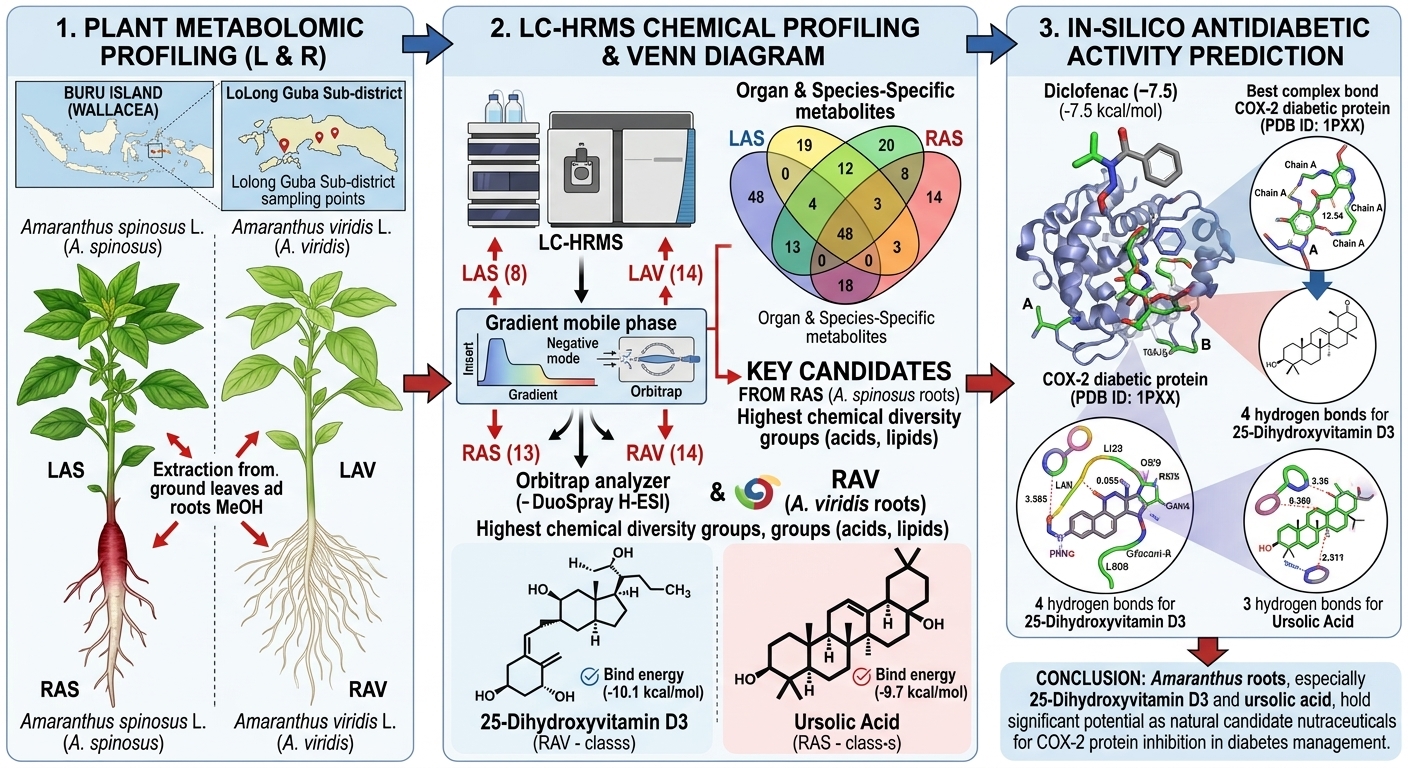
The leaves and roots of A. spinosus and A. viridis on Buru Island (Wallacea region) as antidiabetics have received little attention. The goal of this study was to identify active chemicals in the leaves and roots of these two plant species that could be used as antidiabetic nutraceuticals. The method in this research used five approaches: LC-HRMS, chemometric analysis, volcano plot, Venn diagram, and in silico. The results showed that the roots of both plant species had the highest chemical diversity, especially in the acid, lipid, and derivative groups. The specific compounds identified consisted of LAS (8), LAV, RAS (13), and RAV (14). In silico analysis indicated 25-Dihydroxyvitamin D3 and ursolic acid from the RAS sample as two of the best potential antidiabetic alternatives, with binding energies of (-10.1 kcal/mol) and (-9.7 kcal/mol) to the COX-2 protein, respectively. On the other hand, the positive control (diclofenac) showed a weaker binding energy of -7.5 kcal/mol. In conclusion, 25-Dihydroxyvitamin D3 and ursolic acid compounds have a strong inhibitory effect on COX-2 protein, indicating that they are viable natural candidates for the development of future antidiabetic therapies.
References
Jiménez-Aguilar, D. M., & Grusak, M. A. (2017). Minerals, vitamin C, phenolics, flavonoids and antioxidant activity of Amaranthus leafy vegetables. Journal of Food Composition and Analysis, 58, 33–39. https://doi.org/10.1016/j.jfca.2017.01.008.
Sarker, U., Oba, S., Ullah, R., Bari, A., Ercisli, S., Skrovankova, S., Adamkova, A., Zvonkova, M., & Mlcek, J. (2024). Nutritional and bioactive properties and antioxidant potential of Amaranthus tricolor, A. lividus, A. viridis, and A. spinosus leafy vegetables. Heliyon, 10(9), e30453. https://doi.org/10.1016/j.heliyon.2024.e30453.
Nkobole, N., & Gerhard, P. (2021). ¹H NMR and LC-MS-based metabolomics analysis of wild and cultivated Amaranthus spp. Molecules, 26(4), 795. https://doi.org/10.3390/molecules26040795.
Abdel-Moez, G., Avula, B., Sayed, H., Khalifa, A., Ross, S., Katragunta, K., Khan, I., & Mohamed, S. (2023). Phytochemical profiling of three Amaranthus species using LC-MS/MS metabolomics approach and chemometric tools. Journal of Pharmaceutical and Biomedical Analysis, 236, 115722. https://doi.org/10.1016/j.jpba.2023.115722.
Zhan, X., Chen, Z., Chen, R., & Shen, C. (2022). Environmental and genetic factors involved in plant protection-associated secondary metabolite biosynthesis pathways. Frontiers in Plant Science, 13, 877304. https://doi.org/10.3389/fpls.2022.877304.
Araujo-León, J., Pino, I., Ortíz-Andrade, R., Hidalgo-Figueroa, S., Carrera-Lanestosa, A., Brito-Argáez, L., González-Sánchez, A., Giácoman-Vallejos, G., Hernández-Abreu, O., Peraza-Sánchez, S., Xingú-López, A., & Aguilar-Hernández, V. (2024). HPLC-based metabolomic analysis and characterization of Amaranthus cruentus leaf and inflorescence extracts for their antidiabetic and antihypertensive potential. Molecules, 29, Article number not assigned. https://doi.org/10.3390/molecules29xxxx.
Prince, M., Zihad, S., Ghosh, P., Sifat, N., Rouf, R., Shajib, G., Alam, M., Shilpi, J., & Uddin, S. (2021). Amaranthus spinosus attenuated obesity-induced metabolic disorders in high-carbohydrate-high-fat diet-fed obese rats. Frontiers in Nutrition, 8, 676744. https://doi.org/10.3389/fnut.2021.676744
Sun, J., Liu, B., Rustiami, H., Xiao, H., Shen, X., & Peng, K. (2024). Mapping Asian plants: Plant diversity and a checklist of vascular plants in Indonesia. Plants, 13, Article number not assigned. https://doi.org/10.3390/plants13xxxx.
Van Welzen, P. C., Parnell, J. A. N., & Slik, J. W. F. (2011). Wallace’s line and plant distributions: Two or three phytogeographical areas and where to group Java? Biological Journal of the Linnean Society, 103(3), 531–545. https://doi.org/10.1111/j.1095-8312.2011.01647.x.
Aryal, B., Adhikari, B., Aryal, N., Bhattarai, B. R., Khadayat, K., & Parajuli, N. (2021). LC-HRMS profiling and antidiabetic, antioxidant, and antibacterial activities of Acacia catechu (L.f.) Willd. BioMed Research International, 2021, 7588711. https://doi.org/10.1155/2021/7588711.
Zengin, G., Nilofar, Yildiztugay, E., Bouyahya, A., Cavusoglu, H., Gevrenova, R., & Zheleva-Dimitrova, D. (2023). A comparative study on UHPLC-HRMS profiles and biological activities of Inula sarana different extracts and its beta-cyclodextrin complex. Antioxidants, 12(10), 1842. https://doi.org/10.3390/antiox12101842.
Statistics Buru Regency (BPS). (2024). Lolong Guba district in figures. BPS-Statistics Buru Regency.
Supriadi, A., Ridhowati, S., Saputra, D., Wulandari, W., & Lestari, S. D. (2025). Untargeted metabolomics profiling for the geographical authentication of traditional pempek using high-resolution orbitrap mass spectrometry. Food Chemistry Advances, 6, 100914. https://doi.org/10.1016/j.focha.2025.100914.
Dadwal, V., Joshi, R., & Gupta, M. (2022). A comparative metabolomic investigation in fruit sections of Citrus medica L. and Citrus maxima L. using UHPLC-QTOF-IMS. Food Research International, 157, 111486. https://doi.org/10.1016/j.foodres.2022.111486.
Daina, A., & Zoete, V. (2019). Application of the SwissDrugDesign online resources in virtual screening. International Journal of Molecular Sciences, 20(18), 4612. https://doi.org/10.3390/ijms20184612.
Mohammed, A. E., Alghamdi, S. S., Shami, A., Suliman, R. S., Aabed, K., Alotaibi, M. O., & Rahman, I. (2023). In silico prediction of Malvaviscus arboreus metabolites and green synthesis of silver nanoparticles. International Journal of Nanomedicine, 18, 2141–2162. https://doi.org/10.2147/IJN.S401097.
Selvakumaran, M., Imran, P. M., Kubaib, A., Azam, M., Basha, A. A., & Al-Resayes, S. I. (2024). Anti-inflammatory and antidiabetic activity of newly synthesized derivatives of 4AP2BOB. Journal of Molecular Liquids, 396, 123983. https://doi.org/10.1016/j.molliq.2023.123983
Banerjee, P., Kemmler, E., Dunkel, M., & Preissner, R. (2024). ProTox 3.0: A webserver for the prediction of toxicity of chemicals. Nucleic Acids Research, 52(W1), W513–W520. https://doi.org/10.1093/nar/gkae347.
Sadowska-Bartosz, I., & Bartosz, G. (2021). Biological properties and applications of betalains. Molecules, 26(9), 2520. https://doi.org/10.3390/molecules26092520.
Martinez, R. M., Melo, C. P. B., Pinto, I. C., Mendes-Pierotti, S., Vignoli, J. A., Verri, W. A., & Casagrande, R. (2024). Betalains: A narrative review on pharmacological mechanisms supporting nutraceutical potential. Foods, 13(23), 3909. https://doi.org/10.3390/foods13233909.
Wang, H., Wang, R., Harrison, S., & Prentice, I. C. (2022). Leaf morphological traits as adaptations to multiple climate gradients. Journal of Ecology, 110, 1344–1355. https://doi.org/10.1111/1365-2745.13870.
Kreszies, T., Shellakkutti, N., Osthoff, A., Yu, P., Baldauf, J. A., Zeisler-Diehl, V. V., Ranathunge, K., Hochholdinger, F., & Schreiber, L. (2019). Osmotic stress enhances suberization of apoplastic barriers in barley seminal roots. New Phytologist, 221(1), 180–194. https://doi.org/10.1111/nph.15391.
Grünhofer, P., Schreiber, L., & Kreszies, T. (2021). Suberin in monocotyledonous crop plants. In S. Mukherjee & F. Baluška (Eds.), Rhizobiology: Molecular physiology of plant roots (pp. xx–xx). Springer. https://doi.org/10.1007/978-3-030-XXXX-X.
Chen, A., Liu, T., Wang, Z., & Chen, X. (2022). Plant roots suberin: A layer of defence against biotic and abiotic stresses. Frontiers in Plant Science, 13, 1056008. https://doi.org/10.3389/fpls.2022.1056008.
Sarker, U., & Oba, S. (2019). Nutraceuticals, antioxidant pigments, and phytochemicals in the leaves of Amaranthus spinosus and Amaranthus viridis. Scientific Reports, 9, 20413. https://doi.org/10.1038/s41598-019-50923-5.
Vazquez-Leon, L. A., Paramo-Calderon, D. E., Robles-Olvera, V. J., Valdés-Rodríguez, O. A., Pérez-Vázquez, A., García-Alvarado, M. A., & Rodríguez-Jimenes, G. C. (2017). Variation in bioactive compounds and antiradical activity of Moringa oleifera leaves. European Food Research and Technology, 243, 1593–1608. https://doi.org/10.1007/s00217-017-2876-0.
Ciasa, B., Lanubile, A., Marocco, A., Pascale, M., Logrieco, A. F., & Lattanzio, V. M. T. (2020). Integrated open-source workflow for LC-HRMS plant metabolomics. Frontiers in Plant Science, 11, 111. https://doi.org/10.3389/fpls.2020.00111.
Salam, U., Ullah, S., Tang, Z., Elateeq, A., Khan, Y., Khan, J., Khan, A., & Ali, S. (2023). Plant metabolomics: Roles of primary and secondary metabolites against environmental stress factors. Life, 13, Article number not assigned. https://doi.org/10.3390/life13xxxx.
Zhang, Y., Huang, W., Zhang, C., Huang, H., Yang, S., Wang, Y., Huang, Z., Tang, Y., Li, X., Lian, H., Li, H., Zhang, F., & Sun, B. (2023). Variation in health-promoting compounds and antioxidant capacity of three leafy vegetables. Molecules, 28(12), 4780. https://doi.org/10.3390/molecules28124780.
Gargallo-Garriga, A., Preece, C., Sardans, J., Oravec, M., Urban, O., & Peñuelas, J. (2018). Root exudate metabolomes change under drought. Scientific Reports, 8, 12655. https://doi.org/10.1038/s41598-018-30956-4.
Nemadodzi, L. E., & Gudani, M. M. (2024). ^1H NMR-based metabolomics profile of green and red Amaranthus grown in open field versus greenhouse cultivation system. Metabolites, 14(1), 21. https://doi.org/10.3390/metabo14010021.
Kar, A., & Bhattacharjee, S. (2022). Exploring polyphenol-based bioactive antioxidants of underutilized herb Amaranthus spinosus L. for medicinal purposes. Journal of Exploratory Research in Pharmacology, 7(3), 151–163.
Lin, X. R., Yang, D., Wei, Y. F., Ding, D. C., Ou, H. P., & Yang, S. D. (2024). Amaranthus plants with various color phenotypes recruit different soil microorganisms in the rhizosphere. Plants, 13(16), 2200. https://doi.org/10.3390/plants13162200.
Fouad, M. S., Ghareeb, M. A., Hamed, A. A., Schwaiger, S., Stuppner, H., Halabalaki, M., Amaral, J. G., & David, J. M. (2024). Exploring the antioxidant, anticancer, and antimicrobial potential of Amaranthus viridis L. collected from Fayoum Depression: Phytochemical and biological aspects. South African Journal of Botany, 166, 297–310. https://doi.org/10.1016/j.sajb.2024.01.021.
Sampaio, B. L., Edrada-Ebel, R., & Da Costa, F. B. (2016). Effect of the environment on the secondary metabolic profile of Tithonia diversifolia: A model for environmental metabolomics of plants. Scientific Reports, 6, 29265. https://doi.org/10.1038/srep29265.
Javed, M., Akram, M., Habib, N., Tanwir, K., Ali, Q., Niazi, N. K., Gul, H., & Iqbal, N. (2017). Deciphering the growth, organic acid exudations, and ionic homeostasis of Amaranthus viridis L. and Portulaca oleracea L. under lead chloride stress. Environmental Science and Pollution Research, 25, 2958–2971. https://doi.org/10.1007/s11356-017-0631-3.
Aminu, M., & Ahmad, N. A. (2020). Complex chemical data classification and discrimination using locality preserving partial least squares discriminant analysis. ACS Omega, 5(41), 26601–26610. https://doi.org/10.1021/acsomega.0c03663.
Hamany-Djande, C. Y., Piater, L. A., Steenkamp, P. A., Tugizimana, F., & Dubery, I. A. (2021). A metabolomics approach and chemometric tools for differentiation of barley cultivars and biomarker discovery. Metabolites, 11(9), 578. https://doi.org/10.3390/metabo11090578.
Showemimo, F., Amira, J., Soyombo, M. R., & Porbeni, J. B. O. (2021). Trait selection criteria for genetic improvement of grain and leafy amaranth (Amaranthus spp.) using principal component analysis. Egyptian Journal of Agricultural Research, 99, 170–179.
Yeshitila, M., Gedebo, A., Tesfaye, B., Tugizimana, F., & Dubery, I. A. (2023). Multivariate analysis for yield and yield-related traits of amaranth genotypes from Ethiopia. Heliyon, 9(7), e18207. https://doi.org/10.1016/j.heliyon.2023.e18207.
Tan, W. N., Nagarajan, K., Lim, V., Azizi, J., Khaw, K.-Y., Tong, W. Y., Leong, C. R., & Chear, N. J. Y. (2022). Metabolomics analysis and antioxidant potential of endophytic Diaporthe fraxini ED2 grown in different culture media. Journal of Fungi, 8(5), 519. https://doi.org/10.3390/jof8050519.
Li, R., Sun, Z., Zhao, Y., Li, L., Yang, X., Cen, J., Chen, S., Li, C., & Wang, Y. (2021). Application of UHPLC-Q-TOF-MS/MS metabolomics approach to investigate the taste and nutrition changes in tilapia fillets treated with different thermal processing methods. Food Chemistry, 356, 129737. https://doi.org/10.1016/j.foodchem.2021.129737.
Windarsih, A., Rohman, A., Bakar, N. K. A., & Erwanto, Y. (2023). Metabolomics approach using LC-Orbitrap high-resolution mass spectrometry and chemometrics for authentication of beef meats from different origins in Indonesia. Sains Malaysiana, 52(10), 2869–2887.
Yu, X., Wang, Y., Yan, X., Leng, T., Xie, J., Yu, Q., & Chen, Y. (2024). Metabolomics combined with correlation analysis revealed the differences in antioxidant activities of lotus seeds with varied cultivars. Foods, 13(7), 1084. https://doi.org/10.3390/foods13071084.
Adhikari, B. (2021). Roles of alkaloids from medicinal plants in the management of diabetes mellitus. Journal of Chemistry, 2021, 20909063. https://doi.org/10.1155/2021/20909063.
Surowiak, A. K., Balcerzak, L., Lochyński, S., & Strub, D. J. (2021). Biological activity of selected natural and synthetic terpenoid lactones. International Journal of Molecular Sciences, 22(9), 5036. https://doi.org/10.3390/ijms22095036.
Behl, T., Gupta, A., Albratty, M., Najmi, A., Meraya, A. M., Alhazmi, H. A., Anwer, M. K., Bhatia, S., & Bungau, S. G. (2022). Alkaloidal phytoconstituents for diabetes management: Exploring the unrevealed potential. Molecules, 27(18), 5851. https://doi.org/10.3390/molecules27185851.
Ogawa, E., Suzuki, N., Kamiya, T., & Hara, H. (2024). Sebacic acid, a royal jelly-containing fatty acid, decreases LPS-induced IL-6 mRNA expression in differentiated human THP-1 macrophage-like cells. Journal of Clinical Biochemistry and Nutrition, 74(3), 192–198. https://doi.org/10.3164/jcbn.23-78.
Haq, I. U., Imran, M., Nadeem, M., Tufail, T., Gondal, T. A., & Mubarak, M. S. (2021). Piperine: A review of its biological effects. Phytotherapy Research, 35(2), 680–700. https://doi.org/10.1002/ptr.6855.
Liu, G., Qin, P., Cheng, X., Wu, L., Wang, R., & Gao, W. (2023). Ursolic acid: Biological functions and application in animal husbandry. Frontiers in Veterinary Science, 10, 1251248. https://doi.org/10.3389/fvets.2023.1251248.
Wang, J., Cui, J., Liu, Z., Yang, Y., Li, Z., & Liu, H. (2024). Untargeted metabolomics based on ultra-high-performance liquid chromatography coupled with quadrupole Orbitrap high-resolution mass spectrometry for differential metabolite analysis of Pinelliae Rhizoma and its adulterants. Molecules, 29(9), 2155. https://doi.org/10.3390/molecules29092155.
Correnti, S., Fanelli, G., Preianò, M., Lelli, V., Tarantino, M., Fregola, A., Bitonti, M., Chiarella, E., Timperio, A. M., Rinalducci, S., Savino, R., & Terracciano, R. (2025). Untargeted metabolomics fingerprints in seminal plasma of patients with abnormal sperm morphology using high-performance liquid chromatography and mass spectrometry. Frontiers in Molecular Biosciences, 12, 1578998. https://doi.org/10.3389/fmolb.2025.1578998.
Osmolovskaya, N., Bilova, T., Gurina, A., Orlova, A., Vu, V. D., Sukhikh, S., Zhilkina, T., Frolova, N., Tarakhovskaya, E., Kamionskaya, A., & Frolov, A. (2025). Metabolic responses of Amaranthus caudatus roots and leaves to zinc stress. Plants, 14(14), 2119. https://doi.org/10.3390/plants14142119.
Song, W., Wei, Q., Shi, Z., Pan, Y., Li, Z., & Wang, F. (2025). Integrating transcriptome and metabolomics revealed the key metabolic pathway response of Amaranthus retroflexus L. to resistance to fomesafen. PLOS ONE, 20(2), e0312198. https://doi.org/10.1371/journal.pone.0312198.
Siamey, J., Amissah, J. N., Ofori, P. A., Amoah, R. A., Mensah, E. O., & Kotey, D. A. (2025). Agro-morphological and molecular characterization of Amaranthus genotypes. PLOS ONE, 20(9), e0328567. https://doi.org/10.1371/journal.pone.0328567.
Chen, A., Liu, T., Wang, Z., & Chen, X. (2022). Plant root suberin: A layer of defence against biotic and abiotic stresses. Frontiers in Plant Science, 13, 1056008. https://doi.org/10.3389/fpls.2022.1056008.
Mehravi, S., Hanifei, M., Gholizadeh, A., & Khodadadi, M. (2023). Water deficit stress changes in physiological, biochemical, and antioxidant characteristics of anise (Pimpinella anisum L.). Plant Physiology and Biochemistry, 201, 107806. https://doi.org/10.1016/j.plaphy.2023.107806.
Hajib, A., El Harkaoui, S., Choukri, H., Khouchlaa, A., Aourabi, S., El Menyiy, N., Bouyahya, A., & Matthaeus, B. (2023). Apiaceae family: An important source of petroselinic fatty acid—Abundance, biosynthesis, chemistry, and biological properties. Biomolecules, 13(11), 1675. https://doi.org/10.3390/biom13111675.
Swarnakumari, S., Mohan, S., Sasikala, M., & Umapoorani, T. (2021). Comparative studies on Amaranthus viridis and Amaranthus spinosus. International Journal of Pharmaceutical Sciences and Research, 12(10), 5618–5623.
Sümengen Özdenefe, M., Büyükkaya Kayış, F., Erol, Ü. H., & Mercimek Takcı, A. (2024). Phytochemical screening and in vitro biological activity of Amaranthus viridis growing in Northern Cyprus. International Journal of Secondary Metabolite, 11(3), 592–603.
Hosseini, R., & Heidari, M. (2025). Impact of drought stress on biochemical and molecular responses in lavender (Lavandula angustifolia Mill.): Effects on essential oil composition and antibacterial activity. Frontiers in Plant Science, 16, Article 1405497. https://doi.org/10.3389/fpls.2025.1506660.
Leitão, A. M. F., Silva, B. R., Barbalho, E. C., Paulino, L. R. M., Costa, F. das C., Martins, F. S., & Silva, J. R. V. (2024). The role of L-carnitine in the control of oxidative stress and lipid β-oxidation during in vitro follicle growth, oocyte maturation, embryonic development, and cryopreservation: A review. Zygote, 32(5), 335–340. https://doi.org/10.1017/S096719942400039X.
Sundaresan, A., Radhiga, T., & Pugalendi, K. V. (2016). Ursolic acid and rosiglitazone combination improves insulin sensitivity by increasing skeletal muscle insulin-stimulated IRS-1 tyrosine phosphorylation in high-fat diet-fed C57BL/6J mice. Journal of Physiology and Biochemistry, 72, 345–352.
Razliqi, R. N., Ahangarpour, A., Mard, S. A., & Khorsandi, L. (2023). Gentisic acid ameliorates type 2 diabetes induced by nicotinamide–streptozotocin in male mice by attenuating pancreatic oxidative stress and inflammation through modulation of Nrf2 and NF-κB pathways. Life Sciences, 325, 121770. https://doi.org/10.1016/j.lfs.2023.121770.
Ahirwar, P., & Malik, J. K. (2021). Mechanistic insight into the antidiabetic potential of ursolic acid: In silico molecular docking. Middle East Research Journal of Pharmaceutical Sciences, 1(1), 12–23.
Marcinowska-Suchowierska, E., Kupisz-Urbańska, M., Łukaszkiewicz, J., Płudowski, P., & Jones, G. (2018). Vitamin D toxicity: A clinical perspective. Frontiers in Endocrinology, 9, 550. https://doi.org/10.3389/fendo.2018.00550.
Jurowski, K., & Frydrych, A. (2025). First toxicity profile of aminoindane-based new psychoactive substances: 2-aminoindane (2-AI, CAS: 2975-41-9) and N-methyl-2-aminoindane (NM-2-AI, CAS: 24445–44–1)—Comprehensive prediction of toxicological endpoints important from a clinical and forensic perspective using in silico multi-approach. Toxicology in Vitro, 110, 106149.
Zhi, H., Wang, Z., Zhu, X., Wu, W., Yang, L., Dai, Y., Wang, Z., Jiang, L., Tan, Y., Liu, X., & Liu, L. (2025). Chronic liver injury decreases levels of cerebral carnitine and acetylcarnitine in rats partly due to downregulation of organic cation transporters OCT1/2 and OCTN2 at the blood–brain barrier. Drug Metabolism and Disposition, 53(5), 100072. https://doi.org/10.1124/dmd.124.100072.
Yu, K. N., Nadanaciva, S., Rana, P., Lee, D. W., Ku, B., Roth, A. D., Dordick, J. S., Will, Y., & Lee, M. Y. (2018). Prediction of metabolism-induced hepatotoxicity on three-dimensional hepatic cell culture and enzyme microarrays. Archives of Toxicology, 92(3), 1295–1310. https://doi.org/10.1007/s00204 018 2199 1.
Jurowski, K., & Kobylarz, D. (2025). Toxicity assessment of the novel psychoactive substance HU-210 (Hebrew University 210; CAS: 112830–95–2): First insight into toxicophores and critical toxicity parameters using in silico methods for clinical and forensic toxicology. Toxicology Letters, 410, 39–57.
Biswas, S., Kar, A., Sharma, N., Haldar, P. K., & Mukherjee, P. K. (2021). Synergistic effect of ursolic acid and piperine in CCl₄-induced hepatotoxicity. Annals of Medicine, 53(1), 2009–2017. https://doi.org/10.1080/07853890.2021.1986284.
Khwaza, V., Oyedeji, O. O., & Aderibigbe, B. A. (2020). Ursolic acid-based derivatives as potential anticancer agents: An update. International Journal of Molecular Sciences, 21(16), 5920. https://doi.org/10.3390/ijms21165920.
Risangud, N., Jangpromma, N., Kunnaja, P., Chiranthanut, N., Daduang, S., Chansaenpak, K., & Yubolphan, R. (2025). Enhancing the therapeutic efficacy of piperine in colorectal cancer: Development and evaluation of piperine-loaded PLGA-b-PEG copolymer nanoparticles. European Journal of Pharmaceutics and Biopharmaceutics, 114796. https://doi.org/10.1016/j.ejpb.2025.114796.
Mitra, S., Anand, U., Jha, N. K., Shekhawat, M. S., Saha, S. C., Nongdam, P., Rengasamy, K. R. R., Proćków, J., & Dey, A. (2022). Anticancer applications and pharmacological properties of piperidine and piperine: A comprehensive review on molecular mechanisms and therapeutic perspectives. Frontiers in Pharmacology, 12, 772418. https://doi.org/10.3389/fphar.2021.772418.
Chauhan, A., Pathak, V. M., Yadav, M., Chauhan, R., Babu, N., Chowdhary, M., Ranjan, A., Mathkor, D. M., Haque, S., Tuli, H. S., Ramniwas, S., & Yadav, V. (2024). Role of ursolic acid in preventing gastrointestinal cancer: Recent trends and future perspectives. Frontiers in Pharmacology, 15, 1405497. https://doi.org/10.3389/fphar.2024.1405497.
Hajib, A., El Harkaoui, S., Choukri, H., Khouchlaa, A., Aourabi, S., El Menyiy, N., Bouyahya, A., & Matthaeus, B. (2023). Apiaceae family: An important source of petroselinic fatty acid—Abundance, biosynthesis, chemistry, and biological properties. Biomolecules, 13(11), 1675. https://doi.org/10.3390/biom13111675.
Marion-Letellier, R., Savoye, G., & Ghosh, S. (2016). Fatty acids, eicosanoids, and PPAR gamma. European Journal of Pharmacology, 785, 44–49. https://doi.org/10.1016/j.ejphar.2016.05.015.
Peng, Z., Ban, K., Wawrose, R. A., Gover, A. G., & Kozar, R. A. (2015). Protection by enteral glutamine is mediated by intestinal epithelial cell peroxisome proliferator–activated receptor-γ during intestinal ischemia/reperfusion. Shock, 43(4), 327–333. https://doi.org/10.1097/SHK.0000000000000294.
Hsiao, Y., Su, B.-H., & Tseng, Y. J. (2020). Current development of integrated web servers for preclinical safety and pharmacokinetics assessments in drug development. Briefings in Bioinformatics, 22(3), bbaa124. https://doi.org/10.1093/bib/bbaa124.
Michels, D., Sarah, H. E., Verkempinck, L., Van den Broeck, L., Spaepen, R., Vermeulen, K., Roelants, S., Wealleans, A., & Grauwet, T. (2025). Molecular characteristics of glycolipids determine oil–water interfacial behavior and in vitro lipid digestion kinetics. Food Research International, 202, 115714. https://doi.org/10.1016/j.foodres.2025.115714.
Rivera, Z. A. A., Talubo, N. D. D., & Cabrera, H. S. (2024). Network pharmacology and molecular docking analysis of Morinda citrifolia fruit metabolites suggest anxiety modulation through glutamatergic pathways. Life, 14(9), 1182. https://doi.org/10.3390/life14091182.
Hsiao, Y., Su, B.-H., & Tseng, Y. J. (2020). Current development of integrated web servers for preclinical safety and pharmacokinetics assessments in drug development. Briefings in Bioinformatics, 22(3), bbaa124.
Hevey, R. (2019). Strategies for the development of glycomimetic drug candidates. Pharmaceuticals, 12. https://doi.org/10.3390/ph12020055.
Li, L., Li, J., Ren, J., & Yao, J. (2025). Isorhamnetin exhibits hypoglycemic activity and targets PI3K/AKT and COX-2 pathways in type 1 diabetes. Nutrients, 17, Article 102. https://doi.org/10.3390/nu17203201.
Kondo, H., Fujimoto, K. J., Tanaka, S., Deki, H., & Nakamura, T. (2015). Theoretical prediction and experimental verification on enantioselectivity of haloacid dehalogenase L-DEX YL with chloropropionate. Chemical Physics Letters, 639, 39–44.
Rani, K., Kumari, P., Kumari, A., Mondal, D., Bisht, P., Kohal, R., Asati, V., Gupta, G., & Verma, S. (2025). Unveiling the medicinal diversity of benzoic acid–containing molecules: Insights on druggable targets for type 2 diabetes mellitus. Bioorganic & Medicinal Chemistry, 128, 118245.
Liu, Y., Xie, J., Shi, Q., Gong, Q., & Qin, C. (2025). The effects of dietary supplementation with 25-hydroxyvitamin D₃ on the antioxidant capacity and inflammatory responses of Pelteobagrus fulvidraco. Biology, 14, Article 112.
Kashyap, D., Sharma, A., Tuli, H. S., Punia, S., & Sharma, A. (2016). Ursolic acid and oleanolic acid: Pentacyclic terpenoids with promising anti-inflammatory activities. Recent Patents on Inflammation & Allergy Drug Discovery, 10(1), 21–33.
Liu, C., Yuan, Y., Zhou, J., Hu, R., Ji, L., & Jiang, G. (2020). Piperine ameliorates insulin resistance via inhibiting metabolic inflammation in monosodium glutamate-treated obese mice. BMC Endocrine Disorders, 20, 44.
Nurjanah, S., Gerding, A., Vieira-Lara, M., Evers, B., Langelaar-Makkinje, M., Spiekerkoetter, U., Bakker, B., & Tucci, S. (2023). Heptanoate improves compensatory mechanism of glucose homeostasis in mitochondrial long-chain fatty acid oxidation defect. Nutrients, 15, 3649.
Ramírez, D., & Caballero, J. (2018). Is it reliable to take the molecular docking top-scoring position as the best solution without considering available structural data? Molecules, 23, 1038.
Tsujimura, M., Ishikita, H., & Saito, K. (2025). Determinants of hydrogen bond distances in proteins. Physical Chemistry Chemical Physics, Advance online publication.
Qi, H., & Kulik, H. J. (2019). Evaluating unexpectedly short noncovalent distances in X-ray crystal structures of proteins with electronic structure analysis. Journal of Chemical Information and Modeling, 59(5), 2199–2211. https://doi.org/10.1021/acs.jcim.9b00144.
Vaidyanathan, R., Sreedevi, S., Ravichandran, K., Vinod, S., Krishnan, Y., Babu, L., Parthiban, P., Basker, L., Perumal, T., Rajaraman, V., Arumugam, G., Rajendran, K., & Mahalingam, V. (2023). Molecular docking approach on the binding stability of derivatives of phenolic acids (DPAs) with human serum albumin (HSA): Hydrogen bonding versus hydrophobic interactions or combined influences? JCIS Open, 11, 100074.
Downloads
Published
Issue
Section
License
Copyright (c) 2026 Sri Wahyuningsih, Bambang Rentoaji, Rarastoeti Pratiwi, L. Hartanto Nugroho

This work is licensed under a Creative Commons Attribution-NonCommercial 4.0 International License.