
Scanner-Induced Variability in Multicenter PET Radiomics: Comparative Evaluation of Interpolation Methods and ComBat Harmonization
DOI:
https://doi.org/10.11113/mjfas.v22n1.4971Keywords:
Radiomics, [18F]-FDG PET Images, Interpolation Methods, ComBat Harmonization, VariabilityAbstract
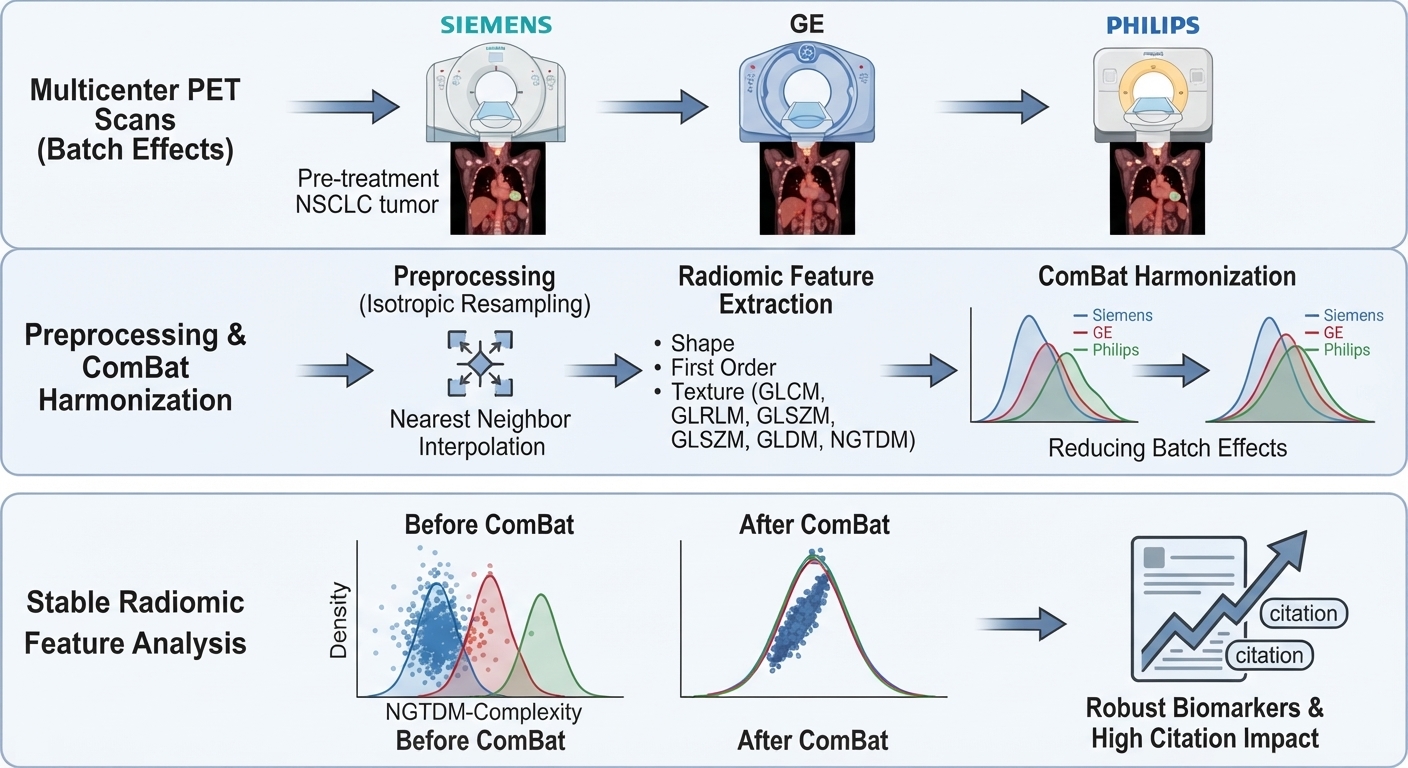
This study aimed to systematically evaluate scanner-induced variability in radiomic features extracted from multicenter [18F]-FDG PET scanners (Siemens, Philips, and GE) and to determine which interpolation method, when combined with ComBat harmonization, most effectively reduces feature variability across scanners. Pre-treated [¹⁸F]-FDG PET scans from 167 stage IIB/III NSCLC patients were obtained from The Cancer Imaging Archive (ACRIN 6668/RTOG 0235 trial). Primary tumors were delineated semi-automatically. The images and masks were resampled into isotropic voxel sizes of 0.5 × 0.5 × 0.5 mm³ using three interpolation methods, namely B-spline, Gaussian, and Nearest Neighbor. A total of 105 radiomic features were extracted. ComBat harmonization was applied to correct for batch effects between scanners. Statistical analysis included the Kruskal–Wallis test, effect size ε², and coefficient of variation (CV) to evaluate variability between scanners before and after ComBat harmonization. ComBat harmonization consistently reduced the variability of radiomic features that emerge from scanner differences. After ComBat harmonization, the Nearest Neighbor interpolation method demonstrated the best performance compared with the B-spline and Gaussian methods. Only 1 out of 105 radiomic features (~0.95%) remained a p-value < 0.05, while approximately 95 of 105 features (90.5%) had CV < 10%. The Nearest Neighbor method also produced the lowest average CV value compared to the B-spline and Gaussian. Radiomic features extracted from different types of scanners can increase radiomic feature variability. The use of Nearest Neighbor interpolation with ComBat harmonization is more effective in reducing radiomic feature variability between different scanners.
References
Kothari, G. (2022). Role of radiomics in predicting immunotherapy response. Journal of Medical Imaging and Radiation Oncology, 66(4), 575–591. https://doi.org/10.1111/1754-9485.13426.
Lambin, P., Rios-Velazquez, E., Leijenaar, R., Carvalho, S., van Stiphout, R. G., Granton, P., … Dekker, A. (2012). Radiomics: Extracting more information from medical images using advanced feature analysis. European Journal of Cancer, 48(4), 441–446. https://doi.org/10.1016/j.ejca.2011.11.036.
Lambin, P., Leijenaar, R. T., Deist, T. M., Peerlings, J., de Jong, E. E., van Timmeren, J., … van Elmpt, W. (2017). Radiomics: The bridge between medical imaging and personalized medicine. Nature Reviews Clinical Oncology, 14(12), 749–762. https://doi.org/10.1038/nrclinonc.2017.141.
Aujay, G., Ahmadi, M., Mokrane, F. Z., Dewaraja, Y., & Kikinis, R. (2022). Comparison of MRI-based response criteria and radiomics for the prediction of early response to transarterial radioembolization in patients with hepatocellular carcinoma. Diagnostic and Interventional Imaging, 103(7–8), 360–366. https://doi.org/10.1016/j.diii.2022.01.009.
Huang, X., Liu, Z., Chen, J., & Li, Y. (2023). Perihematomal edema-based CT-radiomics model to predict functional outcome in patients with intracerebral hemorrhage. Diagnostic and Interventional Imaging, 104(9), 391–400. https://doi.org/10.1016/j.diii.2023.04.008.
Javed, A. A., Khan, A., Liu, Y., & Zhang, X. (2023). Accurate non-invasive grading of nonfunctional pancreatic neuroendocrine tumors with a CT derived radiomics signature. Diagnostic and Interventional Imaging, 105(1), 33–39. https://doi.org/10.1016/j.diii.2023.08.002.
Long, L., Wang, X., Zhang, H., & Li, Y. (2021). MRI-based traditional radiomics and computer-vision nomogram for predicting lymphovascular space invasion in endometrial carcinoma. Diagnostic and Interventional Imaging, 102(7–8), 455–462. https://doi.org/10.1016/j.diii.2021.02.008.
Ikushima, K., Arimura, H., Yasumatsu, R., Kamezawa, H., & Ninomiya, K. (2023). Topology-based radiomic features for prediction of parotid gland cancer malignancy grade in magnetic resonance images. Magnetic Resonance Materials in Physics, Biology and Medicine, 36(5), 767–777. https://doi.org/10.1007/s10334-023-01084-0.
Mattonen, S. A., Palma, D., Law, M., & Hope, A. (2019). [18F] FDG positron emission tomography (PET) tumor and penumbra imaging features predict recurrence in non–small cell lung cancer. Tomography, 5(1), 145–153. https://doi.org/10.18383/j.tom.2018.00026.
Haider, S. P., Burtness, B., Yarbrough, W. G., & Payabvash, S. (2020). Applications of radiomics in precision diagnosis, prognostication and treatment planning of head and neck squamous cell carcinomas. Cancers of the Head & Neck, 5(1). https://doi.org/10.1186/s41199-020-00053-7.
Ventura, D., Barletta, A., Conti, S., & Garassino, M. C. (2023). Radiomics of tumor heterogeneity in 18F-FDG-PET-CT for predicting response to immune checkpoint inhibition in therapy-naïve patients with advanced non-small-cell lung cancer. Cancers, 15(8), 2297. https://doi.org/10.3390/cancers15082297.
Whybra, P., Parkinson, C., Foley, K., Staffurth, J., & Spezi, E. (2019). Assessing radiomic feature robustness to interpolation in 18F-FDG PET imaging. Scientific Reports, 9(1), 1–10. https://doi.org/10.1038/s41598-019-46030-0.
Hosseini, S. A., Shiri, I., Hajianfar, G., Ghafarian, P., Karam, M. B., & Ay, M. R. (2021). The impact of preprocessing on the PET-CT radiomics features in non-small cell lung cancer. Frontiers in Biomedical Technology, 8(4), 261–272. https://doi.org/10.18502/fbt.v8i4.7754.
Ligero, M., Lope, V., González, B., & Dapena, J. (2021). Minimizing acquisition-related radiomics variability by image resampling and batch effect correction to allow for large-scale data analysis. European Radiology, 31(3), 1460–1470. https://doi.org/10.1007/s00330-020-07174-0.
Ramlee, S., Manavaki, R., Aloj, L., & Sanchez, L. E. (2024). Mitigating the impact of image processing variations on tumour [18F]-FDG-PET radiomic feature robustness. Scientific Reports, 14(1). https://doi.org/10.1038/s41598-024-67239-8.
Shafiq-Ul-Hassan, M., Latifi, K., Zhang, G., Ullah, G., Gillies, R., & Moros, E. (2018). Voxel size and gray level normalization of CT radiomic features in lung cancer. Scientific Reports, 8(1), 1–9. https://doi.org/10.1038/s41598-018-28895-9.
Fortin, J.-P., Cullen, N., Sheline, Y. I., Taylor, W. D., Aselcioglu, I., Cook, P. A., … Shinohara, R. T. (2017). Harmonization of cortical thickness measurements across scanners and sites. NeuroImage, 167, 104–120. https://doi.org/10.1016/j.neuroimage.2017.11.024.
Du, D., Smith, J., Lee, C., & Zhao, Y. (2025). Impact of harmonization and oversampling methods on radiomics analysis of multi-center imbalanced datasets: Application to PET-based prediction of lung cancer subtypes. EJNMMI Physics, 12(1). https://doi.org/10.1186/s40658-025-00750-7.
Zounek, A. J., Hall, A., Smith, K., & Johnson, P. (2023). Feasibility of radiomic feature harmonization for pooling of [18F]FET or [18F]GE-180 PET images of gliomas. Zeitschrift für Medizinische Physik, 33(1), 91–102. https://doi.org/10.1016/j.zemedi.2022.12.005.
Horng, H., Lin, Y., & Chang, C. (2022). Improved generalized ComBat methods for harmonization of radiomic features. Scientific Reports, 12(1), 1–11. https://doi.org/10.1038/s41598-022-23328-0.
Kinahan, P., Muzi, M., Bialecki, B., Herman, B., & Coombs, L. (2019). Data from the ACRIN 6668 Trial NSCLC-FDG-PET (Version 2) [Data set]. The Cancer Imaging Archive. https://doi.org/10.7937/tcia.2019.30ilqfcl.
Beichel, R. R., Bauer, C., Deistung, A., Meinzer, H.-P., & Shackleford, J. (2016). Semiautomated segmentation of head and neck cancers in 18F-FDG PET scans: A just-enough-interaction approach. Medical Physics, 43(6), 2948–2964. https://doi.org/10.1118/1.4948679.
Zwanenburg, A., Leger, S., Vallières, M., & Löck, S. (2016). Image biomarker standardisation initiative - feature definitions. arXiv. https://arxiv.org/pdf/1612.07003.pdf.
Leijenaar, R. T. H., Carvalho, S., Velazquez, E. R., Van Elmpt, W., Dekker, A., … Lambin, P. (2015). The effect of SUV discretization in quantitative FDG-PET radiomics: The need for standardized methodology in tumor texture analysis. Scientific Reports, 5, 11075. https://doi.org/10.1038/srep11075.
Van Griethuysen, J. J. M., Fedorov, A., Parmar, C., Hosny, A., Aucoin, N., Narayan, V., … Aerts, H. J. W. L. (2017). Computational radiomics system to decode the radiographic phenotype. Cancer Research, 77(21), e104–e107. https://doi.org/10.1158/0008-5472.CAN-17-0339.
Priya, S., Kumar, P., & Sharma, R. (2023). ComBat harmonization of myocardial radiomic features sensitive to cardiac MRI acquisition parameters. Radiology: Cardiothoracic Imaging, 5(4). https://doi.org/10.1148/ryct.220312.
Tassi, E., Casanova, R., & Varoquaux, G. (2024). Assessment of ComBat harmonization performance on structural magnetic resonance imaging measurements. Human Brain Mapping, 45(18). https://doi.org/10.1002/hbm.70085.
Torbati, M. E., Chou, Y.-H., & Gholipour, A. (2021). A multi-scanner neuroimaging data harmonization using RAVEL and ComBat. NeuroImage, 245, 118703. https://doi.org/10.1016/j.neuroimage.2021.118703.
Cabini, R. F., Rossi, C., & Romano, A. (2022). Preliminary report on harmonization of features extraction process using the ComBat tool in the multi-center ‘Blue Sky Radiomics’ study on stage III unresectable NSCLC. Insights into Imaging, 13(1), 1–9. https://doi.org/10.1186/s13244-022-01171-1.
Yu, H., Li, Z., & Zhang, Y. (2024). Quantifying the reproducibility and longitudinal repeatability of radiomics features in magnetic resonance image-guided accelerator imaging: A phantom study. European Journal of Radiology, 181, 111735. https://doi.org/10.1016/j.ejrad.2024.111735.
Orlhac, F., Frouin, F., Nioche, C., Ayache, N., & Buvat, I. (2022). A guide to ComBat harmonization of imaging biomarkers in multicenter studies. Journal of Nuclear Medicine, 63(2), 263–270. https://doi.org/10.2967/jnumed.121.262464.
Khodabakhshi, Z., Gabrys, H., Wallimann, P., Guckenberger, M., Andratschke, N., & Tanadini-Lang, S. (2024). Magnetic resonance imaging radiomic features stability in brain metastases: Impact of image preprocessing, image-, and feature-level harmonization. Physics in Imaging and Radiation Oncology, 30, 100585. https://doi.org/10.1016/j.phro.2024.100585.
Duron, L., Savatovsky, J., Fournier, L., & Lecler, A. (2021). Can we use radiomics in ultrasound imaging? Impact of preprocessing on feature repeatability. Diagnostic and Interventional Imaging, 102(11), 659–667. https://doi.org/10.1016/j.diii.2021.10.004.
Kallos-Balogh, P., Lambrecht, M., Notghi, A., & Lerch, S. (2024). Multicentric study on the reproducibility and robustness of PET-based radiomics features with a realistic activity painting phantom. PLoS ONE, 19(10), e0309540. https://doi.org/10.1371/journal.pone.0309540.
Downloads
Published
Issue
Section
License
Copyright (c) 2026 Vepy Asyana, Mohammad Haekal, Nila Prasetya Aryani, Deni Hardiansyah, Abdul Waris, Dr. rer. nat Freddy Haryanto

This work is licensed under a Creative Commons Attribution-NonCommercial 4.0 International License.