
Lung Cancer Classification Based on a Small Dataset of X-Ray Images Using Transfer Learning Deep Boltzmann Machine
DOI:
https://doi.org/10.11113/mjfas.v21n6.4521Keywords:
Classification, DBM, Transfer Learning, Lung Cancer, X-rayAbstract
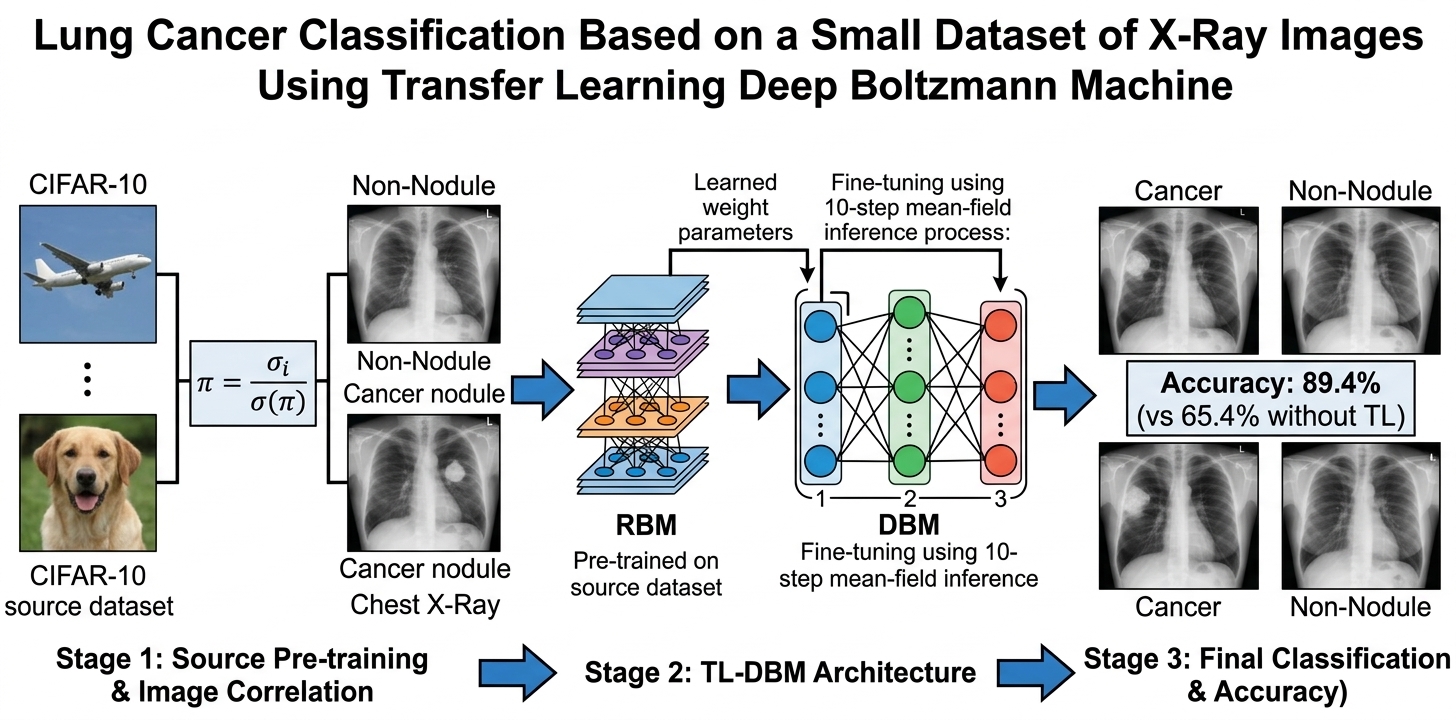
Deep learning has shown significant potential in medical image classification; however, its effectiveness is often limited by the need for large, labeled datasets. In the context of lung cancer detection via X-ray images, the scarcity of annotated data poses a major challenge. This study introduces a Transfer Learning approach integrated with Deep Boltzmann Machines (TL-DBM) to address this limitation. Publicly available datasets such as MNIST and CIFAR-10 were leveraged to pre-train the DBM model, extracting transferable parameters for further training on chest X-ray images. The statistical correlation between source and target images and mean-field inference iterations during training assessed and adjusted to improve performance. Our experiments reveal that using CIFAR-10 source data—specifically airplane and dog categories—and applying a 10-step mean-field process yields the highest classification accuracy of 89.4%, compared to 65.4% without transfer learning. These findings suggest that TL-DBM offers an effective strategy for lung cancer image classification in data-constrained settings.
References
Ait Nasser, I., Mahfoudhi, E., Trabelsi, D., & Bouhlel, M. S. (2023). Deep learning for pneumonia detection from chest X-ray images: A comprehensive review. Medical Image Analysis, 87, 102825.
Krizhevsky, A., Nair, V., & Hinton, G. (n.d.). CIFAR-10 dataset. https://www.cs.toronto.edu/~kriz/cifar.html.
Bengio, Y. (2009). Learning deep architectures for AI. Foundations and Trends in Machine Learning, 2(1), 1–127.
Bengio, Y., Lamblin, P., Popovici, P., & Larochelle, H. (2007). Greedy layer-wise training of deep networks. Advances in Neural Information Processing Systems 19, MIT Press.
Deng, L. (2012). The MNIST database of handwritten digit images for machine learning research. IEEE Signal Processing Magazine, 29(6), 141–142.
Eertink, J. J., Dagnelie, P. C., van der Velden, J. M., Zwezerijnen, B. G., et al. (2022). External validation: a simulation study to compare cross-validation, hold-out validation, and small test sets. Journal of Evaluation in Clinical Practice, 28(5), 1031–1041.
Hinton, G. E., Osindero, S., & Teh, Y. W. (2006). A fast learning algorithm for deep belief nets. Neural Computation, 18, 1527–1554.
Hussain, L., Nguyen, T., Li, H., Abbasi, A. A., Lone, K. J., Zhao, Z., & Chen, M. (2020). A rapid AI-based COVID-19 diagnostic system using chest X-ray images. BioMedical Engineering OnLine, 19, 1–12.
Jensen, A. R., Mainz, J., & Overgaard, J. (2002). Impact of delay on diagnosis and treatment of primary lung cancer. Acta Oncologica, 41(2), 147–152.
Litjens, G., Kooi, T., Bejnordi, B. E., Setio, A. A. A., Ciompi, F., Ghafoorian, M., van der Laak, J. A. W. M., van Ginneken, B., & Sánchez, C. I. (2017). A survey on deep learning in medical image analysis. Medical Image Analysis, 42, 60–88.
Najafabadi, M. M., Villanustre, F., Khoshgoftaar, T. M., Seliya, N., Wald, R., & Muharemagic, E. (2015). Deep learning applications and challenges in big data analytics. Journal of Big Data, 2(1), 1–21.
Pan, S. J., & Yang, Q. (2010). A survey on transfer learning. IEEE Transactions on Knowledge and Data Engineering, 22(10), 1345–1359.
Raghu, M., Zhang, C., Kleinberg, J., & Bengio, S. (2019). Transfusion: Understanding transfer learning for medical imaging. Advances in Neural Information Processing Systems (NeurIPS), 32.
Ranzato, M., Krizhevsky, A., & Hinton, G. (2010). Factored 3-way Restricted Boltzmann Machines for modeling natural images. In Proceedings of the Thirteenth International Conference on Artificial Intelligence and Statistics (AISTATS), 621–628.
Salakhutdinov, R., & Larochelle, H. (2010). Efficient learning of deep Boltzmann machines. In Proceedings of the Thirteenth International Conference on Artificial Intelligence and Statistics (AISTATS), 693–700. JMLR Workshop and Conference Proceedings.
Shen, D., Wu, G., & Suk, H. I. (2017). Deep learning in medical image analysis. Annual Review of Biomedical Engineering, 19, 221–248.
Shiraishi, J., Katsuragawa, S., Ikezoe, J., et al. (2000). Development of a digital image database for chest radiographs with and without a lung nodule: Receiver operating characteristic analysis of radiologists’ detection of pulmonary nodules. AJR American Journal of Roentgenology, 174, 71–74.
Srivastava, N., & Salakhutdinov, R. (2012). Multimodal learning with deep Boltzmann machines. Advances in Neural Information Processing Systems (NeurIPS), 25, 2222–2230.
Sung, H., Ferlay, J., Siegel, R.L., Laversanne, M., Soerjomataram, I., Jemal, A., & Bray, F. (2021). Global cancer statistics 2020: GLOBOCAN estimates of incidence and mortality worldwide for 36 cancers in 185 countries. CA: A Cancer Journal for Clinicians, 71(3), 209–249.
Torrey, L., & Shavlik, J. (2010). Transfer learning. In Handbook of Research on Machine Learning Applications and Trends: Algorithms, Methods, and Techniques (pp. 242–264). IGI Global.
Willemink, M. J., Koszek, W. A., Hardell, C., Wu, J., Fleischmann, D., Harvey, H., … Lungren, M. P. (2020). Preparing medical imaging data for machine learning. Radiology, 295(1), 4–15.
Downloads
Published
Issue
Section
License
Copyright (c) 2025 Fauzia Puspa Lestari, Dr.rer.nat Freddy Haryanto, Sparisoma Viridi, Mohammad Haekal, Idam Arif

This work is licensed under a Creative Commons Attribution-NonCommercial 4.0 International License.