
Integration of ATR-FTIR Spectroscopy and Machine Learning for Age Prediction Model of Black Gel Pen Inks
DOI:
https://doi.org/10.11113/mjfas.v22n2.4879Keywords:
Ink ageing, ATR-FTIR spectroscopy, black gel inks, forensic document examination, machine learning, non-destructive analysisAbstract
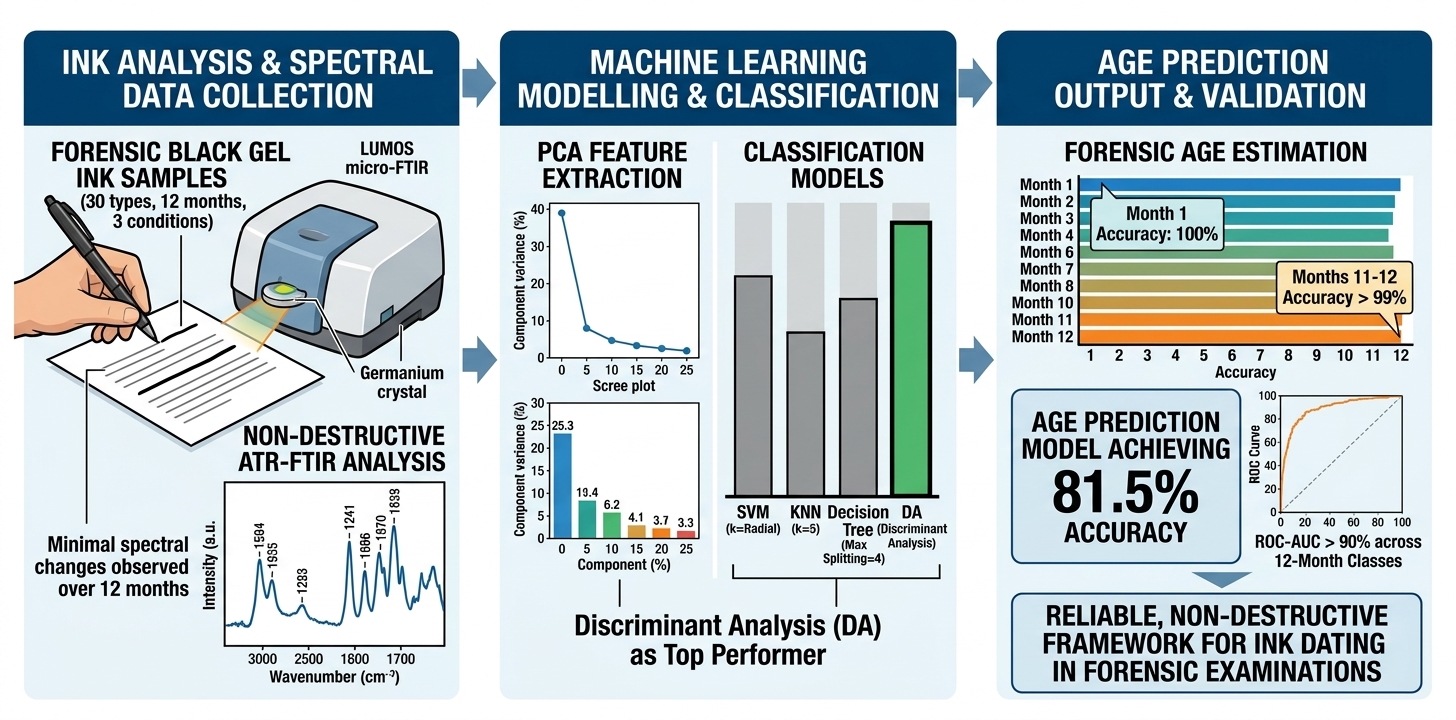
Ink analysis provides a crucial function in forensic document examination for authentication, forgery detection, and ink dating. Today, black gel inks are widely used in both legal and non-legal documents, however they are difficult to analyse due to their pigment formulations, which undergo subtle chemical changes during ageing. Destructive techniques such as Thin Layer Chromatography (TLC) and High-Performance Liquid Chromatography (HPLC) can discriminate ink but are unsuitable for evidentiary purposes. Non-destructive Attenuated Total Reflectance-Fourier Transform infrared (ATR-FTIR) spectroscopy offers an alternative, yet spectral similarities among black gel inks necessitate advanced computational models to facilitate discrimination, classification and age prediction. In this study, predictive ageing models for black gel inks was developed by integrating ATR-FTIR spectroscopy with machine learning (ML). Thirty black gel inks from 23 brands were analysed. Ink lines made using the black gel ink samples were aged for twelve months under three different environmental conditions, and their infrared (IR) spectral data were recorded monthly over the period of 12 months. For age prediction, four classifiers namely Discriminant Analysis(DA), Support Vector Machine(SVM), k-Nearest Neighbour (kNN), and Decision Tree(DT) were trained on full mid-IR, fingerprint region, and PCA (Principal Component Analysis)-derived datasets. Performances of the classifiers were evaluated using accuracy, precision, recall, F1-score, ROC (Receiver Operating Characteristics), and Area Under the Curve (AUC). For age prediction, DA achieved the best accuracy (81.5%) with PCA features, outperforming SVM (76.1%), kNN (48.8%), and DT (40.2%). ROC-AUC values exceeded 90% across all classes. This study demonstrates that ATR-FTIR spectroscopy integrated with machine learning provides a reliable, non -destructive framework for black gel ink classification and age prediction, addressing limitations of destructive methods and strengthening forensic document analysis
References
Gawad, A. A., Salama, T. M., Meshref, M., Mohamed, G. G., & Zedan, A. F. (2022). Coupling ATR-FTIR spectroscopy and chemometric analysis for rapid and non-destructive ink discrimination of forensic documents. Egyptian Journal of Chemistry, 65(8),167–179. https://doi: 10.21608/ejchem.2022.105668.4865.
Khofar, P. N. A., Karim, U. K. A., Elias, E., Safian, M. F., & Halim, M. I. A. (2022). Trends of forensic analysis of pen ink using attenuated total feflectance Fourier transform infrared (ATR-FTIR) spectroscopy. Indonesian Journal of Chemistry, 22(4),1144–1154. https://doi: 10.22146/ijc.72282.
Sharma, V., & Kumar, R. (2017). Fourier transform infrared spectroscopy and high performance thin layer chromatography for characterization and multivariate discrimination of blue ballpoint pen ink for forensic applications. Vibrational Spectroscopy, 92, 96–104. https://doi: 10.1016/j.vibspec.2017.05.006.
Sharma, S., Garg, D., Chophi, R., & Singh, R. (2021). On the spectroscopic investigation of stamp inks using ATR-FTIR and chemometrics: application in forensic document examination. Forensic Chemistry, 26, 100377. https://doi: 10.1016/j.forc.2021.100377.
Ortiz-Herrero, L., Alonso, M. L., García-Ruiz, C., Alonso, R. M., & Bartolomé, L. (2020). A novel, non-invasive, multi-purpose and comprehensive method to date inks in real handwritten documents based on the monitoring of the dye ageing processes. Chemometrics and Intelligent Laboratory Systems, 27, 104187. https://doi: 10.1016/j.chemolab.2020.104187.
Boonna, P., Chaiwan, C., Deepaisarn, S., Simanon, N., Reamtong, O., & Butkinaree, C. (2021). Implementing machine learning methods for ballpoint pen ink classification based on mass spectrometry data: Toward a forensic application. 18th International Joint Conference on Computer Science and Software Engineering: Cybernetics for Human Beings. https://doi: 10.1109/JCSSE53117.2021.9493823.
Asri, M. N. M. (2022). Novel insight in forensic chemistry: chemometrics analysis of self-organizing feature map (SOFM) and Raman spectroscopy. Thesis of Doctor of Philosophy. Universiti Sains Malaysia.
López-Baldomero, A. B., Buzzelli, M., Moronta-Montero, F., Martínez-Domingo, M. A., & Valero, E. M. (2025). Ink classification in historical documents using hyperspectral imaging and machine learning methods. Spectrochimica Acta - Part A: Molecular and Biomolecular Spectroscopy, 335, 125916. https://doi: 10.1016/j.saa.2025.125916.
Mokari, A., Guo, S., & Bocklitz, T. (2023). Exploring the steps of infrared (IR) spectral analysis: Pre-Processing, (classical) data modelling, and deep Learning. Molecules, 28(19),1–21. https:// doi: 10.3390/molecules28196886.
Yang, S. (2022). Research on ink speed recognition method of hyperspectral imaging ink pad based on machine Learning. Proceedings - 2022 International Conference on 3D Immersion, Interaction and Multi-Sensory Experiences, ICDIIME. https://doi: 10.1109/ICDIIME56946.2022.00013.
Rincón-López, J., Álvarez-Valdés, E., Velez-Arango, D., Rojas Zuleta, E., Soto, L. Y. V., Lellesch, L., Londoño, V. A. G., Rosero-Moreano, M., & Taborda-Ocampo, G. (2025). Versatile machine learning algorithms for FTIR spectroscopy: differentiating crosslinked and non-crosslinked gelatin samples. Discover Sustainability, 6,536. http://doi: 10.1007/s43621-025-01146-4.
Mienye, I. D., & Jere, N. (2024). A survey of decision trees: concepts, algorithms, and applications. IEEE Access, 12, 1. https://doi: 10.1109/ACCESS.2024.3416838.
Lee, Y. J., Won, S. Y., Park, S. B., & Kim, H. J. (2024). Chemometric approaches for discriminating manufacturers of Korean handmade paper using infrared spectroscopy. Heritage Science, 12, 373. https://doi: 10.1186/s40494-024-01460-6.
Gautam, R., Chauhan, R., Kumar, R., & and Sharma, V. (2021). PLS-DA and infrared spectroscopy based rapid and non-destructive discrimination of black ball and gel pen inks for forensic application. Forensic Science International: Reports, 3, 100162. https://doi: 10.1016/j.fsir.2020.100162.
Said, H. M., & Ismail, D. (2018). Study on the effect of ageing to gel pen ink on papers using attenuated reflectant mode Fourier transform infrared (ATR-FTIR) spectroscopy. The International Journal of Medicine and Sciences, 3(1), 38–43.
Sauzier, G., McGann, J., Lewis, S. W., & van Bronswijk, W. (2018). A study into the ageing and dating of blue ball tip inks on paper using in situ visible spectroscopy with chemometrics. Analytical Methods, 10(47). https://doi: 10.1039/C8AY01418C.
Cantu, A.A. (2012). A study of the evaporation of a solvent from a solution-application to writing ink aging. Forensic Science International, 219(1-3), 119-128. https://doi:10.1016/j.forsciint.2011.008
Hoang, A. D., Tu, M. B., Ta, T. T., & Hoang, M. H. (2021). Combination of a green and traditional method for estimating relative and absolute ink age: a case study of ballpoint pen ink dating in Vietnam. Journal of Analytical Methods in Chemistry, 34055448. https://doi.10.1155/2021/887054
Merrimo, S., Chandra, D., Borowczak, M., Dhinojwala, A., & Benko, D. (2022). Simultaneous determination of additive concentration in rubber using ATR-FTIR spectroscopy. Spectrochimica Acta Part A: Molecular and Biomolecular Spectroscopy, 281, 121614.
Sugawara, S. (2022). Comparison of preprocessing and machine learning methods for identifying writing inks using mid-infrared hyperspectral imaging and machine learning. Infrared Physics and Technology, 127, 104357. https://doi: 10.1016/j.infrared.2022.104357.
Silva, C. S., Borba, F. S. L., Pimentel, M. F., Pontes, M. J. C., R. S. Honorato, R. S., & C. Pasquini, C. (2013). Classification of blue pen ink using infrared spectroscopy and linear discriminant analysis. Microchemical Journal, 109, 122–127. https://doi: 10.1016/j.microc.2012.03.025.
Downloads
Published
Issue
Section
License
Copyright (c) 2026 Dzulkiflee Ismail, Wan Nur Syuhaila Mat Desa, Nur Atiqah Zaharulill, Nik Fakhuruddin Nik Hassan

This work is licensed under a Creative Commons Attribution-NonCommercial 4.0 International License.