
Characterization of Ground Penetrating Radar Reflection Patterns in the Peatlands of Kubu Raya Regency, Indonesia
DOI:
https://doi.org/10.11113/mjfas.v22n2.4863Keywords:
Dielectric Contrast, Ground Penetrating Radar, Peatland, Reflection PatternsAbstract
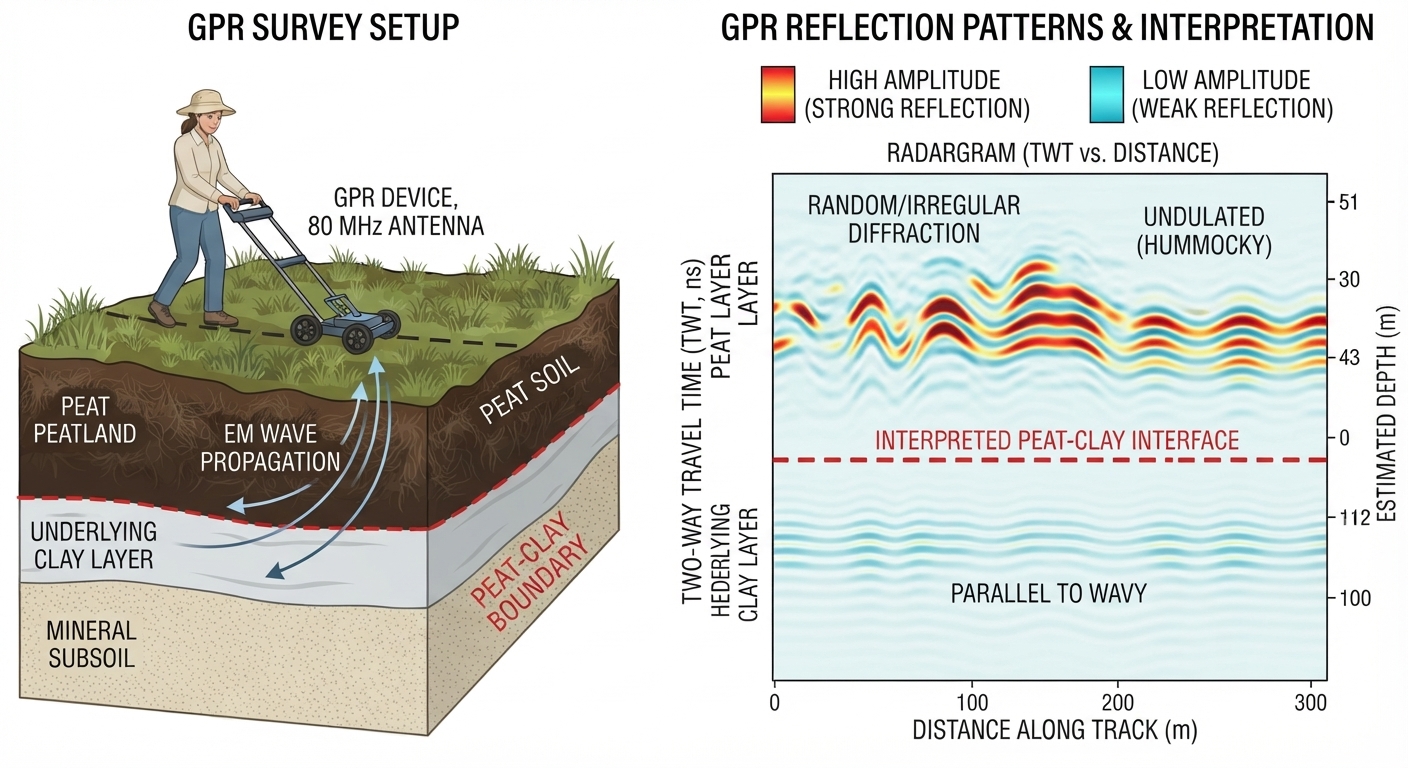
Ground Penetrating Radar (GPR) is a geophysical method that uses electromagnetic waves to map utilities and subsurface layers. It transmits electromagnetic waves, reflects them when they contact the medium, and then records them. Peatlands have unique properties, characterized by low density due to their composition of partially decomposed organic matter and a very high water storage capacity of up to 90% of the total volume. This research aims to interpret the reflection patterns in the subsurface layer of peatland areas. This research used a Plug-in Cobra GPR SE70 system operating at 80 MHz. The research location was in Rasau Jaya Sub-district, Kubu Raya Regency, Indonesia. Data acquisition in the field applied ten tracks with lengths varying from 162 m to 287 m. The data processing consisted of several stages, namely static correction, subtract-mean (dewow), Butterworth bandpass, background removal, average subtraction, and manual gain. The results showed that the reflection patterns on the peat layer showed random/irregular diffraction and undulated (hummocky) with high amplitude. In contrast, the reflection patterns on the clay layer showed parallel to wavy patterns with low amplitude. The results also showed that the peat layer thickness at the research location ranged from 1.07 m to 2.78 m. These findings serve as an essential reference for GPR surveys using the same approach in other areas to improve carbon reserve estimates and assess hydrological risks in peatlands of Kubu Raya Regency.
References
Osaki, M., Nursyamsi, D., Noor, M., Wahyunto, & Segah, H. (2016). Tropical peatland ecosystems. Peatland in Indonesia, 49–58.
Masganti, Anwar, K., & Susanti, M. A. (2017). Potential and utilization of shallow peatland for agriculture. Jurnal Sumberdaya Lahan, 11(1), 43–52.
Jawad, A., Nurdjali, B., & Widiastuti, T. (2015). Zoning area of forest fire in Kubu Raya District of West Kalimantan. Jurnal Hutan Lestari, 3(1), 88–97.
Yuwati, T. W., Rachmanadi, D., Pratiwi, Turjaman, M., Indrajaya, Y., Nugroho, H. Y. S. H., Qirom, M. A., Narendra, B. H., & Winarno, B. (2021). Restoration of degraded tropical peatland in Indonesia: A review. Land, 10(11), 1–31.
Koyan, P., Tronicke, J., Klose, T., & Guillemoteau, J. (2023). 3D GPR to explore peat deposits: Strategies for data acquisition, processing, and interpretation. 12th International Workshop on Advanced Ground Penetrating Radar (IWAGPR), 1–4.
Dewi, I. K., & Adriansyah, R. (2023). Pemodelan 2D data ground penetrating radar (GPR) pada lahan gambut di Desa Jati Mulyo. Journal Online Physics, 9(1), 15–22.
Ryazantsev, P. A., & Ignashov, P. A. (2022). Integrating TDR and GPR methods to study the structure of peatland. Limnology and Freshwater Biology, 5(4), 1556–1558.
Beres, M., & Haeni, F. P. (1991). Application of ground penetrating radar methods in hydrogeologic studies. Ground Water, 29(3), 375–386.
Luo, G., Cao, Y., Xu, H., Yang, G., Wang, S., Huang, Y., & Bai, Z. (2021). Research on typical soil physical properties in a mining area: Feasibility of three-dimensional ground penetrating radar detection. Environmental Earth Sciences, 80(3), 1–11.
Reynolds, J. M. (2011). An introduction to applied and environmental geophysics (2nd ed.). John Wiley & Sons.
Annan, A. P. (2009). Electromagnetic principles of ground penetrating radar. Elsevier.
Sinyutkina, A. (2021). Investigating peat deposits with ground penetrating radar: A case study of drained bogs in Western Siberia, Russia. E3S Web of Conferences, 258, 1–7.
Sumargana, L., Frederik, M., Sumirah, & Nugroho, D. (2019). Ground penetrating radar mapping of peat depth at Burnai-Sibumbung rivers peatland hydrological unit Ogan Komering Ilir Regency. IEEE, 1–10.
Jol, H. M. (2008). Ground penetrating radar: Theory and applications. Elsevier.
Kaufmann, M. S., Klotzsche, A., Vereecken, H., & Kruk, J. (2020). Simultaneous multichannel multi-offset ground penetrating radar measurements for soil characterization. Vadose Zone Journal, 19(1), 1–18.
Ceru, T., Pezdir, V., & Gosar, M. (2021). Using GPR on an ombrotrophic bog in Slovenia to delineate peat morphology. 11th International Workshop on Advanced Ground Penetrating Radar (IWAGPR), 1–6.
Rais, R., Muhardi, & Siregar, H. E. A. (2024). Analisis tingkat kematangan gambut berdasarkan refleksi radargram di Kecamatan Rasau Jaya Kabupaten Kubu Raya. Prisma Fisika, 12(1), 25–29.
Marpaung, F., Sumirah, Sumargana, L., & Nugroho, D. (2020). Profile of dielectric constant of peat in Ogan Komering Ilir Regency, Indonesia using SAR Sentinel-1 and ground penetrating radar. IOP Conference Series: Earth and Environmental Science, 500(012041), 1–6.
Lu, Q., Liu, K., Zeng, Z., Liu, S., Li, R., Xia, L., Guo, S., & Li, Z. (2023). Estimation of the soil water content using the early time signal of ground-penetrating radar in heterogeneous soil. Remote Sensing, 15(12), 1–18.
Akinsunmade, A., Tomecka, S., Kiełbasa, P., Juliszewski, T., Pysz, P., Karczewski, J., & Zagórda, M. (2021). GPR geophysical method as a remediation tool to determine zones of high penetration resistance of soil. Journal of Physics: Conference Series, 1782(012001), 1–8.
Li, S., Xiong, Z., Fan, P., & Xie, K. (2022). Experimental study on the influence of moisture and clay content on stress wave attenuation characteristics of filled joints. Applied Sciences, 12(9140), 1–15.
Downloads
Published
Issue
Section
License
Copyright (c) 2026 Mentari Adelia Lumban Tobing, Muhardi, Hans Andreas Elmaury Siregar

This work is licensed under a Creative Commons Attribution-NonCommercial 4.0 International License.