
Methacrylate-Functionalised Porphyrin for Photo-Polymerised Fluorescent Films in Pb(II) Ion Detection
DOI:
https://doi.org/10.11113/mjfas.v22n2.4737Keywords:
Porphyrins, functionalisation, sensor, thin film, quenching, fluorescence, luminescenceAbstract
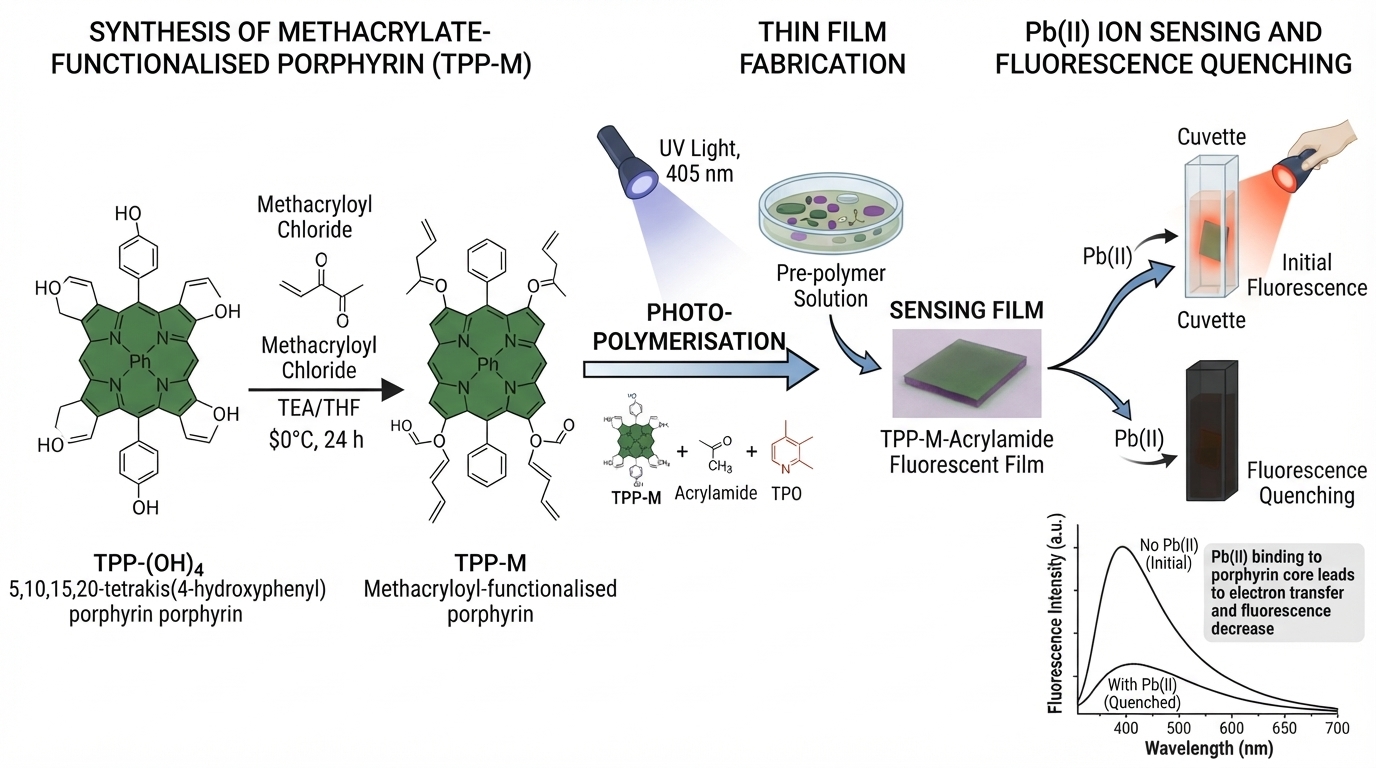
Herein, 5,10,15,20-tetrakis(4-hydroxyphenyl)-21H,23H-porphine (TPP-(OH)4) was functionalised with methacrylate group to convert it to a crosslinker (TPP-M) which later was used in photo-polymerisation alongside acrylamide. TPP-M obtained was characterised using proton nuclear magnetic resonance (1H-NMR), Fourier-Transform infrared (FTIR), ultraviolet-visible (UV- Vis) and fluorescence spectroscopy. The ability of TPP-M to detect Pb(II) ions was tested, and the resulted spectrum showed the reduced fluorescence intensity upon addition of Pb(II) ions. Then, the TPP-M was made into a polymer film through photo-polymerisation using UV light as a light source and diphenyl(2,4,6-trimethylbenzoyl)phosphine oxide (TPO) as a photo-initiator. The film obtained was tested for Pb(II) ion detection using fluorescence spectroscopy and showed reduced fluorescence intensities.
References
Dashtian, K., & Zare-Dorabei, R. (2017). An easily organic–inorganic hybrid optical sensor based on dithizone impregnation on mesoporous SBA-15 for simultaneous detection and removal of Pb(II) ions from water samples: Response-surface methodology. Applied Organometallic Chemistry, 31(12), 1–14.
Engwa, G. A., Nwalo, P. U. F. F. N., & Unachukwu, M. N. (2018). Mechanism and health effects of heavy metal toxicity in humans. Poisoning in the Modern World – New Tricks for an Old Dog? 1–23. IntechOpen.
Ahmed, M., Faisal, M., Ihsan, A., & Naseer, M. M. (2019). Fluorescent organic nanoparticles (FONs) as convenient probes for metal ions detection in aqueous medium. Analyst, 144.
Zhong, W., Wang, L., Qin, D., Zhou, J., & Duan, H. (2020). Two novel fluorescent probes as systematic sensors for multiple metal ions: Focus on detection of Hg2+. ACS Omega, 5, 24285–24295.
Han, S., Zhou, X., Tang, Y., He, M., Zhang, X., Shi, H., & Xiang, Y. (2016). Practical, highly sensitive, and regenerable evanescent-wave biosensor for detection of Hg2+ and Pb2+ in water. Biosensors and Bioelectronics, 80, 265–272.
Faraz, M., Abbasi, A., Naqvi, F., Khare, N., Prasad, R., Barman, I., & Pandey, R. (2018). Polyindole/cadmium sulphide nanocomposite based turn-on, multi-ion fluorescence sensor for detection of Cr3+, Fe3+ and Sn2+ ions. Sensors and Actuators B: Chemical, 269.
Prasad, S. S., Naidu, B. R., Hanafiah, M. M., Lakshmidevi, J., Marella, R. K., Lakkaboyana, S. K., & Venkateswarlu, K. (2021). Porphyrin N-pincer Pd(II) complexes in water: A base-free and nature-inspired protocol for the oxidative self-coupling of potassium aryltrifluoroborates in open-air. Molecules. 26(17), 5390. https://doi.org/10.3390/molecules26175390.
Šindelka, K., Limpouchová, Z., & Procházka, K. (2021). Solubilization of charged porphyrins in interpolyelectrolyte complexes: A computer study. Polymers, 13(4), 1–17.
Wu, D., Huang, Y., Hu, S., Yi, X., & Wang, J. (2018). Sensitive Hg²⁺ sensing via quenching the fluorescence of the complex between polythymine and 5,10,15,20-tetrakis(N-methyl-4-pyridyl)porphyrin (TMPyP). Sensors, 18(11).
Namitha, P. P., Saji, A., Francis, S., & Rajith, L. (2020). Water soluble porphyrin for the fluorescent determination of cadmium ions. Journal of Fluorescence, 30(5), 1215–1222. https://doi.org/10.1007/s10895-020-02574-9.
Tian, J., & Zhang, W. (2019). Synthesis, self-assembly and applications of functional polymers based on porphyrins. Progress in Polymer Science, 95.
Chamkouri, H. (2021). A review of hydrogels, their properties and applications in medicine. American Journal of Biomedical Science & Research, 11, 485–493.
Su, WF. (2013). Ionic Chain Polymerization. In: Principles of Polymer Design and Synthesis. Lecture Notes in Chemistry, vol 82. Springer, Berlin, Heidelberg. 82, 185–218.
Mohamad, F., Tanner, M. G., Choudhury, D., Choudhary, T. R., Wood, H. A. C., Harrington, K., & Bradley, M. (2017). Controlled core-to-core photo-polymerisation – fabrication of an optical fibre-based pH sensor. Analyst, 142(19), 3569–3572.
Tian, Y., Shumway, B. R., & Meldrum, D. R. (2010). A new cross-linkable oxygen sensor covalently bonded into poly(2-hydroxyethylmethacrylate)-co-polyacrylamide thin film for dissolved oxygen sensing. Chemistry of Materials, 2069–2078.
Flouraki, C., Kaliva, M., Papadas, I. T., Armatas, G. S., & Vamvakaki, M. (2016). Nanoporous polystyrene–porphyrin nanoparticles for selective gas separation. Polymer Chemistry, 7(17), 3026–3033.
Ayub, N. F., Hashim, S., Jamaluddin, J., & Adrus, N. (2017). New UV LED curing approach for polyacrylamide and poly(N-isopropylacrylamide) hydrogels. New Journal of Chemistry. 41(12), 5617–5623. https://doi.org/10.1039/C7NJ00894A.
Chinelatto, M. A., Agnelli, J. A. M., & Canevarolo, S. V. (2014). Synthesis and characterization of copolymers from hindered amines and vinyl monomers. Polímeros, 24(1), 30–36.
Chacón-Patiño, M. L., Blanco-Tirado, C., Orrego-Ruiz, J. A., Gómez-Escudero, A., & Combariza, M. Y. (2015). High resolution mass spectrometric view of asphaltene-SiO₂ interactions. Energy and Fuels, 29(3), 1323–1331.
Gujarathi, P. (2016). New meso-substituted unsymmetrical porphyrins: Synthesis and spectral studies. Acta Chimica & Pharmaceutica Indica, 6(3), 104–110.
Tuerdi, G., Nizamidin, P., Kari, N., Yimit, A., & Wang, F. (2018). Optochemical properties of gas-phase protonated tetraphenylporphyrin investigated using an optical waveguide NH₃ sensor. RSC Advances, 8(10), 5614–5621.
Nandiyanto, A., Oktiani, R., Ragadhita, R., & Ijost, I. (2019). How to read and interpret FTIR spectroscopy of organic material. Indonesian Journal of Science and Technology, 4, 97–118.
Clemente, C., Ribeiro, V., Sousa, J., Maia, F., Barreto, A., Andrade, N., Denardin, J., Mele, G., Carbone, L., Mazzetto, S., & Fechine, P. (2013). Porphyrin synthesized from cashew nut shell liquid as part of a novel superparamagnetic fluorescence nanosystem. Journal of Nanoparticle Research, 15.
Ibnaouf, K. H., Elzupir, A. O., Alsalhi, M. S., & Alaamer, A. S. (2018). Influence of functional groups on the photophysical properties of dimethylamino chalcones as laser dyes. Optical Materials, 76, 216–221.
Green, W. A. (2010). Industrial photoinitiators. Industrial Photoinitiators, 1–20. Taylor & Francis Group.
Nikolić, L., Skala, D., Nikolić, V., Stamenković, J., Babić, D., & Ilić-Stojanović, S. (2004). Methyl methacrylate and acrylamide crosslinked macroporous copolymers. Journal of Applied Polymer Science, 91(1), 387–395.
Celebioglu, N., & Yilmaz, Y. (2017). Investigation of the luminescence, mechanical, and thermal properties of ZnO-entrapped poly(N-isopropylacrylamide) gels. Journal of Composite Materials, 51(29), 4079–4090.
Välimäki, H., Hyvärinen, T., Leivo, J., Iftikhar, H., Pekkanen-Mattila, M., Rajan, D. K., Verho, J., Kreutzer, J., Ryynänen, T., Pirhonen, J., Aalto-Setälä, K., Kallio, P., Narkilahti, S., & Lekkala, J. (2020). Covalent immobilization of luminescent oxygen indicators reduces cytotoxicity. Biomedical Microdevices, 22(2).
Mao, Y., Mei, Z., Wen, J., Li, G., Tian, Y., Zhou, B., & Tian, Y. (2018). Honeycomb structured porous films from a platinum porphyrin-grafted poly(styrene-co-4- vinylpyridine) copolymer as an optical oxygen sensor. Sensors and Actuators, B: Chemical, 257, 944–953.
Downloads
Published
Issue
Section
License
Copyright (c) 2026 Fuad Mohamad, Siti Nur Nasiha Nazir

This work is licensed under a Creative Commons Attribution-NonCommercial 4.0 International License.