
Potential of Pometia pinnata Leaf Nano Powder in Stunting Prevention
DOI:
https://doi.org/10.11113/mjfas.v22n2.4712Keywords:
Pometia pinnata, nano powder, antioxidant, antibacterial, calorific valueAbstract
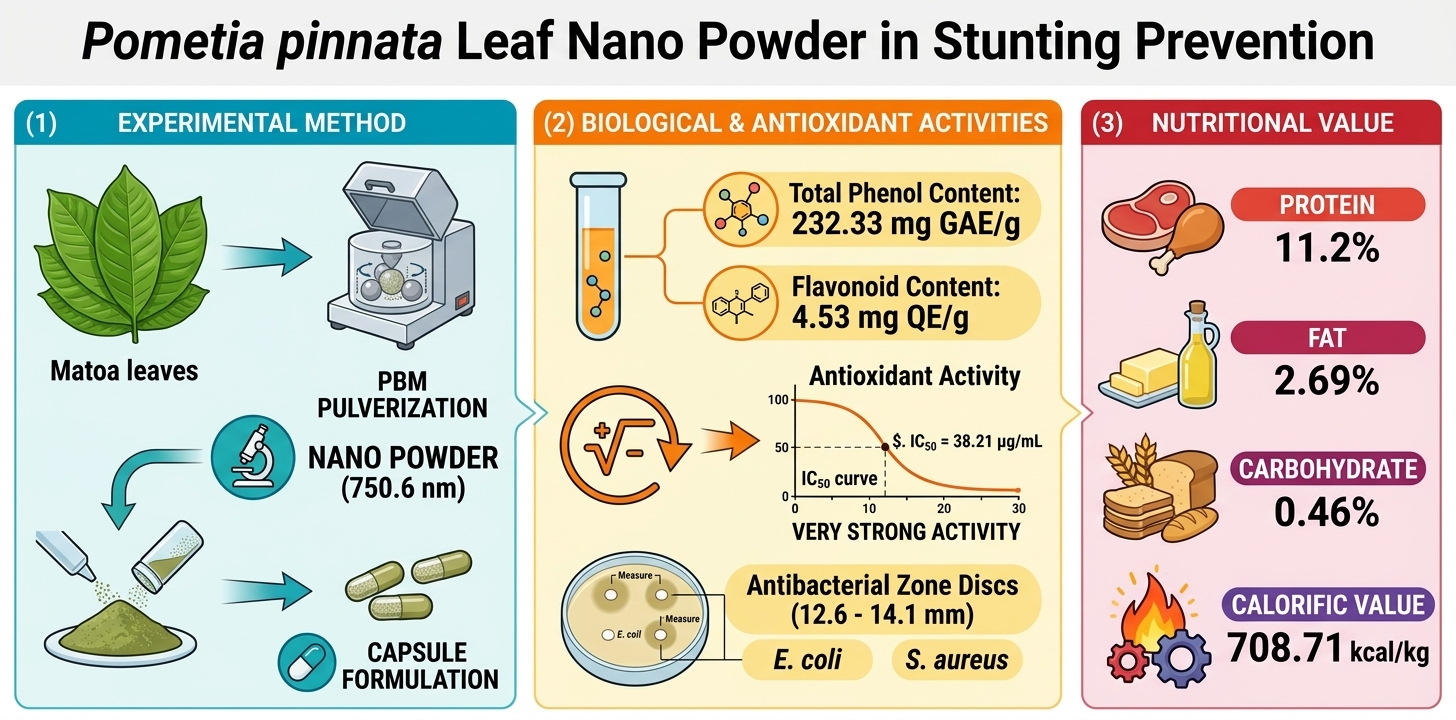
Matoa leaf (Pometia pinnata J.R. Forst & G. Forst.) is one of Indonesia’s endemic plants originating from Papua. Matoa leaves can be utilized as a preventive measure against stunting. Increasing the absorption of active ingredients in a preparation can be achieved by creating nanoparticles. The purpose of this study was to test the potential of matoa leaf nano-powder as an additional ingredient to prevent stunting in children. The stages of this study include the preparation of nanoparticles using the Planetary Ball Mill (PBM) method, capsule preparation formulation, determination of total phenol and flavonoid content, antioxidant activity test, antibacterial test against Escherichia coli and Staphylococcus aureus bacteria, determination of protein content, determination of carbohydrate content, determination of fat content, and determination of caloric value. Based on the results of this study, the antioxidant activity of matoa leaf nano-powder is very strong, with an IC50 value of 38.2078 ± 0.26 µg/mL, corresponding to total phenol and flavonoid levels of 232.3319 ± 14.66 mg GAE/g sample and 4.5288 ± 0.99 mg QE/g sample, respectively. Matoa leaf nanoparticle capsules exhibit strong antibacterial activity against Escherichia coli bacteria at a dose of 150 mg (12.61 ± 2.07 mm), a dose of 200 mg (13.4 ± 2.00 mm), and a dose of 250 mg (13.4 ± 2.00 mm). For Staphylococcus aureus, the inhibition diameters obtained with doses of 150 mg, 200 mg, and 250 mg are 13.25 ± 0.78 mm, 13.81 ± 1.10 mm, and 14.13 ± 1.23 mm, respectively. The results of determining the total protein content of matoa leaf nano powder in the spectrophotometric method of 0.8571% and the Kjeldahl method of 11.2%, total carbohydrate content of 0.4617%, and crude fat content of 2.6916%, with a caloric value of 294.96 kcal / kg and 708.71 kcal / kg. It is concluded that matoa leaf nano powder has the potential to prevent stunting.
References
Styani, E., Irawan, C., Putri, I., & Sukiman, M. (2021). Phytochemical and antidiabetic activity studies of n-hexane, ethyl acetate and methanol extracts of matoa (Pometia pinnata) fruit peel using alpha-glucosidase enzyme. In Proceedings of the International Conference on Innovation in Science and Technology (ICIST 2020), 208.
Sarima, S., Pistanty, M. A., Fathia, M., & Winanda, W. (2025). The potential of various matoa plant (Pometia pinnata) extracts as antibacterial agents: Systematic literature review. Jurnal Pembelajaran dan Biologi Nukleus, 11.
Utoro, P. A. R., Witoyo, J. E., & Alwi, M. (2022). A short literature review on bioactivity of Indonesian matoa (Pometia pinnata) leaves extracts and its application on food products. Journal of Tropical AgriFood, 4.
Sulastri, L., Sugihartini, N., & Efiana, N. (2025). Pometia pinnata in pharmaceutical research: Bioactivity, mechanisms, and formulation prospects. Sciences of Pharmacy, 4. https://doi.org/10.58920/sciphar0403331.
Mulyani, A. T., Khairinisa, M. A., Khatib, A., & Chaerunisaa, A. Y. (2025). Understanding stunting: Impact, causes, and strategy to accelerate stunting reduction—A narrative review. Nutrients, 17.
Kayadoe, M., Rochana, A., Tanuwiria, U. H., & Sinaga, S. (2019). Short communication: Effect of different feed combination on the growth development of spotted cuscus (Spilocuscus maculatus) in captivity. Biodiversitas, 20. https://doi.org/10.13057/biodiv/d200231.
Masfria, M., Sumaiyah, S., Syahputra, H., & Jenifer, J. (2024). Anti-inflammatory and anti-aging activity of hydrogel with active ingredient Phyllanthus emblica L. fruit nanosimplicia. Journal of Medicinal Plants, 22, 49–64.
Masfria, M., Suci, N., Syahputra, H., & Dalimunthe, A. (2026). Exploring the safety and phytochemical composition of nanoherbal formulations from Phyllanthus emblica L. fruit. International Journal of Medical Toxicology and Forensic Medicine, 16. https://doi.org/10.22037/ijmtfm.v16.50297.
Naharros-Molinero, A., Caballo-González, M. Á., de la Mata, F. J., & García-Gallego, S. (2024). Shell formulation in soft gelatin capsules: Design and characterization. Advanced Healthcare Materials, 13.
Masfria, M., Syahputra, H., Celina, A., et al. (2025). Standardisation and toxicity assessment of Dioscorea hispida (Dennst.) tubers: Acute and subchronic dosage studies. Plant Science Today, 12. https://doi.org/10.14719/pst.4277.
Masfria, M., Dalimunthe, A., Syahputra, H., et al. (2023). Standardization study of simplicia nanoparticle from Phyllanthus emblica L. fruit. In A. A., B. W., & S. B. S. (Eds.), AIP Conference Proceedings. American Institute of Physics.
Masfria, M., Sumaiyah, S., Syahputra, H., & Silvia. (2025). Antibacterial and anti-inflammatory activities of nanosimplicia Phyllanthus emblica L. fruit in suspension formulation. International Journal of Applied Pharmaceutics, 17, 376–383. https://doi.org/10.22159/ijap.2025v17i2.52608
Masfria, M., Syahputra, H., Haro, G., & Nasution, L. R. (2024). Phenolic and flavonoids contributions to the antioxidant, antidiabetic, and anticholesterol activities of Eriobotrya japonica fruit extract: An in vitro analysis. International Journal of Drug Delivery Technology, 14, 1962–1970. https://doi.org/10.25258/ijddt.14.4.4.
Masfria, M., Syahputra, H., Khairani, L., et al. (2024). Analysis of phytochemical, mineral, total phenol, flavonoids and antimicrobial from ethanol extracts and fractions of Phyllanthus acidus (L.) Skeels fruit. Journal of Medicinal and Pharmaceutical Chemistry Research, 6, 1368–1382. https://doi.org/10.48309/jmpcr.2024.440641.1100.
Masfria, M., Syahputra, H., Wahyuni, H. S., et al. (2024). Analysis of total flavonoid and antioxidant activity of coconut shell liquid smoke (Cocos nucifera L.) as an antibacterial. Pharmacy Education, 24, 39–45. https://doi.org/10.46542/pe.2024.242.3945.
Syahputra, H., Fadila, N., & Siringoringo, Y. L. (2025). Phytochemical screening, antioxidant, and anti-inflammatory activities of Dioscorea hispida (Dennst.) tuber extracts and fractions. Research Journal of Pharmacy and Technology, 18, 4689–4694. https://doi.org/10.52711/0974-360X.2025.00674.
Masfria, M., Sumaiyah, S., Syahputra, H., & Witarman, M. (2023). Formulation and evaluation of antibacterial and anti-inflammatory capsules containing Phyllanthus emblica L. fruit nanoparticles. Science and Technology Indonesia, 8, 607–615. https://doi.org/10.26554/sti.2023.8.4.607-615.
Syahputra, A., Ervina, I., Darwis, A. F., et al. (2025). In vitro antimicrobial activity of Punica granatum L. extract and anti-inflammatory activity of nano gel in vivo in Wistar rats gingiva. International Journal of Applied Pharmaceutics, 17, 189–199. https://doi.org/10.22159/ijap.2025v17i3.53619.
Masfria, M., Syahputra, H., Samosir, V. C., & Manalu, E. (2024). Study of total phenols, flavonoids, antioxidant and antibacterial activities from Dioscorea hispida tubers. International Journal of Drug Delivery Technology, 14, 754–758. https://doi.org/10.25258/ijddt.14.2.24.
Arunima, & Verulkar, S. (2022). Comparative analysis of different protein estimation methods. The Pharma Innovation Journal, 11.
Hadju, Y., Salimi, Y. K., Bialangi, N., & Ischak, N. I. (2022). Analysis of protein and bioactivity of nike fish (Awaous melanocephalus) extract as antioxidant. Jambura Fish Processing Journal, 4. https://doi.org/10.37905/jfpj.v4i2.15254
Vukmanović, S., Vitas, J., Kravić, S., et al. (2024). Influence of main production variables on nutritional characteristics of winery effluent kombucha. Chemical Industry and Chemical Engineering Quarterly, 30. https://doi.org/10.2298/CICEQ231002001V.
Syam, A., Zainal, Wahiduddin, et al. (2023). Nutrient content and toxicity of pumpkin seed flour. Food Research, 7. https://doi.org/10.26656/fr.2017.7(6).069.
Syahrullah, A. U. H., Sukendar, N. K., Djalal, M., & Wangdi, J. T. (2023). Physicochemical properties of fettuccine paste products made from tapioca flour and corn flour based resistant starch type 3. In AIP Conference Proceedings.
Khan, A., Talpur, F. N., Bhanger, M. I., et al. (2021). Extraction of fat and fatty acid composition from slaughterhouse waste by evaluating conventional analytical methods. American Journal of Analytical Chemistry, 12. https://doi.org/10.4236/ajac.2021.125013.
Liu, Z., Liu, Q., Zhang, D., et al. (2021). Comparison of the proximate composition and nutritional profile of byproducts and edible parts of five species of shrimp. Foods, 10. https://doi.org/10.3390/foods10112603.
Masfria, M., Dalimunthe, A., Suci, N., & Syahputra, H. (2024). Phytochemical constituent analysis of Phyllanthus emblica L. fruit nanoherbals by LC-HRMS and their antimutagenic activity and teratogenic effects. Molecules, 29. https://doi.org/10.3390/molecules29071642.
Sari, R. P., Rumanti, R. M., & Fathta, D. N. (2025). Identification of flavonoid compounds and antioxidant activity test of ethyl acetate extract of matoa leaves (Pometia pinnata) using the DPPH method. International Journal of Health Engineering and Technology, 4. https://doi.org/10.55227/ijhet.v4i4.434.
Kementerian Kesehatan Republik Indonesia. (2020). Farmakope Indonesia (Edisi VI).
Mandosir, Y. M., Prasetyo, Y., Suhartini, B., & Kristanto, B. (2025). Nutrients in matoa for health and exercise performance: A literature study. Formosa Journal of Science and Technology, 4. https://doi.org/10.55927/fjst.v4i1.13648.
Hasan, H., Taupik, M., Andi Suryadi, A. M., & Ihsan, M. (2024). Toxicity effect test of matoa (Pometia pinnata) plant fractions as raw materials for anticancer drugs. Jurnal Farmasi Galenika (Galenika Journal of Pharmacy), 10. https://doi.org/10.22487/j24428744.2024.v10.i2.17016.
Downloads
Published
Issue
Section
License
Copyright (c) 2026 nur Aira Juwita

This work is licensed under a Creative Commons Attribution-NonCommercial 4.0 International License.