
Glycine-L-Proline Media Supplementation Reduces Reactive Oxygen Species and Improves Preimplantation Development in Mouse Embryos
DOI:
https://doi.org/10.11113/mjfas.v22n2.4710Keywords:
Assisted Reproductive Technology, Embryo Development, Glycine, L-Proline, Mitochondria, Reactive Oxygen SpeciesAbstract
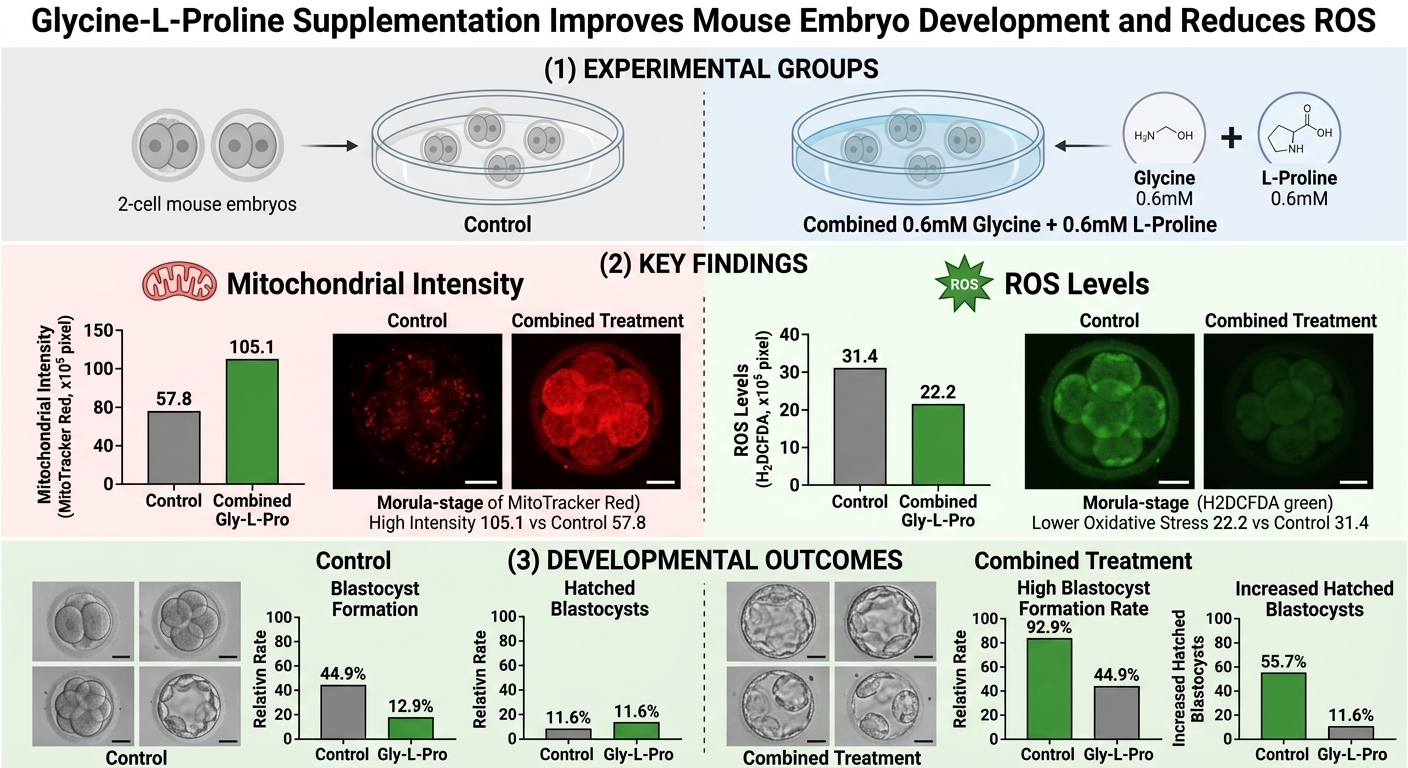
In vitro embryo culture systems often expose embryos to elevated oxidative stress levels, compromising development. Glycine (Gly) and L-Proline (L-Pro), naturally occurring amino acids with antioxidant properties, have been shown to mitigate reactive oxygen species (ROS). This study aimed to assess the individual and combined effects of Gly and L-Pro supplementation on preimplantation development in mouse embryos. Two-cell stage BALB/C mouse embryos were cultured in M16 medium supplemented with either Gly or L-Pro at concentrations of 0.2, 0.4, and 0.6 mM, and a combined group of 0.6 mM Gly + 0.6 mM L-Pro. Developmental progress to the 8-cell, morula, and blastocyst stages was recorded. Mitochondrial activity and ROS levels were quantified using MitoTracker Red and H2DCFDA assays, respectively. The combined treatment group exhibited significantly higher rates of normal morphology (94.3% 8-cell, 85.7% morula, 72.9% blastocyst) and developmental competence (92.9% blastocyst formation, 55.7% hatching) compared to controls (p < 0.01). ROS levels were lowest in the combined group (22.24 ± 1.54 pixel x10^5) and mitochondrial intensities were highest (105.1 ± 5.83 pixel x10^5), indicating improved mitochondrial activity and reduced oxidative stress. These findings suggest a complementary interaction between Gly and L-Pro in enhancing embryo quality and development by modulating oxidative stress and mitochondrial function. This novel supplementation strategy could inform future improvements in assisted reproductive technologies.
References
Morris, M. B., et al. (2020). Selected amino acids promote mouse pre-implantation embryo development in a growth factor-like manner. Frontiers in Physiology, 11, 140. https://doi.org/10.3389/fphys.2020.00140.
Cuevas Saiz, I., et al. (2018). The embryology interest group: Updating ASEBIR’s morphological scoring system for early embryos, morulae and blastocysts. Medicina Reproductiva y Embriología Clínica, 5(1), 42–54. https://doi.org/10.1016/j.medre.2017.11.002.
Baltz, J. M., & Tartia, A. P. (2009). Cell volume regulation in oocytes and early embryos: Connecting physiology to successful culture media. Human Reproduction Update. https://doi.org/10.1093/humupd/dmp045.
Bröer, S., & Gauthier-Coles, G. (2022). Amino acid homeostasis in mammalian cells with a focus on amino acid transport. The Journal of Nutrition. https://doi.org/10.1093/jn/nxab342.
Leese, H. J., McKeegan, P., & Sturmey, R. G. (2021). Amino acids and the early mammalian embryo: Origin, fate, function and life-long legacy. International Journal of Environmental Research and Public Health, 18(18), 9874. https://doi.org/10.3390/ijerph18189874.
Hong, J., & Lee, E. (2007). Intrafollicular amino acid concentration and the effect of amino acids in a defined maturation medium on porcine oocyte maturation, fertilization, and preimplantation development. Theriogenology, 68(5), 728–735. https://doi.org/10.1016/j.theriogenology.2007.06.002.
Men, H., Amos-Landgraf, J. M., Bryda, E. C., & Franklin, C. L. (2023). KSOM-R supports both mouse and rat preimplantation embryo development in vitro. Theriogenology, 198, 69–74. https://doi.org/10.1016/j.theriogenology.2022.12.024.
Erdem, H., Karasahin, T., Alkan, H., Dursun, S., Satilmis, F., & Guler, M. (2020). Effect of embryo quality and developmental stages on pregnancy rate during fresh embryo transfer in beef heifers. Tropical Animal Health and Production, 52(5), 2541–2547. https://doi.org/10.1007/s11250-020-02287-6.
Heitmann, R. J., Hill, M. J., Richter, K. S., DeCherney, A. H., & Widra, E. A. (2013). The simplified SART embryo scoring system is highly correlated to implantation and live birth in single blastocyst transfers. Journal of Assisted Reproduction and Genetics, 30(4), 563–567. https://doi.org/10.1007/s10815-013-9932-1.
Keltz, M. D., Skorupski, J. C., Bradley, K., & Stein, D. (2006). Predictors of embryo fragmentation and outcome after fragment removal in in vitro fertilization. Fertility and Sterility, 86(2), 321–324. https://doi.org/10.1016/j.fertnstert.2006.01.048.
Chi, H. J., Koo, J. J., Choi, S. Y., Jeong, H. J., & Roh, S. I. (2011). Fragmentation of embryos is associated with both necrosis and apoptosis. Fertility and Sterility, 96(1), 187–192. https://doi.org/10.1016/j.fertnstert.2011.04.020.
Pang, Y. W., Jiang, X. L., Zhao, S. J., Huang, Z. Q., & Zhu, H. B. (2018). Beneficial role of melatonin in protecting mammalian gametes and embryos from oxidative damage. Journal of Integrative Agriculture. https://doi.org/10.1016/S2095-3119(18)61942-2.
Magli, M. C., Capoti, A., Resta, S., Stanghellini, I., Ferraretti, A. P., & Gianaroli, L. (2011). Prolonged absence of meiotic spindles by birefringence imaging negatively affects normal fertilization and embryo development. Reproductive Biomedicine Online, 23(6), 747–754. https://doi.org/10.1016/j.rbmo.2011.07.019.
Cecchele, A., Cermisoni, G. C., Giacomini, E., Pinna, M., & Viganò, P. (2022). Cellular and molecular nature of fragmentation of human embryos. International Journal of Molecular Sciences, 23(3), 1349. https://doi.org/10.3390/ijms23031349.
Dai, J., et al. (2015). Changes in mitochondrial function in porcine vitrified MII-stage oocytes and their impacts on apoptosis and developmental ability. Cryobiology, 71(2), 291–298. https://doi.org/10.1016/j.cryobiol.2015.08.002
Aydin, Y., Ozatik, O., Hassa, H., Ulusoy, D., Ogut, S., & Sahin, F. (2013). Relationship between oxidative stress and clinical pregnancy in assisted reproductive technology treatment cycles. Journal of Assisted Reproduction and Genetics, 30(6), 765–772. https://doi.org/10.1007/s10815-013-0005-2.
Li, S., et al. (2018). Glycine treatment enhances developmental potential of porcine oocytes and early embryos by inhibiting apoptosis. Journal of Animal Science, 96(6), 2427–2437. https://doi.org/10.1093/jas/sky154.
Herrick, J. R., Lyons, S. M., Greene, A. F., Broeckling, C. D., Schoolcraft, W. B., & Krisher, R. L. (2016). Direct and osmolarity-dependent effects of glycine on preimplantation bovine embryos. PLoS ONE, 11(7). https://doi.org/10.1371/journal.pone.0159581.
Martin, P., & Sutherland, A. (2001). Exogenous amino acids regulate trophectoderm differentiation in the mouse blastocyst through an mTOR-dependent pathway. Developmental Biology, 240(1), 182–193. https://doi.org/10.1006/dbio.2001.0461.
Takahara, T., Amemiya, Y., Sugiyama, R., Maki, M., & Shibata, H. (2020). Amino acid-dependent control of mTORC1 signaling: A variety of regulatory modes. Journal of Molecular Medicine. https://doi.org/10.1186/s12929-020-00679-2.
Tscherner, A. K., McClatchie, T., Kaboba, G., Boison, D., & Baltz, J. M. (2023). Oocyte-specific deletion of Slc6a9 encoding the GLYT1 glycine transporter eliminates glycine transport in mouse preimplantation embryos and their ability to counter hypertonic stress. Cells, 12(20). https://doi.org/10.3390/cells12202500.
Treleaven, T., et al. (2022). Stage-specific L-proline uptake by amino acid transporter Slc6a19/B0AT1 is required for optimal preimplantation embryo development in mice. Cells, 12(1). https://doi.org/10.3390/cells12010018
Zhu, M., et al. (2020). Regulation of mTORC1 by small GTPases in response to nutrients. The Journal of Nutrition, 150(5), 1004–1011. https://doi.org/10.1093/jn/nxz301.
Chuang, T. H., et al. (2024). Dependency of mitochondrial quantity on blastocyst timeline obscures its actual effect to pregnancy outcomes. Frontiers in Endocrinology, 15. https://doi.org/10.3389/fendo.2024.1415865.
Sathananthan, H., Menezes, J., & Gunasheela, S. (2003). Mechanics of human blastocyst hatching in vitro. Reproductive Biomedicine Online, 7(2), 228–234. https://doi.org/10.1016/S1472-6483(10)61757-9.
Redel, B. K., Spate, L. D., Lee, K., Mao, J., Whitworth, K. M., & Prather, R. S. (2016). Glycine supplementation in vitro enhances porcine preimplantation embryo cell number and decreases apoptosis but does not lead to live births. Molecular Reproduction and Development, 83(3), 246–258. https://doi.org/10.1002/mrd.22618.
Suzuki, H., Satoh, M., & Kabashima, K. (2006). Distributions of mitochondria and the cytoskeleton in hamster embryos developed in vivo and in vitro. Journal of Reproduction and Development, 52(6), 735–742. https://doi.org/10.1262/jrd.18098.
Yu, S., et al. (2021). Glycine ameliorates mitochondrial dysfunction caused by ABT-199 in porcine oocytes. Journal of Animal Science, 99(4). https://doi.org/10.1093/jas/skab072.
Harders, A. R., Spellerberg, P., & Dringen, R. (2024). Exogenous substrates prevent the decline in the cellular ATP content of primary rat astrocytes during glucose deprivation. Neurochemical Research. https://doi.org/10.1007/s11064-024-04104-0.
Hardy, M. L. M., Lakhiani, D., Morris, M. B., & Day, M. L. (2023). Proline and proline analogues improve development of mouse preimplantation embryos by protecting them against oxidative stress. Cells, 12(22), 26–40. https://doi.org/10.3390/cells12222640.
Liang, X., Zhang, L., Natarajan, S. K., & Becker, D. F. (2013). Proline mechanisms of stress survival. Antioxidants & Redox Signaling. https://doi.org/10.1089/ars.2012.5074.
Zander-Fox, D., & Lane, M. (2014). Amino acids and ammonium. In Culture media, solutions, and systems in human ART (pp. 95–111). Cambridge University Press. https://doi.org/10.1017/CBO9781139059053.009.
Moravek, M., Fisseha, S., & Swain, J. E. (2012). Dipeptide forms of glycine support mouse preimplantation embryo development in vitro and provide protection against high media osmolality. Journal of Assisted Reproduction and Genetics, 29(3), 283–290. https://doi.org/10.1007/s10815-011-9705-7.
Van Winkle, L. J. (2021). Amino acid transport and metabolism regulate early embryo development: Species differences, clinical significance, and evolutionary implications. Cells, 10(11), 3154. https://doi.org/10.3390/cells10113154.
Andrés Juan, C., Pérez de la Lastra, J. M., Plou, F. J., Pérez-Lebeña, E., & Reinbothe, S. (2021). The chemistry of reactive oxygen species (ROS) revisited: Outlining their role in biological macromolecules (DNA, lipids and proteins) and induced pathologies. International Journal of Molecular Sciences, 22, 4642. https://doi.org/10.3390/ijms.
Deluao, J. C., et al. (2022). Reactive oxygen species in the mammalian pre-implantation embryo. Reproduction. 164(3), R73–R89. https://doi.org/10.1530/REP-22-0120.
Elmore, S. (2007). Apoptosis: A review of programmed cell death. Toxicologic Pathology, 35(4), 495–516. https://doi.org/10.1080/01926230701320337.
Downloads
Published
Issue
Section
License
Copyright (c) 2026 ninaketerina hashim, Mimi-Sophia Sarbandi, Nor-Ashikin Mohamed Noor Khan, Zolkapli Eshak

This work is licensed under a Creative Commons Attribution-NonCommercial 4.0 International License.