
Optimizing Germination and Seedling Vigour of True Shallot Seeds (TSS) Through Growth Regulators Priming
DOI:
https://doi.org/10.11113/mjfas.v21n5.4616Keywords:
Allium ascalonicum L, eco enzyme, GA3, NAA, priming solutionAbstract
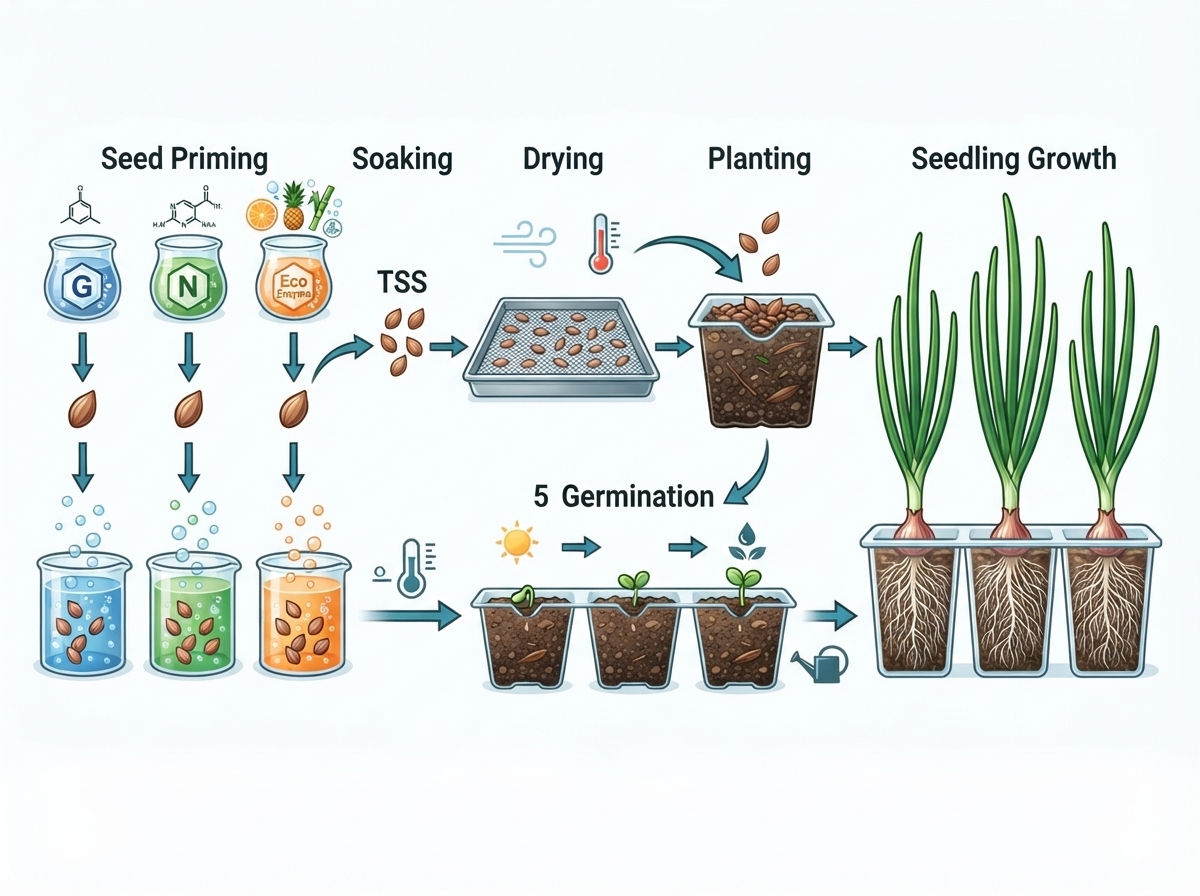
Shallot cultivation with TSS is the right option for the challenges with shallot cultivation using bulbs. However, poor seed storage condition may diminish seed viability. This research aimed to optimize the TSS germination and seedling growth through a priming solution. The experiment was conducted in the Agro-Industry and Biomedical Laboratory greenhouse in the South of Tangerang. It was conducted in a randomized complete block design (RCBD) with 3 replications. The TSS were soaked with water as a control and plant growth regulator priming consisting of GA3, NAA, BAP, B1, Na2S2O3.5H2O, AgNO3, and eco enzyme. Then, TSS was planted in the growth medium, watered, and sprayed daily using priming solution. The research showed that the treatment significantly affected total germinated percentage (TGP), seedling height, root length, fresh weight, seedling dry weight, and root dry weight. The highest TGP was found in the treatment of soaking and watering with the eco enzyme (92%). Meanwhile, the treatment of soaking with GA3 and NAA had the highest seedling (7.11 cm), the heaviest seedling fresh (310.40 mg), and the heaviest root fresh (72.17 mg).
References
Pangestuti, R., Sulistyaningsih, E., Kurniasih, B., & Murti, R. H. (2021). Improving seed germination and seedling growth of true seed shallot (TSS) using plant growth regulator seed priming. IOP Conference Series: Earth and Environmental Science, 883(1), 012024.
Tanjung, K. A., Siregar, L. A. M., & Damanik, R. I. M. (2022). Improving of true shallot seeds germination by the application of plant growth regulators and osmoconditioning treatment. IOP Conference Series: Earth and Environmental Science, 951(1), 012065.*
Arif, A. B., Sasmitaloka, K. S., Widayanti, S. M., & Yuliani, S. (2022). Effect of pelleting on germination and vegetative growth of true seed of shallot (Allium cepa var. ascalonicum L.). Songklanakarin Journal of Science and Technology, 44, 811–816.
Caseiro, R., Bennett, M. A., & Marcos-Filho, J. (2004). Comparison of three priming techniques for onion seed lots differing in initial seed quality. Seed Science and Technology, 32(2), 365–375.
Basra, S. M. A., Zia, M. N., Mehmood, T., Afzal, I., & Khaliq, A. (2002). Comparison of different invigoration techniques in wheat (Triticum aestivum L.) seeds. Pakistan Journal of Arid Agriculture, 5(2).
Nawaz, J., Hussain, M., Jabbar, A., Nadeem, G. A., Sajid, M., Subtain, M. U., et al. (2013). Seed priming: A technique. International Journal of Agriculture and Crop Sciences, 6(20), 1373.
Afzal, I., Basra, S. M. A., Ahmad, N., Cheema, M. A., Warraich, E. A., & Khaliq, A. (2002). Effect of priming and growth regulator treatments on emergence and seedling growth of hybrid maize (Zea mays L.). International Journal of Agriculture & Biology, 4(2), 303–306.
Ibrahim, M., Agarwal, M., Yang, J. O., Abdulhussein, M., Du, X., & Hardy, G., et al. (2019). Plant growth regulators improve the production of volatile organic compounds in two rose varieties. Plants, 8(2), 35.
Zhang, S., Pan, Y., Zhi, C., Zheng, Y., Wang, X., Li, X., et al. (2021). Genome-wide identification and characterization of KNOTTED-like homeobox (KNOX) homologs in garlic (Allium sativum L.) and their expression profiling responding to exogenous cytokinin and gibberellin. International Journal of Molecular Sciences, 22(17), 9237.
Agung, I., & Diara, I. W. (2017). Pre-sowing treatment enhanced germination and vigour of true shallot (Allium cepa var. aggregatum) seeds. International Journal of Environment Agriculture and Biotechnology, 2, 3262–3267.
Liu, Z., Goto, Y., Nishiyama, I., & Kokubun, M. (2001). Effects of foliar and root-applied benzylaminopurine on tillering of rice plants grown in hydroponics. Plant Production Science, 4(3), 220–226.
Sudantha, I. M., Aryana, I. G. M., Suwardji, S., Jayadi, I., & Pramadya, I. M. A. (2021). Growth and yield response of shallots applied with growth regulators benzyl amino purine (GR BAP) and liquid bioactivator of Trichoderma harzianum fungus. Proceedings of the International Conference on Science (ICST), 129–140.
Szablińska-Piernik, J., Lahuta, L. B., Stałanowska, K., & Horbowicz, M. (2022). The imbibition of pea (Pisum sativum L.) seeds in silver nitrate reduces seed germination, seedlings development and their metabolic profile. Plants, 11(14), 1877.
Gül, F., Ekinci, M., Kul, R., & Yıldırım, E. (2020). Effect of glycine betaine and thiamine treatments on germination and seedling growth in eggplant under salt stress. Atatürk Üniversitesi Ziraat Fakültesi Dergisi, 51(2), 190–198.
Bakht, J., Shafi, M., Shah, R., Raziuddin, R., & Munir, I. (2011). Response of maize cultivars to various priming sources. Pakistan Journal of Botany, 43(1), 205–212.
Shah, S. N., Gong, Z. H., Arisha, M. H., Khan, A., & Tian, S. L. (2015). Effect of ethyl methyl sulfonate concentration and different treatment conditions on germination and seedling growth of the cucumber cultivar Chinese long (9930). Genetics and Molecular Research, 14(1), 2440–2449.
Narang, N., Hussain, A., & Madan, S. (2024). A comparative study on compost preparation using lab prepared eco-enzyme and its effect on growth of plant species Phaseolus vulgaris. Environmental Science and Pollution Research, 31(25), 36230–36240.
International Seed Testing Association (ISTA). (1999). International rules for seed testing. Seed Science and Technology, 27, 25–30.
Bartlett, M. S. (1937). Some examples of statistical methods of research in agriculture and applied biology. Supplement to the Journal of the Royal Statistical Society, 4(2), 137–183.
Ningrum, R. S., Karima, R., Renjana, E., Ramadani, A. H., Umarudin, U., Istiqomah, N., et al. (2024). Investigation of eco-enzyme from pineapple (Ananas comosus (L.) Merr.) waste: Chemical composition, antibacterial activity, and molecular docking approach. Waste and Biomass Valorization, 15(8), 4793–4805.
Ginting, N. A., Ginting, N., Sembiring, I., & Sinulingga, S. (2021). Effect of eco-enzymes dilution on the growth of turi plant (Sesbania grandiflora). Jurnal Peternakan Integratif, 9(1), 29–35.
Saputri, A. A., Rahayu, Widijanto, H., Cahyani, V. R., & Rosariastuti, R. (2025). Utilization of indigenous bacteria, eco-enzymes, and biofilms to enhance growth and nutrient uptake in shallots in Larangan Village, Brebes. IOP Conference Series: Earth and Environmental Science, 1490(1), 012021.
Meitiniarti, V. I., Kasmiyati, S., Ezra, E., Nugroho, R. A., & Krave, A. S. (2025). Identification and production of indole-3-acetic acid by bacteria isolated from eco-enzymes. Biodiversitas Journal of Biological Diversity, 26(1).
Azuhro, V., Dzakiy, M. A., & Minarti, I. B. (2024). Effectiveness of eco-enzyme for inducing flower growth in dendrobium Sonia-ersakul orchids. Jurnal Pijar Mipa, 19(1), 179–184.
Gumilar, G. G., Kadarohman, A., & Nahadi, N. (2023). Eco-enzyme production, characteristics and applications: A review. Jurnal Kartika Kimia, 6(1), 45–59.
Gumilar, G.G., Kadarohman, A., and Nahadi, N. (2023) Ecoenzyme production, characteristics and applications: A review. Jurnal Kartika Kimia. 6 (1), 45–59.
Ismail, A. Y., Nainggolan, M. F., & Nauli, A. P. (2024). Characterizing the chemical composition of eco-enzymes derived from vegetable and fruit sources. International Journal of Design & Nature and Ecodynamics, 19(3), 1051–1060.
Trawczyńska, I. (2024). Simulation of increasing the cell membrane permeability under steady-state conditions. Journal of Ecological Engineering, 25(5), 187–192.
Nautiyal, P. C., Sivasubramaniam, K., & Dadlani, M. (2023). Seed dormancy and regulation of germination. Seed Science and Technology, 52, 39–66.
El-Maarouf-Bouteau, H. (2022). The seed and the metabolism regulation. Biology, 11(2), 168.
Taiz, L. (2015). Plant physiology and development. Sinauer Associates Incorporated.
Evans, M. L., Ishikawa, H., & Estelle, M. A. (1994). Responses of Arabidopsis roots to auxin studied with high temporal resolution: Comparison of wild type and auxin-response mutants. Planta, 194(2), 215–222.
Wang, Y., Diao, P., Kong, L., Yu, R., Zhang, M., Zuo, T., et al. (2020). Ethylene enhances seed germination and seedling growth under salinity by reducing oxidative stress and promoting chlorophyll content via ETR2 pathway. Frontiers in Plant Science, 11, 1066.
Downloads
Published
Issue
Section
License
Copyright (c) 2025 Siti Himawati, Delvi Maretta, Dwi Pangesti Handayani, Eka Nurhangga, Rina Aprianti, Irna Surya Bidara, Winda Nawfetrias

This work is licensed under a Creative Commons Attribution-NonCommercial 4.0 International License.