
Effectiveness of Hand Hygiene Interventions in Reducing Microbial Contamination on the Hands of Healthcare Workers in Critical Care Units
DOI:
https://doi.org/10.11113/mjfas.v21n5.4445Keywords:
Hand hygiene, Hand swab, Critical care units, Healthcare workersAbstract
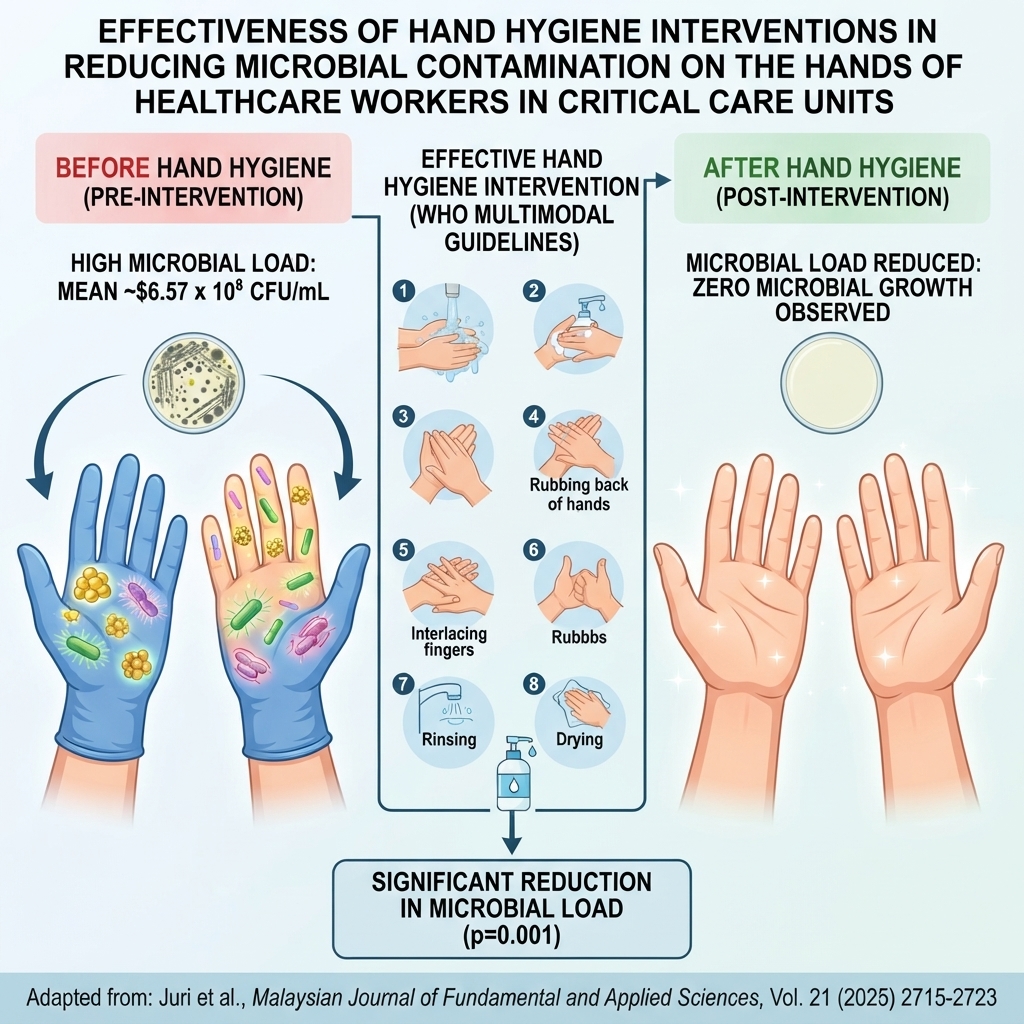
Adherence to hand hygiene guidelines is paramount in preventing the transmission of nosocomial infections within healthcare settings. Healthcare workers play a critical role in maintaining aseptic conditions and preventing the spread of pathogens. This study aimed to evaluate the effectiveness of hand hygiene in reducing microbial contamination on the hands of healthcare workers in critical care units, including the Intensive Care Unit, Neurological Intensive Care Unit, Coronary Care Unit, Cardiac Intensive Care Unit and Surgical Intensive Care Unit. A convenient sampling method was utilized to select 44 healthcare workers for the study. Microbial contamination on the hands of these healthcare workers was assessed before and after hand hygiene. Swab samples were collected from the dominant hands and analyzed using microbiological techniques, including culturing on nutrient agar and MacConkey agar, Gram staining and biochemical tests. The results demonstrated a significant reduction in microbial load on the hands of healthcare workers after they practiced hand hygiene (mean before hand hygiene: 6.57 x 10⁸ ± 2.31 x 10⁸ CFU/mL compared to after hand hygiene: 2.11 x 10⁸ ± 1.52 x 10⁸ CFU/mL), p = 0.001. Before the intervention, a large number of hand swab samples had microbial contamination, including potentially pathogenic microorganisms such as Staphylococcus aureus, Staphylococcus spp., Escherichia coli, and Klebsiella pneumoniae. However, after the intervention, no microbial growth was observed on any hand sample. In conclusion, these findings unequivocally demonstrate the crucial role of effective hand hygiene in preventing the transmission of nosocomial infections within healthcare settings. Consistent adherence to hand hygiene guidelines is essential for maintaining a safe and hygienic environment for patients and healthcare workers alike.
References
World Health Organization. (2022). Global report on infection prevention and control. Geneva, Switzerland: World Health Organization.
Chow, A., Lee, M., Lee, J., et al. (2021). A hospital-associated cluster of COVID-19 case reports and analysis of transmission networks in Malaysia. BMC Infectious Diseases, 21(1), 1–10. Chow, A., Lee, M., Lee, J., et al. (2021). A hospital-associated cluster of COVID-19 case reports and analysis of transmission networks in Malaysia. BMC Infectious Diseases, 21(1), 1–10.
Haque, M., Sartelli, M., McKimm, J., & Bakar, M. A. (2018). Health care-associated infections – an overview. Infection and Drug Resistance, 11, 2321–2333.
Centers for Disease Control and Prevention. (2022). Hand hygiene in healthcare settings. https://www.cdc.gov/handhygiene/index.html.
Protano, C., Andreoli, R., Guidotti, M., et al. (2019). Inadequate hand hygiene compliance among healthcare workers and its role in transmission of antibiotic-resistant bacteria. Journal of Hospital Infection, 101(4), 433–440.
Rücker, M., Agahi, N., Cederström, A., et al. (2022). COVID-19 risk factors among healthcare workers: A Swedish cohort study during the first pandemic wave. BMC Public Health, 22(1), 1234.
El-Saed, M., Alshamrani, M. M., Al Zunitan, M., Almohrij, S., Alharbi, F., & Balkhy, H. H. (2018). Impact of a multicomponent hand hygiene intervention strategy in reducing infection rates at a university hospital in Saudi Arabia. Antimicrobial Resistance and Infection Control, 7, 103.
Gould, D. J., Creedon, S., Jeanes, A., Drey, N. S., Chudleigh, J. H., & Moralejo, D. (2023). Individual hand hygiene improvements and effects on healthcare-associated infections: A long-term follow-up study using an electronic hand hygiene monitoring system. Journal of Hospital Infection, 134, 79–85.
Kylesh, D. P., Helen, P., Juan, S., & Maria, F. (2021). Microbial contamination of the hands of healthcare providers in the operating theatre of a central hospital. Southern African Journal of Infectious Diseases, 36(1), a316.
Rahman, N., Lim, C. J., Mohamad Ibrahim, M. F., et al. (2023). Incidence and risk factors of surgical site infections caused by multidrug-resistant organisms in Kuala Lumpur: A cohort study. Antimicrobial Resistance and Infection Control, 12, 45.
Aznida, A., Anis Safura, R., Liyana, I., & Siti Rohana, S. (2022). A nationwide survey on the hand hygiene improvement in Malaysia hospitals using the WHO Hand Hygiene Self-Assessment Framework (HHSAF) tool. In Asia Pacific Conference on Public Health (APCPH). https://apcph.cphm.my/2022/07/a-nationwide-survey-on-the-hand-hygiene-improvement-in-malaysia-hospitals-using-the-who-hand-hygiene-self-assessment-framework-hhsaf-tool.
World Health Organization. (2022). WHO guidelines on hand hygiene in health care: A summary. Geneva, Switzerland: World Health Organization.
Abd Rahim, M. H., & Ibrahim, M. I. (2022). Hand hygiene knowledge, perception, and self-reported performance among nurses in Kelantan, Malaysia: A cross-sectional study. BMC Nursing, 21(1), 1.
Patruno, A., & Vitali, M. (2024). Improving hand hygiene adherence through targeted educational interventions: Evidence from a hospital-based program. Journal of Preventive Medicine and Hygiene, 65(1), E10–E16.
Pires, D., Gayet-Ageron, A., Bellissimo-Rodrigues, F., et al. (2023). Educating healthcare workers to optimal hand hygiene: Impact of a WHO multimodal improvement strategy on compliance. Clinical Infectious Diseases, 76(4), e1342–e1349.
Abdullah, M. A., Anua, S. M., Suraiya, S., Mazlan, N., & Juri, J. (2025). Airborne and surface cross-contamination of bacteria resistant to carbapenem in critical units of a teaching hospital. Malaysian Journal of Fundamental and Applied Sciences, 21(2025), 1566–1576.
Mody, L., Washer, L. L., Kaye, K. S., Gibson, K., Saint, S., Reyes, K., Cassone, M., Mantey, J., Cao, J., Altamimi, S., Perri, M., Sax, H., Chopra, V., & Zervos, M. (2019). Multidrug-resistant organisms in hospitals: What is on patient hands and in their rooms. Clinical Infectious Diseases, 69(11), 1837–1844.
Nabil, D., Nader, K., Mohammed, S., Amjad, S., & Vinod Kumar, B. (2023). Bacterial contamination of mobile phones used by healthcare workers in critical care units: A cross-sectional study from Saudi Arabia. Microorganisms. https://www.ncbi.nlm.nih.gov/pmc/articles/PMC10459851/.
Khan, M. I., Kashif, M., Ehsan, R., Faizuddin, M., Iqbal, S., & Jamil, H. (2020). Microbial contamination of white coats, hands and mobile phones of health care workers. International Journal of Pathology, 18(2), 46–50.
Kulshrestha, N., Ghatak, T., Gupta, P., Singh, M., Agarwal, J., & Mishra, P. (2021). Surveillance of health-care workers’ hands to detect carriage of multidrug-resistant Staphylococcus spp. in a tertiary care center: An observational study. Medical Journal of Dr. D.Y. Patil Vidyapeeth, 14(4), 403.
Storm, H., Svend, V., Martin, B., Matthias, G., & Hans Jørn, K. (2019). Hand hygiene perception and self-reported hand hygiene compliance among emergency medical service providers: A Danish survey. Scandinavian Journal of Trauma, Resuscitation and Emergency Medicine. https://sjtrem.biomedcentral.com/articles/10.1186/s13049-019-0587-5.
Bhatta, D. R., Koirala, S., Baral, A., Amatya, N. M., & Parajuli, S. (2022). Methicillin-resistant Staphylococcus aureus contamination of frequently touched objects in intensive care units: Potential threat of nosocomial infections. Canadian Journal of Infectious Diseases and Medical Microbiology. https://www.ncbi.nlm.nih.gov/pmc/articles/PMC9148222/.
Menezes, R. de P., Marques, L. de A., Silva, F. F., Silva, N. B. S., & Alves, P. G. V. (2022). Inanimate surfaces and air contamination with multidrug resistant species of Staphylococcus in the neonatal intensive care unit environment. Microorganisms. https://www.mdpi.com/2076-2607/10/3/567.
Anum, L. A., Umrah, I., Mehwish, S., & Hhira, W. (2021). Isolation and identification of microbes on hands and mobile phones causing urinary tract infections. Pakistan Journal of Medicine and Dentistry. https://pjmd.zu.edu.pk/volume-10-issue-1/isolation-and-identification-of-microbes-on-hands-and-mobile-phones-causing-urinary-tract-infections/.
Downloads
Published
Issue
Section
License
Copyright (c) 2025 Jesseca Juri, Dr. Siti Marwanis Anua, Siti Suraiya, Nurzafirah Mazlan, Muhammad Azim Abdullah

This work is licensed under a Creative Commons Attribution-NonCommercial 4.0 International License.