
A Novel Weighted TOPSIS-based Method for Node Centrality Analysis in Complex Networks
DOI:
https://doi.org/10.11113/mjfas.v21n5.4412Keywords:
Complex network, Node centrality, Critical nodes, Benchmark-based weighting, Weighted Modified-TOPSIS (WM-TOPSIS)Abstract
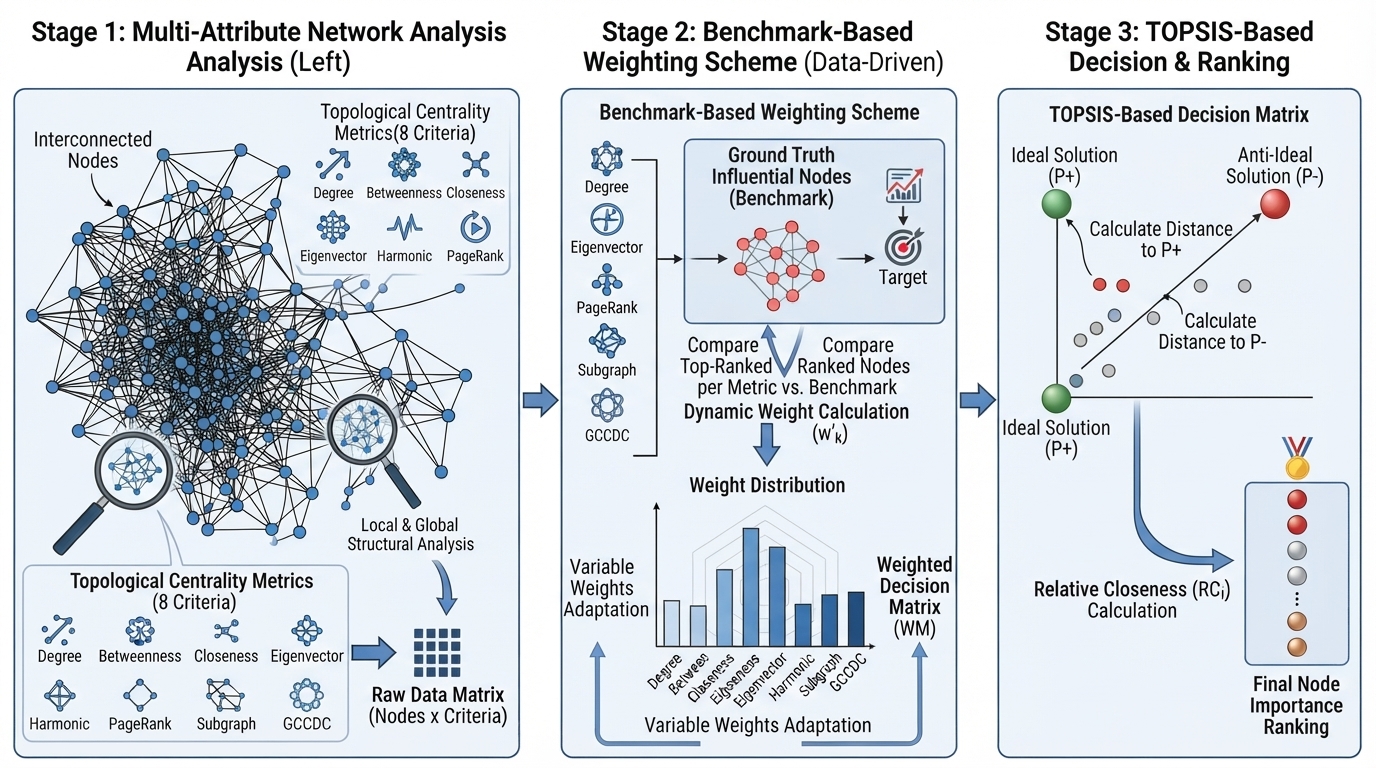
Complex networks are prevalent across domains such as biology, social science, and engineering, where identifying critical nodes is essential for applications such as disease control, traffic optimization, and discovering pivotal proteins. Various centrality metrics exist to assess node importance, each with unique strengths and limitations in capturing significance. Recently, the Technique for Order Performance by Similarity to Ideal Solution (TOPSIS) method is used to pinpoint key nodes by considering centrality measures as multiple attributes of the network. This paper introduces a Weighted Modified-TOPSIS (WM-TOPSIS) method, enhancing TOPSIS by integrating multiple topological centrality measures and proposing a novel benchmark-based, data-driven algorithm to dynamically assign weights to attributes. The effectiveness of WM-TOPSIS was evaluated on Protein-Protein Interaction (PPI) networks of Saccharomyces cerevisiae (Yeast) and Escherichia coli (E. coli). On Yeast, WM-TOPSIS achieved a sensitivity (SN) of 0.5150, specificity (SP) of 0.7455, and accuracy of 0.6927. On E. coli, it recorded an SN of 0.8031, SP of 0.4355, and accuracy of 0.4697. These results highlight WM-TOPSIS’s potential to improve the detection of critical nodes, offering a robust framework for biological network analysis and broader applications.
References
Hamouda, E., ElHafsi, M., & Son, J. (2024). Securing network resilience: Leveraging node centrality for cyberattack mitigation and robustness enhancement. Information Systems Frontiers. Advance online publication. https://doi.org/10.1007/s10796-024-10477-y.
Kallakunta, S., & Sreenivas, A. (2024). Optimizing wireless sensor networks by identifying key nodes using centrality measures. Momona Ethiopian Journal of Science, 16(2), 289–295. https://doi.org/10.4314/mejs.v16i2.7.
Jain, A., & Reddy, B. V. R. (2013). Node centrality in wireless sensor networks: Importance, applications and advances. In Proceedings of the 2013 3rd IEEE International Advance Computing Conference (IACC 2013) (pp. 127–131). IEEE. https://doi.org/10.1109/IADCC.2013.6514207.
Ur Rehman, S., & Ubaida Fatima, P. (2025). Digital currency network centrality measure (DCNC): A new centrality measure for cryptocurrency datasets. [Preprint].
Gopalsamy, T., Thankappan, V., & Chandramohan, S. (2025). Investigating critical node identification in water networks through distance Laplacian energy centrality. Environmental Science and Pollution Research. Advance online publication. https://doi.org/10.1007/s11356-025-36118-8.
Rout, T., Mohapatra, A., Kar, M., & Muduly, D. K. (2025). Centrality-based approach for identifying essential cancer proteins in PPI networks. SN Computer Science, 6(1). https://doi.org/10.1007/s42979-024-03480-2.
Moiz, A., Fatima, U., & Zeeshan Ul Haque, M. (2024). A new framework for pinpointing crucial proteins in protein-protein interaction networks. IEEE Access, 12, 108425–108444. https://doi.org/10.1109/ACCESS.2024.3437215.
Lawson, S., Donovan, D., & Lefevre, J. (2024). An application of node and edge nonlinear hypergraph centrality to a protein complex hypernetwork. PLoS One, 19(10), e0311433. https://doi.org/10.1371/journal.pone.0311433.
Moiz, A., & Fatima, U. (2024). Key element identification in large biological datasets: An MCDM comparative study. In 2024 International Visualization, Informatics and Technology Conference (IVIT 2024) (pp. 153–158). IEEE. https://doi.org/10.1109/IVIT62102.2024.10692773.
Xu, W., Dong, Y., Guan, J., & Zhou, S. (2022). Identifying essential proteins from protein–protein interaction networks based on influence maximization. BMC Bioinformatics, 23, 466. https://doi.org/10.1186/s12859-022-04874-w.
Sprinzak, E., Sattath, S., & Margalit, H. (2003). How reliable are experimental protein-protein interaction data? Journal of Molecular Biology, 327(5), 919–923. https://doi.org/10.1016/S0022-2836(03)00239-0.
Wuchty, S., & Stadler, P. F. (2003). Centers of complex networks. Journal of Theoretical Biology, 223(1), 45–53. https://doi.org/10.1016/S0022-5193(03)00071-7.
Estrada, E., & Rodríguez-Velázquez, J. A. (2005). Subgraph centrality in complex networks. Physical Review E, 71(5), 056103. https://doi.org/10.1103/PhysRevE.71.056103.
Newman, M. E. J. (2005). A measure of betweenness centrality based on random walks. Social Networks, 27(1), 39–54. https://doi.org/10.1016/j.socnet.2004.11.009.
Stephenson, K., & Zelen, M. (1989). Rethinking centrality: Methods and examples. Social Networks, 11(1), 1–37. https://doi.org/10.1016/0378-8733(89)90016-6.
Bonacich, P. (2007). Some unique properties of eigenvector centrality. Social Networks, 29(4), 555–564. https://doi.org/10.1016/j.socnet.2007.04.002.
Freeman, L. C. (1978). Centrality in social networks conceptual clarification. Social Networks, 1(3), 215–239. https://doi.org/10.1016/0378-8733(78)90021-7.
Li, M., Wang, J., Chen, X., Wang, H., & Pan, Y. (2011). A local average connectivity-based method for identifying essential proteins from the network level. Computational Biology and Chemistry, 35(3), 143–150. https://doi.org/10.1016/j.compbiolchem.2011.04.002.
Fatima, U., Hina, S., & Wasif, M. (2023). A novel global clustering coefficient-dependent degree centrality (GCCDC) metric for large network analysis using real-world datasets. Journal of Computational Science, 70, 102008. https://doi.org/10.1016/j.jocs.2023.102008.
Zhao, B., Wang, J., Li, X., & Wu, F. X. (2016). Essential protein discovery based on a combination of modularity and conservatism. Methods, 110, 54–63. https://doi.org/10.1016/j.ymeth.2016.07.005.
Li, M., Li, W., Wu, F. X., Pan, Y., & Wang, J. (2018). Identifying essential proteins based on sub-network partition and prioritization by integrating subcellular localization information. Journal of Theoretical Biology, 447, 65–73. https://doi.org/10.1016/j.jtbi.2018.03.029.
Lei, X., Zhao, J., Fujita, H., & Zhang, A. (2018). Predicting essential proteins based on RNA-Seq, subcellular localization and GO annotation datasets. Knowledge-Based Systems, 151, 136–148. https://doi.org/10.1016/j.knosys.2018.03.027.
Li, M., Niu, Z., Chen, X., Zhong, P., Wu, F., & Pan, Y. (2016). A reliable neighbor-based method for identifying essential proteins by integrating gene expressions, orthology, and subcellular localization information. IEEE/ACM Transactions on Computational Biology and Bioinformatics, 13(5), 845–855. https://doi.org/10.1109/TCBB.2016.2530067.
Luo, J., & Qi, Y. (2015). Identification of essential proteins based on a new combination of local interaction density and protein complexes. PLoS One, 10(6), e0131418. https://doi.org/10.1371/journal.pone.0131418.
Li, M., Zhang, H., Wang, J. X., & Pan, Y. (2012). A new essential protein discovery method based on the integration of protein-protein interaction and gene expression data. BMC Systems Biology, 6, 15. https://doi.org/10.1186/1752-0509-6-15.
Zhang, X., Xu, J., & Xiao, W. X. (2013). A new method for the discovery of essential proteins. PLoS One, 8(3), e58763. https://doi.org/10.1371/journal.pone.0058763.
Peng, W., Wang, J., Wang, W., Liu, Q., Wu, F. X., & Pan, Y. (2012). Iteration method for predicting essential proteins based on orthology and protein-protein interaction networks. BMC Systems Biology, 6, 87. https://doi.org/10.1186/1752-0509-6-87.
Tzeng, G. H., & Huang, J. J. (2011). Multiple attribute decision making: Methods and applications. CRC Press.
Du, Y., Gao, C., Hu, Y., Mahadevan, S., & Deng, Y. (2014). A new method of identifying influential nodes in complex networks based on TOPSIS. Physica A: Statistical Mechanics and Its Applications, 399, 57–69. https://doi.org/10.1016/j.physa.2013.12.031
Hu, J., Du, Y., Mo, H., Wei, D., & Deng, Y. (2016). A modified weighted TOPSIS to identify influential nodes in complex networks. Physica A: Statistical Mechanics and Its Applications, 444, 73–85. https://doi.org/10.1016/j.physa.2015.09.028.
Fei, L., & Deng, Y. (2017). A new method to identify influential nodes based on relative entropy. Chaos, Solitons & Fractals, 104, 257–267. https://doi.org/10.1016/j.chaos.2017.08.010.
Yang, Y., Yu, L., Zhou, Z., Chen, Y., & Kou, T. (2019). Node importance ranking in complex networks based on multicriteria decision making. Mathematical Problems in Engineering, 2019, 9728742. https://doi.org/10.1155/2019/9728742.
Ishfaq, U., Khan, H. U., & Iqbal, S. (2022). Identifying the influential nodes in complex social networks using centrality-based approach. Journal of King Saud University - Computer and Information Sciences, 34(10), 9376–9392. https://doi.org/10.1016/j.jksuci.2022.09.016.
Yang, P., Liu, X., & Xu, G. (2018). A dynamic weighted TOPSIS method for identifying influential nodes in complex networks. Modern Physics Letters B, 32(19), 1850216. https://doi.org/10.1142/S0217984918502160.
Yang, P., Xu, G., & Chen, H. (2018). Multi-attribute ranking method for identifying key nodes in complex networks based on GRA. International Journal of Modern Physics B, 32(32), 1850363. https://doi.org/10.1142/S0217979218503630.
Yang, Y., Yu, L., Wang, X., Chen, S., Chen, Y., & Zhou, Y. (2020). A novel method to identify influential nodes in complex networks. International Journal of Modern Physics C, 31(2), 2050029. https://doi.org/10.1142/S0129183120500229.
Mari, J., Ortega, E., Eballe, R. G., & High, P. S. (2022). Harmonic centrality in some graph families. Mathematics, 10(21), 4128. https://doi.org/10.3390/math10214128.
Page, L., Brin, S., Motwani, R., & Winograd, T. (1999). The PageRank citation ranking: Bringing order to the web. In Proceedings of the 7th International World Wide Web Conference (WWW 1999).
Database of Interacting Proteins (DIP). (2023, July 2). DIP::Stat: Database. Retrieved from https://dip.doe-mbi.ucla.edu/dip/Stat.cgi?SM=0.
Zhong, J., Wang, J., Zhang, Y., Pan, Y., Li, M., & Wu, F. X. (2021). A novel essential protein identification method based on PPI networks and gene expression data. BMC Bioinformatics, 22, 580. https://doi.org/10.1186/s12859-021-04175-8.
Zhong, S., Zhang, H., & Deng, Y. (2022). Identification of influential nodes in complex networks: A local degree dimension approach. Information Sciences, 610, 994–1009. https://doi.org/10.1016/j.ins.2022.07.172.
Downloads
Published
Issue
Section
License
Copyright (c) 2025 Abdul Moiz, Ubaida Fatima, Muhammad Zeeshan Ul Haque

This work is licensed under a Creative Commons Attribution-NonCommercial 4.0 International License.