
Structure of Intermolecular Drug-Polymer Interactions: Ascorbic Acid−PVP K30 Complex
DOI:
https://doi.org/10.11113/mjfas.v21n5.4352Keywords:
FTIR spectroscopy, DFT calculation, amorphous, crystalline, ascorbic acid, PVP K30, melt-quenchingAbstract
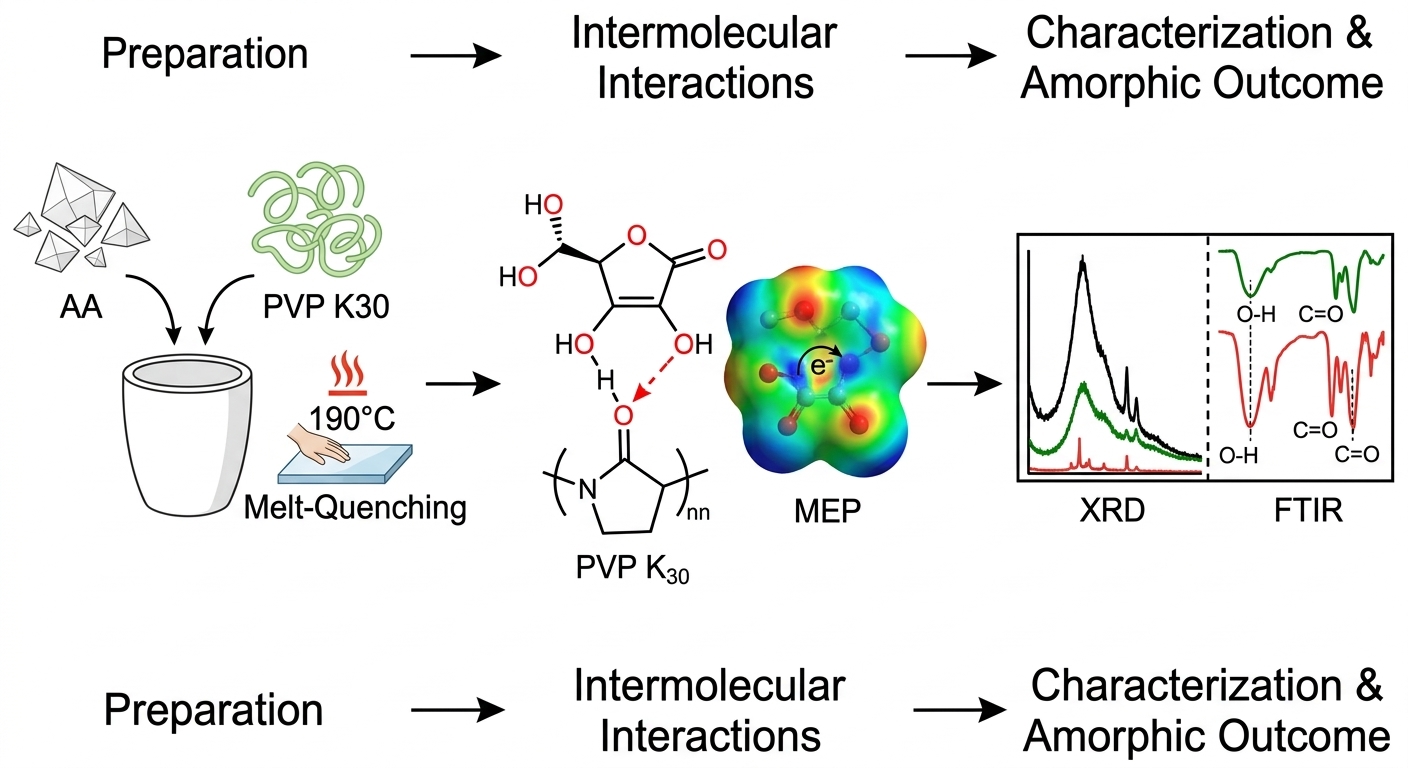
Ascorbic acid (AA) is widely used in pharmaceuticals and food industries, predominantly exists in a crystalline form due to its strong intramolecular hydrogen bonding and high lattice energy. This research explores the structural and intermolecular interactions of AA in a co-amorphous system with polyvinylpyrrolidone K30 (PVP K30), prepared by melt-quenching. The findings reveal that various hydrogen bonding between the hydroxyl groups of AA and the carbonyl groups of PVP K30 plays a key role in forming the amorphous phase. The broadening and shifting of vibrational peaks in FTIR spectra suggest intermolecular interactions, supported by DFT calculations that show reduced HOMO-LUMO energy gaps and enhanced dipole moments in the complex system. FTIR suggests molecular-level interactions promoting amorphization consistent X-ray diffraction (XRD) analysis that confirm the presence of some degree of amorphicity based on peak broadening. This highlights the complex interplay between local molecular interactions and long-range structural organization. Despite the limitations, the results indicate that PVP K30 has the potential to reduce the crystallinity of ascorbic acid and stabilize the amorphous phase, yet not completely. These findings provide insight into the challenges of achieving full amorphization and suggest further optimization in polymer selection and preparation techniques for improved stability.
References
Christina, B., Taylor, L. S., & Mauer, L. J. (2015). Physical stability of L-ascorbic acid amorphous solid dispersions in different polymers: A study of polymer crystallization inhibitor properties. Food Research International, 76, 867–877.
Sanchez, J. O., Ismail, Y., Christina, B., & Mauer, L. J. (2018). Degradation of L‐ascorbic acid in the amorphous solid state. Journal of Food Science, 83(3), 670–681.
Nayak, G., Trivedi, M., Branton, A., Trivedi, D., & Jana, S. (2019). Physicochemical and thermal characterization of ascorbic acid: Impact of biofield energy treatment. Journal of Pharmaceutical and Pharmacological Sciences, 1(2019).
Yin, X., Chen, K., Cheng, H., Chen, X., Feng, S., Song, Y., & Liang, L. (2022). Chemical stability of ascorbic acid integrated into commercial products: A review on bioactivity and delivery technology. Antioxidants, 11(1), 153.
Mehmood, T., Ahmed, A., Ahmad, Z., Javed, M. S., Sharif, H. R., Shah, F. U. H., ... & Murtaza, S. (2022). Physicochemical characteristics of mixed surfactant-stabilized L-ascorbic acid nanoemulsions during storage. Langmuir, 38(31), 9500–9506.
Kilpeläinen, T., Ervasti, T., Uurasjärvi, E., Koistinen, A., Ketolainen, J., Korhonen, O., & Pajula, K. (2022). Detecting different amorphous–amorphous phase separation patterns in co-amorphous mixtures with high resolution imaging FTIR spectroscopy. European Journal of Pharmaceutics and Biopharmaceutics, 180, 161–169.
Rautaniemi, K., Vuorimaa-Laukkanen, E., Strachan, C. J., & Laaksonen, T. (2018). Crystallization kinetics of an amorphous pharmaceutical compound using fluorescence-lifetime-imaging microscopy. Molecular Pharmaceutics, 15(5), 1964–1971.
Ismail, Y., & Mauer, L. J. (2020). Phase transitions of ascorbic acid and sodium ascorbate in a polymer matrix and effects on vitamin degradation. Journal of Food Process Engineering, 43(5), e13073.
Park, H., Seo, H. J., Hong, S. H., Ha, E. S., Lee, S., Kim, J. S., ... & Hwang, S. J. (2020). Characterization and therapeutic efficacy evaluation of glimepiride and L-arginine co-amorphous formulation prepared by supercritical antisolvent process: Influence of molar ratio and preparation methods. International Journal of Pharmaceutics, 581, 119232.
Wdowiak, K., Tajber, L., Miklaszewski, A., & Cielecka-Piontek, J. (2024). Sweeteners show a plasticizing effect on PVP K30—A solution for the hot-melt extrusion of fixed-dose amorphous curcumin-hesperetin solid dispersions. Pharmaceutics, 16(5), 659.
Saberi, A., Kouhjani, M., Yari, D., Jahani, A., Asare-Addo, K., Kamali, H., & Nokhodchi, A. (2023). Development, recent advances, and updates in binary, ternary co-amorphous systems, and ternary solid dispersions. Journal of Drug Delivery Science and Technology, 104746.
Bejaoui, M., Galai, H., Amara, A. B. H., & Ben Rhaiem, H. (2019). Formation of water soluble and stable amorphous ternary system: Ibuprofen/β-cyclodextrin/PVP. Glass Physics and Chemistry, 45, 580–588.
Malkawi, R., Malkawi, W. I., Al-Mahmoud, Y., & Tawalbeh, J. (2022). Current trends on solid dispersions: Past, present, and future. Advances in Pharmacological and Pharmaceutical Sciences, 2022(1), 5916013.
Riekes, M. K., Engelen, A., Appeltans, B., Rombaut, P., Stulzer, H. K., & Van den Mooter, G. (2016). New perspectives for fixed dose combinations of poorly water-soluble compounds: A case study with ezetimibe and lovastatin. Pharmaceutical Research, 33, 1259–1275
Orszulak, L., Lamrani, T., Tarnacka, M., Hachuła, B., Jurkiewicz, K., Zioła, P., ... & Kamiński, K. (2024). The impact of various poly(vinylpyrrolidone) polymers on the crystallization process of metronidazole. Pharmaceutics, 16(1), 136.
Sun, M., Wu, C., Fu, Q., Di, D., Kuang, X., Wang, C., ... & Sun, J. (2016). Solvent-shift strategy to identify suitable polymers to inhibit humidity-induced solid-state crystallization of lacidipine amorphous solid dispersions. International Journal of Pharmaceutics, 503(1–2), 238–246.
Zapata, F., López-Fernández, A., Ortega-Ojeda, F., Quintanilla, G., García-Ruiz, C., & Montalvo, G. (2021). Introducing ATR-FTIR spectroscopy through analysis of acetaminophen drugs: Practical lessons for interdisciplinary and progressive learning for undergraduate students. Journal of Chemical Education, 98(8), 2675–2686.
Singh, G., Mohanty, B. P., & Saini, G. S. S. (2016). Structure, spectra and antioxidant action of ascorbic acid studied by density functional theory, Raman spectroscopic and nuclear magnetic resonance techniques. Spectrochimica Acta Part A: Molecular and Biomolecular Spectroscopy, 155, 61–74.
Barra, P. A., Márquez, K., Gil-Castell, O., Mujica, J., Ribes-Greus, A., & Faccini, M. (2019). Spray-drying performance and thermal stability of L-ascorbic acid microencapsulated with sodium alginate and gum Arabic. Molecules, 24(16), 2872.
Orszulak, L., Lamrani, T., Bernat, R., Tarnacka, M., Żakowiecki, D., Jurkiewicz, K., ... & Kamińska, E. (2024). The influence of PVP polymer topology on the liquid crystalline order of itraconazole in binary systems. Molecular Pharmaceutics.
Joseph, A., & Mathew, S. (2021). Electronic properties of PVP-ionic liquid composite: Spectroscopic and DFT-based thermochemical studies on the effect of anions. Iranian Polymer Journal, 30(5), 505–512.
Blinov, A. V., Nagdalian, A. A., Povetkin, S. N., Gvozdenko, A. A., Verevkina, M. N., Rzhepakovsky, I. V., ... & Shariati, M. A. (2022). Surface-oxidized polymer-stabilized silver nanoparticles as a covering component of suture materials. Micromachines, 13(7), 1105.
Guinet, Y., Paccou, L., & Hédoux, A. (2023). Mechanism for stabilizing an amorphous drug using amino acids within co-amorphous blends. Pharmaceutics, 15(2), 337.
Zeinalipour-Yazdi, C. D., & Loizidou, E. Z. (2021). An experimental FTIR-ATR and computational study of H-bonding in ethanol/water mixtures. Chemical Physics, 550, 111295.
Rosiak, N., Tykarska, E., & Cielecka-Piontek, J. (2024). Myricetin amorphous solid dispersions—Antineurodegenerative potential. Molecules, 29(6), 1287.
Chavan, R. B., Lodagekar, A., Yadav, B., & Shastri, N. R. (2020). Amorphous solid dispersion of nisoldipine by solvent evaporation technique: Preparation, characterization, in vitro, in vivo evaluation, and scale-up feasibility study. Drug Delivery and Translational Research, 10, 903–918.
Browne, E., Worku, Z. A., & Healy, A. M. (2020). Physicochemical properties of poly-vinyl polymers and their influence on ketoprofen amorphous solid dispersion performance: A polymer selection case study. Pharmaceutics, 12(5), 433.
Martínez, L. M., Videa, M., Sosa, N. G., Ramírez, J. H., & Castro, S. (2016). Long-term stability of new co-amorphous drug binary systems: Study of glass transitions as a function of composition and shelf time. Molecules, 21(12), 1712.
Refaat, A., & Ibrahim, M. (2024). Microspectroscopic, DFT and QSAR study of PVP/CaCO₃ blends as potential bone-remineralization membranes. Egyptian Journal of Chemistry, 67(2), 29–41.
Nasidi, I. I., Kaygili, O., Majid, A., Bulut, N., Alkhedher, M., & ElDin, S. M. (2022). Halogen doping to control the band gap of ascorbic acid: A theoretical study. ACS Omega, 7(48), 44390–44397.
Ahmed, L., & Omer, R. (2020). Spectroscopic properties of vitamin C: A theoretical work. Cumhuriyet Science Journal, 41(4), 916–928.
Scharber, M. C., & Sariciftci, N. S. (2021). Low band gap conjugated semiconducting polymers. Advanced Materials Technologies, 6(4), 2000857.
Choudhary, V., Bhatt, A., Dash, D., & Sharma, N. (2019). DFT calculations on molecular structures, HOMO–LUMO study, reactivity descriptors and spectral analyses of newly synthesized diorganotin (IV) 2‐chloridophenylacetohydroxamate complexes. Journal of Computational Chemistry, 40(27), 2354–2363.
Adekoya, O. C., Adekoya, G. J., Sadiku, E. R., Hamam, Y., & Ray, S. S. (2022). Application of DFT calculations in designing polymer-based drug delivery systems: An overview. Pharmaceutics, 14(9), 1972.
Tchouadji Ndjike, M. B., Tchakoutio Nguetcho, A. S., Li, J., & Bilbault, J. M. (2021). Interplay role between dipole interactions and hydrogen bonding on proton transfer dynamics. Nonlinear Dynamics, 105(3), 2619–2643.
Kazemi, S., Daryani, A. S., Abdouss, M., & Shariatinia, Z. (2016). DFT computations on the hydrogen bonding interactions between methacrylic acid-trimethylolpropane trimethacrylate copolymers and letrozole as drug delivery systems. Journal of Theoretical and Computational Chemistry, 15(02), 1650015.
El Kassimi, A., Boutouil, A., El Himri, M., Laamari, M. R., & El Haddad, M. (2020). Selective and competitive removal of three basic dyes from single, binary and ternary systems in aqueous solutions: A combined experimental and theoretical study. Journal of Saudi Chemical Society, 24(7), 527–544.
Zhou, Y., Hao, W., Zhao, X., Zhou, J., Yu, H., Lin, B., ... & Fan, H. J. (2022). Electronegativity‐induced charge balancing to boost stability and activity of amorphous electrocatalysts. Advanced Materials, 34(11), 2100537.
Guerrero‐Pérez, M. O., & Patience, G. S. (2020). Experimental methods in chemical engineering: Fourier transform infrared spectroscopy—FTIR. The Canadian Journal of Chemical Engineering, 98(1), 25–33.
Downloads
Published
Issue
Section
License
Copyright (c) 2025 SITI MAISARAH AZIZ, faizani, Nur Balqish Ezlyn Ibrahim

This work is licensed under a Creative Commons Attribution-NonCommercial 4.0 International License.