
Utilization of Response Surface Methodology to Optimize Ammoniacal Nitrogen Adsorption Efficiency from Palm Oil Mill Secondary Effluent Using Palm Empty Fruit Bunch as Adsorbent
DOI:
https://doi.org/10.11113/mjfas.v21n5.4326Keywords:
Response Surface Methodology, Central Composite Design, Langmuir isotherm, palm EFB, palm oil mill secondary effluentAbstract
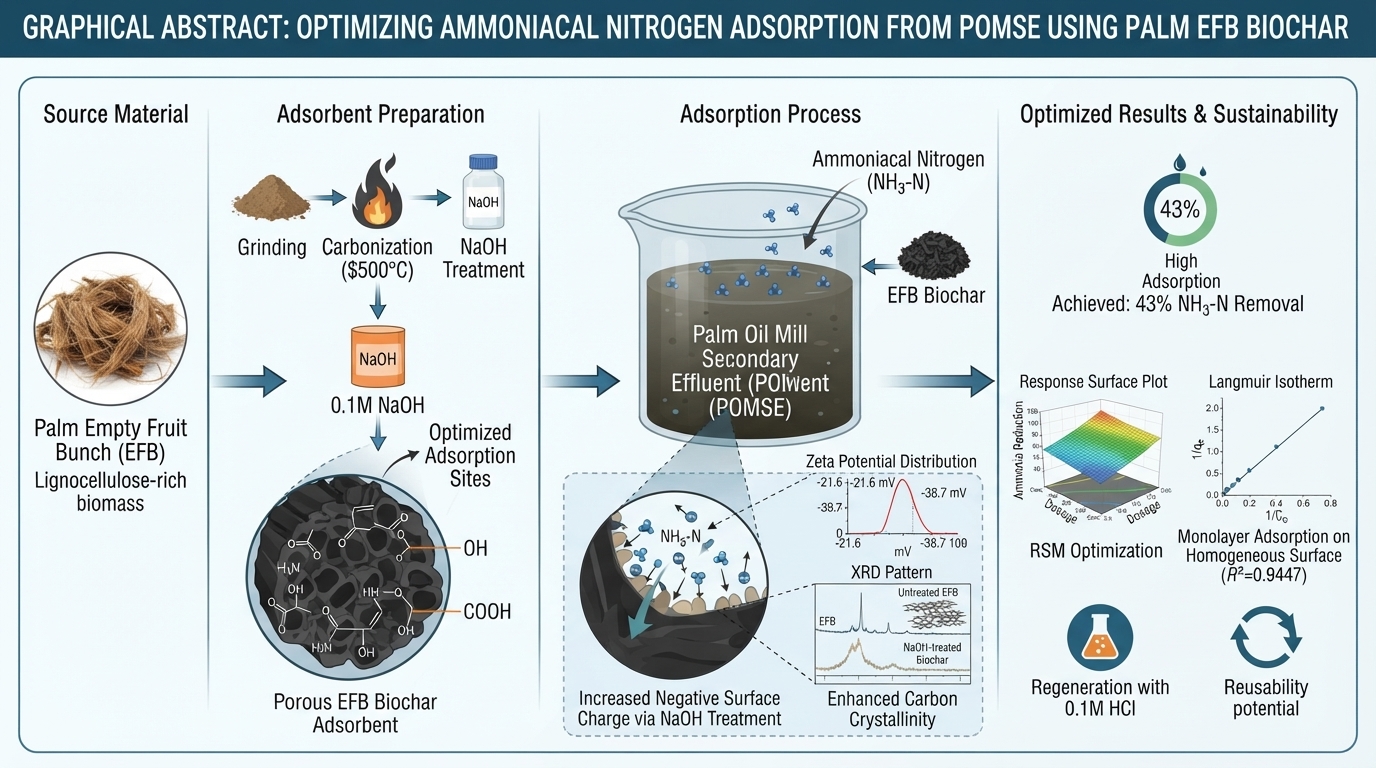
The disposal of ammonia-laden wastewater from the palm oil industry presents a significant environmental challenge leading to water quality deterioration and adverse effects on aquatic ecosystems. The conventional methods for ammonia removal are often costly and complex necessitating the exploration of alternative solutions. This study investigates the use of palm empty fruit bunch (EFB) biochar as a sustainable adsorbent for the removal of ammonia from palm oil mill secondary effluent (POMSE). Employing Response Surface Methodology (RSM) with a Central Composite Design (CCD), the study has optimized key parameters including adsorbent dosage, initial ammonia concentration and carbonization temperature. The results demonstrated that palm EFB biochar effectively reduced ammonia levels, achieving removal efficiencies of approximately 30% at a dosage of 2 g/L and up to 43% at 4 g/L under optimal conditions (initial ammonia concentration of 292.5 mg/L and carbonization temperature of 500°C). The adsorption process conformed to the Langmuir isotherm model, indicating monolayer adsorption on a homogeneous surface. Characterization techniques such as Scanning Electron Microscopy (SEM) and Fourier Transform Infrared (FTIR) spectroscopy confirmed the structural integrity and functional interactions of the biochar with ammonia molecules. Additionally, the study explored the regeneration capabilities of the palm EFB biochar, highlighting its potential for repeated use in wastewater treatment applications. This research underscores the viability of utilizing agricultural waste as an effective and sustainable solution for ammonia removal, contributing to environmental sustainability and resource recovery in the palm oil industry.
References
-[1] Edwards, T. M., Puglis, H. J., Kent, D. B., Durán, J. L., Bradshaw, L. M., & Farag, A. M. (2024). Ammonia and aquatic ecosystems – A review of global sources, biogeochemical cycling, and effects on fish. Science of The Total Environment, 907, 167911. https://doi.org/10.1016/j.scitotenv.2023.167911.
Wyer, K. E., Kelleghan, D. B., Blanes-Vidal, V., Schauberger, G., & Curran, T. P. (2022). Ammonia emissions from agriculture and their contribution to fine particulate matter: A review of implications for human health. Journal of Environmental Management, 323, 116285. https://doi.org/10.1016/j.jenvman.2022.116285.
Deng, Z., Van Linden, N., Guillen, E., Spanjers, H., & Van Lier, J. B. (2021). Recovery and applications of ammoniacal nitrogen from nitrogen-loaded residual streams: A review. Journal of Environmental Management, 295, 113096. https://doi.org/10.1016/j.jenvman.2021.113096.
Bhagowati, B., & Ahamad, K. U. (2018). A review on lake eutrophication dynamics and recent developments in lake modeling. Ecohydrology & Hydrobiology, 19(1), 155–166. https://doi.org/10.1016/j.ecohyd.2018.03.002.
Sarma, D., & Kumar, D. (2024). Eutrophication in freshwater and its microbial implications. In CRC Press eBooks (pp. 194–209). https://doi.org/10.1201/9781003408543-14.
Lu, J., Hong, Y., Wei, Y., Gu, J., Wu, J., Wang, Y., Ye, F., & Lin, J. (2021). Nitrification mainly driven by ammonia-oxidizing bacteria and nitrite-oxidizing bacteria in an anammox-inoculated wastewater treatment system. AMB Express, 11(1). https://doi.org/10.1186/s13568-021-01321-6.
Azman, N. F., Katahira, T., Nakanishi, Y., Chisyaki, N., Uemura, S., Yamada, M., Takayama, K., Oshima, I., Yamaguchi, T., Hara, H., & Yamauchi, M. (2023). Sustainable oil palm biomass waste utilization in Southeast Asia: Cascade recycling for mushroom growing, animal feedstock production, and composting animal excrement as fertilizer. Cleaner and Circular Bioeconomy, 6, 100058. https://doi.org/10.1016/j.clcb.2023.100058
Chang, S. H. (2014). An overview of empty fruit bunch from oil palm as feedstock for bio-oil production. Biomass and Bioenergy, 62, 174–181. https://doi.org/10.1016/j.biombioe.2014.01.002.
Nasir, N., Daud, Z., Awang, H., Aziz, N. a. A., Ahmad, B., Ridzuan, M. B., Abubakar, M. H., & Tajarudin, H. A. (2018). Utilization of empty fruit bunch fibre as potential adsorbent for ammonia nitrogen removal in natural rubber wastewater. International Journal of Integrated Engineering, 10(8). https://doi.org/10.30880/ijie.2018.10.08.009.
Ahmad, T., Sethupathi, S., Bashir, M. J. K., & Tan, S. Y. (2022). Appraising the performance of oil palm fibre biochar for low concentration ammoniacal nitrogen recovery from aquaculture wastewater. Environmental Technology, 1–13. https://doi.org/10.1080/09593330.2022.2152735.
Singh, R. P., Ibrahim, M. H., Esa, N., & Iliyana, M. S. (2010). Composting of waste from palm oil mill: a sustainable waste management practice. Reviews in Environmental Science and Bio/Technology, 9(4), 331–344. https://doi.org/10.1007/s11157-010-9199-2.
Windiastuti, E., Suprihatin, N., Bindar, Y., & Hasanudin, U. (2022). Identification of potential application of oil palm empty fruit bunches (EFB): A review. IOP Conference Series Earth and Environmental Science, 1063(1), 012024. https://doi.org/10.1088/1755-1315/1063/1/012024.
Mkilima, T., Saspugayeva, G., Kaliyeva, G., Samatova, I., Rakhimova, B., Tuleuova, G., Tauyekel, A., Batyayeva, Y., Karibzhanova, R., & Cherkeshova, S. (2024). Enhanced Adsorption of Emerging Contaminants from Pharmaceutical Wastewater Using Alkaline-Treated Pineapple Leaf Fiber Integrated with UV-LED Technology. Case Studies in Chemical and Environmental Engineering, 10, 101000. https://doi.org/10.1016/j.cscee.2024.101000.
Ruan, Z., Di, J., Dong, Y., Sun, X., Zhang, J., Yuan, B., & Bao, S. (2023). Phosphate and ammonia nitrogen recovery from sewage sludge supernatants by coupled MgO-biomass ash and its potential as heavy metal adsorbent. Arabian Journal of Chemistry, 16(8), 104945. https://doi.org/10.1016/j.arabjc.2023.104945.
Dan, K., Bagi, F., Kosong, T., Kelapa, B., Nurul, S., Rosli, S., Harun, S., Md, J., & Othaman, R. (2017). Chemical and physical characterization of oil palm empty fruit bunch. Malaysian Journal of Analytical Science, 21(1), 188–196. https://doi.org/10.17576/mjas-2017-2101-22.
Li, Z., Lu, C., Xia, Z., Zhou, Y., & Luo, Z. (2007). X-ray diffraction patterns of graphite and turbostratic carbon. Carbon, 45(8), 1686–1695. https://doi.org/10.1016/j.carbon.2007.03.038.
Downloads
Published
Issue
Section
License
Copyright (c) 2025 Nurul Izzah Adnan, Dr. Mohammad Arif Budiman Bin Pauzan, Syazwan Hanani Meriam Suhaimy, Mohd Haiqal Abd Aziz, Siti Khadijah Hubadillah, Nur Fatihah Tajul Arifin, Norfadhilatuladha Abdullah

This work is licensed under a Creative Commons Attribution-NonCommercial 4.0 International License.