
Forecasting Kemaman River Water Level Using Hybrid ARIMA-STL Mode
DOI:
https://doi.org/10.11113/mjfas.v22n1.4293Keywords:
Machine learning, time series, predictive models, statistical method, flood forecastingAbstract
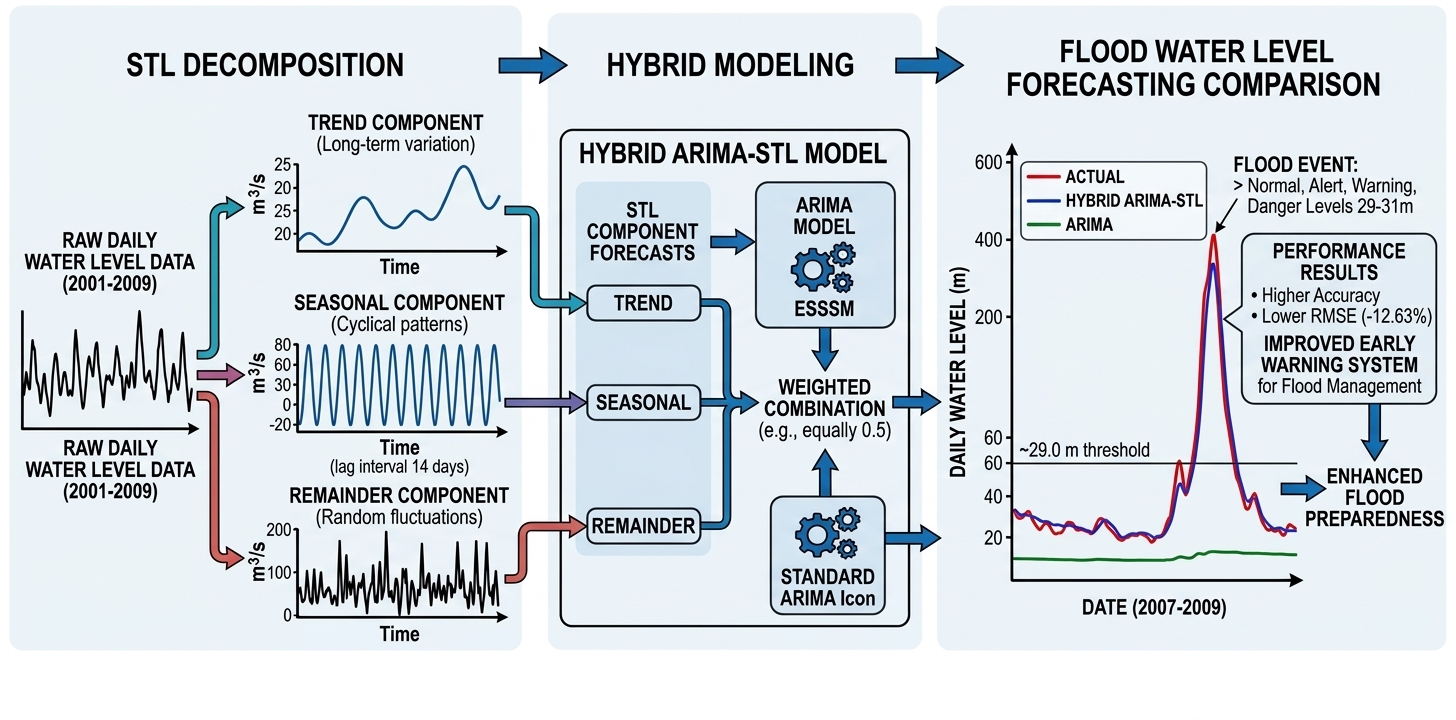
The rise in river water levels is a critical indicator for flood risk and early warning systems particularly in flood-prone areas such as the Kemaman River in Terengganu, Malaysia. This study aims to develop a reliable forecasting model to predict daily water level fluctuations and enhance flood preparedness. A total of 3,287 daily water level observations between 1 January 2001 and 31 December 2009 were used as the unit of analysis. The research addresses the limitation of traditional Autoregressive Integrated Moving Average (ARIMA) models in capturing non-linear and seasonal structures by proposing a hybrid forecasting model that integrates the ARIMA model with Seasonal and Trend Decomposition using Loess (STL). This hybrid ARIMA-STL model improves the ability to capture underlying seasonal patterns and long-term trends in water level data. The findings reveal that the hybrid model offers more accurate and stable predictions compared to the standalone ARIMA model that is effective for early warning systems and water resource management. This study fills a research gap by applying STL decomposition to enhance classical time series forecasting in hydrology that highlights the novelty of integrating statistical and decomposition techniques for improved daily river water level prediction.
References
Wohl, E., & Lininger, K. B. (2022). Hydrology and discharge. In A. Gupta (Ed.), Large rivers: Geomorphology and management (2nd ed., pp. 42–75). John Wiley & Sons.
Shah, S. M. H., Mustaffa, Z., & Yusof, K. W. (2017). Disasters worldwide and floods in the Malaysian region: A brief review. Indian Journal of Science and Technology, 10(2), 1–9. https://doi.org/10.17485/ijst/2017/v10i2/110385.
Brockwell, P. J., & Davis, R. A. (2009). Time series: Theory and methods (Springer Series in Statistics). Springer.
Parvaze, S., Khan, J. N., Kumar, R., & Allaie, S. P. (2021). Temporal flood forecasting for trans-boundary Jhelum River of Greater Himalayas. Theoretical and Applied Climatology, 144, 493–506. https://doi.org/10.1007/s00704-021-03562-8.
Makanda, K., Nzama, S., & Kanyerere, T. (2022). Assessing the role of water resources protection practice for sustainable water resources management: A review. Water, 14(19), 3153. https://doi.org/10.3390/w14193153.
Box, G. E. P., & Jenkins, G. M. (1976). Time series analysis: Forecasting and control. Holden-Day.
Bari, S. H., Rahman, M. T., Hussain, M. M., & Ray, S. (2015). Forecasting monthly precipitation in Sylhet City using ARIMA model. Civil and Environmental Research, 7(1), 69–77.
Adnan, R. M., Yuan, X., Kisi, O., & Curtef, V. (2017). Application of time series models for streamflow forecasting. Civil and Environmental Research, 9(3), 56–63.
Yan, B., Mu, R., Guo, J., Liu, Y., Tang, J., & Wang, H. (2022). Flood risk analysis of reservoirs based on full-series ARIMA model under climate change. Journal of Hydrology, 610, 127979. https://doi.org/10.1016/j.jhydrol.2022.127979.
Rashid, A., Alamgir, M., Ahmed, M. T., Salam, R., Islam, A. R. M. T., & Islam, A. (2022). Assessing and forecasting groundwater level fluctuation in Joypurhat district, northwest Bangladesh, using wavelet analysis and ARIMA modeling. Theoretical and Applied Climatology, 150(1–2), 327–345. https://doi.org/10.1007/s00704-022-04027-y.
Marsani, M. F., Someetheram, V., Mohd Kasihmuddin, M. S., Mohd Jamaludin, S. Z., Mansor, M., & Badyalina, B. (2024). The application of seasonal autoregressive integrated moving average (SARIMA) model in forecasting Malaysia mean sea level. In AIP Conference Proceedings (Vol. 3123, No. 1). AIP Publishing. https://doi.org/10.1063/5.0170840.
Zhang, M., Zhang, X., Qiao, W., Lu, Y., & Chen, H. (2023). Forecasting of runoff in the lower Yellow River based on the CEEMDAN–ARIMA model. Water Supply, 23(3), 1434–1450. https://doi.org/10.2166/ws.2023.097.
Agaj, T., Budka, A., Janicka, E., & Bytyqi, V. (2024). Using ARIMA and ETS models for forecasting water level changes for sustainable environmental management. Scientific Reports, 14(1), 22444. https://doi.org/10.1038/s41598-024-58839-9.
Qadir, J., Sultan Bhat, M., & Meer, M. S. (2024). Forecasting pre- and post-monsoon depth to water levels using the autoregressive integrated moving average (ARIMA) model in the outer plains of Jammu Himalaya. Journal of the Geological Society of India, 100(11), 1557–1567.
Cryer, J. D. (2008). Time series analysis. Springer.
Schreiber, T. (1999). Interdisciplinary application of nonlinear time series methods. Physics Reports, 308(1), 1–64. https://doi.org/10.1016/S0370-1573(98)00073-5.
Tebong, N. K., Simo, T., Takougang, A. N., & Ntanguen, P. H. (2023). STL-decomposition ensemble deep learning models for daily reservoir inflow forecast for hydroelectricity production. Heliyon. https://doi.org/10.1016/j.heliyon.2023.e20606.
Cleveland, R. B., Cleveland, W. S., McRae, J. E., & Terpenning, I. (1990). STL: A seasonal-trend decomposition procedure based on loess. Journal of Official Statistics, 6(1), 3–73.
Xu, Z., Mo, L., Zhou, J., Fang, W., & Qin, H. (2022). Stepwise decomposition–integration–prediction framework for runoff forecasting considering boundary correction. Science of the Total Environment, 851, 158342. https://doi.org/10.1016/j.scitotenv.2022.158342.
Yang, H., & Li, W. (2023). Data decomposition, seasonal adjustment method and machine learning combined for runoff prediction: A case study. Water Resources Management, 37(1), 557–581. https://doi.org/10.1007/s11269-022-03385-3.
Liu, J., Zhou, X. L., Zhang, L. Q., & Xu, Y. P. (2023). Forecasting short-term water demands with an ensemble deep learning model for a water supply system. Water Resources Management, 1–22. https://doi.org/10.1007/s11269-023-04089-w.
Box, G. E. P., Jenkins, G. M., Reinsel, G. C., & Ljung, G. M. (2016). Time series analysis: Forecasting and control (5th ed.). John Wiley & Sons.
Lyu, Z., Ororbia, A., & Desell, T. (2023). Online evolutionary neural architecture search for multivariate non-stationary time series forecasting. Applied Soft Computing, 130, 110522. https://doi.org/10.1016/j.asoc.2023.110522.
Zhang, J., Wei, Y. M., Li, D., Tan, Z., & Zhou, J. (2018). Short-term electricity load forecasting using a hybrid model. Energy, 158, 774–781. https://doi.org/10.1016/j.energy.2018.05.154.
Zhang, G. P. (2003). Time series forecasting using a hybrid ARIMA and neural network model. Neurocomputing, 50, 159–175. https://doi.org/10.1016/S0925-2312(01)00702-0.
Someetheram, V., Marsani, M. F., Kasihmuddin, M. S. M., Jamaludin, S. Z. M., & Mansor, M. A. (2024). Double decomposition with enhanced least-squares support vector machine to predict water level. Journal of Water and Climate Change, 15(6), 2582–2594. https://doi.org/10.2166/wcc.2024.486.
Lapedes, A., & Farber, R. (1987). How neural nets work. In Neural Information Processing Systems.
Someetheram, V., Marsani, M. F., Kasihmuddin, M. S. M., Jamaludin, S. Z. M., Mansor, M. A., & Zamri, N. E. (2025). Hybrid double ensemble empirical mode decomposition and k-nearest neighbors model with improved particle swarm optimization for water level forecasting. Alexandria Engineering Journal, 115, 423–433. https://doi.org/10.1016/j.aej.2025.01.082.
Rahayu, S. P., Prastyo, D. D., & Wijayanti, D. G. P. (2017). Hybrid model for forecasting time series with trend, seasonal and calendar variation patterns. In Journal of Physics: Conference Series (Vol. 890, No. 1, 012160). IOP Publishing. https://doi.org/10.1088/1742-6596/890/1/012160.
Downloads
Published
Issue
Section
License
Copyright (c) 2025 Vikneswari Someetheram, Muhammad Fadhil Marsani, Muhammad Wafiy Adli, Radhie Mohd Salleh, Basri Badyalina

This work is licensed under a Creative Commons Attribution-NonCommercial 4.0 International License.