
From Water to DNA: The Evaluation of Environmental DNA (eDNA) Sampling Volume in a Tropical Blackwater Peat Swamp in Dungun, Terengganu
DOI:
https://doi.org/10.11113/mjfas.v21n5.4246Keywords:
Environmental DNA, Blackwater Peat Swamps, Water Filtration, DNA Extraction, Biodiversity MonitoringAbstract
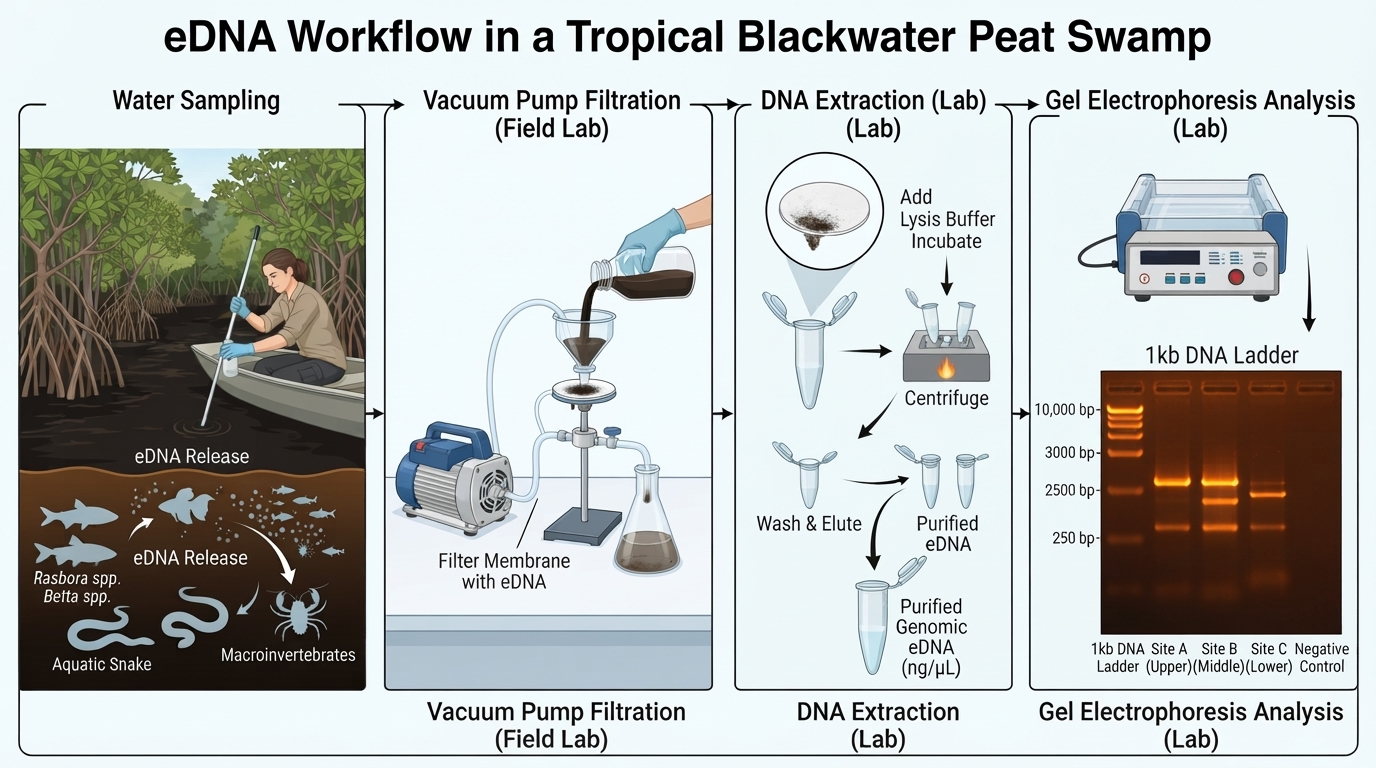
Blackwater peat swamps in Peninsular Malaysia support diverse aquatic species including cryptic and elusive taxa. However, extreme environmental conditions such as high acidity, turbidity and organic content hinder biodiversity monitoring, leaving these ecosystems largely understudied. Environmental DNA (eDNA) offers a non-invasive approach for species detection, thus providing a promising tool for biodiversity assessment. This study investigates the influence of water filtration volume and hydrological factors on DNA concentration in a blackwater peat in Dungun, Terengganu. Water sampling was conducted between November and December 2023 at three substations—designated as upper (A), middle (B) and lower (C) which spaced at 50-meter intervals with five replicate samples filtered from each substation. A total of 2L blackwater per station was filtered using a 0.45 µm mixed cellulose ester (MCE) membrane and an oil-free vacuum pump. eDNA was extracted using a modified DNeasy® Blood & Tissue Kit, quantified with a NanoDrop spectrophotometer and assessed through gel electrophoresis. Results showed that eDNA concentration varied significantly across stations and was influenced by the filtered water volume. The highest eDNA concentrations were recorded at the middle stretch (B1: 480 mL, 32.00 ng/μL; B2: 480 mL, 38.22 ng/μL), followed by the lower stretch (C1: 460 mL, 14.00 ng/μL; C3: 400 mL, 11.00 ng/μL). Sample replicates with filtration volumes below 400 mL (A5, B4, B5, C4, C5) failed to yield detectable DNA, likely due to insufficient water filtration. Despite optimal filtration volumes (>400 mL), A1 (420 mL, 7.66 ng/μL) and C2 (450 mL, 9.10 ng/μL) exhibited low DNA concentrations, suggesting hydrological influences that resulted in localized accumulation or dilution of genetic material. Replicate B3 from Station B (400 mL, 19.50 ng/μL) recorded higher DNA compared to replicate C1 and C3 as this area has a moderate and consistent water flow which likely enhanced the dispersal of eDNA throughout the water column. Gel electrophoresis confirmed high molecular weight DNA in samples exceeding 400 mL, particularly in B1 and B2 which displayed the brightest bands. Statistical analysis (Spearman's ρ = 0.809, p = 0.005) revealed a strong positive correlation between filtration volume and eDNA yield. In conclusion, optimizing filtration volume and accounting for hydrological conditions are crucial for effective eDNA sampling, emphasizing the need for standardized protocols to improve biodiversity monitoring in blackwater peat swamp ecosystems.
References
Wu, P., et al. (2024). Water filter: A rapid water environmental DNA collector in the field. Frontiers in Environmental Science, 1–11. https://doi.org/10.3389/fenvs.2024.1415338.
Goldberg, C. S., et al. (2016). Critical considerations for the application of environmental DNA methods to detect aquatic species. Methods in Ecology and Evolution, 7(11), 1299–1307. https://doi.org/10.1111/2041-210X.12595.
Suarez-Bregua, P., et al. (2022). Environmental DNA (eDNA) for monitoring marine mammals: Challenges and opportunities. Frontiers in Marine Science, 1–9. https://doi.org/10.3389/fmars.2022.987774.
Schenekar, T. (2023). The current state of eDNA research in freshwater ecosystems: Are we shifting from the developmental phase to standard application in biomonitoring? Hydrobiologia, 850(6), 1263–1282. https://doi.org/10.1007/s10750-022-04891-z.
Di Muri, C., et al. (2020). Read counts from environmental DNA (eDNA) metabarcoding reflect fish abundance and biomass in drained ponds. Metabarcoding and Metagenomics, 4, 97–112. https://doi.org/10.3897/mbmg.4.56959.
Nordstrom, B., et al. (2024). Environmental DNA reflects spatial distribution of a rare turtle in a lentic wetland assisted colonization site. Environmental DNA, 6(1), 1–16. https://doi.org/10.1002/edn3.507.
Jeunen, G. J., et al. (2019). Environmental DNA (eDNA) metabarcoding reveals strong discrimination among diverse marine habitats connected by water movement. Molecular Ecology Resources, 19(2). https://doi.org/10.1111/1755-0998.12982.
Handley, L. L., Read, D. S., Hahn, C., & Winfield, I. A. N. J. (2016). Environmental DNA metabarcoding of lake fish communities reflects long-term data from established survey methods. Molecular Ecology, 25, 3101–3119. https://doi.org/10.1111/mec.13660.
Hallam, J., Clare, E. L., Iwan, J., & Julia, J. (2021). Biodiversity assessment across a dynamic riverine system: A comparison of eDNA metabarcoding versus traditional fish surveying methods. Environmental DNA, 1–20. https://doi.org/10.1002/edn3.241.
Lacoursière-Roussel, A., Côté, G., Leclerc, V., & Bernatchez, L. (2016). Quantifying relative fish abundance with eDNA: A promising tool for fisheries management. Journal of Applied Ecology, 53(4), 1148–1157. https://doi.org/10.1111/1365-2664.12598.
Jaqueline, C., et al. (2023). Important role of endogenous microbial symbionts of fish gills in the challenging but highly biodiverse Amazonian blackwaters. Nature Communications, 14, 1–15. https://doi.org/10.1038/s41467-023-39461-x.
Yule, C. M., Lim, Y. Y., & Lim, T. Y. (2018). Recycling of phenolic compounds in Borneo’s tropical peat swamp forests. Journal of Tropical Forest Science, 30(2), 256–266.
Hubert, N., et al. (2016). DNA barcoding Indonesian freshwater fishes: Challenges and prospects. DNA Barcodes, 3(1). https://doi.org/10.1515/dna-2015-0018.
Sule, H. A., Ismail, A., Noor, M., & Azmai, A. (2016). A review of the ichthyofauna of Malaysian peat swamp forest. Malaysian Applied Biology, 45(2), 1–10.
Wittmann, F., et al. (2022). A review of the ecological and biogeographic differences of Amazonian floodplain forests. Water (Switzerland), 14(21), 1–28. https://doi.org/10.3390/w14213360.
Cheshire, D. L. M. (2015). A conceptual review of aquatic ecosystem function and fish dynamics in the Lake Eyre Basin (Technical Report Series No. 15/36). https://doi.org/10.13140/RG.2.2.11685.50406.
Norhisyam, M. S., et al. (2012). Water quality, diversity and distribution of blackwater fishes in selected locations of Raja Musa Peat Swamp Forest Reserve. Water Quality, Diversity and Distribution of Blackwater Fishes in Selected Locations of Raja Musa Peat Swamp Forest Reserve, June 2014, 1–10.
Azalina, N., et al. (2023). Anthropogenic disturbance of aquatic biodiversity and water quality of an urban river in Penang, Malaysia. Water Science and Engineering. https://doi.org/10.1016/j.wse.2023.01.003.
Pont, D., Meulenbroek, P., Valentini, A., & Erős, T. (2021). Congruency between two traditional and eDNA-based sampling methods in characterising taxonomic and trait-based structure of fish communities and community–environment relationships in lentic environments. Ecological Indicators, 129, 107952. https://doi.org/10.1016/j.ecolind.2021.107952.
Sciencedirect, S., et al. (2012). Fish sampling with active methods. Fisheries Research, 124, 1–3. https://doi.org/10.1016/j.fishres.2011.11.013.
Syazwan, M., et al. (2022). Peatlands in Southeast Asia: A comprehensive geological review. Earth-Science Reviews, 232, 104149. https://doi.org/10.1016/j.earscirev.2022.104149.
Sahu, A., Singh, M., Amin, A., & Mehboob, M. (2025). A systematic review on environmental DNA (eDNA) science: An eco-friendly survey method for conservation and restoration of fragile ecosystems. Ecological Indicators, 173, 113441. https://doi.org/10.1016/j.ecolind.2025.113441.
Ruppert, K. M., Kline, R. J., & Rahman, S. (2019). Past, present, and future perspectives of environmental DNA (eDNA) metabarcoding: A systematic review in methods, monitoring, and applications of global eDNA. Global Ecology and Conservation, 17, e00547. https://doi.org/10.1016/j.gecco.2019.e00547.
Shu, L., Ludwig, A., & Peng, Z. (2020). Standards for methods utilizing environmental DNA for detection of fish species. Genes, 11(3), 296. https://doi.org/10.3390/genes11030296.
Liang, Z., & Keeley, A. (2013). Filtration recovery of extracellular DNA from environmental water samples. Environmental Science & Technology, 47(16), 9324–9331. https://doi.org/10.1021/es401342b.
Stoeckle, M. Y., et al. (2022). Current laboratory protocols for detecting fish species with environmental DNA optimize sensitivity and reproducibility, especially for more abundant populations. Environmental DNA, 79, 403–412.
Kirsch, J. E., et al. (2024). Imperfect detection and misidentification affect inferences from data informing water operation decisions. North American Journal of Fisheries Management, 44(2), 335–358. https://doi.org/10.1002/nafm.10974.
Hinlo, R., Gleeson, D., Lintermans, M., & Furlan, E. (2017). Methods to maximise recovery of environmental DNA from water samples (pp. 1–22).
Thalinger, B., et al. (2021). A validation scale to determine the readiness of environmental DNA assays for routine species monitoring. Environmental DNA, 3(4), 823–836. https://doi.org/10.1002/edn3.189.
Jiang, P., et al. (2023). Comparison of environmental DNA metabarcoding and bottom trawling for detecting seasonal fish communities and habitat preference in a highly disturbed estuary. Ecological Indicators, 146, 109754. https://doi.org/10.1016/j.ecolind.2022.109754
Takahashi, M., et al. (2023). Aquatic environmental DNA: A review of the macro-organismal biomonitoring revolution. Science of the Total Environment, 873, 162322. https://doi.org/10.1016/j.scitotenv.2023.162322.
Shu, L., Chen, S., Li, P., & Peng, Z. (2022). Environmental DNA metabarcoding reflects fish DNA dynamics in lentic ecosystems: A case study of freshwater ponds. Fishes, 7(5), 257. https://doi.org/10.3390/fishes7050257.
Díaz, C., et al. (2020). Aquatic suspended particulate matter as source of eDNA for fish metabarcoding. Scientific Reports, 10(1), 1–8. https://doi.org/10.1038/s41598-020-71238-w.
Vourka, A., Karaouzas, I., & Parmakelis, A. (2023). River benthic macroinvertebrates and environmental DNA metabarcoding: A scoping review of eDNA sampling, extraction, amplification and sequencing methods. Biodiversity and Conservation, 32(13), 4221–4238. https://doi.org/10.1007/s10531-023-02710-y.
Simpfendorfer, C. A., Jaiteh, V. F., Wiley, T. R., Heupel, M. R., White, W. T., & Kyne, P. M. (2016). Environmental DNA detects critically endangered largetooth sawfish in the wild. Endangered Species Research, 30, 109–116. https://doi.org/10.3354/esr00731.
Djurhuus, A., Pitz, K., Sawaya, N. A., Rojas-Márquez, J., Michaud, B., Montes, E., Muller-Karger, F., & Breitbart, M. (2017). Evaluation of filtration and DNA extraction methods for environmental DNA biodiversity assessments across multiple trophic levels. Frontiers in Marine Science, 4, 314. https://doi.org/10.3389/fmars.2017.00314.
Su, G. Y., Jeffery, N. W., Nelson, R. J., Whelan, K., Smith, C., & Horne, J. B. (2024). Enumeration potential of environmental DNA for Pacific salmon stock assessments. Environmental DNA, 6(1), 1–20. https://doi.org/10.1002/edn3.508.
Munian, K., Naim, D. M., Tan, M. P., Ibrahim, M., Ismail, M. H., & Esa, Y. (2024). Environmental DNA metabarcoding of freshwater fish in Malaysian tropical rivers using short-read nanopore sequencing as a potential biomonitoring tool. Molecular Ecology Resources, 24(4), 1–14. https://doi.org/10.1111/1755-0998.13936.
Foote, A. D., Thomsen, P. F., Sveegaard, S., Wahlberg, M., Kielgast, J., Kyhn, L. A., Salling, A. B., Galatius, A., Orlando, L., & Gilbert, M. T. P. (2012). Investigating the potential use of environmental DNA (eDNA) for genetic monitoring of marine mammals. PLoS ONE, 7(8), e41781. https://doi.org/10.1371/journal.pone.0041781.
Mathon, L., Dufresne, F., Clusa, L., & Fernández, S. (2021). Benchmarking bioinformatic tools for fast and accurate eDNA metabarcoding species identification. Molecular Ecology Resources, 21(7), 2565–2578. https://doi.org/10.1111/1755-0998.13430.
Mariani, S., Fernandez, C., Baillie, C., Magalon, H., & Jaquemet, S. (2021). Shark and ray diversity, abundance and temporal variation around an Indian Ocean island, inferred by eDNA metabarcoding. Conservation Science and Practice, 3(6), e407. https://doi.org/10.1111/csp2.407.
Laramie, M. B., Pilliod, D. S., Goldberg, C. S., & Strickler, K. M. (2015). Environmental DNA sampling protocol: Filtering water to capture DNA from aquatic organisms (Techniques and Methods 2–A13). U.S. Geological Survey. https://doi.org/10.3133/tm2A13.
Segherloo, I. H., Abdoli, A., Freyhof, J., Arman, H., Mousavi-Sabet, H., & Esmaeili, H. R. (2022). eDNA metabarcoding as a means to assess distribution of subterranean fish communities: Iranian blind cave fishes as a case study. Environmental DNA, 4(3), 402–416. https://doi.org/10.1002/edn3.264.
Kawato, M., Kondo, A., Kubokawa, K., & Watanabe, H. (2021). Optimization of environmental DNA extraction and amplification methods for metabarcoding of deep-sea fish. MethodsX, 8, 101238. https://doi.org/10.1016/j.mex.2021.101238.
Rieder, J., Jemmi, E., Hunter, M. E., & Adrian-Kalchhauser, I. (2024). A guide to environmental DNA extractions for non-molecular trained biologists, ecologists, and conservation scientists. Environmental DNA, 6(5). https://doi.org/10.1002/edn3.70002.
Fujii, K., Doi, H., Matsuoka, S., Nagano, M., Sato, H., & Yamanaka, H. (2019). Environmental DNA metabarcoding for fish community analysis in backwater lakes: A comparison of capture methods. PLoS One, 14(1), 1–17. https://doi.org/10.1371/journal.pone.0210357.
Lucena-Aguilar, G., Marí, A., Barbera, C., Carrillo-Á, A., & Lo, A. (2016). DNA source selection for downstream applications based on DNA quality indicators analysis. BioTechniques, 14(4), 264–270. https://doi.org/10.1089/bio.2015.0064.
Nur, M. N., Ulayya, N., Azis, M., Maryanto, A. E., & Andayani, N. (2020). Methods to maximize environmental DNA (eDNA) for detection of the presence of Alligator Gar (Atractosteus spatula). IOP Conference Series: Earth and Environmental Science, 538(1). https://doi.org/10.1088/1755-1315/538/1/012018.
Fernández, S., Rodríguez-Martínez, S., Martínez, J. L., Garcia-Vazquez, E., & Ardura, A. (2019). How can eDNA contribute in riverine macroinvertebrate assessment? A metabarcoding approach in the Nalón River (Asturias, Northern Spain). Environmental DNA, 1(4), 385–401. https://doi.org/10.1002/edn3.40.
Schober, P., & Schwarte, L. A. (2018). Correlation coefficients: Appropriate use and interpretation. Anesthesia & Analgesia, 126(5), 1763–1768. https://doi.org/10.1213/ANE.0000000000002864.
Deiner, K., Walser, J. C., Mächler, E., & Altermatt, F. (2015). Choice of capture and extraction methods affect detection of freshwater biodiversity from environmental DNA. Biological Conservation, 183, 53–63. https://doi.org/10.1016/j.biocon.2014.11.018.
Capo, E., Spong, G., Königsson, H., & Byström, P. (2020). Effects of filtration methods and water volume on the quantification of brown trout (Salmo trutta) and Arctic char (Salvelinus alpinus) eDNA concentrations via droplet digital PCR. Environmental DNA, 2(2), 152–160. https://doi.org/10.1002/edn3.52.
Mächler, E., Deiner, K., Spahn, F., & Altermatt, F. (2016). Fishing in the water: Effect of sampled water volume on environmental DNA-based detection of macroinvertebrates. Environmental Science & Technology, 50(1), 305–312. https://doi.org/10.1021/acs.est.5b04188.
Hunter, M. E., Ferrante, J. A., Meigs-Friend, G., & Ulmer, A. (2019). Improving eDNA yield and inhibitor reduction through increased water volumes and multi-filter isolation techniques. Scientific Reports, 9(1), 1–9. https://doi.org/10.1038/s41598-019-40977-w.
Wu, J., et al. (2018). Spent substrate of Ganoderma lucidum as a new bio-adsorbent for adsorption of three typical dyes. Bioresource Technology, 266(June), 134–138. https://doi.org/10.1016/j.biortech.2018.06.078
Weitemier, K., Penaluna, B. E., Hauck, L. L., Longway, L. J., Garcia, T., & Cronn, R. (2021). Estimating the genetic diversity of Pacific salmon and trout using multigene eDNA metabarcoding. Molecular Ecology, 30(20), 4970–4990. https://doi.org/10.1111/mec.15811.
Wood, Z. T., Lacoursière-Roussel, A., Leblanc, F., & Trudel, M. (2021). Spatial heterogeneity of eDNA transport improves stream assessment of threatened salmon presence, abundance, and location. Frontiers in Ecology and Evolution, 9(April). https://doi.org/10.3389/fevo.2021.650717.
Harrison, J. B., Sunday, J. M., & Rogers, S. M. (2019). Predicting the fate of eDNA in the environment and implications for studying biodiversity. Proceedings of the Royal Society B: Biological Sciences, 286(1915). https://doi.org/10.1098/rspb.2019.1409.
Bird, S., Dutton, P., Wilkinson, S., Smith, J., Duggan, I., & McGaughran, A. (2024). Developing an eDNA approach for wetland biomonitoring: Insights on technical and conventional approaches. Environmental DNA, 6(3), 1–19. https://doi.org/10.1002/edn3.574.
Brockerhoff, E. G., et al. (2017). Forest biodiversity, ecosystem functioning and the provision of ecosystem services. Biodiversity and Conservation, 26(13), 3005–3035. https://doi.org/10.1007/s10531-017-1453-2.
Holmes, A. E., Baerwald, M. R., Rodzen, J., Schreier, B. M., Mahardja, B., & Finger, A. J. (2024). Evaluating environmental DNA detection of a rare fish in turbid water using field and experimental approaches. PeerJ, 12, 1–26. https://doi.org/10.7717/peerj.16453.
Holman, L. E., de Bruyn, M., Creer, S., Carvalho, G., Robidart, J., & Rius, M. (2019). Detection of introduced and resident marine species using environmental DNA metabarcoding of sediment and water. Scientific Reports, 9(1), 1–10. https://doi.org/10.1038/s41598-019-47899-7.
Chong, G. O., Han, H. S., Lee, S. D., & Lee, Y. H. (2020). Improvement in RNA quantity and quality in cervico-vaginal cytology. Virology Journal, 17(1), 1–7. https://doi.org/10.1186/s12985-020-1282-x.
Smith, T. B., & Skúlason, S. (1996). Evolutionary significance of resource polymorphisms in fishes, amphibians, and birds. Annual Review of Ecology and Systematics, 27, 111–133. https://doi.org/10.1146/annurev.ecolsys.27.1.111.
Jo, T. S. (2023). Utilizing the state of environmental DNA (eDNA) to incorporate time-scale information into eDNA analysis. Proceedings of the Royal Society B: Biological Sciences, 290(1999). https://doi.org/10.1098/rspb.2023.0979.
Ruan, H., et al. (2022). Effects of sampling strategies and DNA extraction methods on eDNA metabarcoding: A case study of estuarine fish diversity monitoring. Zoological Research, 43(2), 192–204.
Olson, N. D., & Morrow, J. B. (2012). DNA extract characterization process for microbial detection methods development and validation. BMC Research Notes, 5(1), 1. https://doi.org/10.1186/1756-0500-5-668.
Macher, T. H., Schütz, R., Yildiz, A., Beermann, A. J., & Leese, F. (2023). Evaluating five primer pairs for environmental DNA metabarcoding of Central European fish species based on mock communities. Metabarcoding and Metagenomics, 7, 217–245. https://doi.org/10.3897/mbmg.7.103856.
Lee, P. Y., Costumbrado, J., Hsu, C., & Kim, Y. H. (2012). Agarose gel electrophoresis for the separation of DNA fragments. Journal of Visualized Experiments, (April), 1–5. https://doi.org/10.3791/3923.
You, A., Be, M. A. Y., & In, I. (2021). Gel electrophoresis: The applications and its improvement with nuclear technology. AIP Conference Proceedings, 050008(April).
Hamedi, J., Danaiefar, M., & Moghimi, H. (2016). Rapid and efficient method for environmental DNA extraction and purification from soil. Journal of Microbiology, Biotechnology and Food Sciences, 5(6), 530–533. https://doi.org/10.15414/jmbfs.2016.5.6.530-533.
Yoshida, T., Kawato, M., & Fujiwara, Y. (2023). Optimization of environmental DNA analysis using pumped deep-sea water for the monitoring of fish biodiversity. Frontiers in Marine Science. https://doi.org/10.3389/fmars.2022.965800.
Petit-Marty, N., Casas, L., & Saborido-Rey, F. (2023). State of the art of data analyses in environmental DNA approaches towards its applicability to sustainable fisheries management. Frontiers in Marine Science, 1–16. https://doi.org/10.3389/fmars.2023.1061530.
Takahashi, M., et al. (2023). Aquatic environmental DNA: A review of the macro-organismal biomonitoring revolution. Science of the Total Environment, 873, 162322. https://doi.org/10.1016/j.scitotenv.2023.162322.
Mauvisseau, Q., Harper, L. R., Sander, M., Hanner, R. H., Kleyer, H., & Deiner, K. (2022). The multiple states of environmental DNA and what is known about their persistence in aquatic environments. Environmental Science & Technology, 56(9), 5322–5333. https://doi.org/10.1021/acs.est.1c07638.
Deng, J., Zhang, H., Wang, Q., Kong, F., Zhao, H., & Zhang, L. (2023). An optimized environmental DNA method to improve detectability of the endangered Sichuan taimen (Hucho bleekeri). Fishes. 8(7), 339. https://doi.org/10.3390/fishes8070339.
Sint, D., Kolp, B., Rennstam Rubbmark, O., Füreder, L., & Traugott, M. (2022). The amount of environmental DNA increases with freshwater crayfish density and over time. Environmental DNA, 4(2), 417–424. https://doi.org/10.1002/edn3.249.
Roopnarain, A., Mukhuba, M., Adeleke, R., & Moeletsi, M. (2017). Biases during DNA extraction affect bacterial and archaeal community profile of anaerobic digestion samples. 3 Biotech, 7(6), 1–12. https://doi.org/10.1007/s13205-017-1009-x.
Downloads
Published
Issue
Section
License
Copyright (c) 2025 Nur Ain Aqilah Binti Ibrahim, Dr. Izzati Adilah Azmir , Dr. Mohd Aqmal-Naser, Dr. Wan Nurhayati Wan Hanafi , Dr. Yuzine Esa , Dr. Amirruddin Ahmad

This work is licensed under a Creative Commons Attribution-NonCommercial 4.0 International License.