
Investigating the Effect of Ligand Conjugation or Substituent in Ruthenium Complexes for Nonlinear Optical Application
DOI:
https://doi.org/10.11113/mjfas.v21n5.4216Keywords:
Nonlinear optic, ruthenium complex, Density Functional Theory, ligand conjugation, diaminophosphineAbstract
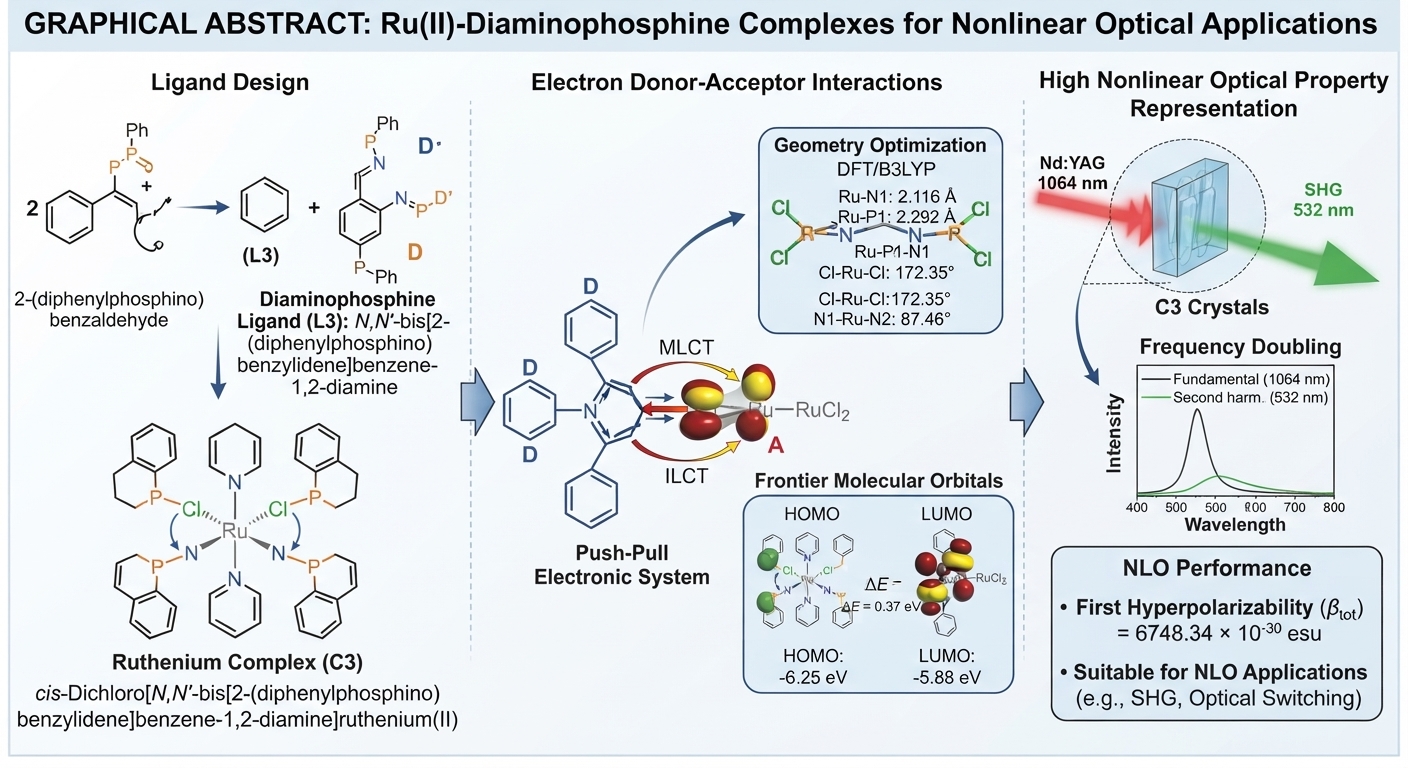
Different nonlinear optic (NLO) properties can be achieved by incorporating various π-conjugated substituents with benzene and naphthalene in ruthenium complexes. To assess the NLO characteristics, a combination of experimental and computational approaches was employed to validate the gathered data. This research involved the synthesis of eight compounds, specifically four distinct diaminophosphine ligands (L1-L2) and their corresponding complexes (C1-C4). The synthesis process yielded a percentage range of 36-69%, and the compounds were subsequently characterized using techniques such as Fourier transform infrared spectroscopy (FTIR), 1H and 31P nuclear magnetic resonance (NMR), as well as ultraviolet-visible (UV-vis) spectroscopy. The experimental results were then compared to the theoretical calculations of FTIR, NMR, and UV-Vis spectroscopy to ensure data validation. In the computational aspect of the study, density functional theory (DFT) based on the B3LYP/6-31G(d,p) level was employed to investigate the NLO properties. The DFT method successfully optimized the geometry of the studied compounds with a deviation error ranging from 0.53% to 4.39% in terms of bond lengths and bond angles. By calculating the first hyperpolarizability, βtot, at 1064 nm, it was determined that C3 exhibited a strong NLO property (6748.34 x 10-30 esu) according to the DFT analysis. This high NLO property can be attributed to the presence of an amine group, which acts as a potent electron-donating group (EDG). Furthermore, the calculation of the lowest HOMO-LUMO energy gap for C3 supported these findings and indicated its suitability as a prime candidate for NLO applications.
References
Soliman, A. M., El-Remaily, M. A. E. A. A. A., Kamel, M. S., El-Araby, A., & Shokr, E. K. (2025). Synthesis, optical linear and non-linear characterization and metal ion sensing application of some novel thieno[2,3-b]thiophene-2,5-dicarbohydrazide Schiff base derivatives. Scientific Reports, 15(1), 1611. https://doi.org/10.1038/s41598-025-1611.
Sharma, V., Chandra, R., Dutta, S., Sahu, D., & Patra, G. K. (2024). Schiff base and organic ligand stabilized metal nanoparticles as potential chemosensors for hazardous metal ions: Design, principle, optical signaling mechanism and application. Inorganica Chimica Acta, 122321. https://doi.org/10.1016/j.ica.2023.122321.
Petrovskaia, A., et al. (2024). Dual emissive mono- and bis-alkynylpyridinium Pt(II) complexes: Synthesis and luminescent properties. Organometallics, 43(20), 2495–2504. https://doi.org/10.1021/acs.organomet.4c00295.
St. Onge, P. B. (2023). Dynamic metal-ligand interactions in semiconducting π-conjugated materials/ Doctoral dissertation. University of Windsor).
Santos, F. A., Cardoso, C. E., Rodrigues, J. J., Jr., De Boni, L., & Abegão, L. M. (2023). Nonlinear optical materials: Predicting the first-order molecular hyperpolarizability of organic molecular structures. Photonics, 10(5), 545. https://doi.org/10.3390/photonics10050545.
Zhao, Y., Xiong, M., Wang, D., Xu, B., & Baesso, M. L. (2024). First single-frequency Pr:LiYF4 ring laser at green. Optics & Laser Technology, 168, 109960. https://doi.org/10.1016/j.optlastec.2023.109960.
Arunkumar, A., & Ju, X. H. (2024). Computational method on highly efficient D-π-A-π-D-based different molecular acceptors for organic solar cells applications and non-linear optical behaviour. Spectrochimica Acta Part A: Molecular and Biomolecular Spectroscopy, 317, 124391. https://doi.org/10.1016/j.saa.2023.124391.
Pang, S., Jillani, M., & Razak, F. I. A. (2023). Synthesis, characterization and density functional theory (DFT) study on the zinc metal complex for nonlinear optical application. Journal of Materials in Life Sciences (JOMALISC), 141–146.
Ronchi, E. (2022). Development and study of novel catalytic reactions to efficiently address synthetic challenges: Enantioselective multicomponent synthesis of homoallylic amines and site-selective debenzylation of mono- and disaccharides. Doctoral dissertation. Harvard University.
Zhou, S., Sun, M., & Zheng, Y. (2024). Physical insight into optical spectroscopy of chiral covalent organic pillars as molecular nanotubes. Physica E: Low-dimensional Systems and Nanostructures, 159, 115926. https://doi.org/10.1016/j.physe.2023.115926.
Nadeem, S., Anwar, A., Khan, M. U., Hassan, A. U., & Alrashidi, K. A. (2024). Exploring the ON/OFF nonlinear optical (NLO) response in tetracene-based chromophores: A DFT study on solvent and frequency-dependent NLO properties for switching applications. Journal of Molecular Liquids, 411, 125730. https://doi.org/10.1016/j.molliq.2023.125730.
Khemalapure, S. S., et al. (2020). Structural, spectroscopic and computational investigations on (4,6-dimethylbenzofuran-3-yl)-acetic acid hydrazide. Journal of Molecular Structure. Advance online publication. https://doi.org/10.1016/j.molstruc.2020.128748.
Le, L. H., Pham, N. H., Tran, P. D., & To, T. H. (2025). Synthesis of an imine-type nickel complex and investigation of its electrocatalytic activity for H2 evolution. RSC Advances, 15(4), 2430–2436. https://doi.org/10.1039/D4RA08023J.
Avcı, D., Özge, Ö., Sönmez, F., Başoğlu, A., Tamer, Ö., & Atalay, Y. (2024). Novel Schiff base-azide metal complexes: Synthesis, spectral, nonlinear optics, and DFT studies. Materials Science in Semiconductor Processing, 179, 108523. https://doi.org/10.1016/j.mssp.2023.108523.
Arabahmadi, R., Kamali, S., & Sharafi, A. R. (2025). Two new cobalt(II) and copper(II) complexes with azo-azomethine ligand: Synthesis, antioxidant and antibacterial activities, thermal investigations, DFT calculations, and molecular docking studies. Journal of Molecular Structure, 1337, 142177. https://doi.org/10.1016/j.molstruc.2025.142177.
Muslim, M., et al. (2025). Exploring superior nonlinear optical properties of copper complexes with π-conjugated ligands: Experimental and theoretical investigation. RSC Advances, 15(6), 4657–4668. https://doi.org/10.1039/D4RA07693C.
Lv, J., et al. (2022). Schiff base-type Cu(I) complexes containing naphthylpyridyl-methanimine ligands featuring higher light-absorption capability: Synthesis, structures, and photophysical properties. Polyhedron, 224, 116002. https://doi.org/10.1016/j.poly.2022.116002.
Jillani, M., Athirah, N., Sapari, S., & Razak, F. I. A. (2023). Investigating the effect of tuning the metal center in complexes for nonlinear optical application. Malaysian Journal of Fundamental and Applied Sciences, 19(5), 817–826. https://doi.org/10.11113/mjfas.v19n5.4104.
Wu, Z. P., et al. (2021). Manipulating the local coordination and electronic structures for efficient electrocatalytic oxygen evolution. Advanced Materials, 33(40), 2103004. https://doi.org/10.1002/adma.202103004.
Abdou, A. (2025). Synthesis, structural, DFT, in vitro biological exploration, and DNA interaction of new Ni(II) and Cu(II) mixed-ligand complexes featuring 2,2′-pyridine-2,6-diylbis(1H-benzimidazole) and 2-hydroxy-naphthaldehyde-based Schiff-base. Applied Organometallic Chemistry, 39(3), e7900. https://doi.org/10.1002/aoc.7900.
Balewski, Ł., et al. (2025). Synthesis, structure, and stability of copper(II) complexes containing imidazoline-phthalazine ligands with potential anticancer activity. Pharmaceuticals, 18(3), 375. https://doi.org/10.3390/ph18030375.
Samanta, P. K., & Misra, R. (2023). Intramolecular charge transfer for optical applications. Journal of Applied Physics, 133(2), 025102. https://doi.org/10.1063/5.0130381.
Fernandes, R. S., & Dey, N. (2022). Ion-specific bathochromic shifts: Simultaneous detection of multiple heavy metal pollutants via charge transfer interactions. Journal of Molecular Liquids, 367, 120369. https://doi.org/10.1016/j.molliq.2022.120369.
Şahin, S. (2024). A new molecular structure and computational analyses: DFT studies, NLO properties, ADMET predictions, biological targets, and docking experiments. Polycyclic Aromatic Compounds, 44(6), 4029–4043. https://doi.org/10.1080/10406638.2022.2113139.
Xu, J., Carney, T. E., Zhou, R., Shepard, C., & Kanai, Y. (2024). Real-time time-dependent density functional theory for simulating nonequilibrium electron dynamics. Journal of the American Chemical Society, 146(8), 5011–5029. https://doi.org/10.1021/jacs.3c12741.
Shafiq, I., et al. (2025). Exploration of promising key electronic and nonlinear optical properties of bifluorenylidene based chromophores: A TD-DFT/DFT approach. Scientific Reports, 15(1), 10701. https://doi.org/10.1038/s41598-024-84172-y.
Kateris, N., Xu, R., & Wang, H. (2023). HOMO–LUMO energy gaps of complexes of transition metals with single and multi-ring aromatics. Combustion and Flame, 257, 112513. https://doi.org/10.1016/j.combustflame.2022.112513.
Bykov, M., Abramov, Z., Pakhomova, M., Borodina, T., Smirnov, V., & Suslov, D. (2022). Structure and catalytic properties of palladium(II)(acetylacetonato-κ²O,O′) bis(tris(diethylamino)phosphine) tetrafluoroborate. Journal of Structural Chemistry, 63(1), 125–139. https://doi.org/10.1134/S002247662201004X.
Abdel-Baset, H. M. (2024). DFT analysis of charge distribution and electrostatic potential in SiO₂ ring clusters with different planar folds. Unpublished manuscript.
Celedón, S., et al. (2023). Design, synthesis, solid-state and solution structures, nonlinear optical and computational studies of copper(II) complexes supported by variously substituted enantiomerically pure push–pull tetradentate Schiff base ligands. Journal of Molecular Structure, 1293, 136281. https://doi.org/10.1016/j.molstruc.2023.136281.
Knoppe, S., Hakkinen, H., Verbiest, T., & Clays, K. (2018). Role of donor and acceptor substituents on the nonlinear optical properties of gold nanoclusters. The Journal of Physical Chemistry C, 122(7), 4019–4028. https://doi.org/10.1021/acs.jpcc.7b12609.
Maity, S., Bain, D., & Patra, A. (2019). An overview on the current understanding of the photophysical properties of metal nanoclusters and their potential applications. Nanoscale, 11(47), 22685–22723. https://doi.org/10.1039/C9NR07176D.
Pang, S. W., Sapari, S., Matmin, J., & Razak, F. I. A. (2020). Computational studies on nonlinear optical properties of metal complexes containing azobenzene. Malaysian Journal of Analytical Sciences, 24(5), 719–726.
Tamer, Ö., Şimşek, M., Dege, N., Avcı, D., & Atalay, Y. (2025). The effect of complex formation on the static and frequency-dependent nonlinear optical properties: A combined experimental and theoretical investigation. Spectrochimica Acta Part A: Molecular and Biomolecular Spectroscopy, 325, 125138. https://doi.org/10.1016/j.saa.2024.125138.
Soto, E., et al. (2024). FeSi₄P₄ and CoSi₃P₃: Hidden gems of ternary tetrel pnictides with outstanding nonlinear optical properties. Chemistry of Materials, 36(18), 8854–8863. https://doi.org/10.1021/acs.chemmater.4c02101.
Kumar, R., Yadav, S. K., Seth, R., & Singh, A. (2023). Designing of gigantic first-order hyperpolarizability molecules via joining the promising organic fragments: A DFT study. Journal of Molecular Modeling, 29(1), 5. https://doi.org/10.1007/s00894-022-05258-4.
Khairul, W. M., et al. (2025). The experimental and DFT approaches on electronic, thermal and conductivity properties of non-linear optical bearing fused aromatic chalcones towards prospective OLEDs. Journal of Molecular Structure, 1319, 139585. https://doi.org/10.1016/j.molstruc.2024.139585.
Mustafa, M. N., et al. (2025). Elucidating the potential of nonlinear optical behavior of azo dyes for advanced laser-based technologies. Advanced Theory and Simulations, 2401202. https://doi.org/10.1002/adts.202401202.
Habeeba, A. A. U., Saravanan, M., Girisun, T. C. S., & Anandan, S. (2021). Nonlinear optical studies of conjugated organic dyes for optical limiting applications. Journal of Molecular Structure, 1240, 130559. https://doi.org/10.1016/j.molstruc.2021.130559.
Sorsche, D., et al. (2025). Shifting the MLCT of d⁶ metal complexes to the red and NIR. Coordination Chemistry Reviews, 530, 216454. https://doi.org/10.1016/j.ccr.2025.216454.
Tariq, S., et al. (2024). Exploration of key electronic properties and optical nonlinearity of diamine based Schiff bases: Spectroscopic characterization and DFT study. Journal of Molecular Structure, 1308, 138135. https://doi.org/10.1016/j.molstruc.2023.138135.
Downloads
Published
Issue
Section
License
Copyright (c) 2025 Mamoona Jillani, Nur Hidayah Tahang, Nur Amira Mohd Yusuf, Suhaila Sapari, Shi Wee Yee, fazira ilyana abdul razak

This work is licensed under a Creative Commons Attribution-NonCommercial 4.0 International License.