
Amplitude and Phase Synchronization Stability of Auditory Evoked Potentials with Influence of Transcranial Magnetic Stimulation
DOI:
https://doi.org/10.11113/mjfas.v21n5.4154Keywords:
Auditory evoked potentials, electroencephalography, Anacardium occidentale, Transcranial Magnetic StimulationAbstract
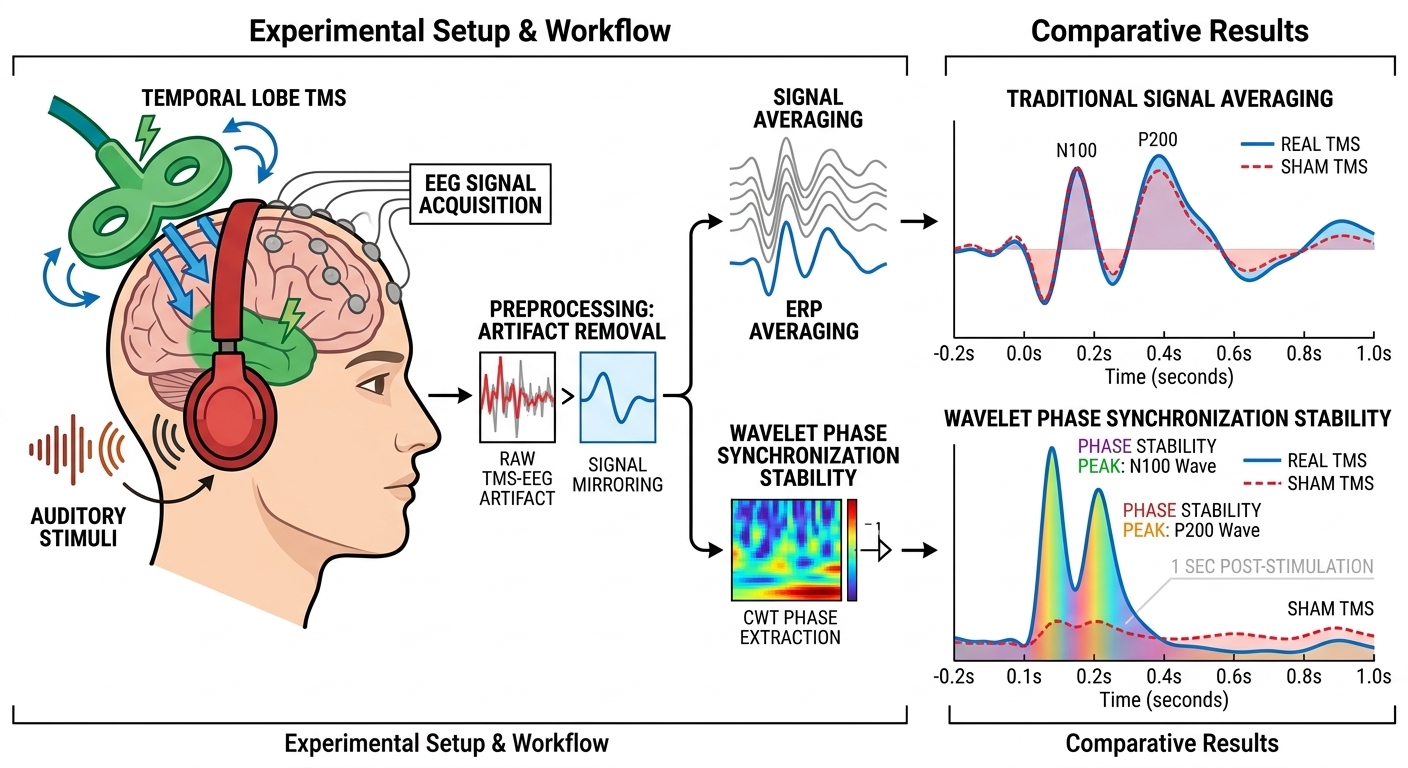
The integration of Transcranial Magnetic Stimulation (TMS) with Electroencephalography (EEG) offers a robust framework for investigating brain function and underlying neural mechanisms. While most TMS-EEG studies have focused on TMS-evoked potentials (TEPs) to examine the immediate cortical effects of TMS, limited attention has been given to its influence on the auditory cortex, particularly in terms of how long the modulation persists. This study aims to analyze the effects of TMS on Auditory Evoked Potentials (AEPs), with a focus on changes observed 1 and 2 seconds after stimulation. Single-pulse TMS was applied with a 4-second interstimulus interval (ISI) and presented simultaneously with auditory stimuli delivered at a 1-second ISI. The influence of TMS on AEPs was assessed using time-domain averaging and phase synchronization stability analysis. Results showed minimal differences in the averaged N100 and P200 components between TMS and sham conditions at 2 seconds post-stimulation with ANOVA p=0.08. However, phase stability analysis revealed significantly higher synchronization in the N100 wave 1 second after TMS ANOVA p=0.01, followed by increased stability in the P200 and P300 components compared to the sham condition. These findings highlight the importance of advanced analytical techniques in detecting subtle and transient neural changes induced by TMS. By providing insights into the temporal characteristics of TMS-modulated auditory processing, this study contributes to the development of more targeted diagnostic and therapeutic applications involving non-invasive brain stimulation.
References
Afifi, S. Y. (2024). A new era of current and future treatment applications of transcranial magnetic stimulation. Egyptian Journal of Neurology, Psychiatry and Neurosurgery, 60(1), 1–10. https://doi.org/10.1186/s41983-024-00825-9.
Vucic, S., Stanley Chen, K. H., Kiernan, M. C., Hallett, M., Benninger, D. H., Di Lazzaro, V., et al. (2023). Clinical diagnostic utility of transcranial magnetic stimulation in neurological disorders: Updated report of an IFCN committee. Clinical Neurophysiology, 150, 131–175. https://doi.org/10.1016/j.clinph.2023.03.010.
Chen, J. J., Zeng, B. S., Wu, C. N., Stubbs, B., Carvalho, A. F., Brunoni, A. R., et al. (2020). Association of central noninvasive brain stimulation interventions with efficacy and safety in tinnitus management: A meta-analysis. JAMA Otolaryngology–Head & Neck Surgery, 146(9), 801–809. https://doi.org/10.1001/jamaoto.2020.1497.
Wang, J., Wu, Z., Hong, S., Ye, H., Zhang, Y., Lin, Q., et al. (2024). Cerebellar transcranial magnetic stimulation for improving balance capacity and activity of daily living in stroke patients: A systematic review and meta-analysis. BMC Neurology, 24(1). https://doi.org/10.1186/s12883-024-03720-1.
Wang, M., Zhang, W., & Zang, W. (2024). Repetitive transcranial magnetic stimulation improves cognition, depression, and walking ability in patients with Parkinson’s disease: A meta-analysis. BMC Neurology, 24(1), 1–14. https://doi.org/10.1186/s12883-024-03990-9.
Xue, H., Li, Y. X., Xiao, Y. S., Fan, W. H., & He, H. X. (2024). Repetitive transcranial magnetic stimulation for Alzheimer’s disease: An overview of systematic reviews and meta-analysis. Frontiers in Aging Neuroscience, 16, 1383278. https://doi.org/10.3389/fnagi.2024.1383278.
Riccitelli, G. C., Borgonovo, R., Villa, M., Pravatà, E., & Kaelin-Lang, A. (2024). Efficacy of transcranial magnetic stimulation treatment in reducing neuropsychiatric symptomatology after traumatic brain injury. Frontiers in Neurology, 15, 1412304. https://doi.org/10.3389/fneur.2024.1412304.
Chen, Y. H., Liang, S. C., Sun, C. K., Cheng, Y. S., Tzang, R.-F., Chiu, H.-J., et al. (2023). A meta-analysis on the therapeutic efficacy of repetitive transcranial magnetic stimulation for cognitive functions in attention-deficit/hyperactivity disorders. BMC Psychiatry, 23(1). https://doi.org/10.1186/s12888-023-05261-2.
Xu, Y., Zhang, Y., Zhao, D., Tian, Y., & Yuan, T.-F. (2023). Growing placebo response in TMS treatment for depression: A meta-analysis of 27-year randomized sham-controlled trials. Nature Mental Health, 1(10), 792–809. https://doi.org/10.1038/s44220-023-00118-9.
Sharbafshaaer, M., Cirillo, G., Esposito, F., Tedeschi, G., & Trojsi, F. (2024). Harnessing brain plasticity: The therapeutic power of repetitive transcranial magnetic stimulation (rTMS) and theta burst stimulation (TBS) in neurotransmitter modulation, receptor dynamics, and neuroimaging for neurological innovations. Biomedicines, 12(11), 2506. https://doi.org/10.3390/biomedicines12112506.
Zhu, M., Huang, S., Chen, W., Pan, G., & Zhou, Y. (2024). The effect of transcranial magnetic stimulation on cognitive function in post-stroke patients: A systematic review and meta-analysis. BMC Neurology, 24(1), 1–14. https://doi.org/10.1186/s12883-024-03726-9.
Noda, Y. (2020). Toward the establishment of neurophysiological indicators for neuropsychiatric disorders using transcranial magnetic stimulation‐evoked potentials: A systematic review. Psychiatry and Clinical Neurosciences, 74(1), 12–34. https://doi.org/10.1111/pcn.12936.
Daskalakis, Z. J., McClintock, S. M., Hadas, I., Kallioniemi, E., Zomorrodi, R., Throop, A., et al. (2021). Confirmatory efficacy and safety trial of magnetic seizure therapy for depression (CREST-MST): Protocol for identification of novel biomarkers via neurophysiology. Trials, 22(1), 1–8. https://doi.org/10.1186/s13063-021-05873-7.
Li, X., Honda, S., Nakajima, S., Wada, M., Yoshida, K., Daskalakis, Z. J., et al. (2021). TMS-EEG research to elucidate the pathophysiological neural bases in patients with schizophrenia: A systematic review. Journal of Personalized Medicine, 11(5), 388. https://doi.org/10.3390/jpm11050388.
Vittala, A., Murphy, N., Maheshwari, A., & Krishnan, V. (2020). Understanding cortical dysfunction in schizophrenia with TMS/EEG. Frontiers in Neuroscience, 14, 537642. https://doi.org/10.3389/fnins.2020.00554.
Sasaki, R., Hand, B. J., Liao, W. Y., Semmler, J. G., & Opie, G. M. (2024). Investigating the effects of repetitive paired-pulse transcranial magnetic stimulation on visuomotor training using TMS-EEG. Brain Topography. https://doi.org/10.1007/s10548-024-01071-1.
Bai, Z., Zhang, J. J., & Fong, K. N. K. (2023). Immediate effects of intermittent theta burst stimulation on primary motor cortex in stroke patients: A concurrent TMS-EEG study. IEEE Transactions on Neural Systems and Rehabilitation Engineering, 31(12), 2758–2766. https://doi.org/10.1109/tnsre.2023.3282659.
Sato, S., Bergmann, T. O., & Borich, M. R. (2015). Opportunities for concurrent transcranial magnetic stimulation and electroencephalography to characterize cortical activity in stroke. Frontiers in Human Neuroscience, 9, 136672. https://doi.org/10.3389/fnhum.2015.00250.
Momi, D., Wang, Z., & Griffiths, J. D. (2023). TMS-evoked responses are driven by recurrent large-scale network dynamics. eLife, 12. https://doi.org/10.7554/eLife.83232.
Rocchi, L., Di Santo, A., Brown, K., Ibáñez, J., Casula, E., & Rawji, V. (2021). Disentangling EEG responses to TMS due to cortical and peripheral activations. Brain Stimulation, 14(1), 4–18. https://doi.org/10.1016/j.brs.2020.10.011.
Russo, S., Sarasso, S., Puglisi, G. E., Dal Palù, D., Pigorini, A., & Casarotto, S. (2022). TAAC - TMS adaptable auditory control: A universal tool to mask TMS clicks. Journal of Neuroscience Methods, 370, 109491. https://doi.org/10.1016/j.jneumeth.2022.109491.
Conde, V., Tomasevic, L., Akopian, I., Stanek, K., Saturnino, G. B., Thielscher, A., et al. (2019). The non-transcranial TMS-evoked potential is an inherent source of ambiguity in TMS-EEG studies. NeuroImage, 185, 300–312. https://doi.org/10.1016/j.neuroimage.2018.10.052.
Casula, E. P., Leodori, G., Ibáñez, J., Benussi, A., Rawji, V., Tremblay, S., et al. (2022). The effect of coil orientation on the stimulation of the pre-supplementary motor area: A combined TMS and EEG study. Brain Sciences, 12(10), 1358. https://doi.org/10.3390/brainsci12101358.
Ross, J. M., Ozdemir, R. A., Lian, S. J., Fried, P. J., Schmitt, E. M., Inouye, S. K., et al. (2022). A structured ICA-based process for removing auditory evoked potentials. Scientific Reports, 12(1), 1–19. https://doi.org/10.1038/s41598-022-05397-3.
Cristofari, A., De Santis, M., Lucidi, S., Rothwell, J., & Casula, E. P. (2023). Machine learning-based classification to disentangle EEG responses to TMS and auditory input. Brain Sciences, 13(6), 866. https://doi.org/10.3390/brainsci13060866.
Pelaquim, A., Sanfins, M. D., & Fornazieri, M. A. (2024). Changes in auditory evoked potentials increase the chances of adults having central auditory processing disorder. International Archives of Otorhinolaryngology, 28(2), e134–e140. https://doi.org/10.1055/s-0042-1759747.
Schwade, L. F., Didoné, D. D., & Sleifer, P. (2017). Auditory evoked potential mismatch negativity in normal-hearing adults. International Archives of Otorhinolaryngology, 21(3), 232–238. https://doi.org/10.1055/s-0036-1586734.
Schecklmann, M., Volberg, G., Frank, G., Hadersdorfer, J., Steffens, T., Weisz, N., et al. (2011). Paired associative stimulation of the auditory system: A proof-of-principle study. PLoS ONE, 6(11), e27088. https://doi.org/10.1371/journal.pone.0027088.
Ragazzoni, A., Pirulli, C., Veniero, D., Feurra, M., Cincotta, M., Giovannelli, F., et al. (2013). Vegetative versus minimally conscious states: A study using TMS-EEG, sensory and event-related potentials. PLoS ONE, 8(3), e57069. https://doi.org/10.1371/journal.pone.0057069.
Chang, C. H., Wang, W. L., Shieh, Y. H., Peng, H. Y., Ho, C. S., & Tsai, H. C. (2022). Low-frequency repetitive transcranial magnetic stimulation to dorsolateral prefrontal cortex and auditory cortex in a patient with tinnitus and depression: A case report. Frontiers in Psychiatry, 13, 847618. https://doi.org/10.3389/fpsyt.2022.847618.
Azcona Ganuza, G., & Alegre, M. (2022). Static magnetic stimulation of human auditory cortex: A feasibility study. NeuroReport, 33(9), 487–494. https://doi.org/10.1097/WNR.0000000000001809.
Rossi, S., Hallett, M., Rossini, P. M., Pascual-Leone, A., Avanzini, G., Bestmann, S., et al. (2009). Safety, ethical considerations, and application guidelines for the use of transcranial magnetic stimulation in clinical practice and research. Clinical Neurophysiology, 120(12), 2008–2039. https://doi.org/10.1016/j.clinph.2009.08.016.
Mortezapouraghdam, Z., Corona-Strauss, F. I., Takahashi, K., & Strauss, D. J. (2018). Reducing the effect of spurious phase variations in neural oscillatory signals. Frontiers in Computational Neuroscience, 12, 389488. https://doi.org/10.3389/fncom.2018.00082.
Strauss, D. J., Delb, W., D’Amelio, R., & F. L. Y. (2008). Objective quantification of the tinnitus decompensation by synchronization measures of auditory evoked single sweeps. IEEE Transactions on Neural Systems and Rehabilitation Engineering, 16(1), 74–81.
Zhang, Q., Luo, C., Ngetich, R., Zhang, J., Jin, Z., & Li, L. (2022). Visual selective attention P300 source in frontal-parietal lobe: ERP and fMRI study. Brain Topography, 35(6), 636–650. https://doi.org/10.1007/s10548-022-00916-x.
Downloads
Published
Issue
Section
License
Copyright (c) 2025 Arief Harris, Azli Yahya, Tian Swee Tan

This work is licensed under a Creative Commons Attribution-NonCommercial 4.0 International License.