
Mathematical Modeling of Tuberculosis Transmission Dynamics with Vaccination and Drug Resistance
DOI:
https://doi.org/10.11113/mjfas.v21n5.3894Keywords:
Tuberculosis, Drug-resistance, Bifurcation, Equilibria, Bi-quadratic polynomialAbstract
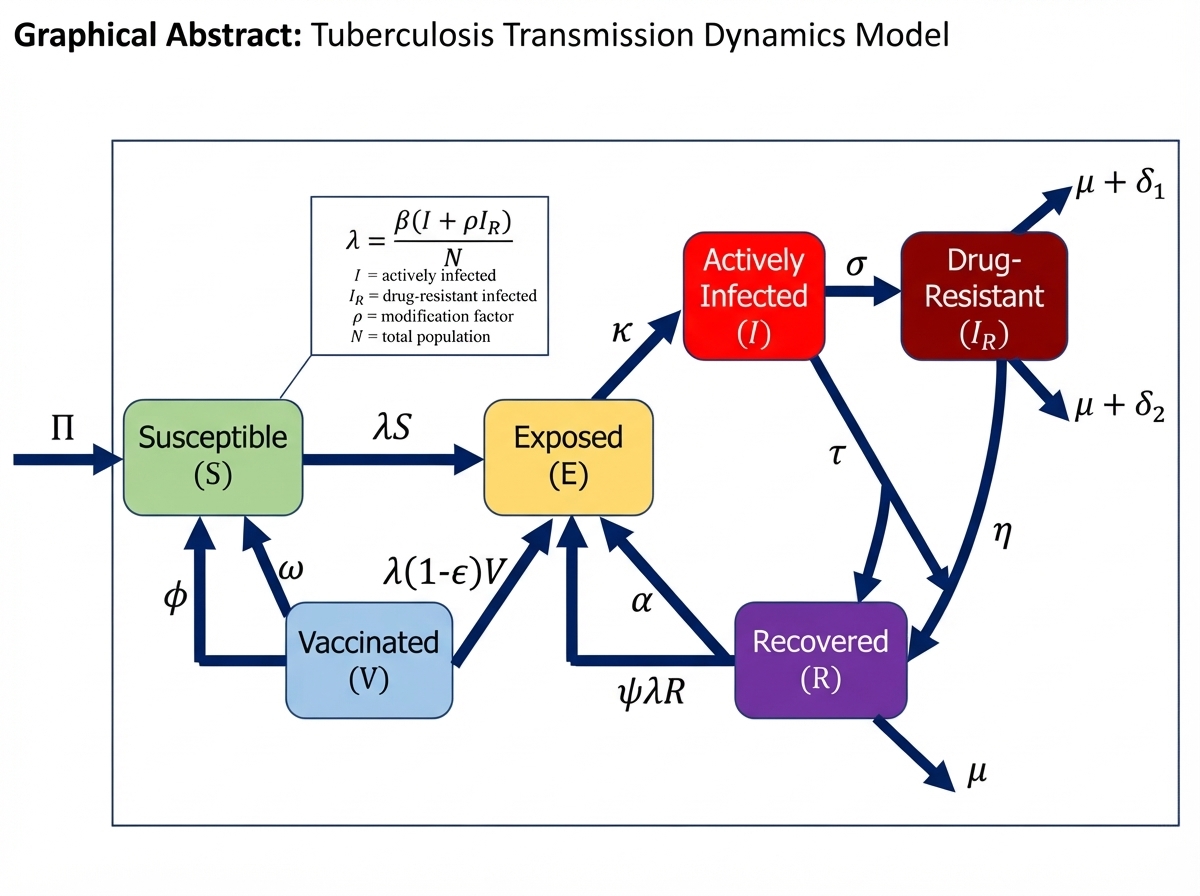
The spread of tuberculosis, a disease that is communicable and caused by the Bacillus mycobacterium, is the main topic of this study. Vaccination and drug-resistant patients are the subjects of particular attention. Patients who are freshly infected with tuberculosis undergo an average treatment duration of 6–8 months; however, for those who are multidrug resistant, the treatment can extend up to 2.5 years. Despite decades of study, widespread use of a vaccine, and an apparent push by the WHO to promote a single global management strategy in recent years, tuberculosis continues to be the second most prevalent infectious killer, following COVID-19. In 2021, experts estimate that 10.6 million people worldwide contracted tuberculosis, either latently or actively. Using a mathematical model, we performed an investigation to investigate the dynamics of tuberculosis transmission in humans. We conducted sensitivity analysis on the model to identify the primary parameters impacting the disease's propagation and establish the fundamental reproduction number. The analysis's findings can inform the proposal of effective intervention techniques. The research looked at the tuberculosis endemic equilibrium point and assessed the stability on a local and global scale related to the disease-free equilibrium point. We examined the effects of the transmission rate on the backward bifurcation of the model. Global stable endemic equilibrium coexists with stable disease-free equilibrium (DFE). It has been demonstrated that vaccine efficacy and a small percentage of the population who receive vaccinations contribute equally to reducing the burden of disease. The drug-resistant group is a bigger concern than the infected group, which shows that health workers and government agencies need to be extra careful to keep an eye on this silent source of tuberculosis transmission. Based on the numerical simulation, it can be demonstrated that, if vaccination coverage and efficacy are both quite high, it is possible to effectively control tuberculosis in a population by using an imperfect vaccination. Health professionals and government organizations should monitor this covert method of tuberculosis transmission, as these findings indicate that the group resistant to drugs poses a greater threat than those who are afflicted.
References
Ishaku, A., Gazali, A. M., Abdullahi, S. A., & Hussaini, N. (2020). Analysis and optimal control of an HIV model based on CD4 count. Journal of Mathematical Biology, 81(1), 209–241. https://doi.org/10.1007/s00285-020-01508-8.
Yeketi, A. A., Ainun, W., & Othman, M. (2019). A compartmental model on the effect of quarantine on MDR-TB. International Journal of Mathematics and Computer Science. Retrieved from http://ijmcs.future-in-tech.net.
Alexander, M. E., Bowman, C., Moghadas, S. M., Summers, R., Gumel, A. B., & Sahai, B. M. (2004). A vaccination model for transmission dynamics of influenza. SIAM Journal on Applied Dynamical Systems, 3(4), 503–524.
Ally, Y. A., Wan Ainun, M., & Musa, R. (2021). A mathematical model of the tuberculosis epidemic. Acta Biotheoretica, 69(3), 225–255.
Arino, J., McCluskey, C. C., & Van den Driessche, P. (2003). Global results for an epidemic model with vaccination that exhibits backward bifurcation. SIAM Journal on Applied Mathematics, 64(1), 260–276.
Ayinla, A. Y., & Wan Ainun, M. (2019). A compartmental model on the effect of quarantine on MDR-TB. International Journal of Mathematics and Computer Science, 14(3), 613–629.
Bimal, K. M., & Jyohka, S. (2014). Mathematical model on pulmonary and multidrug-resistant tuberculosis patients with vaccination. Journal of the Egyptian Mathematical Society, 22, 311–316.
Brauer, F., & Castillo-Chavez, C. (2000). Mathematical models in population biology and epidemiology (Texts in Applied Mathematics Series, Vol. 40). Springer.
Christopher, D. (2006). HIV/AIDS, tuberculosis and malaria. The Lancet, 367, 938–940.
Daniel, T. N., Bates, J. H., & Downes, K. A. (1994). History of tuberculosis. In B. R. Bloom (Ed.), Tuberculosis: Pathogenesis, protection, and control (pp. 13–24). American Society for Microbiology.
Elbasha, E. H., & Gumel, A. B. (2006). Theoretical assessment of public health impact of imperfect prophylactic HIV-1 vaccines with therapeutic benefits. Bulletin of Mathematical Biology, 68, 577–614.
Getachew, T. T., Oluwole, D. M., & David, M. (2017). Modelling and optimal control of pneumonia disease with cost-effective strategies. Journal of Biological Dynamics, 11(2), 400–426. https://doi.org/10.1080/17513758.2017.1337245
Handika, L. S., Isnani, D., & Agus, S. (2023). Analysis of SVEIL model of tuberculosis disease spread with imperfect vaccination. JTAM (Jurnal Teori dan Aplikasi Matematika), 7(1), 125–138.
Hattif, K., Rachik, M., Saadi, S., & Tabit, Y. (2009). Optimal control of tuberculosis with exogenous reinfection. Applied Mathematical Sciences, 3(5), 231–240.
Jaramillo, E. (1999). Tuberculosis and stigma: Predictors of prejudice against people with tuberculosis. Journal of Health Psychology, 4(1), 71–79.
Jiazhe, L., Rui, X., & Xiaohong, T. (2019). Transmission dynamics of cholera with hyperinfectious and hypoinfectious vibrios: Mathematical modelling and control strategies. Mathematical Biosciences and Engineering, 16(5), 4339–4358. https://doi.org/10.3934/mbe.2019216.
Jinhui, Z., Yong, L., & Xinan, Z. (2015). Mathematical modeling of tuberculosis data of China. Journal of Theoretical Biology, 365, 159–163.
Kalu, A. U., & Inyama, S. C. (2012). Mathematical model of the role of vaccination and treatment on the transmission dynamics of tuberculosis. Mathematical Medicine and Biology, 11(1), 10–23.
Gabriela, M. G., Paula, R., Frank, M. H., Natalia, B. M., Marion, M., & Graham, F. M. (2007). Implications of partial immunity on the prospects for tuberculosis control by post-exposure interventions. Journal of Theoretical Biology, 248, 608–617.
Mayowa, M. O., Olumuyiwa, J. P., Emile Franc, D. G., Hasan, S. P., & Festus, A. O. (2022). Mathematical model for control of tuberculosis. Journal of Applied Mathematics and Computing, 69, 69–87.
Muhammad, A. K., Manzoor, A., Saif, U., Muhammad, F., & Taza, G. (2019). Modeling the transmission dynamics of tuberculosis in Khyber Pakhtunkhwa, Pakistan. Advances in Mechanical Engineering, 11(6).
Nadolinskaia, I. N., Karpov, S. D., & Goncharenko, V. A. (2020). Vaccines against tuberculosis: Problems and prospects (Review). Biochemistry (Moscow), 56(5), 497–504.
Ojo, M., Gbadamosi, B., Olukayode, A., & Oluwaseun, O. R. (2018). Sensitivity analysis of dengue model with saturated incidence rate. Open Access Library Journal, 5(3), 1–15.
Ojo, M., & Akinpelu, F. (2017). Sensitivity analysis of Ebola virus model. Asian Research Journal of Mathematics, 1, 1–10.
Panovska, G. J. (2020). Can mathematical modelling solve the current Covid-19 crisis? Springer.
Peter, A., & Mark, T. D. (2005). The success and failure of BCG—Implications for a novel tuberculosis vaccine. Nature Reviews Microbiology, 3, 656–662.
Abimbode, S. F., Olaniyi, O., Ajala, A., & Ibrahim, M. O. (2020). Optimal control analysis of a tuberculosis model. Optimal Control Applications and Methods, 41(3), 1–20.
Saif, U., Muhammad, A. K., Muhammad, F., & Taza, G. (2019). Modeling and analysis of tuberculosis (TB) in Khyber Pakhtunkhwa, Pakistan. Mathematics and Computers in Simulation, 165, 181–199.
Selain, K. K., Emile, F. D., & Vinh, H. T. (2020). Analysis and simulation of a mathematical model of tuberculosis transmission in Democratic Republic of the Congo. Advances in Difference Equations, 2020(642), 1–19.
Sulayman, F., & Abdullah, F. A. (2022). Dynamical behaviour of a modified tuberculosis model with impact of public health education and hospital treatment. Axioms, 11(723), 1–23.
Sulayman, F., Abdullah, F. A., & Mohd, H. M. (2021). An SVEIRE model of tuberculosis to assess the effect of an imperfect vaccine and other exogenous factors. Mathematics, 9(327), 1–23.
Sulayman, F., & Abdullahi, F. A. (2023). Dynamics of tuberculosis transmission model with reinfection issues. Matematika: Malaysian Journal of Industrial and Applied Mathematics, 39(2), 125–148.
World Health Organization. (2022). Global tuberculosis report. World Health Organization.
Yongqi, L., Zhendong, S., Guiquan, S., Qiu, Z., Li, J., Lin, Z., ... Zhongwei, J. (2011). Modeling transmission of tuberculosis with MDR and undetected cases. Discrete Dynamics in Nature and Society, 2011, 1–12.
Yusuf, T. T., & Abidemi, A. (2023). Effective strategies towards eradicating the tuberculosis epidemic. Healthcare Analytics, 3(100131), 1–14.
Downloads
Published
Issue
Section
License
Copyright (c) 2025 Usman Garba, Amirah Azmi, Mohd Hafiz Mohd, Rosalio G Artes Jr

This work is licensed under a Creative Commons Attribution-NonCommercial 4.0 International License.