
Character Sums Associated with Non-homogeneous Beatty Sequences for Quadratic Common Difference
DOI:
https://doi.org/10.11113/mjfas.v21n5.3700Keywords:
Beatty sequence, Estimation of character sums, Cardinality, Multiplicative group, DiscrepancyAbstract
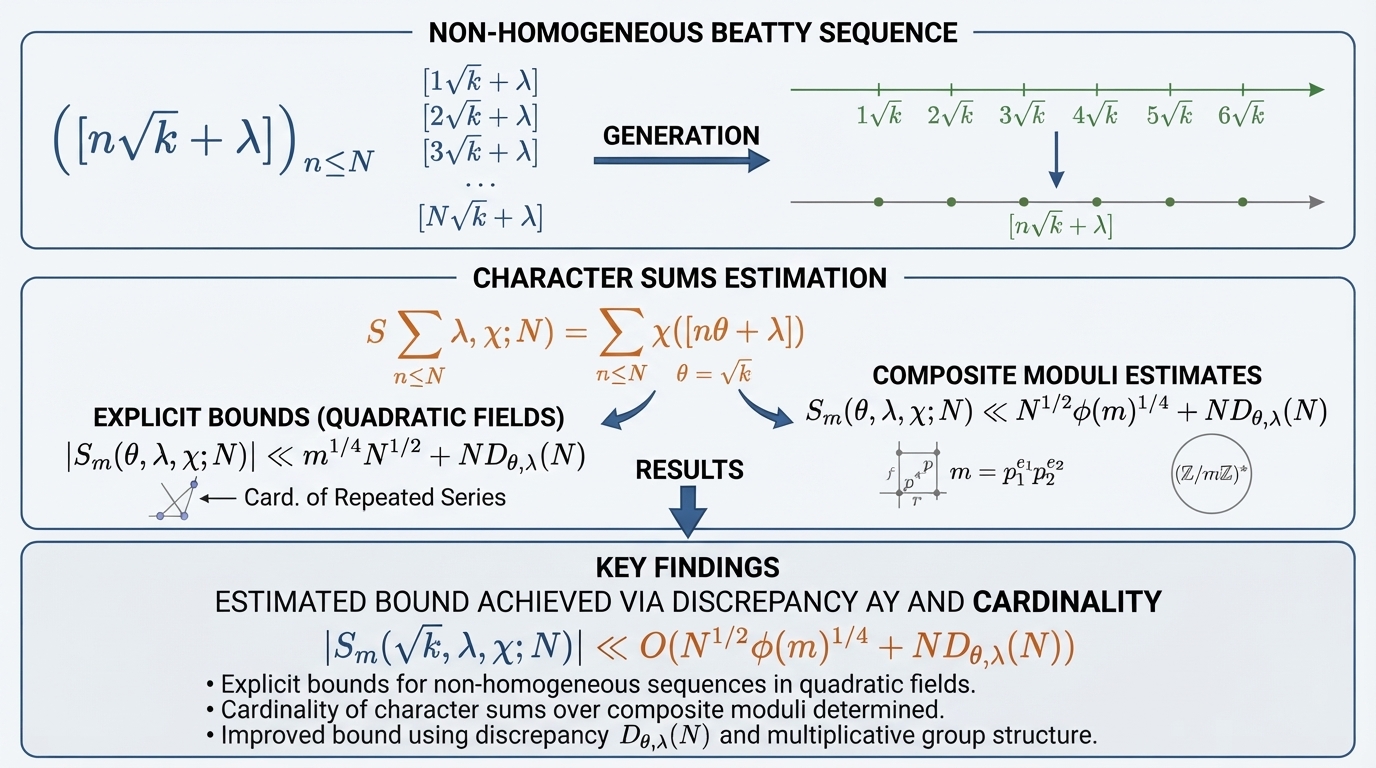
Beatty sequence is a special type of sequence by taking the floor of the positive value of an irrational number. This paper will find an explicit bounds of character sums associated with non-homogeneous Beatty sequence in quadratic fields. Next, we obtained the cardinality of character sums associated with composite moduli. Finally, we found the estimated bound of character sums associated with composite moduli by using the discrepancy and the cardinality.
References
Chua, L., Park, S. and Smith, G. D. (2015). Bounded Gaps between Primes in Special Sequences. Proc. Amer. Math. Soc., 143, 4597–4611.
Banks, W. D. and Shparlinski, I. E. (2006). Non-residues and Primitive Roots in Beatty Sequences. Bull. Austral. Math. Soc., 73, 433–443.
Banks, W. D. and Shparlinski, I. E. (2007). Prime Divisors in Beatty Sequences. Journal of Number Theory, 123, 413–425.
Cassaigne, J., DuchÃłne, E. and Rigo, M. (2016). Nonhomogeneous Beatty Sequences Leading to Invariant Games. SIAM Journal on Discrete Mathematics, 30, 1798–1829.
Harman, G. (2015). Primes in Intersections of Beatty Sequences. Journal of Integer Sequences, 18. (Article 15.7.3).
Kimberling, C. (2016). Beatty Sequences and Trigonometric Functions. Integers, 16.
Simpson, J. (2004). Disjoint Beatty Sequences. Integers: Electronic Journal of Combinatorial Number Theory, 4.
Deraman, F., Sapar, S. H., Johari, M. A. M., Mohd Atan, K. A. and Rasedee, A. F. N. (2019). Extended Bounds of Beatty Sequence Associated with Primes. International Journal of Engineering and Advanced Technology, 8, 115–118.
Lidl, R. and Niederreiter, H. (1986). Introduction to Finites Fields and Their Applications. Cambridge: Cambridge University Press.
Russo, V. and Schwiebert, L. (2011). Beatty Sequences, Fibonacci Numbers, and the Golden Ratio. Fibonacci Quart, 49, 151–154.
Shallit, J. (2022). Sumsets of Wythoff Sequences, Fibonacci Representation, and Beyond. Period. Math. Hung., 84, 37–46.
Phunphayap, P. N., Pongsriiam, P. and Shallit, J. (2022). Sumsets Associated with Beatty Sequences. Discrete Math, 345, 112810.
Khani, M. and Zarei, A. (2023). The Additive Structure of Integers with the Lower Wythoff. Archive for Mathematical Logic, 62, 225–237.
Shparlinski, I. E. (2016). Open Problems on Exponential and Character Sums.
Banks, W. D. and Shparlinski, I. E. (2009). Character Sums with Beatty Sequences on Burgess-type Intervals. Analytic Number Theory, 15–21.
Venkov, B. A. (1970). Elementary Number Theory. Wolters-Noordhoff.
Kuipers, L. and Niederreiter, H. (1974). Uniform Distribution of Sequences. New York, London, Sydney: Wiley-Interscience.
Nathanson, M. B. (2000). Elementary Methods in Number Theory. Springer.
Allouche, J.-P. and Shallit, J. (2003). Automatic Sequences: Theory, Applications, Generalizations. Cambridge University Press.
Francis, F. (2023). Short Character Sums and Their Applications. Ph.D. Thesis. University of New South Wales Canberra.
Downloads
Published
Issue
Section
License
Copyright (c) 2025 Chee Wai Low, S. H. Sapar, F. Deraman, M. A. M. Johari, F. Yunos

This work is licensed under a Creative Commons Attribution-NonCommercial 4.0 International License.