
Agricultural Waste–Derived Biofertilizers for Sustainable Mushroom Cultivation: A Case Study Using Banana Peel
DOI:
https://doi.org/10.11113/mjfas.v21n5.3517Keywords:
Food waste, banana peel, sustainability, future food, beneficial microorganism, macro-elementsAbstract
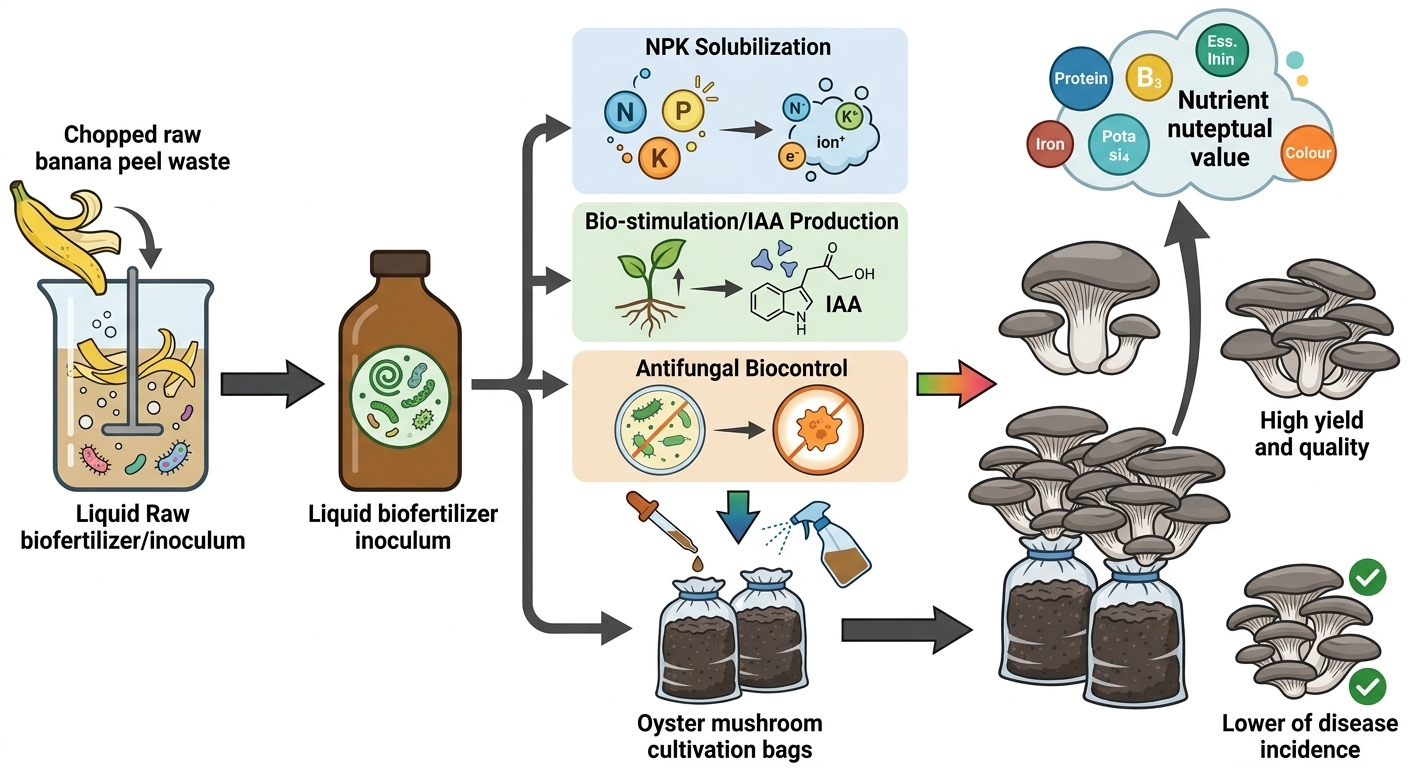
Mushrooms are not only a nutritious and versatile food source but also have the potential to contribute to sustainable agriculture via the use of biofertilizers. Following Agenda 2030, biofertilizers can be selected from the widely available food and agricultural wastes to increase circularity. Food and agricultural wastes serve as optimal candidates for biofertilizers, offering a wealth of plant-growth-promoting nutrients and microorganisms. Primarily rich in essential macro-elements like nitrogen, phosphorus, and potassium, these wastes directly contribute to plant growth. The diverse array of plant-growth-promoting bacteria within biofertilizers enhances soil fertility, promotes plant growth, improves nutrient absorption, and provides valuable attributes such as antifungal properties and nutrient solubilization. This review seeks to underscore the significance of employing biofertilizers in mushroom cultivation for enhancing circularity in future food production, specifically focusing on banana peels as an illustrative example.
References
Okuda, Y. (2022). Sustainability perspectives for future continuity of mushroom production: The bright and dark sides. Frontiers in Sustainable Food Systems, 6.
Rahmann, G., Azim, K., Brányiková, I., Chander, M., David, W., Erisman, J. W., et al. (2021). Innovative, sustainable, and circular agricultural systems for the future. Organic Agriculture, 11, 179–185. https://doi.org/10.1007/s13165-021-00356-0.
Wan-Mohtar, W. A. A. Q. I., Mahmud, N., Supramani, S., Ahmad, R., Zain, N. A. M., Hassan, N. A. M., et al. (2018). Fruiting-body-base flour from an oyster mushroom—a waste source of antioxidative flour for developing potential functional cookies and steamed-bun. AIMS Agriculture and Food, 3(4), 481–492. https://doi.org/10.3934/agrfood.2018.4.481.
Khan, R., Brishti, F. H., Arulrajah, B., Goh, Y. M., Abd Rahim, M. H., Karim, R., et al. (2024). Mycoprotein as a meat substitute: Production, functional properties, and current challenges—a review. International Journal of Food Science and Technology, 59, 522–544. https://doi.org/10.1111/ijfs.16791.
Forbes, H., Quested, T., & O’Connor, C. (2021). Food waste index report 2021.
Mohd Zaini, N. S., Khudair, J. D. A., Mohsin, Z. A., Jitming Lim, E., Minato, W., Idris, H., et al. (2023). Biotransformation of food waste into biofertilisers through composting and anaerobic digestion: A review. Plant, Soil and Environment, 69, 409–420.
FAO. (2013). Food wastage footprint: Impacts on natural resources.
Mahanty, T., Bhattacharjee, S., Goswami, M., Bhattacharyya, P., Das, B., Ghosh, A., et al. (2017). Biofertilizers: A potential approach for sustainable agriculture development. Environmental Science and Pollution Research, 24, 3315–3335. https://doi.org/10.1007/s11356-016-8104-0.
Pradhan, S., Abdelaal, A. H., Mroue, K., Al-Ansari, T., Mackey, H. R., & McKay, G. (2020). Biochar from vegetable wastes: Agro-environmental characterization. Biochar, 2, 439–453. https://doi.org/10.1007/s42773-020-00069-9.
Wazir, A., Gul, Z., & Hussain, M. (2018). Comparative study of various organic fertilizers effect on growth and yield of two economically important crops, potato and pea. Agricultural Sciences, 9, 703–717. https://doi.org/10.4236/as.2018.96049.
Abdel-Aziz, H. M. M., Soliman, M. I., Abo Al-Saoud, A. M., & El-Sherbeny, G. A. (2021). Waste-derived NPK nanofertilizer enhances growth and productivity of Capsicum annuum L. Plants, 10(6). https://doi.org/10.3390/plants10061144.
Grand View Research. (2022). Mushroom market size & analysis report, 2022–2030. California, USA.
Mohd Zaini, N. A., Azizan, N. A. Z., Abd Rahim, M. H., Jamaludin, A. A., Raposo, A., Raseetha, S., et al. (2023). A narrative action on the battle against hunger using mushroom, peanut, and soybean-based wastes. Frontiers in Public Health, 11, 1604.
Ayimbila, F., & Keawsompong, S. (2023). Nutritional quality and biological application of mushroom protein as a novel protein alternative. Current Nutrition Reports, 12, 290–307. https://doi.org/10.1007/s13668-023-00468-x.
Mohd Zaini, N. S., Khudair, A. J. D., Gengan, G., Abd Rahim, M. H., Meor Hussin, A. S., Idris, H., et al. (2023). Enhancing the nutritional profile of vegan diet: A review of fermented plant-based milk as a nutritious supplement. Journal of Food Composition and Analysis, 105, 105567. https://doi.org/10.1016/j.jfca.2023.105567.
Dimopoulou, M., Kolonas, A., Mourtakos, S., Androutsos, O., & Gortzi, O. (2022). Nutritional composition and biological properties of sixteen edible mushroom species. Applied Sciences, 12(16), 8074. https://doi.org/10.3390/app12168074.
Kozarski, M., Klaus, A., van Griensven, L., Jakovljevic, D., Todorovic, N., Wan-Mohtar, W. A. A. Q. I., et al. (2023). Mushroom β-glucan and polyphenol formulations as natural immunity boosters and balancers: Nature of the application. Food Science and Human Wellness, 12, 378–396. https://doi.org/10.1016/j.fshw.2022.07.040.
Vunduk, J., Wan-Mohtar, W. A. A. Q. I., Mohamad, S. A., Abd Halim, N. H., Mohd Dzomir, A. Z., Žižak, Ž., et al. (2019). Polysaccharides of Pleurotus flabellatus strain Mynuk produced by submerged fermentation as a promising novel tool against adhesion and biofilm formation of foodborne pathogens. LWT, 112, 108221. https://doi.org/10.1016/j.lwt.2019.05.119.
Wu, S., Zhang, S., Peng, B., Tan, D., Wu, M., Wei, J., et al. (2024). Ganoderma lucidum: A comprehensive review of phytochemistry, efficacy, safety and clinical study. Food Science and Human Wellness, 13, 568–596. https://doi.org/10.26599/FSHW.2022.9250051.
Bell, V., Silva, C. R. P. G., Guina, J., & Fernandes, T. H. (2022). Mushrooms as future generation healthy foods. Frontiers in Nutrition, 9.
Wan-Mohtar, W. A., Khalid, N. I., Rahim, M. H., Luthfi, A. A., Zaini, N. S., Din, N. A., et al. (2023). Underutilized Malaysian agro-industrial wastes as sustainable carbon sources for lactic acid production. Fermentation, 9(10), 905. https://doi.org/10.3390/fermentation9100905.
Masevhe, M. R., Taylor, N. J., & Soundy, P. (2016). Alternative substrates for cultivating oyster mushrooms (Pleurotus ostreatus). South African Journal of Plant and Soil, 33(2), 97–103.
Mallakpour, S., Sirous, F., & Hussain, C. M. (2021). Sawdust, a versatile, inexpensive, readily available bio-waste: From mother earth to valuable materials for sustainable remediation technologies. Advances in Colloid and Interface Science, 295, 102492. https://doi.org/10.1016/j.cis.2021.102492.
Chen, F., Xiong, S., Sundelin, J., Martín, C., & Hultberg, M. (2020). Potential for combined production of food and biofuel: Cultivation of Pleurotus pulmonarius on soft- and hardwood sawdusts. Journal of Cleaner Production, 266, 122011. https://doi.org/10.1016/j.jclepro.2020.122011.
Hu, W., Di, Q., Liang, T., Liu, J., & Zhang, J. (2022). Effects of spent mushroom substrate biochar on growth of oyster mushroom (Pleurotus ostreatus). Environmental Technology & Innovation, 28, 102729. https://doi.org/10.1016/j.eti.2022.102729.
Carrasco, J., Zied, D. C., Pardo, J. E., Preston, G. M., & Pardo-Giménez, A. (2018). Supplementation in mushroom crops and its impact on yield and quality. AMB Express, 8(1), 146. https://doi.org/10.1186/s13568-018-0678-0.
Mohd Zaini, N. S., Idris, H., Yaacob, J. S., Wan-Mohtar, W. A., Putra Samsudin, N. I., Abdul Sukor, A. S., et al. (2022). The potential of fermented food from Southeast Asia as biofertiliser. Horticulturae, 8(2), 102. https://doi.org/10.3390/horticulturae8020102.
Peyvast, G., Olfati, J.-A., Kariminia, A., & Fallah, A. (2009). Rhizobia as biofertilizer for oyster mushroom cultivation. Journal of Pure and Applied Microbiology, 3(2), 421–424.
Pratiksha, K., Narute, T. K., Surabhi, S., Ganesh, A., & Sujoy, S. (2017). Effect of liquid biofertilizers on the yield of button mushroom. Journal of Mycopathological Research, 55(2), 135–141.
Nam, W. L., Phang, X. Y., Su, M. H., Liew, R. K., Ma, N. L., Rosli, M. H. N. B., et al. (2018). Production of bio-fertilizer from microwave vacuum pyrolysis of palm kernel shell for cultivation of oyster mushroom (Pleurotus ostreatus). Science of the Total Environment, 624, 9–16. https://doi.org/10.1016/j.scitotenv.2017.12.108.
Owaid, M. N., Nassar, B. M., Abed, A. M., & Turki, A. M. (2015). Effect of cellulosic matter and container size on cultivation and yield of oyster mushroom Pleurotus ostreatus. Journal of Medicinal Herbs and Ethnomedicine, 1(2), 59–63.
Thongklang, N., & Luangharn, T. (2016). Testing agricultural wastes for the production of Pleurotus ostreatus. Mycosphere, 7(6), 766–772.
Awalludin, M. F., Sulaiman, O., Hashim, R., & Nadhari, W. N. A. W. (2015). An overview of the oil palm industry in Malaysia and its waste utilization through thermochemical conversion, specifically via liquefaction. Renewable and Sustainable Energy Reviews, 50, 1469–1484. https://doi.org/10.1016/j.rser.2015.05.085.
Muswati, C., Simango, K., Tapfumaneyi, L., Mutetwa, M., & Ngezimana, W. (2021). The effects of different substrate combinations on growth and yield of oyster mushroom (Pleurotus ostreatus). International Journal of Agronomy, 2021, 9962285. https://doi.org/10.1155/2021/9962285.
Singh, G., Tiwari, A., Rathore, H., Prasad, S., Hariprasad, P., & Sharma, S. (2021). Valorization of paddy straw using de-oiled cakes for P. ostreatus cultivation and utilization of spent mushroom substrate for biopesticide development. Waste and Biomass Valorization, 12, 333–346. https://doi.org/10.1007/s12649-020-00957-y.
Pardo-Giménez, A., Carrasco, J., Roncero, J. M. M., Álvarez-Ortí, M., Zied, D. C., & Pardo-González, J. E. (2018). Recycling of the biomass waste defatted almond meal as a novel nutritional supplementation for cultivated edible mushrooms. Acta Scientiarum Agronomy, 40(1). https://doi.org/10.4025/actasciagron.v40i1.39341.
Moonmoon, M., Shelly, N. J., Khan, M. A., Uddin, M. N., Hossain, K., Tania, M., et al. (2011). Effects of different levels of wheat bran, rice bran and maize powder supplementation with sawdust on the production of shiitake mushroom (Lentinus edodes (Berk.) Singer). Saudi Journal of Biological Sciences, 18(4), 323–328. https://doi.org/10.1016/j.sjbs.2010.12.008.
Koutrotsios, G., Kalogeropoulos, N., Kaliora, A. C., & Zervakis, G. I. (2018). Toward an increased functionality in oyster (Pleurotus) mushrooms produced on grape marc or olive mill wastes serving as sources of bioactive compounds. Journal of Agricultural and Food Chemistry, 66(23), 5971–5983. https://doi.org/10.1021/acs.jafc.8b01532.
Risnawati, R., Meitiyani, & Susilo. (2021). The effect of adding kepok banana peels (Musa paradisiaca) to powder media on the growth of white oyster mushrooms (Pleurotus ostreatus). IOP Conference Series: Earth and Environmental Science, 755, 012066. https://doi.org/10.1088/1755-1315/755/1/012066.
Royse, D. J., Baars, J., & Tan, Q. (2017). Current overview of mushroom production in the world. In Edible and Medicinal Mushrooms (pp. 5–13). Wiley. https://doi.org/10.1002/9781119149446.ch2.
Lamont, J. R., Wilkins, O., Bywater-Ekegärd, M., & Smith, D. L. (2017). From yogurt to yield: Potential applications of lactic acid bacteria in plant production. Soil Biology and Biochemistry, 111, 1–9. https://doi.org/10.1016/j.soilbio.2017.03.015.
Mohd Zaini, N. S., Idris, H., Yaacob, J. S., Wan-Mohtar, W. A., Putra Samsudin, N. I., Abdul Sukor, A. S., et al. (2022). The potential of fermented food from Southeast Asia as biofertiliser. Horticulturae, 8(2), 102. https://doi.org/10.3390/horticulturae8020102.
Mohd Zaini, N. S., Khudair, J. D. A., Mohsin, Z. A., Jitming Lim, E., Minato, W., Idris, H., et al. (2023). Biotransformation of food waste into biofertilisers through composting and anaerobic digestion: A review. Plant, Soil and Environment, 69(8), 409–420.
Campbell, C. G., & Feldpausch, G. L. (2022). The consumer and dairy food waste: An individual plus policy, systems, and environmental perspective. Journal of Dairy Science, 105(5), 3736–3745. https://doi.org/10.3168/jds.2021-20994.
Alzate Acevedo, S., Díaz Carrillo, Á. J., Flórez-López, E., & Grande-Tovar, C. D. (2021). Recovery of banana waste-loss from production and processing: A contribution to a circular economy. Molecules, 26(17), 5282. https://doi.org/10.3390/molecules26175282.
Kumari, P., Gaur, S. S., & Tiwari, R. K. (2023). Banana and its by-products: A comprehensive review on its nutritional composition and pharmacological benefits. EFood, 4(4), e110. https://doi.org/10.1002/efd2.110.
Bhavani, M., Morya, S., Saxena, D., & Awuchi, C. G. (2023). Bioactive, antioxidant, industrial, and nutraceutical applications of banana peel. International Journal of Food Properties, 26(1), 1277–1289. https://doi.org/10.1080/10942912.2023.2209701.
Jiang, R., Sun, S., Xu, Y., Qiu, X., Yang, J., & Li, X. (2015). Leaching behavior of total organic carbon, nitrogen, and phosphorus from banana peel. Water Science and Technology, 71(10), 1458–1462. https://doi.org/10.2166/wst.2015.117.
Lopez, C., Armada, E., & Roxas, G. F. (2012). Yield improvement of Volvariella volvacea in composted banana peels under indoor conditions. WVSU Research Journal, 1(1), 55–59. https://doi.org/10.59460/wvsurjvol1iss1pp55-59.
Aldave, A. N., Beri, M. S., Cabrera, E. Q., Rodriguez, T. A., Abergos, K. N. B., Besmonte, C. B., et al. (2021). Mycelial growth performance of paddy straw mushroom (Volvariella volvacea) in banana wastes. Agricultura CRI Journal, 1(1), 1–9.
Adejoye, O. D., Awotona, F. E., & Mesewonrun, O. T. (2009). Growth and yield of Lentinus squarrosulus (Mont.) Singer, a Nigerian edible mushroom, as affected by supplements. Advances in Food Sciences, 31, 214–217.
Otieno, O. D., Mulaa, F. J., Obiero, G., & Midiwo, J. (2022). Utilization of fruit waste substrates in mushroom production and manipulation of chemical composition. Biocatalysis and Agricultural Biotechnology, 39, 102250. https://doi.org/10.1016/j.bcab.2021.102250.
Lohmousavi, S. M., Abad, H. H. S., Noormohammadi, G., & Delkhosh, B. (2020). Synthesis and characterization of a novel controlled release nitrogen-phosphorus fertilizer hybrid nanocomposite based on banana peel cellulose and layered double hydroxides nanosheets. Arabian Journal of Chemistry, 13, 6977–6985. https://doi.org/10.1016/j.arabjc.2020.06.042.
Suwannarach, N., Kumla, J., Zhao, Y., & Kakumyan, P. (2022). Impact of cultivation substrate and microbial community on improving mushroom productivity: A review. Biology (Basel), 11(4), 569. https://doi.org/10.3390/biology11040569.
Kumla, J., Suwannarach, N., Sujarit, K., Penkhrue, W., Kakumyan, P., Jatuwong, K., et al. (2020). Cultivation of mushrooms and their lignocellulolytic enzyme production through the utilization of agro-industrial waste. Molecules, 25(12), 2811. https://doi.org/10.3390/molecules25122811.
Pereira, M. A. F., Monteiro, C. R. M., Pereira, G. N., Júnior, S. E. B., Zanella, E., Ávila, P. F., et al. (2021). Deconstruction of banana peel for carbohydrate fractionation. Bioprocess and Biosystems Engineering, 44, 297–306. https://doi.org/10.1007/s00449-020-02442-1.
Shalahuddin, A. K. M., Rashid, M., & Haque, M. M. (2018). Effect of different chemical nutrients (NPK) on growth and yield of oyster mushroom (Pleurotus ostreatus). American-Eurasian Journal of Agricultural & Environmental Sciences, 18, 1–7. https://doi.org/10.5829/idosi.aejaes.2018.01.07.
Sun, J., Luo, H., Jiang, Y., Wang, L., Xiao, C., & Weng, L. (2022). Influence of nutrient (NPK) factors on growth and pharmacodynamic component biosynthesis of Atractylodes chinensis: An insight on acetyl-CoA carboxylase (ACC), 3-hydroxy-3-methylglutaryl-CoA reductase (HMGR), and farnesyl pyrophosphate synthase (FPPS). Frontiers in Plant Science, 13, 1–15.
Hussein, H. S., Shaarawy, H. H., Hussien, N. H., & Hawash, S. I. (2019). Preparation of nano-fertilizer blend from banana peels. Bulletin of the National Research Centre, 43(1), 70. https://doi.org/10.1186/s42269-019-0102-8.
Teshome, Z. T. (2022). Effects of banana peel compost rates on Swiss chard growth performance and yield in Shirka district, Oromia, Ethiopia. Heliyon, 8(7), e09875.
Panwar, N. (2015). Studies on physicochemical characteristics and fertility of soil by addition of banana peels – waste management. International Journal of Scientific Research and Development, 3(2), 121–125.
Jariwala, H. J., & Syed, H. S. (2016). Study on use of fruit peels powder as a fertilizer. In Recent Advances in Environmental Sciences and Engineering Conference Proceedings.
Kadir, A. A., Rahman, N. A., & Azhari, N. W. (2016). The utilization of banana peel in the fermentation liquid in food waste composting. IOP Conference Series: Materials Science and Engineering, 136(1), 012055. https://doi.org/10.1088/1757-899X/136/1/012055.
Nossier, M. (2021). Impact of organic fertilizers derived from banana and orange peels on tomato plant quality. Arab Universities Journal of Agricultural Sciences, 29(2), 459–469. https://doi.org/10.21608/ajs.2021.46495.1278.
Mustaqim, M., Purnomo, C., & Cahyono, R. (2018). Potassium recovery from banana peels by hydrothermal treatment. In AIP Conference Proceedings, 2026(1), 050065. https://doi.org/10.1063/1.5065008.
Islam, M., Halder, M., Siddique, M. A. B., Razir, S. A. A., Sikder, S., & Joardar, J. C. (2019). Banana peel biochar as alternative source of potassium for plant productivity and sustainable agriculture. International Journal of Recycling of Organic Waste in Agriculture, 8, 407–413. https://doi.org/10.1007/s40093-019-00313-8.
Ayunin, I. Q. (2021). Effectiveness of banana peel-based liquid organic fertilizer application as potassium source for eggplant (Solanum melongena L.) growth and yield. IOP Conference Series: Earth and Environmental Science, 752(1), 012022.
El-Awadi, M. E., Sadak, M. S., & Dawood, M. G. (2021). Comparative effect of potassium and banana peel in alleviating the deleterious effect of water deficit on soybean plants. Journal of Materials and Environmental Science, 12(6), 929–943.
Zhou, N., Chen, H., Feng, Q., Yao, D., Chen, H., Wang, H., et al. (2017). Effect of phosphoric acid on the surface properties and Pb(II) adsorption mechanisms of hydrochars prepared from fresh banana peels. Journal of Cleaner Production, 165, 221–230. https://doi.org/10.1016/j.jclepro.2017.07.111.
Bong, H. K., Selvarajoo, A., & Arumugasamy, S. K. (2022). Stability of biochar derived from banana peel through pyrolysis as alternative source of nutrient in soil: Feedforward neural network modelling study. Environmental Monitoring and Assessment, 194(1), 70. https://doi.org/10.1007/s10661-021-09691-x.
Mustapha, M., Bashir, D., Mohammed, B., & Alasa, J. (2021). Study on the use of banana and pineapple peel waste as biofertilizers: Enhancing soil fertility, promoting sustainable agriculture and environmental sanitation. Conference Proceedings, 569–574.
Moyo, L. B., Simate, G. S., & Mutsatsa, T. (2022). Biological acidification of pig manure using banana peel waste to improve the dissolution of particulate phosphorus: A critical step for maximum phosphorus recovery as struvite. Heliyon, 8(10), e10720.
Hikal, W. M., Said-Al Ahl, H. A. H., Bratovcic, A., Tkachenko, K. G., Sharifi-Rad, J., Kačániová, M., et al. (2022). Banana peels: A waste treasure for human being. Evidence-Based Complementary and Alternative Medicine, 2022, 7616452. https://doi.org/10.1155/2022/7616452.
Aboul-Enein, A. M., Salama, Z. A., Gaafar, A. A., Aly, H. F., Abou-Elella, F., & Ahmed, H. A. (2016). Identification of phenolic compounds from banana peel (Musa paradisiaca L.) as antioxidant and antimicrobial agents. Journal of Chemical and Pharmaceutical Research, 8(4), 46–55.
Kumari, S., & Naraian, R. (2021). Enhanced growth and yield of oyster mushroom by growth-promoting bacteria Glutamicibacter arilaitensis MRC119. Journal of Basic Microbiology, 61(1), 45–54. https://doi.org/10.1002/jobm.202000379.
Saubenova, M., Oleinikova, Y., Sadanov, A., Yermekbay, Z., Bokenov, D., & Shorabaev, Y. (2023). The input of microorganisms to the cultivation of mushrooms on lignocellulosic waste. AIMS Agriculture and Food, 8(2), 239–277. https://doi.org/10.3934/agrfood.2023014.
Chen, L., Yan, M., Qian, X., Yang, Z., Xu, Y., Wang, T., et al. (2022). Bacterial community composition in the growth process of Pleurotus eryngii and growth-promoting abilities of isolated bacteria. Frontiers in Microbiology, 13, 1–12.
Eyini, M., Parani, K., Pothiraj, C., & Rajapandy, V. (2005). Effect of Azotobacter bioinoculant on the growth and substrate utilization potential of Pleurotus eous seed spawn. Mycobiology, 33(1), 19–22. https://doi.org/10.4489/myco.2005.33.1.019.
Kim, M. K., Math, R. K., Cho, K. M., Shin, K. J., Kim, J. O., Ryu, J. S., et al. (2008). Effect of Pseudomonas sp. P7014 on the growth of edible mushroom Pleurotus eryngii in bottle culture for commercial production. Bioresource Technology, 99(8), 3306–3308. https://doi.org/10.1016/j.biortech.2007.06.039.
Lim, Y., Ryu, J. S., Shi, S., Noh, W., Kim, E., Le, Q. V., et al. (2008). Isolation of bacteria associated with the king oyster mushroom, Pleurotus eryngii. Mycobiology, 36(1), 13–18. https://doi.org/10.4489/myco.2008.36.1.013
Park, Y. B., Park, Y. J., & Jang, M. J. (2025). Growth characteristics of pseudomonas putida and pleurotus ostreatus after co-cultivation. Mycobiology, 53(1), 72–78. https://doi.org/10.1080/12298093.2024.2436774.
Abdullah, A., & Amalia, Y. (2023). Lactic acid fermentation of banana peel using Lactobacillus plantarum: Effect of substrate concentration, inoculum concentration, and various nitrogen sources. Reaktor, 22(3), 92–101. https://doi.org/10.14710/reaktor.22.3.92-101.
Ngouénam, J. R., Momo Kenfack, C. H., Foko Kouam, E. M., Kaktcham, P. M., Maharjan, R., & Ngoufack, F. Z. (2021). Lactic acid production ability of Lactobacillus sp. from four tropical fruits using their by-products as carbon source. Heliyon, 7(8), e07079. https://doi.org/10.1016/j.heliyon.2021.e07079,
Budiari, S., Maryati, Y., Susilowati, A., Mulyani, H., & Lotulung, P. D. N. (2019). The effect of lactic acid fermentation in antioxidant activity and total polyphenol contents of the banana (Musa acuminata Linn) juice. AIP Conference Proceedings, 2175(1), 020024. https://doi.org/10.1063/1.5134588.
Ammar, E. E., Rady, H. A., Khattab, A. M., Amer, M. H., Mohamed, S. A., Elodamy, N. I., et al. (2023). A comprehensive overview of eco-friendly bio-fertilizers extracted from living organisms. Environmental Science and Pollution Research, 30(53), 113119–113137. https://doi.org/10.1007/s11356-023-30260-x.
Khanyile, N., Dlamini, N., Masenya, A., Madlala, N. C., & Shezi, S. (2024). Preparation of biofertilizers from banana peels: Their impact on soil and crop enhancement. Agriculture, 14(11), 1894. https://doi.org/10.3390/agriculture14111894.
Downloads
Published
Issue
Section
License
Copyright (c) 2025 Muhamad Hafiz Abd Rahim, Nurul Solehah, Nurazlin Zainuddin, Aisyah Ahmad Fauzi, Nor-Khaizura Mahmud-Ab-Rashid

This work is licensed under a Creative Commons Attribution-NonCommercial 4.0 International License.