
Fabrication and Optimisation of Alginate/Agarose Silver Nanocomposites Hydrogel Towards Antimicrobial Activities
DOI:
https://doi.org/10.11113/mjfas.v22n4.5542Keywords:
Alginate–agarose hydrogel, Silver nanoparticles, Nanocomposite wound dressing, Mechanical properties, Antibacterial activityAbstract
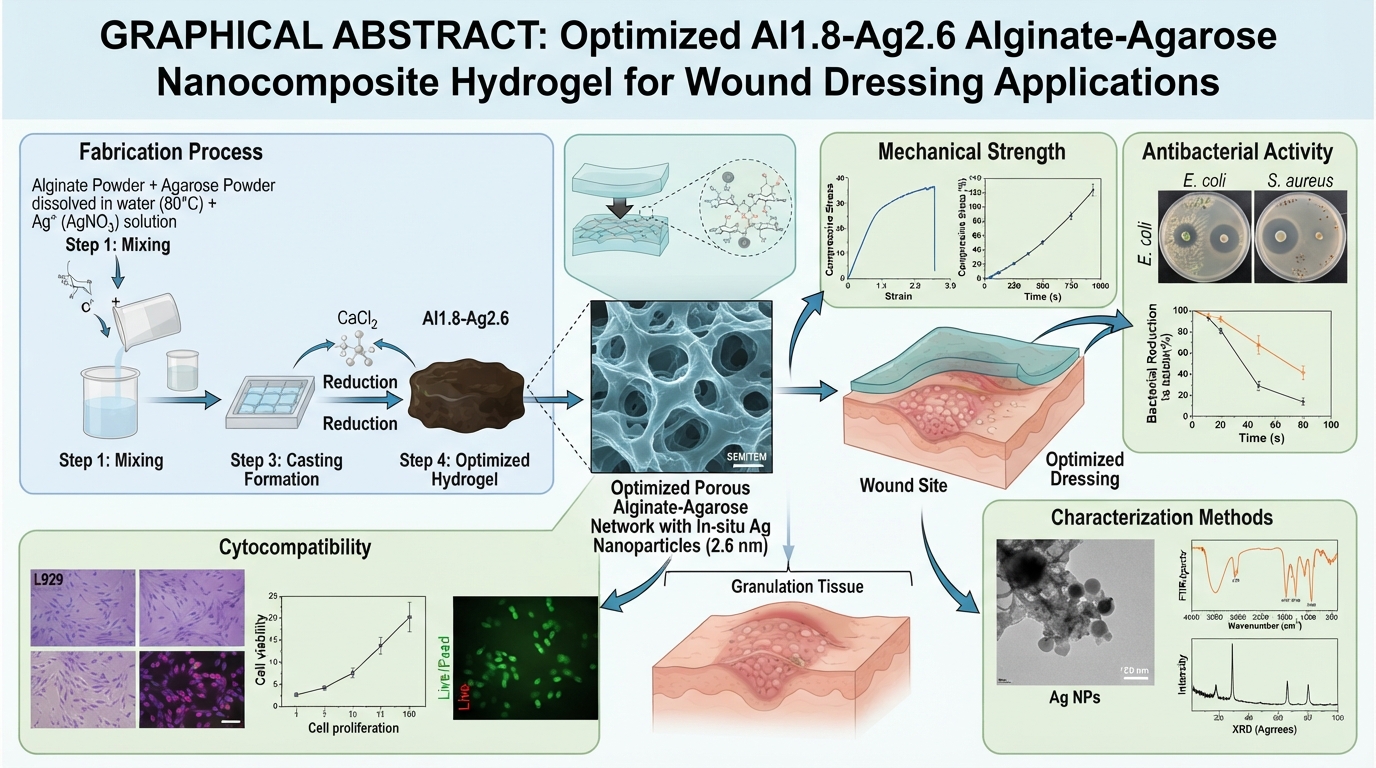
The co-implantation of alginate (Al) and agarose (Ag) with silver nanoparticles (AgNPs) is one of the feasible strategies to develop nanocomposite hydrogels for future wound dressings. Natural hydrogels have emerged as promising materials because of their excellent biocompatibility; however, they experience poor mechanical strength and infection susceptibility. This study aims to 3synthesise and optimise AgNP-loaded alginate-agarose composite hydrogel beads and to comprehensively evaluate their physiochemical, mechanical, antimicrobial, and cell attachment performance for potential applications in wound dressing. Composite hydrogels were synthesised using alginate and agarose with different ratios and loaded with silver nanoparticles. Structural characterisation was carried out by Field emission scanning electron microscopy (FESEM) and transmission electron microscopy (TEM). Fourier transform infrared (FT-IR) spectroscopy was used to analyse the chemical interactions. The functional properties were analysed through swelling ratio measurement, mechanical strength (ASTM D638 Type V), and antibacterial assay against Pseudomonas aeruginosa (P. aeruginosa), Staphylococcus aureus (S. aureus), and Escherichia coli (E. coli). FESEM and TEM images revealed that the nanocomposite hydrogels have a porous structure and the AgNPs were well dispersed (6.6–22.9 nm, mean 14.1 nm). The FTIR data showed a strong coordination of silver ions with carboxylate groups in the polymer network. The swelling analysis also showed that the hydrogels are suitable for exudate management. The mechanical strength analysis of the Al1.8–Ag2.6 formulation brought the best compromise between strength (Young's modulus 20.7 kPa) and flexibility. Moreover, the antibacterial assay confirmed the excellent bactericidal effect against the tested bacteria. The optimised Al1.8–Ag2.6 nanocomposite hydrogel beads showed a synergistic improvement in mechanical strength, antimicrobial activity and cytocompatibility. This study demonstrates that AgNP-loaded alginate-agarose hydrogel has significant potential as an antimicrobial wound dressing materials.
References
Zhang YS, Khademhosseini A. Advances in engineering hydrogels. Science (1979). 2017. https://doi.org/10.1126/science.aaf3627
Correa S, Grosskopf AK, Lopez Hernandez H, Chan D, Yu AC, Stapleton LM, et al. Translational Applications of Hydrogels. Chem Rev. 2021. https://doi.org/10.1021/acs.chemrev.0c01177
Yang J, Yu H, Wang L, Liu J, Liu X, Hong Y, et al. Advances in adhesive hydrogels for tissue engineering. Eur Polym J. 2022. https://doi.org/10.1016/j.eurpolymj.2022.111241
Catoira MC, Fusaro L, Di Francesco D, Ramella M, Boccafoschi F. Overview of natural hydrogels for regenerative medicine applications. J Mater Sci Mater Med. 2019;30. https://doi.org/10.1007/s10856-019-6318-7
Ahmed EM. Hydrogel: Preparation, characterization, and applications: A review. J Adv Res. 2015. https://doi.org/10.1016/j.jare.2013.07.006
He J, Sun Y, Gao Q, He C, Yao K, Wang T, et al. Gelatin Methacryloyl Hydrogel, from Standardization, Performance, to Biomedical Application. Adv Healthc Mater. 2023;12. https://doi.org/10.1002/adhm.202300395
Chaudhuri O, Cooper-White J, Janmey PA, Mooney DJ, Shenoy VB. Effects of extracellular matrix viscoelasticity on cellular behaviour. Nature. 2020. https://doi.org/10.1038/s41586-020-2612-2
Shang S, Zhuang K, Chen J, Zhang M, Jiang S, Li W. A bioactive composite hydrogel dressing that promotes healing of both acute and chronic diabetic skin wounds. Bioact Mater. 2024;34. https://doi.org/10.1016/j.bioactmat.2023.12.026
Ghavaminejad A, Park CH, Kim CS. In Situ Synthesis of Antimicrobial Silver Nanoparticles within Antifouling Zwitterionic Hydrogels by Catecholic Redox Chemistry for Wound Healing Application. Biomacromolecules. 2016;17. https://doi.org/10.1021/acs.biomac.6b00039
Begum F, Mahto AK, Kumari S, Dewangan RP. In-Situ Synthesis of Silver Nanoparticle within Self-Assembling Ultrashort Peptide Hydrogel as Antibacterial with Wound Healing Properties. Curr Protein Pept Sci. 2025;26. https://doi.org/10.2174/0113892037367553250327084808
Joly JP, Aricov L, Balan GA, Popescu EI, Mocanu S, Leonties AR, et al. Formation of Alginate/Chitosan Interpenetrated Networks Revealed by EPR Spectroscopy. Gels. 2023;9. https://doi.org/10.3390/gels9030231
Shukla A, Syaifie PH, Rochman NT, Jaya Syaifullah S, Jauhar MM, Mardliyati E. A recent study of natural hydrogels: improving mechanical properties for biomedical applications. Biomed Mater [Internet]. Biomed Mater; 2025 [cited 2025 Dec 24];20. https://doi.org/10.1088/1748-605X/ADB2CD
Yan X, Huang H, Bakry AM, Wu W, Liu X, Liu F. Advances in enhancing the mechanical properties of biopolymer hydrogels via multi-strategic approaches. Int J Biol Macromol [Internet]. Elsevier; 2024 [cited 2025 Dec 24];272:132583. https://doi.org/10.1016/J.IJBIOMAC.2024.132583
Liu L, Wang Y, Li X, Li P, Jin Y, Yu H, et al. Recent developments in polysaccharide-based conductive hydrogels: A review and perspective. Carbohydr Polym. 2025. https://doi.org/10.1016/j.carbpol.2025.124453
Li Z, Lin Z. Recent advances in polysaccharide-based hydrogels for synthesis and applications. Aggregate. 2021. https://doi.org/10.1002/agt2.21
Cambria E, Brunner S, Heusser S, Fisch P, Hitzl W, Ferguson SJ, et al. Cell-Laden Agarose-Collagen Composite Hydrogels for Mechanotransduction Studies. Front Bioeng Biotechnol. 2020;8. https://doi.org/10.3389/fbioe.2020.00346
Zigan C, Benito Alston C, Chatterjee A, Solorio L, Chan DD. Characterization of Composite Agarose–Collagen Hydrogels for Chondrocyte Culture. Ann Biomed Eng. 2025;53. https://doi.org/10.1007/s10439-024-03613-x
Rana MM, De la Hoz Siegler H. Evolution of Hybrid Hydrogels: Next-Generation Biomaterials for Drug Delivery and Tissue Engineering. Gels 2024, Vol 10, Page 216 [Internet]. Multidisciplinary Digital Publishing Institute; 2024 [cited 2025 Dec 24];10:216. https://doi.org/10.3390/GELS10040216
Rahman MM, Shahid MA, Hossain MT, Sheikh MS, Rahman MS, Uddin N, et al. Sources, extractions, and applications of alginate: a review. Discover Applied Sciences 2024 6:8 [Internet]. Springer; 2024 [cited 2025 Dec 24];6:443-. https://doi.org/10.1007/S42452-024-06151-2
Huang Y, Peng S, Chen Y, Chu B. Agarose Hydrogels for Bone Tissue Engineering, from Injectables to Bioprinting. Gels 2025, Vol 11, Page 255 [Internet]. Multidisciplinary Digital Publishing Institute; 2025 [cited 2025 Dec 24];11:255. https://doi.org/10.3390/GELS11040255
Baishya G, Parasar B, Limboo M, Kumar R, Dutta A, Hussain A, et al. Advancements in nanocomposite hydrogels: a comprehensive review of biomedical applications. Discover Materials 2024 4:1 [Internet]. Springer; 2024 [cited 2025 Dec 24];4:40-. https://doi.org/10.1007/S43939-024-00111-8
Barrett-Catton E, Ross ML, Asuri P. Multifunctional Hydrogel Nanocomposites for Biomedical Applications. Polymers 2021, Vol 13, Page 856 [Internet]. Multidisciplinary Digital Publishing Institute; 2021 [cited 2025 Dec 24];13:856. https://doi.org/10.3390/POLYM13060856
Pangli H, Vatanpour S, Hortamani S, Jalili R, Ghahary A. Incorporation of Silver Nanoparticles in Hydrogel Matrices for Controlling Wound Infection. J Burn Care Res [Internet]. J Burn Care Res; 2021 [cited 2025 Dec 24];42:785–93. https://doi.org/10.1093/JBCR/IRAA205
Nicolae-Maranciuc A, Chicea D. Polymeric Systems as Hydrogels and Membranes Containing Silver Nanoparticles for Biomedical and Food Applications: Recent Approaches and Perspectives. Gels 2025, Vol 11, Page 699 [Internet]. Multidisciplinary Digital Publishing Institute; 2025 [cited 2025 Dec 24];11:699. https://doi.org/10.3390/GELS11090699
Pranantyo D, Yeo CK, Wu Y, Fan C, Xu X, Yip YS, et al. Hydrogel dressings with intrinsic antibiofilm and antioxidative dual functionalities accelerate infected diabetic wound healing. Nat Commun [Internet]. 2024 [cited 2025 Dec 24];15:954. https://doi.org/10.1038/s41467-024-44968-y
Stuermer EK. Wound biofilm: a bacterial success story. Journal of Wound Management [Internet]. Cambridge Media; 2023 [cited 2025 Dec 24];24. https://doi.org/10.35279/JOWM2023.24.02.04
Shen AZ, Taha M, Ghannoum M, Tyring SK. Biofilms and Chronic Wounds: Pathogenesis and Treatment Options. Journal of Clinical Medicine 2025, Vol 14, Page 7784 [Internet]. Multidisciplinary Digital Publishing Institute; 2025 [cited 2025 Dec 24];14:7784. https://doi.org/10.3390/JCM14217784
Nishiguchi A. Advances in injectable hydrogels with biological and physicochemical functions for cell delivery. Polymer Journal 2024 56:10 [Internet]. Nature Publishing Group; 2024 [cited 2025 Dec 24];56:895–903. https://doi.org/10.1038/s41428-024-00934-5
Baishya G, Parasar B, Limboo M, Kumar R, Dutta A, Hussain A, et al. Advancements in nanocomposite hydrogels: a comprehensive review of biomedical applications. Discover Materials 2024 4:1 [Internet]. Springer; 2024 [cited 2025 Dec 24];4:40-. https://doi.org/10.1007/S43939-024-00111-8
Liu Y, Jiang L, Jiang R, Liu H. Versatile nanocomposite hydrogel induced by Au-Se interaction showing mechanically tough and multi-responsive self-healing properties. Journal of Materials Science 2024 59:19 [Internet]. Springer; 2024 [cited 2025 Dec 24];59:8287–97. https://doi.org/10.1007/S10853-024-09708-Z
Yang N, Zhu M, Xu G, Liu N, Yu C. A near-infrared light-responsive multifunctional nanocomposite hydrogel for efficient and synergistic antibacterial wound therapy and healing promotion. J Mater Chem B [Internet]. The Royal Society of Chemistry; 2020 [cited 2025 Dec 24];8:3908–17. https://doi.org/10.1039/D0TB00361A
Liu Y, Yu D, Han H, Jia H. NIR-responsive nano-photothermal and antioxidant platforms to combat bacteria. Science China Materials 2025 68:6 [Internet]. Springer; 2025 [cited 2025 Dec 24];68:2111–21. https://doi.org/10.1007/S40843-025-3353-2
Jayashankar T, Ping MKX, Zhi HW, Yusop N, Ghazalli NF. Preparation and Characterizations of Alginate-Agarose Polymeric Hydrogel for Potential Stem Cell Delivery. Journal of Polymer Science and Technology (ISSN: 2550-1917). 2021;6.
Malektaj H, Drozdov AD, deClaville Christiansen J. Mechanical Properties of Alginate Hydrogels Cross-Linked with Multivalent Cations. Polymers 2023, Vol 15, Page 3012 [Internet]. Multidisciplinary Digital Publishing Institute; 2023 [cited 2025 Dec 24];15:3012. https://doi.org/10.3390/POLYM15143012
Liang Z, Liu C, Li L, Xu P, Luo G, Ding M, et al. Double-Network Hydrogel with Tunable Mechanical Performance and Biocompatibility for the Fabrication of Stem Cells-Encapsulated Fibers and 3D Assemble. 2016 [cited 2025 Dec 24]; https://doi.org/10.1038/srep33462
Narayana S, Gowda BHJ, Hani U, Ahmed MG, Asiri ZA, Paul K. Smart Poly(N-isopropylacrylamide)-Based Hydrogels: A Tour D’horizon of Biomedical Applications. Gels 2025, Vol 11, Page 207 [Internet]. Multidisciplinary Digital Publishing Institute; 2025 [cited 2025 Dec 24];11:207. https://doi.org/10.3390/GELS11030207
Greco I, Miskovic V, Varon C, Marraffa C, Iorio CS. Printability of Double Network Alginate-Based Hydrogel for 3D Bio-Printed Complex Structures. Front Bioeng Biotechnol [Internet]. Frontiers Media S.A.; 2022 [cited 2025 Dec 24];10:896166. https://doi.org/10.3389/FBIOE.2022.896166/BIBTEX
Dynamic cross-linking of an alginate–acrylamide tough hydrogel system: time-resolved in situ mapping of gel self-assembly - RSC Advances (RSC Publishing) DOI:10.1039/D0RA09210J [Internet]. [cited 2025 Dec 24]. https://pubs.rsc.org/en/content/articlehtml/2021/ra/d0ra09210j. Accessed 24 Dec 2025
Kumar N, Dixit A, Bag DS. Synthesis of highly swellable silver nanocomposite ionic double network (Ag-IDN) hydrogels and study of their characteristic properties. Polymer Bulletin 2021 79:8 [Internet]. Springer; 2021 [cited 2025 Dec 24];79:6759–76. https://doi.org/10.1007/S00289-021-03816-5
Bardajee GR, Dianatnejad N, Mahmoodi NO, Mahmoodain H. Mechanical properties and development of silver Nanoparticle-enhanced Alginate-polyacrylamide double network Hydrogel. Journal of Polymer Research 2024 31:11 [Internet]. Springer; 2024 [cited 2025 Dec 24];31:343-. https://doi.org/10.1007/S10965-024-04188-W
Al-Hasani, F. J., Hamad, Q. A., & Faheed, N. K. (2024). Enhancing the cell viability and antibacterial properties of alginate-based composite layer by adding active particulates. Discover Applied Sciences, 6(2), 70. https://doi.org/10.1007/s42452-024-05715-6
Han, J., Meng, Q., Xue, S., Su, W., & Wu, J. (2025). Silk fibroin methacryloyl hydrogel loaded with silver-gallic acid nanoparticles for enhanced diabetic wound healing. International Journal of Biological Macromolecules, 307, 142108. https://doi.org/10.1016/j.ijbiomac.2025.142108
Iqbal, Y., Amin, F., Usman, Y., & Farrukh Sarfraz, M. (2024). Alginate-Based hydrogels with inorganic Nanomaterials: A promising approach for wound healing and bone tissue regeneration. European Polymer Journal, 212, 113057. https://doi.org/10.1016/j.eurpolymj.2024.113057
Najafian-Najafabadi, A., Salehi, M., Amani, A. M., Ebrahiminezhad, A., Vojoudi, E., Dortaj, H., Alizadeh, A. A., Amiri, S., Hooshmand-Ardakani, A., & Vaez, A. (2025). Biomimetic skin regeneration using a dual-layer scaffold/hydrogel: Polycaprolactone-gelatin electrospun scaffold incorporated with bromelain-silver nanoparticles and alginate hydrogel enriched with selenium-doped bioglass. International Journal of Biological Macromolecules, 311, 143733. https://doi.org/10.1016/j.ijbiomac.2025.143733
Downloads
Published
Issue
Section
License
Copyright (c) 2026 Veithesswary Mogan, Norshamiza Abu Bakar, Dr Norhayati Yusop, Dr Juan Matmin, Dr Nur Fatiha Ghazalli

This work is licensed under a Creative Commons Attribution-NonCommercial 4.0 International License.