
Comparative Analysis of Different Fixation and Dehydration Methods for Cells Seeded on Gel-Based Scaffolds using Scanning Electron Microscopy
DOI:
https://doi.org/10.11113/mjfas.v22n1.4681Keywords:
Scanning electron microscopy, scaffold, collagen type 1, MatrigelTM, dental pulp stem cellsAbstract
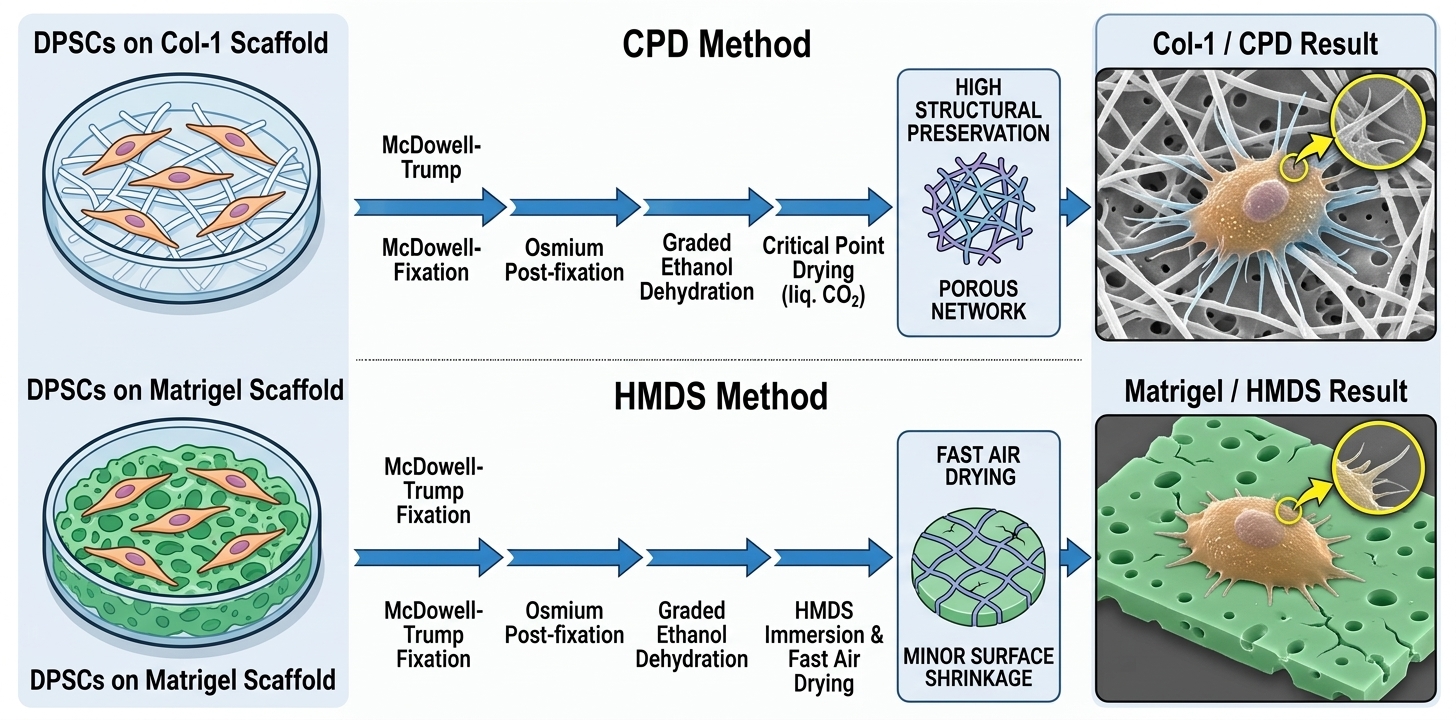
MatrigelTM, a complex mixture of ECM proteins, and Collagen type 1 (Col-1), a major component of the natural extracellular matrix, are widely utilised in both cell culture and tissue engineering. High magnification by scanning electron microscopy allows detailed microstructural analysis of the cells and scaffolds. However, the efficiency of the techniques may be directly affected by different fixation and dehydration methods. Optimisation of the fixation and dehydration protocol for cell growth on scaffold is important as it influences the morphological integrity and structural preservation of cells within gel-based scaffolds. This study compared the osmium tetroxide hexamethyldisilane (HMDS) and critical point drying (CPD) method to fix and dehydrate cells which were seeded on Col-1 and MatrigelTM scaffolds by SEM analysis. Col-1 and MatrigelTM scaffolds were prepared and seeded with dental pulp stem cells (DPSC) for 3 days; followed by fixation using with McDowell-Trump fixative, osmium tetroxide hexamethyldisilane (HMDS) or the critical point drying (CPD) method and analysed by SEM. Both HMDS and CPD displayed good compatibility with cells and scaffolds for SEM analysis. No significant differences were observed on the morphology of DPSC prepared using either HMDS or CPD (Mann–Whitney U test, p = 0.10 for both). However, each of the fixation methods substantially provided different preservative effects on Col-1 and MatrigelTM microstructures. In conclusion, both HMDS and CPD methods were found suitable for fixation and dehydration of DPSC plated on Col-1 and MatrigelTM scaffolds for analysis by SEM.
References
Potdar, P. D. (2015). Human dental pulp stem cells: Applications in future regenerative medicine. World Journal of Stem Cells, 7(5), 839. https://doi.org/10.4252/wjsc.v7.i5.839.
Dolega, M. E., Abeille, F., Picollet-D’hahan, N., & Gidrol, X. (2015). Controlled 3D culture in Matrigel microbeads to analyze clonal acinar development. Biomaterials, 52, 347–357. https://doi.org/10.1016/j.biomaterials.2015.02.042.
Wang, J., Chu, R., Ni, N., & Nan, G. (2020). The effect of Matrigel as scaffold material for neural stem cell transplantation for treating spinal cord injury. Scientific Reports, 10(1), 2576. https://doi.org/10.1038/s41598-020-59148-3.
Nocera, A. D., Comín, R., Salvatierra, N. A., & Cid, M. P. (2018). Development of 3D-printed fibrillar collagen scaffold for tissue engineering. Biomedical Microdevices, 20(2), 26. https://doi.org/10.1007/s10544-018-0270-z.
Busra, M. F. M., & Lokanathan, Y. (2019). Recent development in the fabrication of collagen scaffolds for tissue engineering applications: A review. Current Pharmaceutical Biotechnology, 20(12), 992–1003. https://doi.org/10.2174/1389201020666190731121016.
Mathew-Steiner, S. S., Roy, S., & Sen, C. K. (2021). Collagen in wound healing. Bioengineering, 8(5), 63. https://doi.org/10.3390/bioengineering8050063.
Li, Y., et al. (2021). Collagen-based biomaterials for bone tissue engineering. Materials & Design, 210, 110049. https://doi.org/10.1016/j.matdes.2021.110049.
Thavarajah, R., Mudimbaimannar, V., Elizabeth, J., Rao, U., & Ranganathan, K. (2012). Chemical and physical basics of routine formaldehyde fixation. Journal of Oral and Maxillofacial Pathology, 16(3), 400. https://doi.org/10.4103/0973-029X.102496.
Doughty, M. J., Bergmanson, J. P., & Blocker, Y. (1997). Shrinkage and distortion of the rabbit corneal endothelial cell mosaic caused by a high-osmolality glutaraldehyde–formaldehyde fixative compared to glutaraldehyde. Tissue and Cell, 29(5), 533–547. https://doi.org/10.1016/S0040-8166(97)80054-7.
Dwiranti, A., Masri, F., Rahmayenti, D. A., & Putrika, A. (2019). The effects of osmium tetroxide post-fixation and drying steps on leafy liverwort ultrastructure studied by scanning electron microscopy. Microscopy Research and Technique, 82(7), 1041–1046. https://doi.org/10.1002/jemt.23251.
Ramirez-Camacho, M. C., Beltran-Partida, E. A., Valdez-Salas, B., & Curiel Alvarez, M. A. (2024). Streamlined chemical fixation method for morphological investigation of Candida albicans with scanning electron microscopy. MethodsX, 13, 102985. https://doi.org/10.1016/j.mex.2024.102985.
Koga, D., Morinaga, R., & Kusumi, S. (2025). Direct imaging of the three-dimensional ultrastructure of neuronal organelles. Anatomical Science International, 100(4), 598–613. https://doi.org/10.1007/s12565-025-00888-5.
Ullah, N., Guhar, D., & Khan, S. (2025). Preparation and topographical studies of various biological specimens using an alternative to critical point drying for scanning electron microscopy. Journal of Microscopy, 299(1), 25–35. https://doi.org/10.1111/jmi.13412.
Nordestgaard, B. G., & Rostgaard, J. (1985). Critical-point drying versus freeze drying for scanning electron microscopy: A quantitative and qualitative study on isolated hepatocytes. Journal of Microscopy, 137(2), 189–207. https://doi.org/10.1111/j.1365-2818.1985.tb02577.x.
Schu, M., Terriac, E., Koch, M., Paschke, S., Lautenschläger, F., & Flormann, D. A. D. (2021). Scanning electron microscopy preparation of the cellular actin cortex: A quantitative comparison between critical point drying and hexamethyldisilazane drying. PLOS ONE, 16(7), e0254165. https://doi.org/10.1371/journal.pone.0254165.
Nation, J. L. (1983). A new method using hexamethyldisilazane for preparation of soft insect tissues for scanning electron microscopy. Stain Technology, 58(6), 347–351. https://doi.org/10.3109/10520298309066811.
Jusman, Y., Ng, S. C., & Abu Osman, N. A. (2014). Investigation of CPD and HMDS sample preparation techniques for cervical cells in developing a computer-aided screening system based on FE-SEM/EDX. The Scientific World Journal, 2014, 289817. https://doi.org/10.1155/2014/289817.
Ali, R., El-Boubbou, K., & Boudjelal, M. (2021). An easy, fast, and inexpensive method of preparing a biological specimen for scanning electron microscopy (SEM). MethodsX, 8, 101521. https://doi.org/10.1016/j.mex.2021.101521.
Chatzimpinou, A., et al. (2023). Dehydration as an alternative sample preparation for soft X-ray tomography. Journal of Microscopy, 291(3), 248–255. https://doi.org/10.1111/jmi.13214.
Kuehlmann, B., Zucal, I., Bonham, C. A., Joubert, L.-M., & Prantl, L. (2021). SEM and TEM for identification of capsular fibrosis and cellular behavior around breast implants: A descriptive analysis. BMC Molecular and Cell Biology, 22(1), 25. https://doi.org/10.1186/s12860-021-00364-8.
Collart-Dutilleul, P.-Y., et al. (2014). Adhesion and proliferation of human mesenchymal stem cells from dental pulp on porous silicon scaffolds. ACS Applied Materials & Interfaces, 6(3), 1719–1728. https://doi.org/10.1021/am4046316.
Arnaoutova, I., George, J., Kleinman, H. K., & Benton, G. (2012). Basement membrane matrix (BME) has multiple uses with stem cells. Stem Cell Reviews and Reports, 8(1), 163–169. https://doi.org/10.1007/s12015-011-9278-y.
Fridman, R., Benton, G., Arnaoutova, I., Kleinman, H. K., & Bonfil, R. D. (2012). Increased initiation and growth of tumor cell lines, cancer stem cells, and biopsy material in mice using basement membrane matrix protein (Cultrex or Matrigel) co-injection. Nature Protocols, 7(6), 1138–1144. https://doi.org/10.1038/nprot.2012.053.
Benton, G., Kleinman, H. K., George, J., & Arnaoutova, I. (2011). Multiple uses of basement membrane-like matrix (BME/Matrigel) in vitro and in vivo with cancer cells. International Journal of Cancer, 128(8), 1751–1757. https://doi.org/10.1002/ijc.25781.
Jokinen, J., et al. (2004). Integrin-mediated cell adhesion to type I collagen fibrils. Journal of Biological Chemistry, 279(30), 31956–31963. https://doi.org/10.1074/jbc.M401409200.
Francescone, R. A., III, Faibish, M., & Shao, R. (2011). A Matrigel-based tube formation assay to assess the vasculogenic activity of tumor cells. Journal of Visualized Experiments, (55), 3040. https://doi.org/10.3791/3040.
Bîrcă, A. C., et al. (2023). H₂O₂-PLA-(Alg)₂Ca hydrogel enriched in Matrigel® promotes diabetic wound healing. Pharmaceutics, 15(3), 857. https://doi.org/10.3390/pharmaceutics15030857.
Lawrence, B. J., & Madihally, S. V. (2008). Cell colonization in degradable 3D porous matrices. Cell Adhesion & Migration, 2(1), 9–16. https://doi.org/10.4161/cam.2.1.5884.
Nishida, T., Seino, S., & Imoto, Y. (2025). Visualizing antimicrobial effects on bacterial surfaces by SEM: A comparative study of hexamethyldisilazane (HMDS) and freeze-drying. Microscopy Research and Technique. https://doi.org/10.1002/jemt.70037.
Melo, T. dos S., Miranda-Magalhães, A., de Figueiredo, R. C. B. Q., & Pereira-Neves, A. (2025). Replacing critical point drying with hexamethyldisilazane drying enhances ultrastructural preservation of cell surface projections in Trichomonas vaginalis for scanning electron microscopy. PLOS ONE, 20(10), e0333745. https://doi.org/10.1371/journal.pone.0333745.
Hazrin-Chong, N. H., & Manefield, M. (2012). An alternative SEM drying method using hexamethyldisilazane (HMDS) for microbial cell attachment studies on sub-bituminous coal. Journal of Microbiological Methods, 90(2), 96–99. https://doi.org/10.1016/j.mimet.2012.04.014.
Downloads
Published
Issue
Section
License
Copyright (c) 2025 Nur Fatiha NUR Ghazalli, Gisele Soh Jing Wen, Nur Julia Nabila Nasir, Norshamiza Abu Bakar, Norhayati Yusop

This work is licensed under a Creative Commons Attribution-NonCommercial 4.0 International License.