
Fractional Analysis of Magnetic non-Newtonian Casson Fluid with Copper Nanoparticles Through Inclined Stenosed Artery
DOI:
https://doi.org/10.11113/mjfas.v22n1.4716Keywords:
Caputo-Fabrizio, Casson fluid, Magnetic field, Copper Nanoparticles, Inclined stenosed arteryAbstract
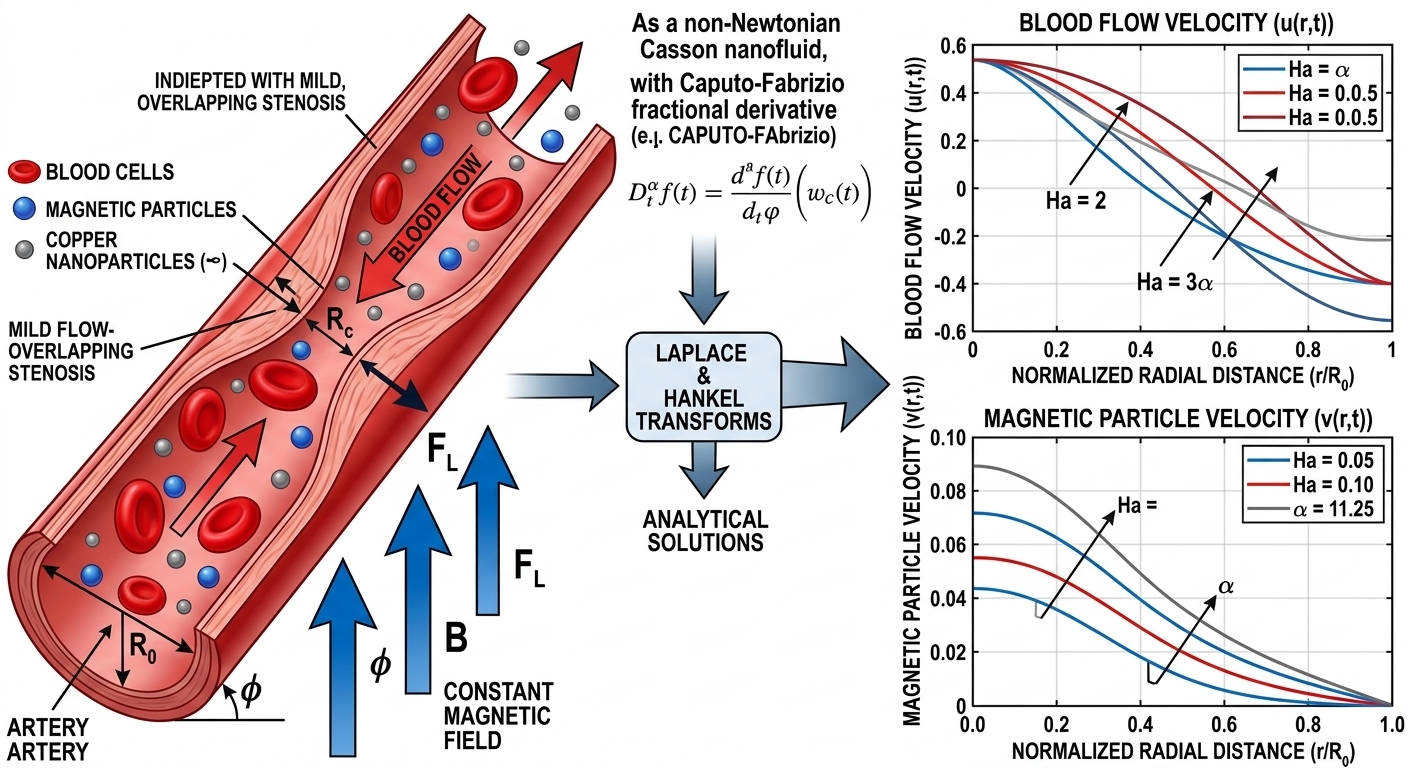
Cardiovascular diseases include various heart and blood vessel disorders. Arterial stenosis, caused by the buildup of fatty deposits and other materials, narrows arteries and disrupts normal blood flow, leading to increased wall shear stress and flow disturbances. In this study, the Caputo-Fabrizio fractional derivative is applied to analyze blood flow with copper nanoparticles in an inclined stenosed artery. Blood is modeled as a non-Newtonian Casson fluid under a uniform magnetic field and pressure gradient. Using the Laplace and Hankel transform techniques, analytical solutions for blood and magnetic particle velocities are obtained, and the effects of flow parameters, Hartmann number, time, Casson fluid parameter, and fractional order are presented graphically. Validation against limiting cases shows good agreement with previous studies. The results demonstrate that blood and particle velocities increase with fractional order, time, and Casson fluid parameter, but decrease with higher Hartmann number, with blood velocity generally exceeding particle velocity. These findings are useful for designing targeted drug delivery systems by understanding the behavior of non-Newtonian nanofluids in stenosed arteries under magnetic fields.
References
Akbar, N. S. (2014). Blood flow analysis of Prandtl fluid model in tapered stenosed arteries. Ain Shams Engineering Journal, 5(4), 1267–1275.
Kallekar, L. C., Viswanath, M., & Anand, M. (2017). Effect of wall flexibility on the deformation during flow in a stenosed coronary artery. Fluids, 2(2), 16. https://doi.org/10.3390/fluids2020016.
Beckman, J. A., Ansel, G. M., Lyden, S. P., & Das, T. S. (2020). Carotid artery stenting in asymptomatic carotid artery stenosis: JACC review topic of the week. Journal of the American College of Cardiology, 75(6), 648–656. https://doi.org/10.1016/j.jacc.2019.12.040.
Dhange, M. G., Sankad, U., Bhujakkanavar, K. K., & Misra, J. C. (2024). Hemodynamic characteristics of blood flow in an inclined overlapped stenosed arterial section. Partial Differential Equations in Applied Mathematics, 11, 100829. https://doi.org/10.1016/j.padiff.2024.100829.
Udupa, M. C., Saha, S., & Natarajan, S. (2025). Study of blood flow patterns in a stenosed artery through the combined effect of body acceleration and generalized Womersley solution. Scientific Reports, 15(1), 1845. https://doi.org/10.1038/s41598-025-01845-x.
Sharma, B., Gandhi, R., Abbas, T., & Bhatti, M. M. (2023). Magnetohydrodynamics hemodynamics hybrid nanofluid flow through inclined stenotic artery. Applied Mathematics and Mechanics, 44, 459–476. https://doi.org/10.1007/s10483-023-2923-0.
Intan Diyana, M., Nurul Aini, J., & Sharidan, S. (2023). Solute dispersion in an unsteady Herschel–Bulkley flow through an inclined stenosed artery. Journal of Advanced Research in Numerical Heat Transfer, 14(1), 29–38.
Bali, R., & Awasthi, U. (2007). Effect of a magnetic field on the resistance to blood flow through stenotic artery. Applied Mathematics and Computation, 188, 1635–1641. https://doi.org/10.1016/j.amc.2006.11.012
Ikbal, M. A., Chakravarty, S., Wong, K. L., Mazumdar, J., & Mandal, P. K. (2009). Unsteady response of non-Newtonian blood flow through a stenosed artery in magnetic field. Journal of Computational and Applied Mathematics, 230(1), 243–259. https://doi.org/10.1016/j.cam.2009.01.031.
Zainal, N. A., Nazar, R., Naganthran, K., & Pop, I. (2021). Stability analysis of unsteady MHD rear stagnation point flow of hybrid nanofluid. Mathematics, 9(19), 2428. https://doi.org/10.3390/math9192428.
Zainal, N. A., Nazar, R., Naganthran, K., & Pop, I. (2021). Unsteady MHD mixed convection flow in hybrid nanofluid at three-dimensional stagnation point. Mathematics, 9(5), 549. https://doi.org/10.3390/math9050549.
Varshney, G., Katiyar, V., & Kumar, S. (2010). Effect of magnetic field on the blood flow in artery having multiple stenosis: A numerical study. International Journal of Engineering, Science and Technology, 2(2), 967–982.
Mamun, K., Funazaki, K., Akter, S., & Akhter, M. (2020). The effect of magnetic field on blood flow through stenotic artery: A review on biomagnetic fluid dynamics.
Liaqat, H., Salah, U., & Asif, S. (2023). Unsteady and incompressible magnetohydrodynamics blood flow in an inclined cylindrical channel. International Journal of Physics Research and Applications.
Wajihah, S. A., & Sankar, D. S. (2023). A review on non-Newtonian fluid models for multi-layered blood rheology in constricted arteries. Archive of Applied Mechanics, 93(5), 1771–1796. https://doi.org/10.1007/s00419-023-02368-6.
Akhtar, S., Hussain, Z., Nadeem, S., Najjar, I. M. R., & Sadoun, A. M. (2023). CFD analysis on blood flow inside a symmetric stenosed artery: Physiology of coronary artery disease. Science Progress, 106(2), 368504231180092. https://doi.org/10.1177/00368504231180092.
Buchanan, J. R., Kleinstreuer, C., & Comer, J. K. (2000). Rheological effects on pulsatile hemodynamics in a stenosed tube. Computers & Fluids, 29(6), 695–724. https://doi.org/10.1016/S0045-7930(99)00033-4.
Siddiqui, S. U., Verma, N. K., Mishra, S., & Gupta, R. S. (2009). Mathematical modelling of pulsatile flow of Casson’s fluid in arterial stenosis. Applied Mathematics and Computation, 210(1), 1–10. https://doi.org/10.1016/j.amc.2008.12.059.
Azmi, W. F. W., Mohamad, A. Q., Jiann, L. Y., & Shafie, S. (2021). Analytical solution of unsteady Casson fluid flow through a vertical cylinder with slip velocity effect. Journal of Advanced Research in Fluid Mechanics and Thermal Sciences, 87(1), 68–75.
Bhatti, M. M., Sait, S. M., & Ellahi, R. (2022). Magnetic nanoparticles for drug delivery through tapered stenosed artery with blood-based non-Newtonian fluid. Pharmaceuticals, 15(11), 1352. https://doi.org/10.3390/ph15111352.
Majeed, S., Ali, F., Imtiaz, A., Khan, I., & Andualem, M. (2022). Fractional model of MHD blood flow in a cylindrical tube containing magnetic particles. Scientific Reports, 12(1), 418. https://doi.org/10.1038/s41598-021-04088-9
Choi, S. U. S., & Eastman, J. A. (1995). Enhancing thermal conductivity of fluids with nanoparticles.
Elnaqeeb, T., Mekheimer, K. S., & Alghamdi, F. (2016). Cu-blood flow model through a catheterized mild stenotic artery with a thrombosis. Mathematical Biosciences, 282, 135–146. https://doi.org/10.1016/j.mbs.2016.10.005.
Maqbool, K., Shaheen, S., & Siddiqui, A. M. (2019). Effect of nanoparticles on MHD flow of tangent hyperbolic fluid in a ciliated tube: An application to fallopian tube. Mathematical Biosciences and Engineering, 16(4), 2927–2941. https://doi.org/10.3934/mbe.2019147.
Awadalla, M., Abuasbeh, K., Noupoue, Y.-Y.-Y., & Abdo, M.-S. (2023). Modeling drug concentration in blood through Caputo–Fabrizio and Caputo fractional derivatives. Computer Modeling in Engineering & Sciences, 135(3), 2767–2785. https://doi.org/10.32604/cmes.2023.026148.
Abbas, S., Nisa, Z. U., Nazar, M., Amjad, M., Ali, H., & Jan, A. Z. (2024). Application of heat and mass transfer to convective flow of Casson fluids in a microchannel with Caputo–Fabrizio derivative approach. Arabian Journal for Science and Engineering, 49(1), 1275–1286. https://doi.org/10.1007/s13369-023-08351-1.
Caputo, M., & Fabrizio, M. (2015). A new definition of fractional derivative without singular kernel. Progress in Fractional Differentiation and Applications, 1, 73–85.
Ali, F., Imtiaz, A., Khan, I., & Sheikh, N. A. (2018). Flow of magnetic particles in blood with isothermal heating: A fractional model for two-phase flow. Journal of Magnetism and Magnetic Materials, 456, 413–422. https://doi.org/10.1016/j.jmmm.2018.02.038.
Moitoi, A. J., & Shaw, S. (2022). Magnetic drug targeting during Caputo–Fabrizio fractionalized blood flow through a permeable vessel. Microvascular Research, 139, 104262. https://doi.org/10.1016/j.mvr.2021.104262.
Yadeta, H. B., & Shaw, S. (2023). Analysis of unsteady non-Newtonian Jeffrey blood flow and transport of magnetic nanoparticles through an inclined porous artery with stenosis using the time fractional derivative. Journal of Applied Physics, 134(10), 104701. https://doi.org/10.1063/5.0161926.
Mackolil, J., & Mahanthesh, B. (2019). Exact and statistical computations of radiated flow of nano and Casson fluids under heat and mass flux conditions. Journal of Computational Design and Engineering, 6(4), 593–605. https://doi.org/10.1016/j.jcde.2019.04.005.
Jamil, D. F., Uddin, S., Kamardan, M. G., & Roslan, R. (2020). The effects of magnetic blood flow in an inclined cylindrical tube using Caputo–Fabrizio fractional derivatives. CFD Letters, 12, 111–122.
Shah, N. A., Vieru, D., & Fetecau, C. (2016). Effects of the fractional order and magnetic field on the blood flow in cylindrical domains. Journal of Magnetism and Magnetic Materials, 409, 10–19. https://doi.org/10.1016/j.jmmm.2016.02.049.
Khashi’ie, N. S., Arifin, N. M., Pop, I., & Wahid, N. S. (2020). Flow and heat transfer of hybrid nanofluid over a permeable shrinking cylinder with Joule heating: A comparative analysis. Alexandria Engineering Journal, 59(3), 1787–1798. https://doi.org/10.1016/j.aej.2020.04.021.
Noranuar, W. N. I. N., Mohamad, A. Q., Shafie, S., Khan, I., Jiann, L. Y., & Ilias, M. R. (2021). Non-coaxial rotation flow of MHD Casson nanofluid carbon nanotubes past a moving disk with porosity effect. Ain Shams Engineering Journal, 12(4), 4099–4110. https://doi.org/10.1016/j.asej.2021.03.009.
Khashi’ie, N. S., Arifin, N. M., Pop, I., & Wahid, N. S. (2020). Flow and heat transfer of hybrid nanofluid over a permeable shrinking cylinder with Joule heating: A comparative analysis. Alexandria Engineering Journal, 59(3), 1787–1798. https://doi.org/10.1016/j.aej.2020.04.021.
Noranuar, W. N. I. N., Mohamad, A. Q., Shafie, S., Khan, I., Jiann, L. Y., & Ilias, M. R. (2021). Non-coaxial rotation flow of MHD Casson nanofluid carbon nanotubes past a moving disk with porosity effect. Ain Shams Engineering Journal, 12(4), 4099–4110. https://doi.org/10.1016/j.asej.2021.03.009.
Downloads
Published
Issue
Section
License
Copyright (c) 2025 Wai Hao Chan, Dzuliana Fatin Jamil, Salah Uddin, Norhaliza Abu Bakar, Rozaini Roslan

This work is licensed under a Creative Commons Attribution-NonCommercial 4.0 International License.