
Ash Fouling Prediction of Individual Heating Surface of Boiler for Ultra-Supercritical Coal Power Plant based on Regression Techniques
DOI:
https://doi.org/10.11113/mjfas.v22n2.4706Keywords:
Ash Fouling, Regression, Gaussian Process Regression, Support Vector MachineAbstract
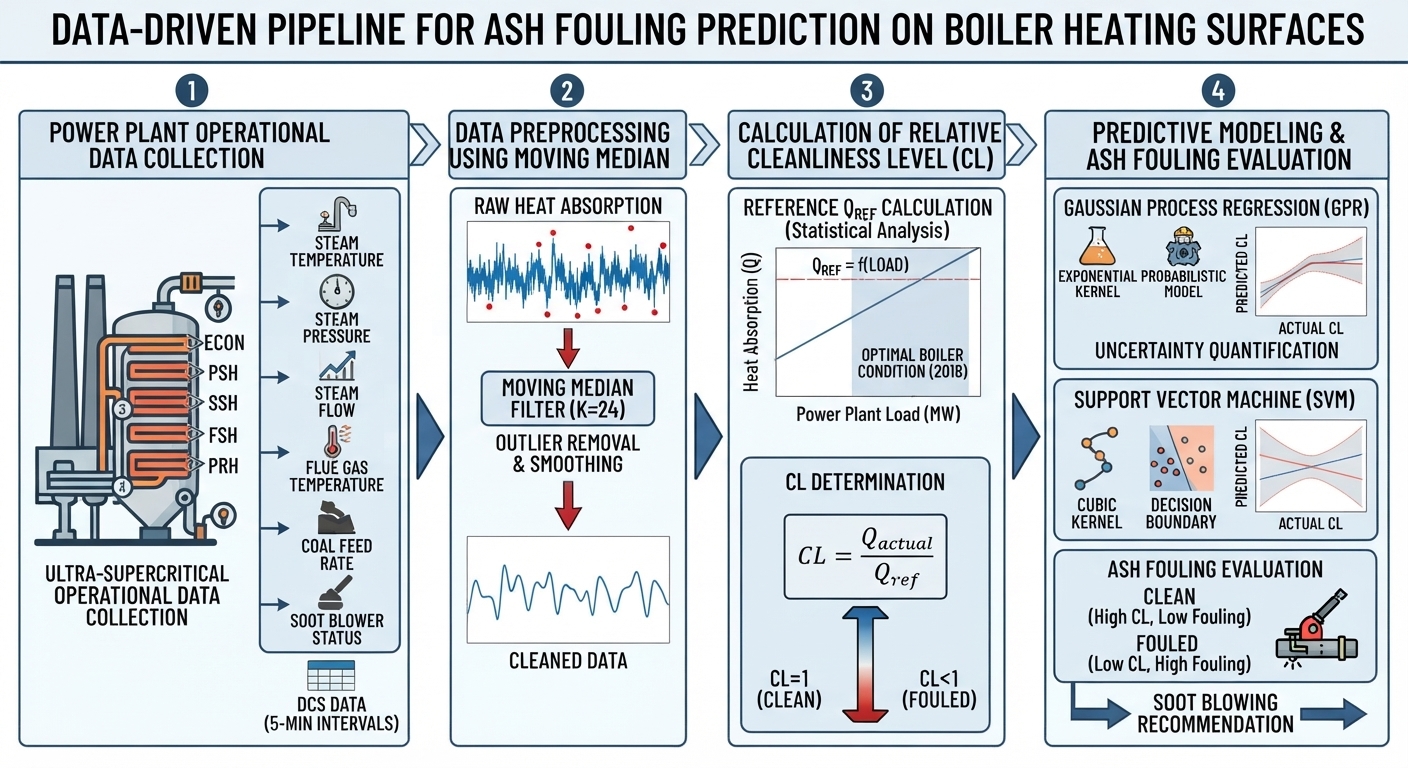
The ash fouling inside the boiler has a detrimental effect on its performance, leading to suboptimal efficiency. Soot blower systems are commonly used during power plant operations to mitigate fouling. Most soot blower operations are scheduled and fixed without considering the actual degree of fouling inside the boiler, often resulting in either insufficient or excessive blowing. The former reduces heat transfer efficiency, while the latter leads to the wastage of high-pressure steam and shortens the lifespan of boiler pipes. This study aims to predict the fouling conditions of six individual heating surfaces within the boiler: primary, secondary, and final superheaters; primary and final reheaters; and the economizer, utilizing indirect and data-driven methods. Direct methods, such as sensor installation, are impractical due to the extreme conditions within the boiler. The study initially establishes the relative cleanliness level as an indicator of fouling degree by comparing current heat absorption values with reference values derived from statistical analysis during periods of stable boiler conditions. Data cleaning methods are then applied before employing regression techniques for ash fouling prediction. Gaussian Process Regression (GPR), a nonparametric kernel-based probabilistic model, and Support Vector Machine (SVM) with different kernels are experimented with for comparison. Experimental analysis demonstrates high accuracy, ranging from 91.4% to 98.2% for GPR and 89.1% to 98.1% for SVM on the case study data. The implementation of the prediction model in this study is expected to enhance soot blowing operations, ultimately optimizing boiler performance. This improvement will lead to higher energy efficiency and a reduction in detrimental emissions.
References
Xu, L., et al. (2021). Improvement of slagging monitoring and soot-blowing of waterwall in a 650 MWe coal-fired utility boiler. Journal of the Energy Institute, 96, 106–120. https://doi.org/10.1016/j.joei.2021.02.006.
Shi, Y., Li, M., Cui, F., Wen, J., & Zeng, J. (2021). A neural-network-based method for ash fouling prediction of heat transfer surface in coal-fired power plant boiler. IEEE Access, 9, 109584–109604. https://doi.org/10.1109/ACCESS.2021.3100145.
Cui, F., Qin, S., Zhang, J., Li, M., & Shi, Y. (2022). A hybrid method for prediction of ash fouling on heat transfer surfaces. Energies, 15(13). https://doi.org/10.3390/en15134658.
Shi, Y., et al. (2018). Preventive soot blowing strategy based on state of health prediction for coal-fired power plant boiler.
Shi, Y., et al. (2019). Soot blowing optimization for frequency in economizers to improve boiler performance in coal-fired power plant. Energies, 12(15). https://doi.org/10.3390/en12152901.
Anitha Kumari, S., & Srinivasan, S. (2019). Ash fouling monitoring and soot-blow optimization for reheater in thermal power plant. Applied Thermal Engineering, 149, 62–72. https://doi.org/10.1016/j.applthermaleng.2018.12.031.
Sundaram, T., Basim Ismail, F., Gunnasegaran, P., & Gurusingam, P. (2017). Development and implementation of intelligent soot blowing optimization system for TNB Janamanjung. In MATEC Web of Conferences. https://doi.org/10.1051/matecconf/201713101006.
Pattanayak, L., Ayyagari, S. P. K., & Sahu, J. N. (2015). Optimization of sootblowing frequency to improve boiler performance and reduce combustion pollution. Clean Technologies and Environmental Policy, 17(7), 1897–1906. https://doi.org/10.1007/s10098-015-0906-0.
Tong, S., Zhang, X., Tong, Z., Wu, Y., Tang, N., & Zhong, W. (2019). Online ash fouling prediction for boiler heating surfaces based on wavelet analysis and support vector regression. Energies, 13(1). https://doi.org/10.3390/en13010059.
Band, S. S., et al. (2021). Groundwater level prediction in arid areas using wavelet analysis and Gaussian process regression. Engineering Applications of Computational Fluid Mechanics, 15(1), 1147–1158. https://doi.org/10.1080/19942060.2021.1944913.
Zeng, A., Ho, H., & Yu, Y. (2020). Prediction of building electricity usage using Gaussian process regression. Journal of Building Engineering, 28. https://doi.org/10.1016/j.jobe.2019.101054.
Blackburn, L. D., Tuttle, J. F., Andersson, K., Fry, A., & Powell, K. M. (2022). Development of novel dynamic machine learning-based optimization of a coal-fired power plant. Computers & Chemical Engineering, 163, 107848.
Zeng, H., Hu, L., Zhang, Q., & Ye, W. (2025). Boiler fouling and slagging prediction based on multi-modal database and deep learning. Applied Thermal Engineering, 127878.
Yang, K., Gao, L., Lin, Z., Lian, D., & Lin, Y. (2025). A machine learning based dynamic prediction model for pollution status of heating surface in coal-fired boilers. Case Studies in Thermal Engineering, 106953.
Ebrahim, N., Ttlnae001, T., & Jestin, L. (2016). Investigation into methods for the calculation and measurement of pulverised coal boiler flue gas furnace exit temperature.
Beér, J. M. (2000). Combustion technology developments in power generation in response to environmental challenges. Retrieved from http://www.elsevier.com/locate/pecs.
Teler, J., Trojan, M., & Taler, D. (2009). Assessment of ash fouling and slagging in coal fired utility boilers. In Proceedings of International Conference on Heat Exchanger Fouling and Cleaning VIII.
Zhang, X., Yuan, J., Chen, Z., Tian, Z., & Wang, J. (2018). A dynamic heat transfer model to estimate the flue gas temperature in the horizontal flue of the coal-fired utility boiler. Applied Thermal Engineering, 135, 368–378. https://doi.org/10.1016/j.applthermaleng.2018.02.067
Rasmussen, C. E., & Williams, C. K. I. (2006). Gaussian processes for machine learning. MIT Press.
Downloads
Published
Issue
Section
License
Copyright (c) 2026 Assoc. Prof. Ts. Dr. Azura Bt. Che Soh, Maslina Mohd Ibrahim, Asnor Juraiza Ishak, Raja Kamil, mohd amran mohd radzi, Amir Redzuan Mohd Ibrahim

This work is licensed under a Creative Commons Attribution-NonCommercial 4.0 International License.