
Extraction and Characterization of β-glucan from Ulva rigida and Gracilaria fisheri: A Comparative Study of Two Extraction Methods
DOI:
https://doi.org/10.11113/mjfas.v21n6.4612Keywords:
β-glucan, extraction, seaweeds, Ulva rigida, Gracilaria fisheriAbstract
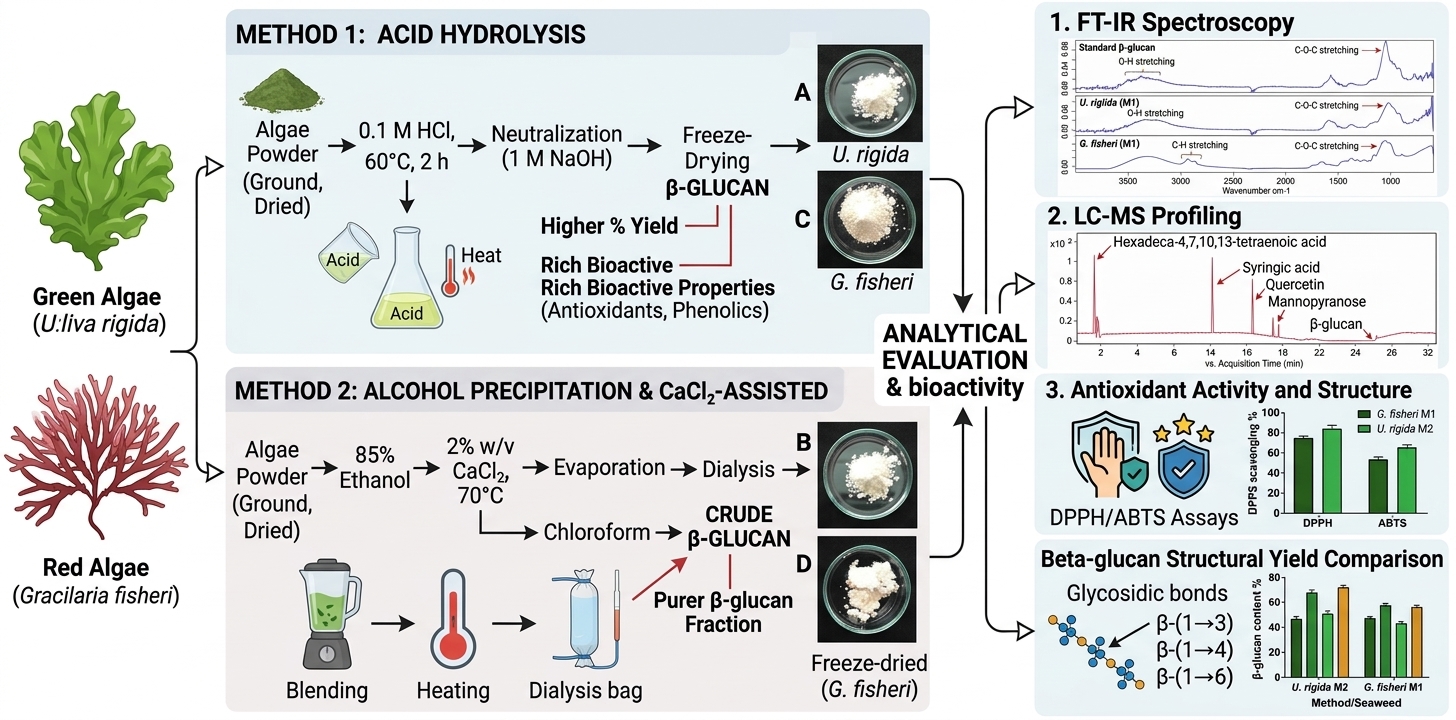
Ulva rigida and Gracilaria fisheri are very common algae and are considered potential sources of β-glucans. In this study, acid hydrolysis with 0.1 M HCl (Method 1) and alcohol precipitation with CaCl₂-assisted extraction (Method 2) were used to isolate β-glucan from both algae and followed by characterization. The crude extract from U. rigida was whiter than the β-glucan crude from G. fisheri, which had a faint brown color. In comparison to Method 2, Method 1 produced a higher percentage of both algae and contained phenolic compounds (0.32 ± 0.00–1.35 ± 0.04 μg gallic acid/mg sample). It also demonstrating significant antioxidant activities properties via DPPH, ABTS, and reducing power assays. The existence of β-glucan functional groups was established by FT-IR analysis, and the extracts from G. fisheri (both methods) and U. rigida (method 1) have been determined to contain β-glucans by LC-MS. These findings highlight U. rigida and G. fisheri as promising alternative sources of β-glucan for potential applications in the food, pharmaceutical, and cosmetic industries. The results suggest that acid hydrolysis (Method 1) is a more effective method for extracting β-glucan, resulting in a higher yield while preserving its bioactive properties.
References
Bai, J., Ren Y., Li, Y., Fan, M., Qian, H., Wang, L., Wu, G., Zhang, H., Qi, X., Xu, M. & Rao, Z. (2019). Physiological functionalities and mechanisms of β-glucans. Trends in Food Science & Technology, 88, 5766.
Seo, G., Hyun, C., Choi, S., Kim, Y. & Cho, M. (2019). The wound healing effect of four types of beta-glucan. Applied Biological Chemistry, 62, 20.
Chen, H., Liu, N., He, F. & Xu, X. (2022). Specific β-glucans in chain conformations and their biological functions. Polymer Journal, 54, 427–453.
Ciecierska, A., Drywień, M. E., Hamulka, J. & Sadkowski, T. (2019). Nutraceutical functions of beta-glucans. Roczniki Państwowego Zakładu Higieny, 70(4), 315324.
Zhou, F., Zhang, Y., Zhang, Q., Lu, J., Lui, Y., & Wang, J. (2019). Structure characterization and immunological activity of a β-glucan from white H. marmoreus and its silver nanoparticle derivatives. Carbohydrate Polymers, 210, 18.
Kumar, D., Narwal, S., Virani, S., Pal Singh Verma, R., Gyawali S. & Singh, G.P. (2020). Wheat and Barley Grain Biofortification. Woodhead Publishing. 295308.
Babu, L. R. (2015). Green extraction techniques, structural analysis and antioxidant activities of-glucan present in oats. International Journal of Latest Trends in Engineering and Technology, 5, 125–135.
Singla, A., Gupta, O. P., Sagwal, V., Kumar, A., Patwa, N., Mohan, N., Ankush, Kumar, D., Vir, O., Singh, J., Kumar, L., Lal, C., & Singh, G. (2024). Beta-Glucan as a Soluble dietary fiber source: origins, biosynthesis, extraction, purification, structural characteristics, bioavailability, biofunctional attributes, industrial utilization, and global trade. Nutrients, 16(6), 900.
Zheng, Z., Huang, Q., Luo, X., Xiao, Y., Cai, W. & Ma, H. (2019). Effects and mechanisms of ultrasound- and alkali-assisted enzymolysis on production of water-soluble yeast β-glucan. Bioresource Technology, 273, 394-403.
Ramalingam, P., Kumar, S. P., Rao, H. C. Y. & Chelliah, J. (2021). Synthesis of β-glucan nanoparticles from red algae–derived β-glucan for potential biomedical applications. Applied Biochemistry and Biotechnology, 193, 3983–3995.
Bobadilla, F., Rodriguez-Tirado, C., Imarai, M., Galotto, M.J. & Andersson, R. (2013). Soluble β-1,3/1,6-glucan in seaweed from the southern hemisphere and its immunomodulatory effect. Carbohydrate Polymers, 92(1), 241248.
Dubois, M., Gilles, K. A., Hamilton, J. K., Rebers, P. A. & Smith, F. (1956). Colorimetric method for determination of sugars and related substances. Analytical Chemistry, 28, 350–356.
Blois, M. S. (1958). Antioxidant determinations by the use of a stable free radical. Nature 181, 1199–1200.
Re, R., Pellegrini, N., Proteggente, A., Pannala, A., Yang, M. & Rice-Evans, C. (1999). Antioxidant activity applying an improved ABTS radical cation decolorization assay. Free Radical Biology and Medicine 26, 1231–1237.
Yen, G. C. & Chen, H. Y. (1995). Antioxidant activity of various tea extracts in relation to their antimutagenicity. Journal of Agricultural and Food Chemistry, 43, 27–37.
Singleton, V. L. & Rossi, J. A. (1965). Colorimetry of total phenolics with phosphomolybdic phosphotungstic acid reagents. American Journal of Enology and Viticulture, 1, 144-158.
Lowry, O. H., Rosebrough, N. J., Farr, A. L. & Randall, R. J. (1951). Protein measurement with the Folin phenol reagent. Journal of Biological Chemistry, 193(1), 265275.
Chokri, S., Ben Younes, S., Ellafi, A., Mnif, S., Lopez-Maldonado, E.A. & Slaheddine Masmoudi, A. (2024). Exploring Rhamnus alaternus polysaccharides: Extraction, characterization, and analysis of antioxidant and antimicrobial properties. Polymers, 16(22), 3180.
Bhuyar, P., Sundararaju, S., Rahim, M. H. A., Unpaprom, Y., Maniam, G.P. & Govindan, N. (2021). Antioxidative study of polysaccharides extracted from red (Kappaphycus alvarezii), green (Kappaphycus striatus) and brown (Padina gymnospora) marine macroalgae/seaweed. SN Applied Sciences, 3, 485.
Mousavian, Z., Safavi, M., Azizmohseni, F., Hadizadeh, M. & Mirdamadi, S. (2022). Characterization, antioxidant and anticoagulant properties of exopolysaccharide from marine microalgae. AMB Express, 12, 27.
Bikmurzin, R., Bandzevičiūtė, R., Maršalka, A., Maneikis, A. & Kalėdienė, L. (2022). FT-IR method limitations for β-glucan analysis. Molecules, 17(14), 4616.
Wang, C., Hou, X., Liu, J., Sun, X., & Zhao, G. (2025). Investigation on physicochemical properties and biological activities of yeast nanosized β-glucan. LWT, 225, 117939.
Kaur, R., Sharma, M., Ji, D., Xu, M., Agyei, D. (2020). Structural features, modification, and functionalities of beta-glucan. Fibers, 8(1), 1. https://doi.org/10.3390/fib8010001.
Zhong, X., Wang, G., Li, F., Fang, S., Zhou, S., Ishiwata, A., Tonevitsky A.G., Shkurnikov M., Cai, H. & Ding, F. (2023). Immunomodulatory effect and biological significance of β-glucans. Pharmaceutics, 15(6), 1615.
Srinivasulu, C., Ramgopal, M., Ramanjaneyulu, G., Anuradha, C. M. & Kumar, C. S. (2018). Syringic acid (SA)‒a review of its occurrence, biosynthesis, pharmacological and industrial importance. Biomedicine & Pharmacotherapy, 108, 547557.
Xu, D., Hu, M. J., Wang, Y. Q. & Cui, Y. L. (2019). Antioxidant activities of quercetin and its complexes for medicinal application. Molecules, 24(6), 1123.
Alqahtani, F. Y., Aleanizy, F. S., Mahmoud A. Z., Farshori N. N., Alfaraj R., Al-Sheddi E. S. & Alsarra I. A. (20[19). Chemical composition and antimicrobial, antioxidant, and anti-inflammatory activities of Lepidium sativum seed oil. Saudi Journal of Biological Sciences, 26(5), 1089–1092.
Fagali, N. & Catalá, A. (2008). Antioxidant activity of conjugated linoleic acid isomers, linoleic acid and its methyl ester determined by photoemission and DPPH techniques. Biophysical Chemistry, 137(1), 5662.
Wang, S., Gan, J., Li, J., Wang, Y., Zhang, J., Song, L., Yang, Z. & Jiang, X. (2022). Shengmai Yin formula exerts cardioprotective effects on rats with chronic heart failure via regulating linoleic acid metabolism. Prostaglandins & Other Lipid Mediators, 158, 106608.
Kim, M. M. & Kim, S. K. (2010). Effect of phloroglucinol on oxidative stress and inflammation. Food and Chemical Toxicology, 48(10), 29252933.
Downloads
Published
Issue
Section
License
Copyright (c) 2025 Thitikorn Prombanchong, Uraiwan Phetkul, Sulaiman Madyod, Suwanna Pholmai

This work is licensed under a Creative Commons Attribution-NonCommercial 4.0 International License.