
Tailoring the pH-responsive Properties of Titania Nanocomposite Functionalized with Polymethacrylic Acid for the Photodegradation of Paracetamol
DOI:
https://doi.org/10.11113/mjfas.v21n6.4597Keywords:
Photocatalyst, Titania, Polymethacrylic Acid, Free Radical Polymerization, ParacetamolAbstract
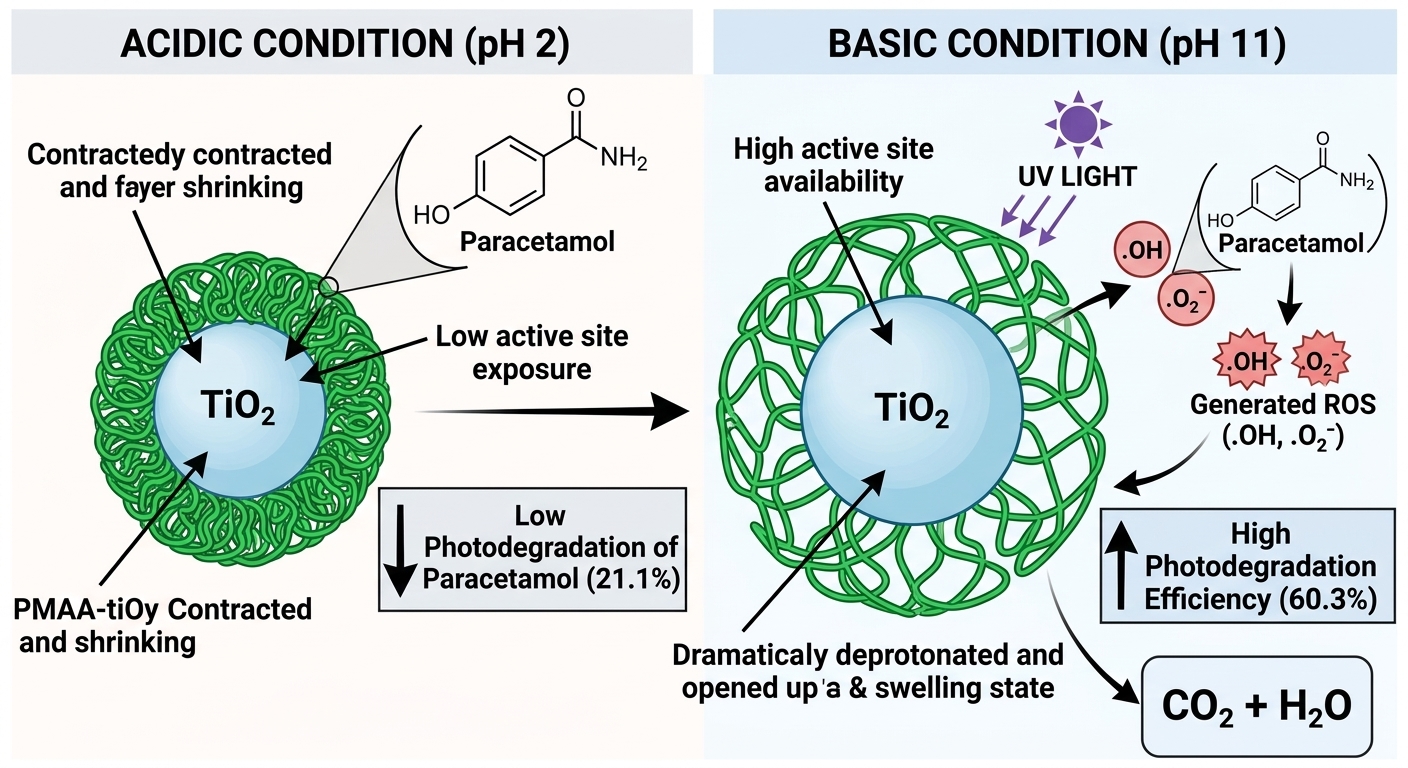
In this work, the free radical polymerization (FRP) method was employed to create pH-responsive polymethacrylic acid-titania nanocomposites (PMAA-TiO2 NCs) for the efficient photocatalytic degradation of paracetamol, a commonly used analgesic and antipyretic known as acetaminophen. The environmental risk posed by the accumulation of paracetamol in the food chain underscores the need for effective water treatment solutions. The need to address potential environmental toxicity prompted a meticulous investigation of TiO2 and crosslinker (CL) concentrations on PMAA, with X-ray diffraction (XRD) confirming anatase and rutile phases. Fourier transform infrared (FTIR) spectra validated distinctive functional groups, and ultraviolet-visible near-infrared (UV-vis-NIR) spectroscopy determined bandgap energy alignment within the anatase TiO2 range. Field emission scanning electron microscopy (FESEM) revealed seamless integration of PMAA with TiO2 nanoparticles, displaying a size distribution of 35 to 80 nm. Thermogravimetric analysis (TGA) demonstrated polymer degradation at 300 – 500 °C. Notably, the pH-dependent photocatalytic efficiency showed optimal TiO2 (0.4 g) and CL (0.7 g), achieving 60.3% removal efficiency in basic conditions and 21.1% in acidic conditions under UV light. This pH-responsive behavior was attributed to the swelling effect of PMAA under basic conditions, which increased the surface area and provided more active sites for photocatalysis. The PMAA layer's ionization in basic environments led to a highly negatively charged surface, facilitating greater interaction with reactive oxygen species (ROS) and enhancing photocatalytic performance. These results highlight PMAA's crucial role in imparting pH responsiveness to TiO2, emphasizing its significance in environmental remediation.
Author Biography
-
Sheela Chandren, ᵃDepartment of Chemistry, Faculty of Science, Universiti Teknologi Malaysia, 81310 UTM Johor Bahru, Johor, Malaysia; ᵇCentre for Sustainable Nanomaterials, Ibnu Sina Institute for Scientific and Industrial Research, Universiti Teknologi Malaysia, 81310 UTM Johor Bahru, Johor, Malaysia

Dr. Sheela Chandren is a senior lecturer at the Universiti Teknologi Malaysia. She obtained her Ph.D. from Hokkaido University, Japan. Her current research focuses on the development, characterization, and application of titania-based photocatalysts in various chemical reactions. Among the photocatalysts that have been successfully prepared are well-ordered titania by using magnetic fields, titania encapsulated in hollow silica shell for organic synthesis and titania on stainless steel for outdoor applications.
References
Tayyab, S., Z. Chao, and A. Hafiz Muhammad. (2022). Titanium Dioxide: Advancements and Thermal Applications, in Titanium Dioxide, A. Hafiz Muhammad, Editor. IntechOpen: Rijeka. p. Ch. 1.
Nasr, M., Eid, C., Habchi, R., Miele, P., & Bechelany, M. (2018). Recent Progress on Titanium Dioxide Nanomaterials for Photocatalytic Applications. ChemSusChem, 11(18): p. 3023-3047.
Tsang, C. H. A., Li, K., Zeng, Y., Zhao, W., Zhang, T., Zhan, Y., Xie, R., Leung, D. Y. C., & Huang, H. (2019). Titanium oxide based photocatalytic materials development and their role of in the air pollutants degradation: Overview and forecast. Environment International. 125: p. 200-228.
Zhou, S., Bai, J., Huang, K., Ye, X., Peng, Y., & Lei, M. (2022). Consideration of Photoactivity of TiO2 Pigments via the Photodegration of Methyl Orange under UV Irradiation. Materials (Basel). 15(17).
Anucha, C. B., Altin, I., Bacaksiz, E., & Stathopoulos, V. N. (2022). Titanium dioxide (TiO2)-based photocatalyst materials activity enhancement for contaminants of emerging concern (CECs) degradation: In the light of modification strategies. Chemical Engineering Journal Advances. 10.
Gateva, S., Jovtchev, G., Angelova, T., Nonova, T., Tyutyundzhiev, N., Geleva, E., Katrandzhiev, K., Nikolova, N., Dimitrov, D., & Angelov, C. (2022). Effect of UV Radiation and Other Abiotic Stress Factors on DNA of Different Wild Plant Species Grown in Three Successive Seasons in Alpine and Subalpine Regions. Phyto. 91: p. 293-313.
Ali, I., Kim, S.-R., Kim, S.-P., & Kim, J.-O. (2017). Anodization of bismuth doped TiO2 nanotubes composite for photocatalytic degradation of phenol in visible light. Catalysis Today. 282: p. 31-37.
Chen, H.-Y.T., S. Tosoni, and G. Pacchioni. (2018) A DFT study of the acid–base properties of anatase TiO2 and tetragonal ZrO2 by adsorption of CO and CO2 probe molecules. Surface Science. 652: p. 163-171
Khoiriah, Khoiriah & Putri, Reza & Ratnawati, Ratnawati & Sari, Mega. (2024). Investigating the effect of hydrogen peroxide on photocatalytic degradation of commercial paracetamol using TiO2. Journal of Chemical Technology and Metallurgy. 59: p. 539-548.
Akşit, D.A.-O. and G.A.-O. Pozan Soylu. (2022). Photocatalytic degradation of paracetamol by semiconductor oxides under UV and sunlight illumination. Turkish journal of chemistry. (1300-0527 (Print)).
Che Ku Hitam, C.K. and A. Abdul Jalil. (2020). A review on exploration of Fe2O3 photocatalyst towards degradation of dyes and organic contaminants. Journal of environmental management. 258: p. 110050.
Brillas, E. and J. Manuel Peralta-Hernández. (2023). Removal of paracetamol (acetaminophen) by photocatalysis and photoelectrocatalysis. A critical review. Separation and Purification Technology. 309: p. 122982.
Li, R., K. Landfester, and C.A.-O. Ferguson. (2022). Temperature and pH-Responsive Polymeric Photocatalysts for Enhanced Control and Recovery. Angewandte Chemie (International ed. in English), (1521-3773 (Electronic)).
Chen, Y.-W. and Y.-H. (2021). Hsu Effects of Reaction Temperature on the Photocatalytic Activity of TiO2 with Pd and Cu Cocatalysts. Catalysts.
Karimi Estahbanati, M. R., Mahinpey, N., Feilizadeh, M., Attar, F., & Iliuta, M. C. (2019) Kinetic study of the effects of pH on the photocatalytic hydrogen production from alcohols. International Journal of Hydrogen Energy. 44(60): p. 32030-32041.
Amanda and Cesar. (2018). Polymer Nanocomposites with Different Types of Nanofiller, in Nanocomposites, S. Subbarayan, Editor. IntechOpen: Rijeka. p. Ch. 6.
Bhat, A. H., Khan, I., Bhawani, S. A., Abdul Rahim, M. K., & Gazal, U. (2021). Chapter Fifteen - Stimuli-responsive polymer composites for fabric applications, in Smart Polymer Nanocomposites, S.A. Bhawani, A. Khan, and M. Jawaid, Editors Woodhead Publishing. p. 351-376.
Bril, M., S. Fredrich, and N.A. Kurniawan. (2022) Stimuli-responsive materials: A smart way to study dynamic cell responses. Smart Materials in Medicine. 3: p. 257-273.
Hong, W.-X., V.Y. Shevtsov, and Y.-T. Shieh. (2022) Preparation of pH-responsive poly(methyl methacrylate) nanoparticles with CO2-triggered aggregation. Journal of Polymer Research. 29(8).
Liu, Z., Wang, W., Xie, R., Ju, X. J., & Chu, L. Y. (2016). Stimuli-responsive smart gating membranes. Chem Soc Rev. 45(3): p. 460-75.
Bashina, A.V.S., N B Sadovnikova, E A Belyaeva and K V and Korchagina. (2019). Specific surface area of strongly swelling polymer hydrogels for agriculture. Earth and Environmental Science.
Jin, L., Shaaban, E., Bamonte, S., Cintron, D., Shuster, S., Zhang, L., Li, G., & He, J. (2021). Surface basicity of Metal@TiO2 to enhance photocatalytic efficiency for CO2 reduction. ACS Applied Materials & Interfaces, 13(32), 38595–38603.
Taborda, E. A., Franco, C. A., Lopera, S. H., Castro, R. H., Maya, G. A., Idrobo, E. A., & Cortés, B. (2021). Effect of surface acidity of SiO2 nanoparticles on thermal stability of polymer solutions for application in EOR processes. Journal of Petroleum Science and Engineering. 196.
Wang, Min, Liu, L., Cui, Y., Geng, H., Zhao, H., Liang, B., & Yang, J. (2019). Effects specific surface area and oxygen vacancy on the photocatalytic properties of mesoporous F doped SnO2 nanoparticles prepared by hydrothermal method. Journal of Materials Science: Materials in Electronics. 30(17): p. 16110-16123.
Varghese, S. A., Rangappa, S. M., Siengchin, S., & Parameswaranpillai, J. (2020). Natural polymers and the hydrogels prepared from them, in Hydrogels Based on Natural Polymers. p. 17-47.
Ziylan-Yavaş, A. and N.H. Ince. (2018). Catalytic ozonation of paracetamol using commercial and Pt-supported nanocomposites of Al2O3: The impact of ultrasound. Ultrasonics Sonochemistry. 40: p. 175-182.
Tony, A. A., Tony, E. A. E., Ali, S. B., Ezzeldin, A. M., & Mahmoud, A. A. (2020). COVID-19-associated sleep disorders: A case report. Neurobiology of Sleep and Circadian Rhythms. 9: p. 100057.
Lozano-Morales, S. A., Morales, G., López Zavala, M. Á., Arce-Sarria, A., & Machuca-Martínez, F. (2019). Photocatalytic Treatment of Paracetamol Using TiO2 Nanotubes: Effect of pH. Processes. 7.
Wardhani, S., Purwonugroho, D., Fitri, C. W., & Prananto, Y. P. (2018). Effect of pH and irradiation time on TiO2-chitosan activity for phenol photo-degradation.
Chelbi, S., Djouadi, D., Chelouche, A., Hammiche, L., Touam, T., & Doghmane, A. (2020). Effects of Ti-precursor concentration and annealing temperature on structural and morphological properties of TiO2 nano-aerogels synthesized in supercritical ethanol. SN Applied Sciences. 2(5): p. 872.
Kunnamareddy, M., Diravidamani, B., Rajendran, R., Singaram, B., & Varadharajan, K. (2018)., Synthesis of silver and sulphur codoped TiO2 nanoparticles for photocatalytic degradation of methylene blue. Journal of Materials Science: Materials in Electronics. 29(21): p. 18111-18119.
León, A., Reuquen, P., Garín, C., Segura, R., Vargas, P., Zapata, P., & Orihuela, P. (2017). FTIR and Raman Characterization of TiO2 Nanoparticles Coated with Polyethylene Glycol as Carrier for 2-Methoxyestradiol. Applied Sciences. 7(1).
Zhang, Y.-W., Guan, W.-J., Lu, Y.-M., & Zhao, J.-X. (2016). Efficient and “green” fabrication of pH-responsive poly(methacrylic acid) nano-hydrogels in water. RSC Advances. 6(71): p. 66571-66578.
Nikolic, V., B. Loncarevic, and A. Popovic. (2019) Biodegradation of copolymer obtained by grafting reaction between methacrylic acid and starch. Polymer Bulletin. 76.
Zhang, Y., Gu, W., Zhao, J., & Qin, Z. (2017). A facile, efficient and “green” route to pH-responsive crosslinked poly(methacrylic acid) nanoparticles. Colloids and Surfaces A: Physicochemical and Engineering Aspects. 531: p. 1-8.
Benli, M., Gümüş, B., Kahraman, Y., Yağci, Ö., ceylan erdoğan, D., Huck, O., & Özcan, M. (2020). Thermal, structural and morphological characterization of dental polymers for clinical applications. Journal of prosthodontic research. 65
Al-Baradi, A. M., Al-Shehri, S. F., Badawi, A., Merazga, A., & Atta, A. A. (2018). A study of optical, mechanical and electrical properties of poly(methacrylic acid)/TiO2 nanocomposite. Results in Physics. 9: p. 879-885.
Mejenom, A.A., M.N.H., and M.I.N. Isa. (2018). X-Ray Diffraction and Infrared Spectroscopic Analysis of Solid Biopolymer Electrolytes Based on Dual Blend Carboxymethyl Cellulose-Chitosan Doped with Ammonium Bromide. ASM Science Journal Special Issue.
Zare, Y. (2016). Study of nanoparticles aggregation/agglomeration in polymer particulate nanocomposites by mechanical properties. Composites Part A: Applied Science and Manufacturing. 84: p. 158-164.
Kopač, T., A. Ručigaj, and M. Krajnc. (2020). The mutual effect of the crosslinker and biopolymer concentration on the desired hydrogel properties. International Journal of Biological Macromolecules. 159: p. 557-569.
Zeljko, M., Ocelić Bulatović, V., Špada, V. A.-O., & Blagojević, S. L. (2021). Environmentally Friendly UV-Protective Polyacrylate/ TiO2 Nanocoatings.
Jerczynski, K., Lipinska, M., Raj, W., Šlouf, M., Halagan, K., Kozanecki, M., Grobelny, J., Matyjaszewski, K., & Pietrasik, J. (2022) Effect of hybrid TiO2 nanoparticles with controlled morphology on rheological properties of poly(styrene-co-acrylonitrile) nanocomposites. Materials Today Chemistry. 26: p. 101189
Sadikin, Siti Naqiyah Ridwan, Jaenudin Umar, Marjoni Imamora Ali Raub, Aini Ayuni Mohd Yunas, Jumril Hamzah, Azrul Azlan Dahlan, Dahyunir Rahman, Mohd Yusri Abd Umar, Akrajas Ali. (2023). Photocatalytic activity and stability properties of porous TiO2 film as photocatalyst for methylene blue and methylene orange degradation. International Journal of Electrochemical Science. 18(9).
Ba-Abbad, Muneer M.Kadhum, Abdul Amir H.Mohamad, Abu Bakar Takriff, Mohd S.Sopian, Kamaruzzaman. (2012). Synthesis and Catalytic Activity of TiO2 Nanoparticles for Photochemical Oxidation of Concentrated Chlorophenols under Direct Solar Radiation. International Journal of Electrochemical Science. 7(6): p. 4871-4888.
Kulkarni, H., Mladenov, N., & Datta, S. (2018). Effects of acidification on the optical properties of dissolved organic matter from high and low arsenic groundwater and surface water. The Science of the Total Environment, 653, 1326–1332.
Zhao, H., Zhang, Q., Wen, X., Wang, G., Gong, X., & Shi, X. (2021). Dual Covalent Cross-Linking Networks in Polynorbornene: Comparison of Shape Memory Performance.
Saranya, K., Padil, V., Senan, C., Pilankatta, R., Saranya, K., George, B., Wacławek, S., & Cernik, M. (2018). Green Synthesis of High Temperature Stable Anatase Titanium Dioxide Nanoparticles Using Gum Kondagogu: Characterization and Solar Driven Photocatalytic Degradation of Organic Dye. Nanomaterials. 8: p. 1002.
Thakur, N., Thakur, N., Kumar, A., Thakur, V. K., Kalia, S., Arya, V., Kumar, A., Kumar, S., & Kyzas, G. Z. (2024). A critical review on the recent trends of photocatalytic, antibacterial, antioxidant and nanohybrid applications of anatase and rutile TiO2 nanoparticles. The Science of the Total Environment, 914, 169815.
Nurazzi, N. M., Asyraf, M. R. M., Rayung, M., Norrrahim, M. N. F., Shazleen, S. S., Rani, M. S. A., Shafi, A. R., Aisyah, H. A., Radzi, M. H. M., Sabaruddin, F. A., Ilyas, R. A., Zainudin, E. S., & Abdan, K. (2021). Thermogravimetric Analysis Properties of Cellulosic natural fiber polymer composites: A review on influence of chemical treatments. Polymers, 13(16).
Bajpai, S., N. Chand, and M. Mahendra. (2014). The adsorptive removal of a cationic drug from aqueous solution using poly (methacrylic acid) hydrogels. Water SA. 40: p. 49.
Fredi, G. and A. Dorigato. (2021). Recycling of bioplastic waste: A review. Advanced Industrial and Engineering Polymer Research. 4(3): p. 159-177.
Wang, Y., Yu, J., Peng, W., Tian, J., & Yang, C. (2019). Novel multilayer TiO2 heterojunction decorated by low g-C3N4 content and its enhanced photocatalytic activity under UV, visible and solar light irradiation. Scientific Reports 9.
Emran, K. (2018). The Electrocatalytic Activity of Polyaniline/TiO2 Nanocomposite for Congo Red Degradation in Aqueous Solutions. International journal of electrochemical science. 13.
Bansal, A., Kumar, A., Kumar, P., Bojja, S., Chatterjee, A., Ray, S., & Jain, S. (2015). Visible light-induced surface initiated atom transfer radical polymerization of methyl methacrylate on titania/reduced graphene oxide nanocomposite. RSC Adv. 5.
Jain, A. and D. Vaya. (2017). Photocatalytic Activity of TiO2 Nanomaterial. Journal of the Chilean Chemical Society.
Dharma, H. N. C., Jaafar, J., Widiastuti, N., Matsuyama, H., Rajabsadeh, S., Othman, M. H. D., Rahman, M. A., Jafri, N. N. M., Suhaimin, N. S., Nasir, A. M., & Alias, N. H. (2022). A Review of Titanium Dioxide TiO2-Based Photocatalyst for Oilfield-Produced Water Treatment. Membranes (Basel). 12(3)
Narzary, B. B., Baker, B. C., Yadav, N., D'Elia, V., & Faul, C. F. J. (2021). Crosslinked porous polyimides: structure, properties and applications. Polymer Chemistry. 12(45): p. 6494-6514.
Kankala, R. K., Wang, S.-B., Chen, A.-Z., & Zhang, Y. S. (2018). Chapter 2 - Self-Assembled Nanogels: From Particles to Scaffolds and Membranes, in Handbook of Nanomaterials for Cancer Theranostics, J. Conde, Editor. Elsevier. p. 33-62.
Ruziwa, D.T., Oluwalana, Abimbola E.Mupa, Mathew Meili, Lucas Selvasembian, Rangabhashiyam Nindi, Matthew M. Sillanpaa, Mika Gwenzi, Willis Chaukura, Nhamo. (2023). Pharmaceuticals in wastewater and their photocatalytic degradation using nano-enabled photocatalysts. Journal of Water Process Engineering. 54: p. 103880.
Filimonova, E., Bergmann, T., Zhao, S., Dyatlov, V. A., Malfait, W. J., & Wu, T. (2024). Effect of polymer concentration and cross-linking density on the microstructure and properties of polyimide aerogels. Journal of Sol-Gel Science and Technology. 110(3): p. 747-759.
Wang, Q., Zhang, Y., Ma, Y., Wang, M., & Pan, G. (2023). Nano-crosslinked dynamic hydrogels for biomedical applications. Materials today.
Pavel, M., Anastasescu, C., State, R.-N., Vasile, A., Papa, F., & Balint, I. (2023). Photocatalytic Degradation of Organic and Inorganic Pollutants to Harmless End Products: Assessment of Practical Application Potential for Water and Air Cleaning. Catalysts. 13.
Terao, S. and Y. Murakami. (2024). Formation of OH Radicals on BiVO4–TiO2 Nanocomposite Photocatalytic Film under Visible-Light Irradiation: Roles of Photocatalytic Reduction Channels. Reactions. 5 (98-110)
Ghalehkhondabi, V., A. Fazlali, and M. Soleymani. (2021). Folic acid-conjugated pH-responsive poly(methacrylic acid) nanospheres for targeted delivery of anticancer drugs to breast cancer cells. Journal of Molecular Liquids. 348: p. 118028.
Li, W., Tian, Y., Zhao, C., Zhang, Q., & Geng, W. (2016). Synthesis of magnetically separable Fe3O4@PANI/TiO2 photocatalyst with fast charge migration for photodegradation of EDTA under visible-light irradiation. Chemical Engineering Journal. 303: p. 282-291.
Al-Shaeli, M., Benkhaya, S., Al-Juboori, R. A., Koyuncu, I., & Vatanpour, V. (2024). pH-responsive membranes: Mechanisms, fabrications, and applications. Science of The Total Environment. 946: p. 17
Sonali A. Wankhede. (2021). Preparation of TiO2-nanoparticles and its use in waste-water treatment. International Journal of Engineering Research & Technology (IJERT). 09(04).
Downloads
Published
Issue
Section
License
Copyright (c) 2025 Sheela Chandren, Elis Osman, Prof. Dr., Dr.

This work is licensed under a Creative Commons Attribution-NonCommercial 4.0 International License.