
MLR-based Study of the Wind-pressure Profile in Arabian Sea Cyclones
DOI:
https://doi.org/10.11113/mjfas.v21n6.4552Keywords:
Holland parameter B, Wind-Pressure Profile, Multi-linear regression (MLR), Arabian Sea CycloneAbstract
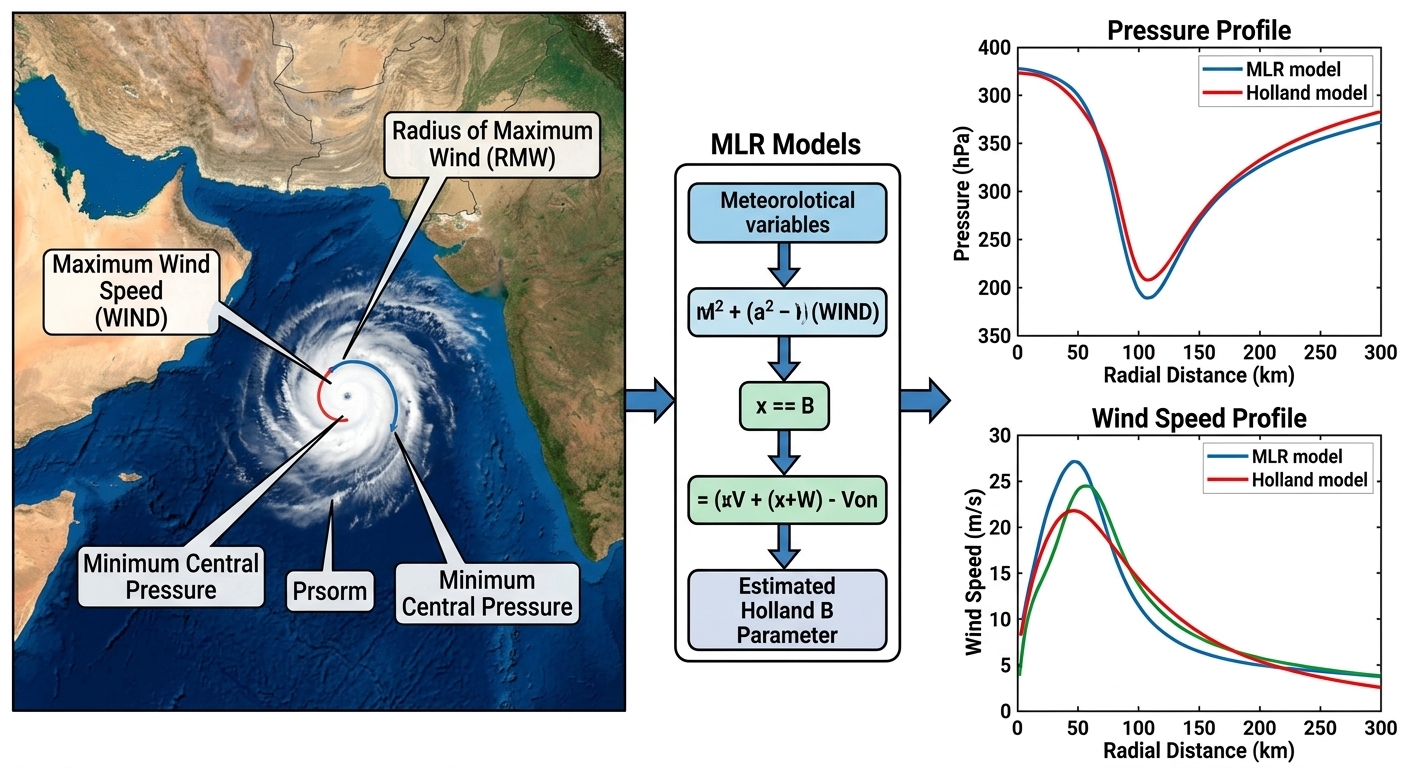
Tropical cyclones (TCs) in the Arabian Sea have become more frequent and intense, due to climatic variability. These changes represent an increasing hazard to coastal communities and infrastructure throughout the area. Accurate calculation of cyclone wind and pressure fields is critical for cyclone forecasting, early warning systems and disaster response. Usually cyclones are studied with the help of wind-pressure models. One such model is Holland Model which utilizes a wind-pressure profile parameter B. This parameter which is a power exponent plays an essential role in shaping wind and pressure profiles. It defines that how sharply the pressure drops from the outer environment to the cyclone’s center. Although various models for estimating the wind-pressure profile parameter B exist for basins such as the Atlantic, Northwest Pacific and Bay of Bengal, no such model has been specifically developed for the Arabian Sea. This study addresses this gap by constructing and evaluating multi- linear regression (MLR) models to create such power exponents for Arabian Sea cyclones using best-track cyclone data from the IBTrACS dataset (1980–2023) which is the satellite data. Four models Bα, Bβ and Bγ for wind-pressure profile parameter B are developed for Arabian Sea cyclones incorporating different combinations of meteorological variables, including maximum sustained wind, central pressure, pressure drop, radius of maximum wind (RMW) and latitude. Model’s performance is assessed using adjusted R², predicted R², RMSE and MAE. Model Bγ is the best-performing model with the predicted R² of 78%, with the lowest standard error (0.1395). We have also calculated B, the Holland’s wind-pressure profile parameter, on Arabian Sea data. The data used here is satellite data instead of aircraft data. Further, all these models including B are applied to the 20% test dataset to validate the predicted wind-pressure profile parameters. Finally, we will compare Bα, Bβ and Bγ with B. For the test data Bγ shows good accuracy. Its correlation with B values is 0.7796. These models are used to generate both the wind and pressure profiles of Cyclone Tauktae. Finally, results obtained by MLR are compared with the results obtained by B. Among all MLR models Bγ gives results closest to B model. So, the model Bγ is recommended as the most reliable MLR model for estimating the wind-pressure parameter for the Arabian Sea.
References
Labban, A. H., Hasanean, H. M., Almahri, A., Al-Sakkaf, A. S., & Hussein, M. A. A. (2024). Characterizing the tropical cyclones activity over Arabian Sea (1982–2021). Oceans, 5(4), 840–856. https://doi.org/10.3390/oceans5040048.
Wang, Y. (2024). Hurricane dynamics. In Reference module in Earth systems and environmental sciences (p. B9780323960267000886). Elsevier. https://doi.org/10.1016/B978-0-323-96026-7.00088-6.
Xiao, Y. F., Duan, Z. D., Xiao, Y. Q., Ou, J. P., Chang, L., & Li, Q. S. (2011). Typhoon wind hazard analysis for southeast China coastal regions. Structural Safety, 33(4–5), 286–295. https://doi.org/10.1016/j.strusafe.2011.04.003.
Vickery, P. J., Masters, F. J., Powell, M. D., & Wadhera, D. (2009). Hurricane hazard modeling: The past, present, and future. Journal of Wind Engineering and Industrial Aerodynamics, 97(7–8), 392–405. https://doi.org/10.1016/j.jweia.2009.05.005.
Holland, G. J. (1980). An analytic model of the wind and pressure profiles in hurricanes. Monthly Weather Review, 108(8), 1212–1218. https://doi.org/10.1175/1520-0493(1980)108<1212:AAMOTW>2.0.CO;2.
Chen, P., Zhang, Z., Li, Y., Ye, R., Li, R., & Song, Z. (2024). The two-parameter Holland pressure model for tropical cyclones. Journal of Marine Science and Engineering, 12(1), 92. https://doi.org/10.3390/jmse12010092.
Arthur, W. C. (2021). A statistical–parametric model of tropical cyclones for hazard assessment. Natural Hazards and Earth System Sciences, 21(3), 893–916. https://doi.org/10.5194/nhess-21-893-2021.
Sun, Z., Zhang, B., & Tang, J. (2021). Estimating the key parameter of a tropical cyclone wind field model over the Northwest Pacific Ocean: A comparison between neural networks and statistical models. Remote Sensing, 13(14), 2653. https://doi.org/10.3390/rs13142653.
Knaff, J. A. (2011). Simple diagnosis of tropical cyclone structure via pressure gradients. Weather and Forecasting, 26.
Hubbert, G. D., Holland, G. J., Leslie, L. M., & Manton, M. J. (1991). A real-time system for forecasting tropical cyclone storm surges. Weather and Forecasting, 6(1), 86–97. https://doi.org/10.1175/1520-0434(1991)006<0086:ARTSFF>2.0.CO;2.
Haper, B. H. (1999). An updated parametric model of the tropical cyclone. (Report).
Vickery, P. J., Skerlj, P. F., Steckley, A. C., & Twisdale, L. A. (2000). Hurricane wind field model for use in hurricane simulations. Journal of Structural Engineering, 126(10), 1203–1221. https://doi.org/10.1061/(ASCE)0733-9445(2000)126:10(1203).
Willoughby, H. E., & Rahn, M. E. (2004). Parametric representation of the primary hurricane vortex. Part I: Observations and evaluation of the Holland (1980) model. Monthly Weather Review, 132(12), 3033–3048. https://doi.org/10.1175/MWR2831.1.
Jakobsen, F., & Madsen, H. (2004). Comparison and further development of parametric tropical cyclone models for storm surge modelling. Journal of Wind Engineering and Industrial Aerodynamics, 92(5), 375–391. https://doi.org/10.1016/j.jweia.2004.01.003.
Holland, G. (2008). A revised hurricane pressure–wind model. Monthly Weather Review, 136(9), 3432–3445. https://doi.org/10.1175/2008MWR2395.1.
Fang, G., et al. (2018). Reconstruction of radial parametric pressure field near ground surface of landing typhoons in Northwest Pacific Ocean. Journal of Wind Engineering and Industrial Aerodynamics, 183, 223–234. https://doi.org/10.1016/j.jweia.2018.10.020.
Chai, T. R. (2014). Root mean square error (RMSE) or mean absolute error (MAE): Arguments against avoiding RMSE in the literature. Geoscientific Model Development, 7(3), 1247–1250.
Ott, R. L., & Longnecker, M. T. (2016). An introduction to statistical methods and data analysis (7th ed.). Cengage Learning.
Schober, P., Boer, C., & Schwarte, L. A. (2018). Correlation coefficients: Appropriate use and interpretation. Anesthesia & Analgesia, 126(5), 1763–1768. https://doi.org/10.1213/ANE.0000000000002864.
O’Brien, R. M. (2007). A caution regarding rules of thumb for variance inflation factors. Quality & Quantity, 41(5), 673–690. https://doi.org/10.1007/s11135-006-9018-6.
Keith, T. (2015). Multiple regression and beyond: An introduction to multiple regression and structural equation modeling (2nd ed.). Routledge.
Bjerynes, V. (2021). The meteorology of the temperate zone and the general atmospheric circulation. Monthly Weather Review, 49(2), April.
India Meteorological Department. (2021). Preliminary report on extremely severe cyclonic storm Tauktae (14–19 May 2021) over the Arabian Sea. RSMC New Delhi, IMD
Downloads
Published
Issue
Section
License
Copyright (c) 2025 Ingila Rahim, Sadia Parveen, Rashid Kamal Ansari, Muhammad Adeel

This work is licensed under a Creative Commons Attribution-NonCommercial 4.0 International License.