
Bacillus amyloliquefaciens Activates the Basal Defense of Chinese cabbage Against Alternaria brassicicola
DOI:
https://doi.org/10.11113/mjfas.v21n6.4454Keywords:
Biocontrol mechanism, black leaf spot disease, callose deposition, swollen conidiaAbstract
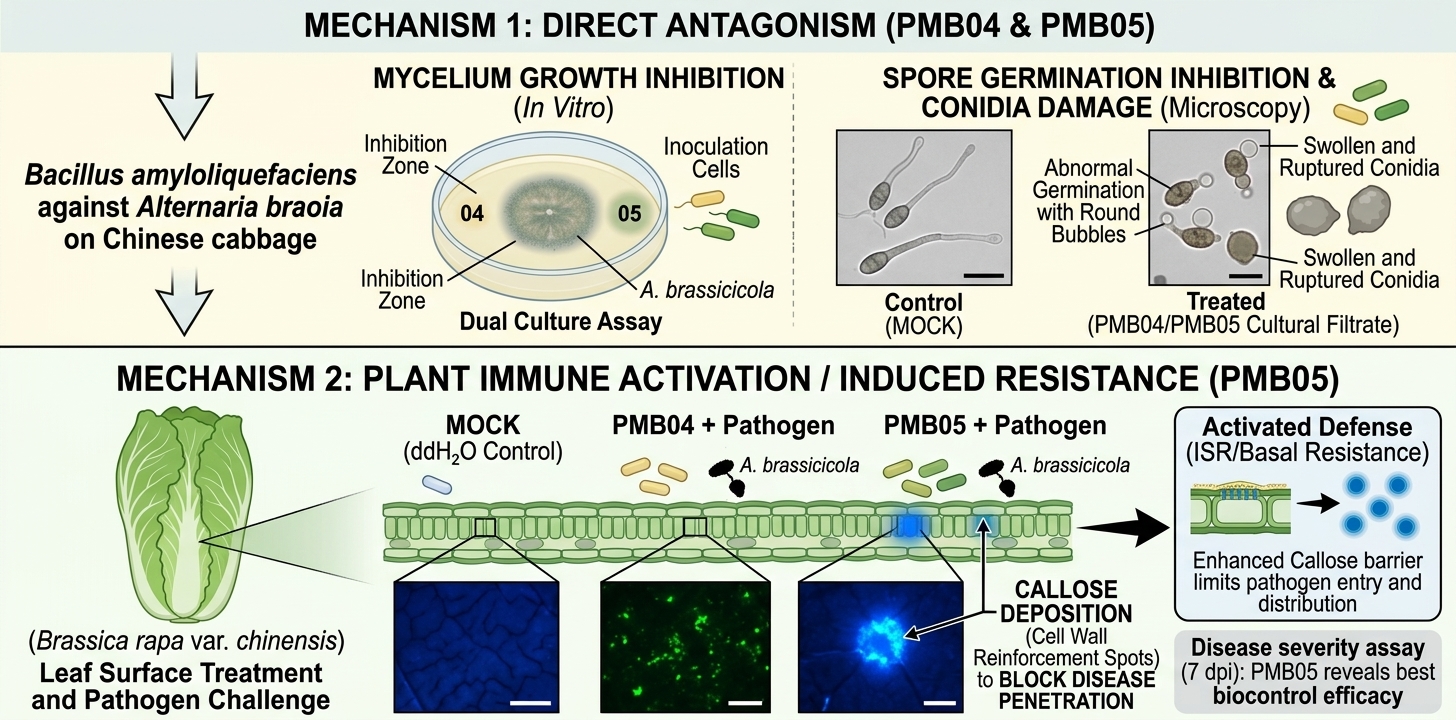
Alternaria brassicicola is a necrotrophic plant pathogen that causes substantial damage to a broad range of host plants, especially Brassica species. Various strategies were used to control this disease, including applying antagonistic microorganisms. In this study, we evaluate two strains of Bacillus amyloliquefaciens (PMB04 and PMB05) as biological agents to control black leaf spot disease caused by A. brassicicola on Chinese cabbage (Brassica rapa var. chinensis). We found these two strains inhibited the mycelial growth and spore germination of A. brassicicola, and suppressed the disease severity on Chinese cabbage. However, PMB04 showed a better in vitro inhibitory effect than PMB05, but PMB05 has a better biocontrol efficacy than PMB04. To gain more insight into the converse between these two strains' inhibitory effect and biocontrol efficacy, the plant immune response was intensified with the B. amyloliquefaciens bacterial cell and cultural filtrate. The results exhibited that both forms of PMB05 significantly intensify the plant immunity in leaf tissue upon the inoculation of A. brassisicola spores rather than those of PMB04. This suggests that B. amyloliquefaciens strain PMB04 and PMB05 have different biocontrol mechanisms.
References
Okamoto, T., Wei, X., Mehraj, H., Hossain, M. R., Akter, A., Miyaji, N., & Watanabe, M. (2021). Chinese cabbage (Brassica rapa L. var. pekinensis) breeding: Application of molecular technology. In J. M. Al-Khayri, S. M. Jain, & D. V. Johnson (Eds.), Advances in plant breeding strategies: Vegetable crops (pp. 59–94). Springer International Publishing. https://doi.org/10.1007/978-3-030-66969-0_2.
Li, X., Ren, X., Ibrahim, E., Kong, H., Wang, M., Xia, J., … Yan, J. (2024). Response of Chinese cabbage (Brassica rapa subsp. pekinensis) to bacterial soft rot infection by change of soil microbial community in root zone. Frontiers in Microbiology, 15, 1401896. https://doi.org/10.3389/fmicb.2024.1401896.
Walsh, H. M., Rönkä, A., & Walsh, J. A. (2023). Identification and genetic inheritance of a new source of broad-spectrum extreme resistance to turnip mosaic virus (TuMV) in Brassica rapa. European Journal of Plant Pathology, 165(4), 693–699. https://doi.org/10.1007/s10658-022-02634-3.
Wu, Y., Zhang, B., Liu, S., Zhao, Z., Ren, W., Chen, L., … Zhang, Y. (2023). A whole-genome assembly for Hyaloperonospora parasitica, a pathogen causing downy mildew in cabbage (Brassica oleracea var. capitata L.). Journal of Fungi, 9(8), 819. https://doi.org/10.3390/jof9080819.
Shi, X., Zeng, K., Wang, X., Liang, Z., & Wu, X. (2021). Characterization of Alternaria species causing leaf spot on Chinese cabbage in Shanxi Province of China. Journal of Plant Pathology, 103, 283–293. https://doi.org/10.1007/s42161-020-00740-x.
Khan, M., Salman, M., Jan, S. A., & Shinwari, Z. K. (2021). Biological control of fungal phytopathogens: A comprehensive review based on Bacillus species. MOJ Biology and Medicine, 6, 90–92. https://doi.org/10.15406/mojbm.2021.06.00137.
Hong, C. Y., Zheng, J. L., Chen, T. Y., Chao, H. R., & Lin, Y. H. (2018). PFLP-intensified disease resistance against bacterial soft rot through the MAPK pathway in PAMP-triggered immunity. Phytopathology, 108(12), 1467–1474. https://doi.org/10.1094/PHYTO-03-18-0100-R.
Wang, Y. H., Lai, I. L., Zheng, J. L., & Lin, Y. H. (2019). Using dynamic changes of chlorophyll fluorescence in Arabidopsis thaliana to evaluate plant immunity-intensifying Bacillus spp. strains. Phytopathology, 109(9), 1566–1576. https://doi.org/10.1094/PHYTO-02-19-0063-R.
Ho, T. H., Chuang, C. Y., Zheng, J. L., Chen, H. H., Liang, Y. S., Huang, T. P., & Lin, Y. H. (2020). Bacillus amyloliquefaciens strain PMB05 intensifies plant immune responses to confer resistance against bacterial wilt of tomato. Phytopathology, 110(12), 1877–1885. https://doi.org/10.1094/PHYTO-01-20-0026-R.
Chuang, C. Y., Lin, S. T., Li, A. T., Li, S. H., Hsiao, C. Y., & Lin, Y. H. (2022). Bacillus amyloliquefaciens PMB05 increases resistance to bacterial wilt by activating mitogen-activated protein kinase and reactive oxygen species pathway crosstalk in Arabidopsis thaliana. Phytopathology, 112(12), 2495–2502. https://doi.org/10.1094/PHYTO-04-22-0134-R.
Liang, Y. S., Fu, J. Y., Chao, S. H., Tzean, Y., Hsiao, C. Y., Yang, Y. Y., … Lin, Y. H. (2022). Postharvest application of Bacillus amyloliquefaciens PMB04 fermentation broth reduces anthracnose occurrence in mango fruit. Agriculture, 12(10), 1646. https://doi.org/10.3390/agriculture12101646.
Li, G., Li, X., Zhang, T., Yu, J., Hou, H., & Yi, L. (2023). Controlling soft rot of postharvest chilli pepper (Capsicum annuum L.) by an antagonist Bacillus amyloliquefaciens S917: Efficacy and action mode. Biological Control, 178, 105133. https://doi.org/10.1016/j.biocontrol.2022.105133.
Jiao, R., Munir, S., He, P., Yang, H., Wu, Y., Wang, J., … He, Y. (2020). Biocontrol potential of the endophytic Bacillus amyloliquefaciens YN201732 against tobacco powdery mildew and its growth promotion. Biological Control, 143, 104160. https://doi.org/10.1016/j.biocontrol.2019.104160.
Kulimushi, P. Z., Basime, G. C., Nachigera, G. M., Thonart, P., & Ongena, M. (2018). Efficacy of Bacillus amyloliquefaciens as biocontrol agent against fungal diseases of maize under tropical climates: From lab to field assays in South Kivu. Environmental Science and Pollution Research, 25(30), 29808–29821. https://doi.org/10.1007/s11356-017-9314-9.
Chou, H. P., Huang, Y. C., Lin, Y. H., & Deng, W. L. (2022). Selection, formulation, and field evaluation of Bacillus amyloliquefaciens PMB01 for managing tomato bacterial wilt. Agriculture, 12(10), 1714. https://doi.org/10.3390/agriculture12101714.
Hsiao, C. Y., Blanco, S. D., Peng, A. L., Fu, J. Y., Chen, B. W., Luo, M. C., … Lin, Y. H. (2023). Seed treatment with calcium carbonate containing Bacillus amyloliquefaciens PMB05 powder efficiently controls black rot disease of cabbage. Agriculture, 13(5), 926. https://doi.org/10.3390/agriculture13050926.
Wang, F., Chao, S. H., Tsai, C. H., Blanco, S. D., Yang, Y. Y., & Lin, Y. H. (2023). Developing fermentation liquid of Bacillus amyloliquefaciens PMB04 to control bacterial leaf spot of sweet pepper. Agriculture, 13(7), 1456. https://doi.org/10.3390/agriculture13071456.
Morcillo, R. J. L., Baroja-Fernández, E., López-Serrano, L., Leal-López, J., Muñoz, F. J., Bahaji, A., … Pozueta-Romero, J. (2022). Cell-free microbial culture filtrates as candidate biostimulants to enhance plant growth and yield and activate soil and plant-associated beneficial microbiota. Frontiers in Plant Science, 13, 1040515. https://doi.org/10.3389/fpls.2022.1040515.
Raaijmakers, J. M., De Bruijn, I., Nybroe, O., & Ongena, M. (2010). Natural functions of lipopeptides from Bacillus and Pseudomonas: More than surfactants and antibiotics. FEMS Microbiology Reviews, 34(6), 1037–1062.
Lam, V. B., Meyer, T., Arias, A. A., Ongena, M., Oni, F. E., & Höfte, M. (2021). Bacillus cyclic lipopeptides iturin and fengycin control rice blast in potting and acid sulfate soils by antagonism and induced systemic resistance. Microorganisms, 9(7), 1441. https://doi.org/10.3390/microorganisms9071441.
Luo, L., Zhao, C., Wang, E., Raza, A., & Yin, C. (2022). Bacillus amyloliquefaciens as an excellent agent for biofertilizer and biocontrol in agriculture: An overview of its mechanisms. Microbiological Research, 259, 127016. https://doi.org/10.1016/j.micres.2022.127016.
Wang, Y., Li, X., Fan, B., Zhu, C., & Chen, Z. (2021). Regulation and function of defense-related callose deposition in plants. International Journal of Molecular Sciences, 22(5), 2393. https://doi.org/10.3390/ijms22052393.
Wang, B., Andargie, M., & Fang, R. (2022). The function and biosynthesis of callose in higher plants. Heliyon, 8(4), e09248. https://doi.org/10.1016/j.heliyon.2022.e09248.
Zheng, J. L., Li, J. R., Li, A. T., Li, S. H., Blanco, S. D., Chen, S. Y., … Lin, Y. H. (2024). A rapid method for screening pathogen-associated molecular pattern-triggered immunity-intensifying microbes. Plants, 13(16), 2185. https://doi.org/10.3390/plants13162185.
Li’aini, A. S., Lin, Y. H., Huang, T. C., & Sulistyowati, L. (2017). Application of Bacillus amyloliquefaciens to control black rot disease on cabbage caused by Xanthomonas campestris pv. campestris. Journal of Plant Medicine, 59, 39–44.
Wu, Y. M., Chen, X., Wang, F., Hsiao, C. Y., Yang, C. Y., Lin, S. T., … Lin, Y. H. (2021). Bacillus amyloliquefaciens strains control strawberry anthracnose through antagonistic activity and plant immune response intensification. Biological Control, 157, 104592. https://doi.org/10.1016/j.biocontrol.2021.104592.
Rumandani, N. A. (2025). The utilization of Bacillus spp. as endophytes in enhancing plant resistance and health against Fusarium oxysporum: A mini review. Journal of Syntax Literate, 10(1).
Li, Z., Guo, B., Wan, K., Cong, M., Huang, H., & Ge, Y. (2015). Effects of bacteria-free filtrate from Bacillus megaterium strain L2 on the mycelium growth and spore germination of Alternaria alternata. Biotechnology & Biotechnological Equipment, 29(6), 1062–1068. https://doi.org/10.1080/13102818.2015.1068135.
Gong, A. D., Li, H. P., Yuan, Q. S., Song, X. S., Yao, W., He, W. J., … Liao, Y. C. (2015). Antagonistic mechanism of iturin A and plipastatin A from Bacillus amyloliquefaciens S76-3 from wheat spikes against Fusarium graminearum. PLoS ONE, 10(2), e0116871. https://doi.org/10.1371/journal.pone.0116871.
Dhumal, G., Chaudhari, K., & Mohan, M. (2021). Bacillus amyloliquefaciens: A review. Research & Reviews: Journal of Microbiology & Virology, 11(1), 9–17. https://doi.org/10.37591/RRJoMV.
Guo, Z., Sun, J., Ma, Q., Li, M., Dou, Y., Yang, S., & Gao, X. (2024). Improving surfactin production in Bacillus subtilis 168 by metabolic engineering. Microorganisms, 12(5), 998. https://doi.org/10.3390/microorganisms12050998.
Sagar, A., Yadav, S. S., Sayyed, R. Z., Sharma, S., & Ramteke, P. W. (2022). Bacillus subtilis: A multifarious plant growth promoter, biocontrol agent, and bioalleviator of abiotic stress. In Bacilli in agrobiotechnology: Plant stress tolerance, bioremediation, and bioprospecting (pp. 561–580). Springer International Publishing. https://doi.org/10.1007/978-3-030-85465-2_24.
Dobrzyński, J., Jakubowska, Z., Kulkova, I., Kowalczyk, P., & Kramkowski, K. (2023). Biocontrol of fungal phytopathogens by Bacillus pumilus. Frontiers in Microbiology, 14, 1194606. https://doi.org/10.3389/fmicb.2023.1194606.
Li, A. T., Liu, S. K., Li, J. R., Blanco, S. D., Tsai, H. W., Xie, J. X., … Lin, Y. H. (2024). A mitogen-activated protein kinase pathway is required for Bacillus amyloliquefaciens PMB05 to enhance disease resistance to bacterial soft rot in Arabidopsis thaliana. Plants, 13(18), 2591. https://doi.org/10.3390/plants13182591.
Downloads
Published
Issue
Section
License
Copyright (c) 2025 Gabryna Auliya Nugroho, Yi-Hsien Lin, Tzou-Chi Huang, Yulia Nuraini, Li'aini Arrohmatus Syafaqoh

This work is licensed under a Creative Commons Attribution-NonCommercial 4.0 International License.