
Bipolar Pythagorean Neutrosophic Generalized Weighted Hamacher Heronian Mean (BPN-GWHHM) for MCDM in Business Resilience
DOI:
https://doi.org/10.11113/mjfas.v21n5.4338Keywords:
Bipolar Pythagorean Neutrosophic Set, Hamacher Operator, Heronian Mean, MCDM, Financial Performance EvaluationAbstract
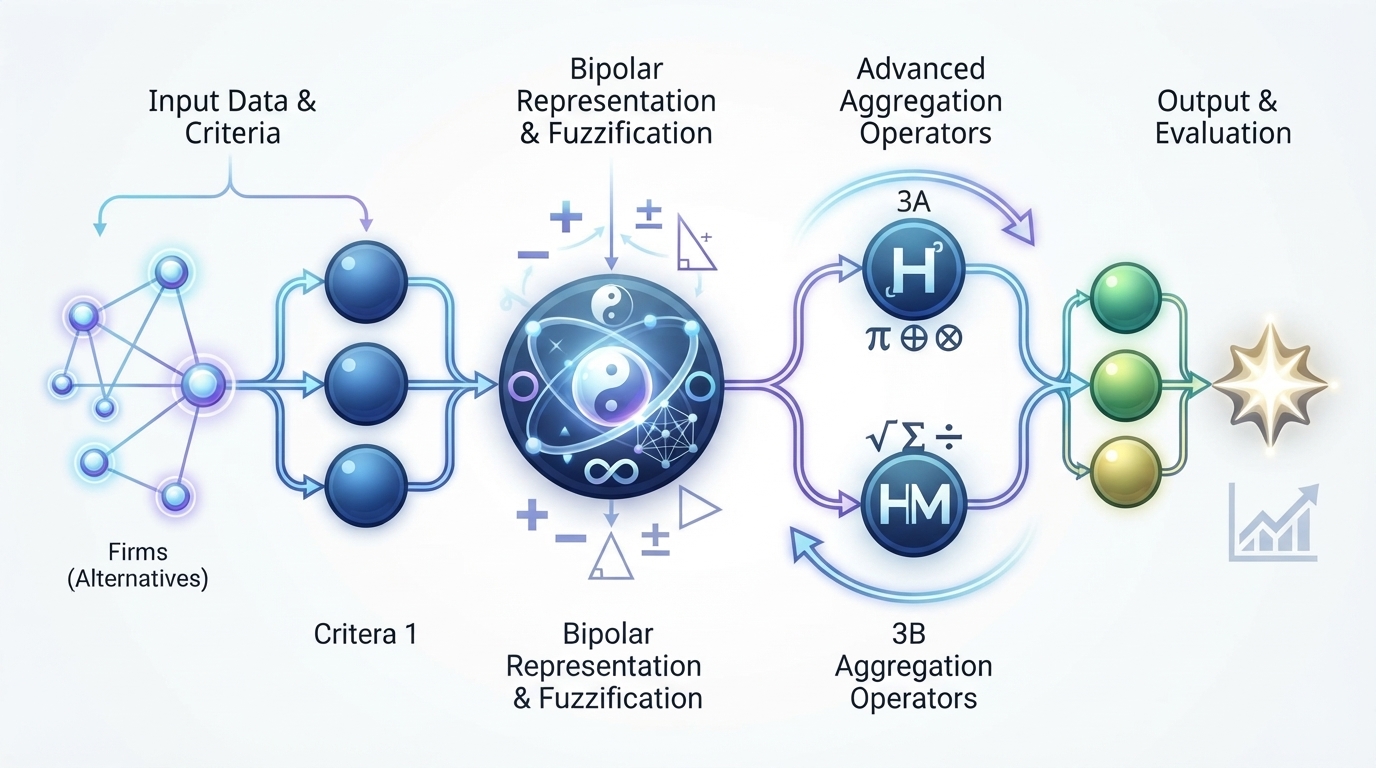
This study proposes the Bipolar Pythagorean Neutrosophic-Generalized Weighted Hamacher Heronian Mean (BPN-GWHHM) operator to improve decision-making in multi-criteria decision-making (MCDM) effectively handling uncertainty, indeterminacy, and bipolar information. The method enhances the aggregation process by capturing the complex interrelationships between positive and negative elements while maintaining sensitivity to data fluctuations through generalized weighting. The proposed operator is implemented to financial performance evaluation among firms, demonstrating robustness and practical reliability. Sensitivity analysis is utilized to confirm its stability under varying parameter values.
References
Ozili, P. K., & Iorember, P. T. (2024). Financial stability and sustainable development. International Journal of Finance & Economics, 29(3), 2620–2646. https://doi.org/10.1002/ijfe.2803.
Chadha, G., & Singhania, M. (2024). Demystifying the influence of debt providers’ preferences on sustainability reporting: A firm-level meta-analytical inquiry. Environmental Science and Pollution Research, 31(10), 14704–14747. https://doi.org/10.1007/s11356-023-31552-y.
Kholmamatov, F. K. (2024). Current analysis and current issues of ensuring the financial stability of the banking system in Uzbekistan. European Journal of Business Startups and Open Society, 4(3), 2795–9228. https://inovatus.es/index.php/ejbsos/article/view/2681.
Akash, T. R., Reza, J., & Alam, M. A. (2024). Evaluating financial risk management in corporation financial security systems. World Journal of Advanced Research and Reviews, 23(1), 2203–2213. https://doi.org/10.30574/wjarr.2024.23.1.2206.
Karavar, N., & Yaman, K. (2024). Financial performance and bankruptcy risk analysis: An application on private health insurance companies in Turkey. Journal of Applied and Theoretical Social Sciences, 6(1), 50–73. https://doi.org/10.37241/jatss.2024.103.
Jana, C., Muhiuddin, G., Pal, M., & Al-Kadi, D. (2021). Intuitionistic fuzzy Dombi hybrid decision-making method and their applications to enterprise financial performance evaluation. Mathematical Problems in Engineering, 2021, 1–14. https://doi.org/10.1155/2021/3218133.
Mohamed, M., & Elsayed, A. (2024). A novel multi-criteria decision making approach based on bipolar neutrosophic set for evaluating financial markets in Egypt. Multicriteria Algorithms with Applications, 5, 1–17. https://doi.org/10.61356/j.mawa.2024.5394.
Khalilzadeh, M., Banihashemi, S. A., & Božanić, D. (2024). A step-by-step hybrid approach based on multi-criteria decision-making methods and a bi-objective optimization model to project risk management. Decision Making: Applications in Management and Engineering, 7(1), 442–472. https://doi.org/10.31181/dmame712024884.
Rane, J., Kaya, Ö., Mallick, S. K., & Rane, N. L. (2024). Enhancing black-box models: Advances in explainable artificial intelligence for ethical decision-making. In Future research opportunities for artificial intelligence in Industry 4.0 and 5.0 (pp. 136–180). Deep Science Publishing. https://doi.org/10.70593/978-81-981271-0-5_4.
Salamat, N., Kamran, M., Ashraf, S., Abdulla, M. E. M., Ismail, R., & Al-Shamiri, M. M. (2024). Complex decision modeling framework with fairly operators and quaternion numbers under intuitionistic fuzzy rough context. Computer Modeling in Engineering & Sciences, 139(2), 1893–1933. https://doi.org/10.32604/cmes.2023.044697.
Wang, H., Midaraju, P., Zhang, Y.-Q., & Sunderraman, R. (2004). Interval neutrosophic sets. arXiv. https://arxiv.org/abs/math/0409113.
Wang, H., Smarandache, F., Sunderraman, R., & Zhang, Y.-Q. (2005). Interval neutrosophic sets and logic: Theory and applications in computing (Vol. 5).
Wang, H., Smarandache, F., Zhang, Y., & Sunderraman, R. (2010). Single valued neutrosophic sets. ResearchGate. https://www.researchgate.net/publication/262034557.
Razak, S. A., Rodzi, Z. M., & Ahmad, G. (2024). Exploring the boundaries of uncertainty: Interval valued Pythagorean neutrosophic set and their properties. Malaysian Journal of Fundamental and Applied Sciences, 20(4), 813–824. https://doi.org/10.11113/mjfas.v20n4.3482.
Smarandache, F. (1998). Neutrosophy: Neutrosophic probability, set, and logic. American Research Press.
Mustapha, N., Alias, S., Yasin, R. M., Abdullah, I., & Broumi, S. (2021). Cardiovascular diseases risk analysis using distance-based similarity measure of neutrosophic sets. Neutrosophic Sets and Systems, 47, 26–37. https://digitalrepository.unm.edu/cgi/viewcontent.cgi?article=1967&context=nss_journal.
Abdulbaqi, A. S., Radhi, A. D., Qudr, L. A. Z., Penubadi, H. R., Sekhar, R., Shah, P., … Gheni, H. M. (2025). Neutrosophic sets in big data analytics: A novel approach for feature selection and classification. International Journal of Neutrosophic Science, 25(1), 428–438. https://doi.org/10.54216/IJNS.250138.
Mandala, V., Avacharmai, R., Chintale, P., Malviya, R. K., Vandanapu, M. K., & Boddapati, V. N. (2025). Intelligent bankruptcy prediction using cutting-edge N-valued interval neutrosophic sets for classification. International Journal of Neutrosophic Science, 25(2), 303–312. https://doi.org/10.54216/IJNS.250226.
Mohamed, F., Abdul, S. N. A. S., Mohd, Z. N. N. A., Mohd, R. N. A., Mohamad, S. N. F., & Othman, S. A. (2024). Multi criteria decision making under single-valued neutrosophic set environment for supplier selection. Journal of Quality Measurement and Analysis, 20(2), 149–162. https://doi.org/10.17576/jqma.2002.2024.11.
Al-Quran, A., Al-Sharqi, F., Rahman, A. U., & Rodzi, Z. Md. (2024). The q-rung orthopair fuzzy-valued neutrosophic sets: Axiomatic properties, aggregation operators and applications. AIMS Mathematics, 9(2), 5038–5070. https://doi.org/10.3934/math.2024245.
Iqbal, Q., & Kalsoom, S. (2024). Advanced logarithmic aggregation operators for enhanced decision-making in uncertain environments. International Journal of Knowledge and Innovation Studies, 2(2), 57–69. https://doi.org/10.56578/ijkis020201.
MacLaurin, C. (1730). IV. A second letter from Mr. Colin McLaurin, Professor of Mathematicks in the University of Edinburgh and F. R. S. to Martin Folkes, Esq; concerning the roots of equations, with the demonstration of other rules in algebra; being the continuation of the letter published in the Philosophical Transactions, N° 394. Philosophical Transactions of the Royal Society of London, 36(408), 59–96. https://doi.org/10.1098/rstl.1729.0011.
Yager, R. R. (1998). Fusion of ordinal information using weighted median aggregation. International Journal of Approximate Reasoning, 18(1–2), 35–52. https://doi.org/10.1016/S0888-613X(97)10003-2.
Choquet, G. (1954). Theory of capacities. Annales de l’Institut Fourier, 5, 131–295. https://doi.org/10.5802/aif.53.
Dombi, J. (1982). A General Class of Fuzzy Operators, the Demorgan Class of Fuzzy Operators and Fuzziness Measures induced by Fuzzy Operators. Fuzzy sets and systems, 8(2), 149–163. DOI: 10.1016/0165-0114(82)90005-7
Hamacher, H. (1978). Uber logische verknunpfungenn unssharfer aussagen und deren zugenhorige bewertungsfunktione. Hemisphere publishing corporation (pp. 276–288). Washington DC: Hemisphere.
Gassert, H. (2004). Operators on fuzzy sets: zadeh and einstein ations on fuzzy sets properties of t-norms and t-conorms [presentation]. In seminar paper, department of computer science information systems group, university of fribourg. https://pdfs.semanticscholar.org/a045/52b74047208d23d77b8aa9f5f334b59e65ea.pdf
Mesiar, R. (1999). Nearly Frank t-norms. Tatra mountains mathematical publications, 16(127), 127–134.
Akram, M., Naz, S., Santos-García, G., & Saeed, M. R. (2023). Extended CODAS method for MAGDM with 2-tuple linguistic T-spherical fuzzy sets. AIMS Mathematics, 8(2), 3428–3468. https://doi.org/10.3934/math.2023176.
Mahmood, T., Rehman, U. U., & Naeem, M. (2023). A novel approach towards Heronian mean operators in multiple attribute decision making under the environment of bipolar complex fuzzy information. AIMS Mathematics, 8(1), 1848–1870. https://doi.org/10.3934/math.2023095.
Li, B., & Yang, L. (2021). Power improved generalized Heronian mean operators utilizing Hamacher operations with picture fuzzy information. Complexity, 2021, 1–25. https://doi.org/10.1155/2021/6261229.
Anusha, G., Ramana, P. V., & Sarkar, R. (2023). Hybridizations of Archimedean copula and generalized MSM operators and their applications in interactive decision-making with Q-rung probabilistic dual hesitant fuzzy environment. Decision Making: Applications in Management and Engineering, 6(1), 646–678. https://doi.org/10.31181/dmame0329102022a.
Ahemad, F., Khan, A. Z., Mehlawat, M. K., Gupta, P., & Roy, S. K. (2023). Multi-attribute group decision-making for solid waste management using interval-valued Q-rung orthopair fuzzy COPRAS. RAIRO - Operations Research, 57(3), 1239–1265. https://doi.org/10.1051/ro/2023033.
Jamil, M., Abdullah, S., Khan, M. Y., Smarandache, F., & Ghani, F. (2019). Application of the bipolar neutrosophic Hamacher averaging aggregation operators to group decision making: An illustrative example. Symmetry, 11(5), 698. https://doi.org/10.3390/sym11050698.
Jamil, M., Afzal, F., Afzal, D., Thapa, D. K., & Maqbool, A. (2022). Multicriteria decision-making methods using bipolar neutrosophic Hamacher geometric aggregation operators. Journal of Function Spaces, 2022, 1–13. https://doi.org/10.1155/2022/5052867.
Mei, Y., Yang, J., & Chen, B. (2023). Multi-criteria group decision-making method based on an improved single-valued neutrosophic Hamacher weighted average operator and grey relational analysis. Journal of Computer and Communications, 11(3), 167–188. https://doi.org/10.4236/jcc.2023.113013.
Nithya Sri, S., Vimala, J., Kausar, N., Özbilge, E., & Pamucar, D. (2024). An MCDM approach on Einstein aggregation operators under bipolar linear Diophantine fuzzy hypersoft set. Heliyon, 10, e29863. https://doi.org/10.1016/j.heliyon.2024.e29863
Abdul Halim, N. Q., Awang, N. A., Yaacob, S. N., Hashim, H., & Abdullah, L. (2024). Rough neutrosophic Shapley weighted Einstein averaging aggregation operator and its application in multi-criteria decision-making problem. Journal of Advanced Research in Applied Sciences and Engineering Technology, 43(2), 52–64. https://doi.org/10.37934/araset.43.2.5264.
Thilagavathy, A., & Mohanaselvi, S. (2024). T-spherical fuzzy Hamacher Heronian mean geometric operators for multiple criteria group decision making using SMART based TODIM method. Results in Control and Optimization, 14, 100357. https://doi.org/10.1016/j.rico.2023.100357.
Yaacob, S. N., Hashim, H., Awang, N. A., Sulaiman, N. H., Al-Quran, A., & Abdullah, L. (2024). Bipolar neutrosophic Dombi-based Heronian mean operators and their application in multi-criteria decision-making problems. International Journal of Computational Intelligence Systems, 17, 3–22. https://doi.org/10.1007/s44196-024-00544-2.
Asif, M., Ishtiaq, U., & Argyros, I. K. (2025). Hamacher aggregation operators for Pythagorean fuzzy set and its application in multi-attribute decision-making problem. Spectrum of Operational Research, 2(1), 27–40. http://sor-journal.org/index.php/sor/article/view/8/7.
Paul, T. K., Jana, C., & Pal, M. (2023). Enhancing multi-attribute decision making with Pythagorean fuzzy Hamacher aggregation operators. Journal of Industrial Intelligence, 1(1), 30–54. https://doi.org/10.56578/jii010103.
Razak, S. A., Rodzi, Z. M., & Ramli, N. (2025). Revolutionizing decision-making in e-commerce and IT procurement: An IVPNS-COBRA linguistic variable framework for enhanced multi-criteria analysis. International Journal of Economic Sciences, 14(1), 1–31. https://doi.org/10.31181/ijes1412025176
Hamidifar, H., Yaghoubi, F., & Rowinski, P. M. (2024). Using multi‐criteria decision‐making methods in prioritizing structural flood control solutions: A case study from Iran. Journal of Flood Risk Management, 17(3), e12991. https://doi.org/10.1111/jfr3.12991.
Kamari, M. S. M., Rodzi, Z. M., & Kamis, N. H. (2025). Pythagorean neutrosophic method based on the removal effects of criteria (PNMEREC): An innovative approach for establishing objective weights in multi-criteria decision-making challenges. Malaysian Journal of Fundamental and Applied Sciences, 21(1), 1678–1696. https://doi.org/10.11113/mjfas.v21n1.3600.
Ahmad, N., Rodzi, Z. M., Al-Sharqi, F., Al-Quran, A., Lutfi, A., Yusof, Z. M., & Hassanuddin, N. A. (2024). Innovative theoretical approach: Bipolar Pythagorean neutrosophic sets (BPNSs) in decision-making. International Journal of Neutrosophic Science, 23(1), 249–256. https://doi.org/10.54216/IJNS.230122.
Liu, H. Z., & Pei, D. W. (2012). HOWA operator and its application to multi-attribute decision making. Journal of Zhejiang Science-Technology University, 25, 138–142.
Downloads
Published
Issue
Section
License
Copyright (c) 2025 Dr. Zahari Md. Rodzi, Nur Fathiah Fatin Mohamad Fauzi, DR NORZIEHA MUSTAPHA, Abd.Ghafur Ahmad, FAISAL AL-SHARQI

This work is licensed under a Creative Commons Attribution-NonCommercial 4.0 International License.