
Parametric Model Fit with Cure Fraction in Prostate Cancer Survival: A Simulation Study on True Model Selection using MLE
DOI:
https://doi.org/10.11113/mjfas.v21n5.4283Keywords:
Cure fraction, Generalized-Weibull, Hazard ratio, MLE, SimulationAbstract
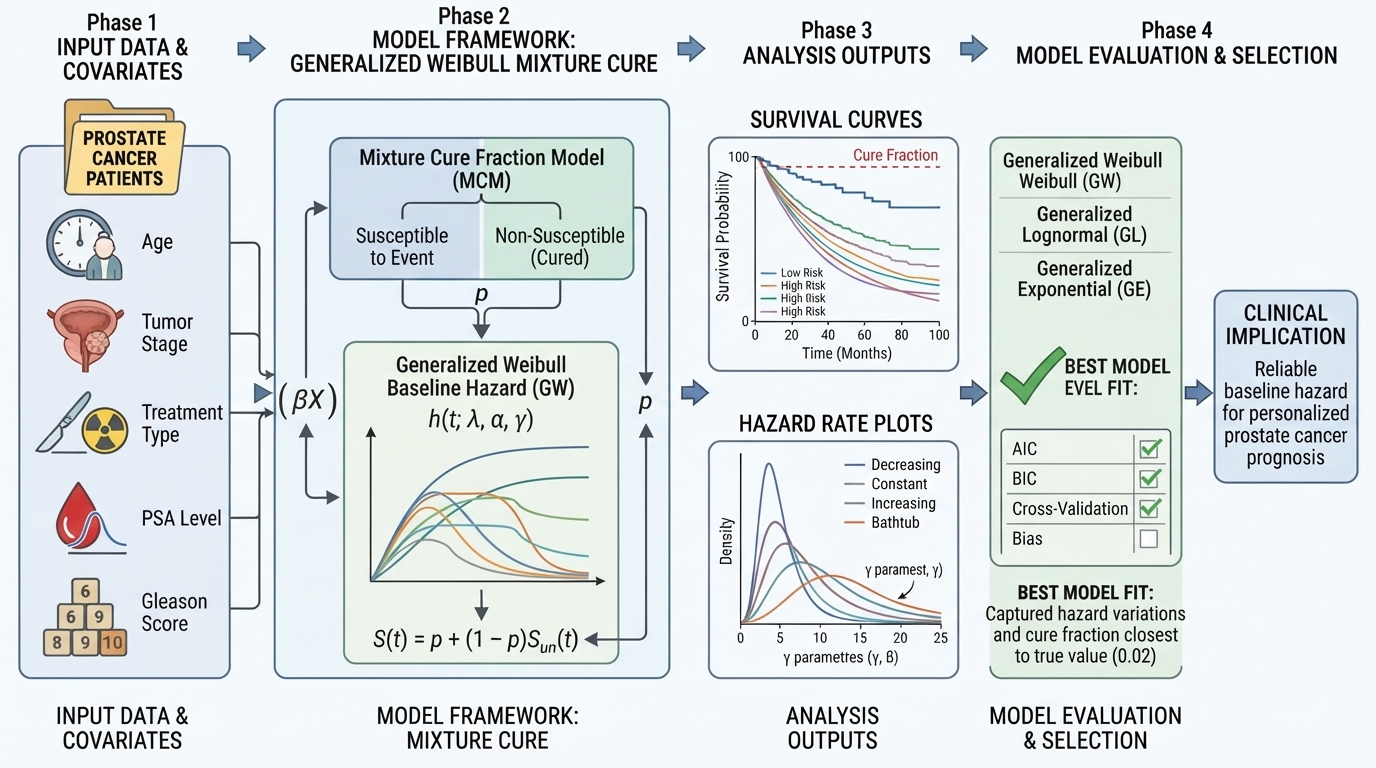
This research aims to evaluate and select the best model from multiple options to establish a reliable baseline for modeling prostate cancer by comprehensively assessing generalized survival models. Specifically, the study examines the Generalized Weibull, Generalized Log-Normal, and Generalized Exponential models while incorporating mixture cure fraction (MCF), Proportional Hazard (PH), covariates, and right-censoring. These generalized models enhance flexibility in handling cure fractions and advance the understanding of survival analysis in prostate cancer research. A simulation-based approach was used with sample sizes of 500, 1000, and 2000, generated using true parameter estimates derived from real-life prostate data. The models were estimated via MLE and assessed using AIC, BIC, and cross-validation to determine model fit. Results indicate that the Generalized Weibull model consistently outperforms other models, particularly in scenarios where treatment, age, and PSA are the key predictors. Moreover, the Generalized Weibull model emerges better as it maintains a CF closest to the true value 0.02 in all sample sizes. The Generalized Log-Normal distribution excels when Gleason is influential. The Generalized Exponential, though reasonable, generally underperforms relative to the other models. A key novelty of this study is the demonstration of the Generalized Weibull function's superior performance as a baseline hazard in prostate cancer survival modeling, especially with cure fraction and right-censored data.
References
Botta, L., Capocaccia, R., Bernasconi, A., Rossi, S., Galceran, J., Maso, L. D., Lepage, C., Molinié, F., Bouvier, A.-M., Marcos-Gragera, R., Vener, C., Guevara, M., Murray, D., Ragusa, R., Gatta, G., & Jooste, V. (2024). Estimating cure and risk of death from other causes of cancer patients: EUROCARE-6 data on head & neck, colorectal, and breast cancers. European Journal of Cancer, 208, 114187. https://doi.org/10.1016/j.ejca.2024.114187.
Boag, J. W. (1949). Maximum likelihood estimates of the proportion of patients cured by cancer therapy. Journal of the Royal Statistical Society: Series B (Statistical Methodology), 11(1), 15–44. https://doi.org/10.1111/j.2517-6161.1949.tb00020.x.
Berkson, J., & Gage, R. P. (1952). Survival curve for cancer patients following treatment. Journal of the American Statistical Association, 47(259), 501–515. https://doi.org/10.1080/01621459.1952.1050118.
Gamel, J. W., McLean, I. W., & Rosenberg, S. H. (1990). Proportion cured and mean log survival time as functions of tumour size. Statistics in Medicine, 9(8), 999–1006. https://doi.org/10.1002/sim.4780090814.
Kannan, N., Kundu, D., Nair, P., & Tripathi, R. C. (2010). The generalized exponential cure rate model with covariates. Journal of Applied Statistics, 37(10), 1625–1636. https://doi.org/10.1080/02664760903117739.
Mazucheli, J., Coelho-Barros, E. A., & Achcar, J. A. (2013). The exponentiated exponential mixture and non-mixture cure rate model in the presence of covariates. Computer Methods and Programs in Biomedicine, 112(1), 114–124. https://doi.org/10.1016/j.cmpb.2013.06.015.
Sy, J. P., & Taylor, J. M. G. (2000). Estimation in a Cox proportional hazards cure model. Biometrics, 56(1), 227–236. https://doi.org/10.1111/j.0006-341X.2000.00227.x.
Usman, U., Suleiman, S., Magaji Arkilla, B., & Aliyu, Y. (2021). Nadarajah-Haghighi model for survival data with long term survivors in the presence of right censored data. Pakistan Journal of Statistics and Operation Research, 17(3), 695–709. https://doi.org/10.18187/pjsor.v17i3.3511.
Ishag, M. A. S., Wanjoya, A., Adem, A., & Afify, A. Z. (2024). Exponentiated Weibull mixture cure model to handle right-censored data set. In V. Gayoso Martínez, F. Yilmaz, A. Queiruga-Dios, D. M. L. D. Rasteiro, J. Martín-Vaquero, & I. Mierluş-Mazilu (Eds.), Mathematical methods for engineering applications (Vol. 439, pp. 241–251). Springer Nature Switzerland. https://doi.org/10.1007/978-3-031-49218-1_17.
Farewell, V. T. (1982). The use of mixture models for the analysis of survival data with long-term survivors. Biometrics, 38(4), 1041. https://doi.org/10.2307/2529885.
Halpern, J., B., W. M., & Jun, B. (1987). Cure rate models: Power of the logrank and generalized Wilcoxon tests. Statistics in Medicine, 6(4), 483–489. https://doi.org/10.1002/sim.4780060407.
Yin, J., Zhang, Y., & Yu, Z. (2024). Deep partially linear transformation model for right-censored survival data. arXiv. arXiv:2412.07611.
Taylor, J. M. G. (1995). Semi-parametric estimation in failure time mixture models. Biometrics, 51(3), 899. https://doi.org/10.2307/2532991.
Kuk, A. Y. C., & Chen, C.-H. (1992). A mixture model combining logistic regression with proportional hazards regression. Biometrika, 79(3), 531–541. https://doi.org/10.1093/biomet/79.3.531.
Asselain, B., Fourquet, A., Hoang, T., Tsodikov, A. D., & Yakovlev, A. Y. (1996). A parametric regression model of tumor recurrence: An application to the analysis of clinical data on breast cancer. Statistics & Probability Letters, 29(3), 271–278. https://doi.org/10.1016/0167-7152(95)00182-4.
J. G., & Sinha, D. (1999). A new Bayesian model for survival data with a surviving fraction. Journal of the American Statistical Association, 94(447), 909–919. https://doi.org/10.1080/01621459.1999.10474196.
Broët, P., Rycke, Y., Tubert-Bitter, P., Lellouch, J., Asselain, B., & Moreau, T. (2001). A semiparametric approach for the two-sample comparison of survival times with long-term survivors. Biometrics, 57(3), 844–852. https://doi.org/10.1111/j.0006-341X.2001.00844.x.
Yin, G., & Ibrahim, J. G. (2005). A general class of Bayesian survival models with zero and nonzero cure fractions. Biometrics, 61(2), 403–412. https://doi.org/10.1111/j.1541-0420.2005.00329.x.
Kim, S., Chen, M.-H., Dey, D. K., & Gamerman, D. (2007). Bayesian dynamic models for survival data with a cure fraction. Lifetime Data Analysis, 13(1), 17–35. https://doi.org/10.1007/s10985-006-9028-7.
Yu, M., Taylor, J. M. G., & Sandler, H. M. (2008). Individual prediction in prostate cancer studies using a joint longitudinal survival–cure model. Journal of the American Statistical Association, 103(481), 178–187. https://doi.org/10.1198/016214507000000400.
Peace, K. E. (Ed.). (2009). Design and analysis of clinical trials with time-to-event endpoints. Chapman and Hall/CRC. https://doi.org/10.1201/9781420066401.
Umar Yusuf, M., & Abu Bakar, M. R. B. (2016). Cure models based on Weibull distribution with and without covariates using right censored data. Indian Journal of Science and Technology, 9(28). https://doi.org/10.17485/ijst/2016/v9i28/97350.
Haberland, J., Baras, N., & Wolf, U. (2019). Populationsbasierte Anteile geheilter Krebspatientinnen und -patienten in Deutschland. GMS Medizinische Informatik, Biometrie und Epidemiologie, 15(1), Doc02. https://doi.org/10.3205/MIBE000196.
Green, N., Kurt, M., Moshyk, A., Larkin, J., & Baio, G. (2024). A Bayesian hierarchical mixture cure modelling framework to utilize multiple survival datasets for long-term survivorship estimates: A case study from previously untreated metastatic melanoma. arXiv preprint arXiv:2401.13820. http://arxiv.org/abs/2401.13820.
Menger, A., Sheikh, M. T., & Chen, M.-H. (2023). Bayesian modeling of survival data in the presence of competing risks with cure fractions and masked causes. Sankhya A. https://doi.org/10.1007/s13171-023-00335-5.
Zhao, X., & Zhou, X. (2006). Proportional hazards models for survival data with long-term survivors. Statistics & Probability Letters, 76(15), 1685–1693. https://doi.org/10.1016/j.spl.2006.04.018.
Ibrahim, J. G., Chen, M.-H., & Sinha, D. (2001). Bayesian survival analysis. Springer. https://doi.org/10.1007/978-1-4757-3447-8.
Tsodikov, A. D., Ibrahim, J. G., & Yakovlev, A. Y. (2003). Estimating cure rates from survival data: An alternative to two-component mixture models. Journal of the American Statistical Association, 98(464), 1063–1078. https://doi.org/10.1198/016214503000000107.
Martinez, E. Z., Lopes De Freitas, B. C., Achcar, J. A., Aragon, D. C., & Peres, M. V. D. O. (2021). Exponentiated Weibull models applied to medical data in presence of right-censoring, cure fraction and covariates. Statistics, Optimization & Information Computing, 10(2), 548–571. https://doi.org/10.19139/soic-2310-5070-1266.
Felizzi, F., Paracha, N., Pöhlmann, J., & Ray, J. (2021). Mixture cure models in oncology: A tutorial and practical guidance. PharmacoEconomics – Open, 5(2), 143–155. https://doi.org/10.1007/s41669-021-00260-z.
Mao, F., Cheung, L. C., & Cook, R. J. (2024). Two-phase designs with failure time processes subject to nonsusceptibility. Biometrics, 80(1), ujad038. https://doi.org/10.1093/biomtc/ujad038.
Stamey, J., & Stamey, W. (2024). A Bayesian hierarchical model for 2-by-2 tables with structural zeros. Stats, 7(4), 1159–1171. https://doi.org/10.3390/stats7040068.
Waraich, T. A., Khalid, S. Y., Kathia, U. M., Ali, A., Qamar, S. S. S., Yousuf, A., & Saleem, R. M. U. (2024). Assessing the efficacy and long-term outcomes of surgical intervention versus radiotherapy: A comprehensive systematic review and meta-analysis of prostate cancer treatment modalities. Cureus. https://doi.org/10.7759/cureus.58842.
Lee, S., Lambert, P. C., Sweeting, M. J., Latimer, N. R., & Rutherford, M. J. (2024). Evaluation of flexible parametric relative survival approaches for enforcing long-term constraints when extrapolating all-cause survival. Value in Health, 27(1), 51–60. https://doi.org/10.1016/j.jval.2023.10.003.
Bütepage, G., Carlqvist, P., Jacob, J., Toft Hornemann, A., & Vertuani, S. (2022). Overall survival of individuals with metastatic cancer in Sweden: A nationwide study. BMC Public Health, 22(1), 1913. https://doi.org/10.1186/s12889-022-14255-w.
Chen, R., Tang, L., Melendy, T., Yang, L., Goodison, S., & Sun, Y. (2024). Prostate cancer progression modeling provides insight into dynamic molecular changes associated with progressive disease states. Cancer Research Communications, 4(10), 1589–1601. https://doi.org/10.1158/2767-9764.CRC-23-0279.
Dauda, K. A., Lamidi, R. K., Dauda, A. A., & Yahya, W. B. (2023). A new generalized Gamma-Weibull distribution with applications to time-to-event data. bioRxiv. https://doi.org/10.1101/2023.11.18.567670.
Powar, S. K., & Panhalkar, S. S. (2024). Flood-susceptibility analysis of Kolhapur city using frequency ratio model. Geomatics and Environmental Engineering, 18(6), 23–45. https://doi.org/10.7494/geom.2024.18.6.23.
Rangoli, A. M., Talawar, A. S., Agadi, R. P., & Sorganvi, V. (2025). New modified exponentiated Weibull distribution: A survival analysis. Cureus. https://doi.org/10.7759/cureus.77347.
Tyagi, D., Pandey, M., & Hanagal, D. D. (2021). Shared frailty models with generalized Weibull baseline distribution: A Bayesian approach. arXiv preprint arXiv:2112.10986. https://doi.org/10.48550/arXiv.2112.10986.
Downloads
Published
Issue
Section
License
Copyright (c) 2025 Haruna Suleiman, Dr., Shariffah Suhaila Syed Jamaludin

This work is licensed under a Creative Commons Attribution-NonCommercial 4.0 International License.