
The Electrical Characteristics of a Filamentary Discharge of Capillary Guided Corona Discharge Plasma Jet
DOI:
https://doi.org/10.11113/mjfas.v21n5.3532Keywords:
Nonthermal Plasma, Plasma jet, Filamentary Discharge, Gas flowAbstract
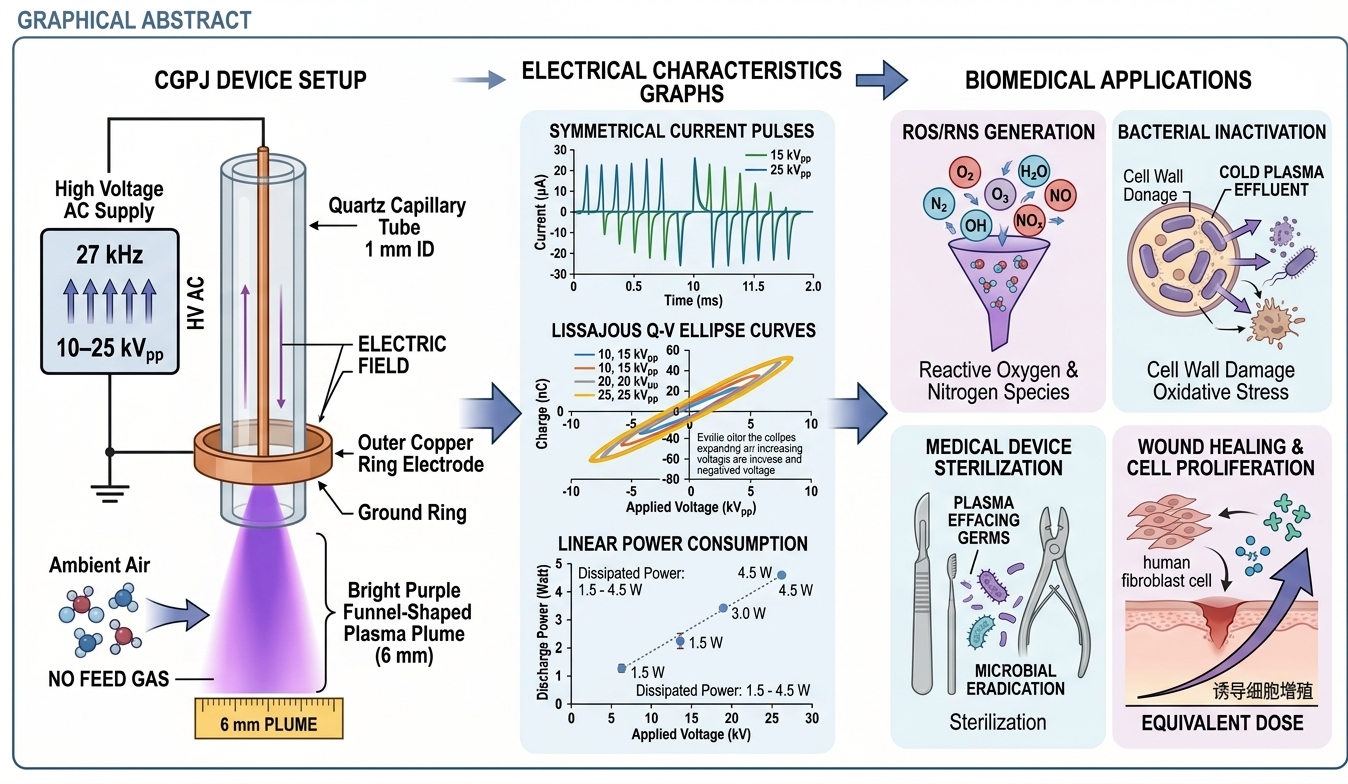
Nonthermal plasma jet device has been employed as a sterilisation means and effectively eradicate various microorganisms. Plasma jet device for this purpose has been most successful with a He or argon gas flow and often characterized by a long plasma plume. The expensive working gases such as helium and the gas control system however limits many practical applications. Capillary guided plasma jet (CGPJ) studied here employed at ambient air generated a constant funnel-shaped plasma plume of about 6 mm. The plasma jet plume has been optimised with different inner diameter capillary quartz tube and gap distance. The dissipative power was around 1.5 to 4.5 W. The effectiveness of the CGPJ in utilizing ambient air enables continuous sterilization and microbial inactivation processes, making it a promising approach for the treatment of medical devices and intricate implants. However, its direct application to living cells may pose safety concerns and may require further investigation and adjustment to enhance biocompatibility and safety for in vivo applications.
References
von Woedtke, T., Reuter, S., Masur, K., & Weltmann, K. D. (2013). Plasmas for medicine. Elsevier B.V. https://doi.org/10.1016/j.physrep.2013.05.005
Laroussi, M. (2005). Low temperature plasma-based sterilization: Overview and state-of-the-art. Plasma Processes and Polymers. https://doi.org/10.1002/ppap.200400078
Bogaerts, A., et al. (2015). Multi-level molecular modelling for plasma medicine. Journal of Physics D: Applied Physics, 49(5). https://doi.org/10.1088/0022-3727/49/5/054002
Graves, D. B. (2012). The emerging role of reactive oxygen and nitrogen species in redox biology and some implications for plasma applications to medicine and biology. Journal of Physics D: Applied Physics, 45(26), 263001. https://doi.org/10.1088/0022-3727/45/26/263001
Yap, S. L., Norhayati, M. N., Teow, S. Y., & Yap, S. S. (2022, February). Equivalent dose of atmospheric plasma jet on inducing cell proliferation in human fibroblast cell. Proceedings of the IEEE International Conference on Plasma Science (ICOPS), 199–199. https://doi.org/10.1109/icops37625.2020.9717576
Tay, W. H., Yap, S. L., & Wong, C. S. (2014). Electrical characteristics and modeling of a filamentary dielectric barrier discharge in atmospheric air (Ciri Elektrik dan Model Suatu Nyahcas Dielektrik Berpenghadang dalam Udara Atmosfera). Journal of Science and Technology.
Lu, X., Naidis, G. V., Laroussi, M., & Ostrikov, K. (2014). Guided ionization waves: Theory and experiments. Physics Reports. Elsevier. https://doi.org/10.1016/j.physrep.2014.02.006
Pang, B., et al. (2021). Discharge mode transition in a He/Ar atmospheric pressure plasma jet and its inactivation effect against tumor cells in vitro. Journal of Applied Physics, 130(15). https://doi.org/10.1063/5.0063135
Shaker, M. M., Mohammad, R. K., & Fuliful, F. K. (2023). Investigation on characteristics of atmospheric pressure helium plasma jet by using different Pyrex tubes thickness. Journal of Physics Conference Series.
Acharya, T. R., Jang, M., Lee, G. J., & Choi, E. H. (2023). A comprehensive study on the synthesis, characteristics, and catalytic applications of submerged hydrogen-mixed argon plasma-synthesized silver nanoparticles. Current Applied Physics, 56, 36–46. https://doi.org/10.1016/j.cap.2023.09.003
Baldanov, B. B., Ranzhurov, T. V., Semenov, A. P., & Gomboeva, S. V. (2019). Cold atmospheric argon plasma jet source and its application for bacterial inactivation. Journal of Theoretical and Applied Physics, 13(2), 95–99. https://doi.org/10.1007/s40094-019-0326-3
Lu, X., Laroussi, M., & Puech, V. (2012). On atmospheric-pressure non-equilibrium plasma jets and plasma bullets. Plasma Sources Science and Technology, 21(3), 034005. https://doi.org/10.1088/0963-0252/21/3/034005
R. T. P., & Kar, S. (2023). Effect of an additional floating electrode on radio frequency cross-field atmospheric pressure plasma jet. Scientific Reports, 13(1). https://doi.org/10.1038/s41598-023-37805-7
Nishime, T. M. C., Wagner, R., & Kostov, K. G. (2020). Study of modified area of polymer samples exposed to a He atmospheric pressure plasma jet using different treatment conditions. Polymers, 12(5), 1028. https://doi.org/10.3390/polym12051028
Mohd Nasir, N., Lee, B. K., Yap, S. S., Thong, K. L., & Yap, S. L. (2016). Cold plasma inactivation of chronic wound bacteria. Archives of Biochemistry and Biophysics, 605, 76–85. https://doi.org/10.1016/j.abb.2016.03.033
Muttiah, B., Mohd Nasir, N., Mariappan, V., Vadivelu, J., Vellasamy, K. M., & Yap, S. L. (2024). Targeting colon cancer and normal cells with cold plasma-activated water: Exploring cytotoxic effects and cellular responses. Physics of Plasmas, 31(8). https://doi.org/10.1063/5.0216291
Downloads
Published
Issue
Section
License
Copyright (c) 2025 Norhayati nasir, Professor, Dr, Dr

This work is licensed under a Creative Commons Attribution-NonCommercial 4.0 International License.