
Multi-Drug Resistant Bacteria from Sewage Treatment Plants in Johor: Isolation and Characterization
DOI:
https://doi.org/10.11113/mjfas.v22n1.3129Keywords:
Antibiotic susceptibility; antibiotic resistant bacteria; STP – sewage treatment plants; pathogen; MAR IndexAbstract
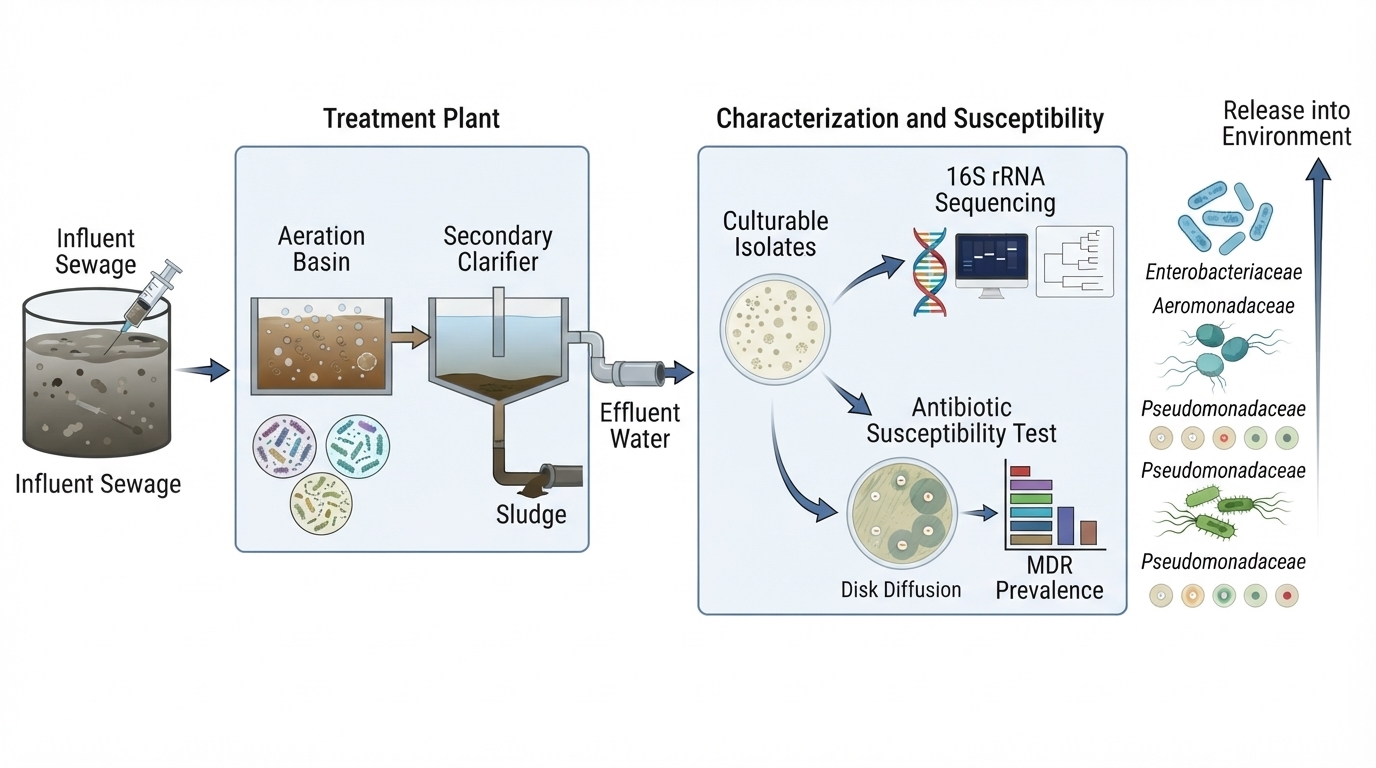
In this study, we revealed multi-drug resistant (MDR) bacteria isolated from three sewage treatment plants (STPs) against ciprofloxacin, chloramphenicol, gentamicin, tetracycline, and sulfamethoxazole. The antibiotic susceptibility test (AST) result shows that these isolates are distinctly highly resistant to sulfamethoxazole for influent (100%) and effluent (80-100%) samples for the first sampling (S1), while the lowest resistance (0%), resistant to chloramphenicol in some locations, in the second sampling (S2). Among the culturable isolates, multi-resistant bacteria were screened through AST, and these species were identified through 16S rRNA gene sequencing. From the cumulative multi-resistant isolates, 45.45% are known opportunistic bacteria species from the Enterobacteriaceae family (Citrobacter sp., Serratia sp., Enterococcus sp., and Escherichia sp.), while 27.27% are Aeromonadaceae and Pseudomonadaceae, respectively. This study reveals the prevalence of culturable multi-resistant opportunistic bacteria in influent and effluents of the three selected STPs for both sampling times.
References
Roulová, N., Mot’ková, P., Brožková, I., & Pejchalová, M. (2022). Antibiotic resistance of Pseudomonas aeruginosa isolated from hospital wastewater in the Czech Republic. Journal of Water and Health, 20(4), 692–701. https://doi.org/10.2166/wh.2022.101.
Tiwari, A., Kurittu, P., Al-Mustapha, A. I., Heljanko, V., Johansson, V., Thakali, O., … Oikarinen, S. (2022). Wastewater surveillance of antibiotic-resistant bacterial pathogens: A systematic review. Frontiers in Microbiology, 13, 977106. https://doi.org/10.3389/fmicb.2022.977106.
Pei, M., Zhang, B., He, Y., Su, J., Gin, K., Lev, O., … Hu, S. (2019). State of the art of tertiary treatment technologies for controlling antibiotic resistance in wastewater treatment plants. Environment International, 131, 105026. https://doi.org/10.1016/j.envint.2019.105026.
Osunmakinde, C. O., Selvarajan, R., Mamba, B. B., & Msagati, T. A. (2019). Profiling bacterial diversity and potential pathogens in wastewater treatment plants using high-throughput sequencing analysis. Microorganisms, 7(11), 506. https://doi.org/10.3390/microorganisms7110506.
Karkman, A., Do, T. T., Walsh, F., & Virta, M. P. J. (2018). Antibiotic-resistance genes in wastewater. Trends in Microbiology, 26(3), 220–228. https://doi.org/10.1016/j.tim.2017.09.005.
Ding, H., Qiao, M., Zhong, J., Zhu, Y., Guo, C., Zhang, Q., … Wu, Y. (2020). Characterization of antibiotic resistance genes and bacterial community in selected municipal and industrial sewage treatment plants beside Poyang Lake. Water Research, 174, 115603. https://doi.org/10.1016/j.watres.2020.115603.
Hutinel, M., Fick, J., Larsson, D. G. J., & Flach, C.-F. (2021). Investigating the effects of municipal and hospital wastewaters on horizontal gene transfer. Environmental Pollution, 276, 116733. https://doi.org/10.1016/j.envpol.2021.116733.
Ben, W., Wang, J., Cao, R., Yang, M., Zhang, Y., & Qiang, Z. (2017). Distribution of antibiotic resistance in the effluents of ten municipal wastewater treatment plants in China and the effect of treatment processes. Chemosphere, 172, 392–398. https://doi.org/10.1016/j.chemosphere.2017.01.041.
Gray, D. A., & Wenzel, M. (2020). Multitarget approaches against multiresistant superbugs. ACS Infectious Diseases, 6(6), 1346–1365. https://doi.org/10.1021/acsinfecdis.0c00001.
Jäger, T., Hembach, N., Elpers, C., Wieland, A., Alexander, J., Hiller, C., … Schwartz, T. (2018). Reduction of antibiotic-resistant bacteria during conventional and advanced wastewater treatment, and the disseminated loads released to the environment. Frontiers in Microbiology, 9, 2599. https://doi.org/10.3389/fmicb.2018.02599.
Roy, N., Alex, S. A., Chandrasekaran, N., Mukherjee, A., & Kannabiran, K. (2021). A comprehensive update on antibiotics as an emerging water pollutant and their removal using nano-structured photocatalysts. Journal of Environmental Chemical Engineering, 9(2), 104796. https://doi.org/10.1016/j.jece.2020.104796.
Chen, C., Aris, A., Yong, E. L., & Noor, Z. Z. (2022). Evaluation of the occurrence of antibiotics at different treatment stages of decentralised and conventional sewage treatment plants. International Journal of Environmental Science and Technology, 19(6), 5547–5562. https://doi.org/10.1007/s13762-021-03519-4.
Noor, Z. Z., Rabiu, Z., Sani, M. H. M., Samad, A. F. A., Kamaroddin, M. F. A., Perez, M. F., … Khare, S. K. (2021). A review of bacterial antibiotic resistance genes and their removal strategies from wastewater. Current Pollution Reports, 7, 1–16. https://doi.org/10.1007/s40726-021-00198-0.
Bayot, M. L., & Bragg, B. N. (2022). Antimicrobial susceptibility testing. In StatPearls. StatPearls Publishing. https://www.ncbi.nlm.nih.gov/books/NBK539714/
Bayot, M. L., & Bragg, B. N. (2019). Antimicrobial susceptibility testing. StatPearls. StatPearls Publishing. https://europepmc.org/article/NBK/nbk539714
Bauer, A. W., Kirby, W. M. M., Sherris, J. C., & Turck, M. (1966). Antibiotic susceptibility testing by a standardized single disk method. American Journal of Clinical Pathology, 45(4), 493–496. https://pubmed.ncbi.nlm.nih.gov/5325707/.
Sandhu, R., Dahiya, S., & Sayal, P. (2016). Evaluation of multiple antibiotic resistance (MAR) index and doxycycline susceptibility of Acinetobacter species among inpatients. Indian Journal of Microbiology Research, 3(3), 299. https://doi.org/10.1016/j.ijid.2016.02.710.
Junior, J. C. R., Tamanini, R., Soares, B. F., de Oliveira, A. M., de Godoi Silva, F., da Silva, F. F., … Beloti, V. (2016). Efficiency of boiling and four other methods for genomic DNA extraction of deteriorating spore-forming bacteria from milk. Semina: Ciências Agrárias, 37(5), 3069–3078. https://doi.org/10.5433/1679-0359.2016v37n5p3069.
Voytas, D. (2000). Agarose gel electrophoresis. Current Protocols in Molecular Biology, 51(1), 2.5A.1–2.5A.9. https://doi.org/10.1002/0471142727.mb0205as51.
Machado, E. C., Freitas, D. L., Leal, C. D., de Oliveira, A. T., Zerbini, A., Chernicharo, C. A. L., & de Araújo, J. C. (2023). Antibiotic resistance profile of wastewater treatment plants in Brazil reveals different patterns of resistance and multi-resistant bacteria in final effluents. Science of the Total Environment, 857, 159376. https://doi.org/10.1016/j.scitotenv.2022.159376.
Pazda, M., Kumirska, J., Stepnowski, P., & Mulkiewicz, E. (2019). Antibiotic resistance genes identified in wastewater treatment plant systems: A review. Science of the Total Environment, 697, 134023. https://doi.org/10.1016/j.scitotenv.2019.134023.
Barbosa, V., Morais, M., Silva, A., Delerue-Matos, C., Figueiredo, S. A., & Domingues, V. F. (2021). Comparison of antibiotic resistance in the influent and effluent of two wastewater treatment plants. AIMS Environmental Science, 8(2), 101–116. https://doi.org/10.3934/environsci.2021008.
Abdelgalel, R. R., Ibrahem, R. A., Mohamed, D. S., & Ahmed, A. B. F. (2025). Multidrug-resistant Escherichia coli in wastewater sources: A comparative study and identification of resistance hotspots. BMC Microbiology, 25(1), 498. https://doi.org/10.1186/s12866-025-04244-5.
Jendrzejewska, N., & Karwowska, E. (2018). The influence of antibiotics on wastewater treatment processes and the development of antibiotic-resistant bacteria. Water Science and Technology, 77(9), 2320–2326. https://doi.org/10.2166/wst.2018.153.
Małecka-Adamowicz, M., Kubera, Ł., Donderski, W., & Kolet, K. (2017). Microbial air contamination on the premises of the sewage treatment plant in Bydgoszcz (Poland) and antibiotic resistance of Staphylococcus spp. Archives of Environmental Protection, 43(4). http://archive.sciendo.com/AEP/aep.2016.43.issue-4/aep-2017-0040/aep-2017-0040.pdf.
Lenart-Boroń, A., Prajsnar, J., Guzik, M., Boroń, P., & Chmiel, M. (2020). How much of antibiotics can enter surface water with treated wastewater and how it affects the resistance of waterborne bacteria: A case study of the Białka River sewage treatment plant. Environmental Research, 191, 110037. https://doi.org/10.1016/j.envres.2020.110037.
Makowska, N., Koczura, R., & Mokracka, J. (2016). Class 1 integrase, sulfonamide and tetracycline resistance genes in wastewater treatment plant and surface water. Chemosphere, 144, 1665–1673. https://doi.org/10.1016/j.chemosphere.2015.10.044.
Karkman, A., Do, T. T., Walsh, F., & Virta, M. P. (2018). Antibiotic-resistance genes in wastewater. Trends in Microbiology, 26(3), 220–228. https://doi.org/10.1016/j.tim.2017.09.005.
Grossman, T. H. (2016). Tetracycline antibiotics and resistance. Cold Spring Harbor Perspectives in Medicine, 6(4), a025387. https://doi.org/10.1101/cshperspecta025387.
Stachurová, T., Malachová, K., Semerád, J., Sterniša, M., Rybková, Z., & Smole Možina, S. (2020). Tetracycline induces the formation of biofilm of bacteria from different phases of wastewater treatment. Processes, 8(8), 989. https://doi.org/10.3390/pr8080989.
Van Hoek, A. H. A. M., Mevius, D., Guerra, B., Mullany, P., Roberts, A. P., & Aarts, H. J. M. (2011). Acquired antibiotic resistance genes: An overview. Frontiers in Microbiology, 2, 203. https://doi.org/10.3389/fmicb.2011.00203.
Kohanski, M. A., Dwyer, D. J., & Collins, J. J. (2010). How antibiotics kill bacteria: From targets to networks. Nature Reviews Microbiology, 8(6), 423–435. https://doi.org/10.1038/nrmicro2333.
Fernández, M., Conde, S., de la Torre, J., Molina-Santiago, C., Ramos, J.-L., & Duque, E. (2012). Mechanisms of resistance to chloramphenicol in Pseudomonas putida KT2440. Antimicrobial Agents and Chemotherapy, 56(2), 1001–1009. https://doi.org/10.1128/AAC.05398-11.
Rodriguez-Mozaz, S., Chamorro, S., Marti, E., Huerta, B., Gros, M., Sànchez-Melsió, A., et al. (2015). Occurrence of antibiotics and antibiotic resistance genes in hospital and urban wastewaters and their impact on the receiving river. Water Research, 69, 234–242. https://doi.org/10.1016/j.watres.2014.11.021.
Ayandele, A., Oladipo, E., Oyebisi, O., & Kaka, M. (2020). Prevalence of multi-antibiotic resistant Escherichia coli and Klebsiella species obtained from a tertiary medical institution in Oyo State, Nigeria. Qatar Medical Journal, 2020(1), 9. https://doi.org/10.5339/qmj.2020.9.
Azli, B., Razak, M. N., Omar, A. R., Mohd Zain, N. A., Abdul Razak, F., & Nurulfiza, I. (2022). Metagenomics insights into the microbial diversity and microbiome network analysis on the heterogeneity of influent to effluent water. Frontiers in Microbiology, 13, 715. https://doi.org/10.3389/fmicb.2022.779196
Luczkiewicz, A., Kotlarska, E., Artichowicz, W., Tarasewicz, K., & Fudala-Ksiazek, S. (2015). Antimicrobial resistance of Pseudomonas spp. isolated from wastewater and wastewater-impacted marine coastal zone. Environmental Science and Pollution Research, 22, 19823–19834. https://doi.org/10.1007/s11356-015-5098-y.
Iglewski, B. H. (1996). Pseudomonas. In S. Baron (Ed.), Medical microbiology (4th ed.). University of Texas Medical Branch at Galveston. https://www.ncbi.nlm.nih.gov/books/NBK8326/.
NI, A. H., & Huycke, M. M. (2014). Enterococcal disease, epidemiology, and implications for treatment. National Center for Biotechnology Information. https://www.ncbi.nlm.nih.gov/books/NBK190429/.
Khanna, A., Khanna, M., & Aggarwal, A. (2013). Serratia marcescens—A rare opportunistic nosocomial pathogen and measures to limit its spread in hospitalized patients. Journal of Clinical and Diagnostic Research, 7(2), 243. https://doi.org/10.7860/JCDR/2013/5010.2737.
Pund, R., & Theegarten, D. (2008). The importance of aeromonads as a human pathogen. Bundesgesundheitsblatt-Gesundheitsforschung-Gesundheitsschutz, 51, 569–576. https://doi.org/10.1007/s00103-008-0531-8.
Pepperell, C., Kus, J., Gardam, M., Humar, A., & Burrows, L. L. (2002). Low-virulence Citrobacter species encode resistance to multiple antimicrobials. Antimicrobial Agents and Chemotherapy, 46(11), 3555–3560. https://doi.org/10.1128/AAC.46.11.3555-3560.2002.
Savini, V., Catavitello, C., Talia, M., Manna, A., Pompetti, F., Favaro, M., et al. (2008). Multidrug-resistant Escherichia fergusonii: A case of acute cystitis. Journal of Clinical Microbiology, 46(4), 1551–1552. https://doi.org/10.1128/JCM.01210-07.
Rizzo, L., Manaia, C., Merlin, C., et al. (2013). Urban wastewater treatment plants as hotspots for antibiotic resistant bacteria and genes spread into the environment: A review. Science of the Total Environment. https://doi.org/10.1016/j.scitotenv.2013.01.032.
Manaia, C. M., Rocha, J., Scaccia, N., Marano, R., Radu, E., Biancullo, F., et al. (2018). Antibiotic resistance in wastewater treatment plants: Tackling the black box. Environment International, 115, 312–324. https://doi.org/10.1016/j.envint.2018.03.044.
Victoria, N. S., Kumari, T. S. D., & Lazarus, B. (2022). Assessment on impact of sewage in coastal pollution and distribution of fecal pathogenic bacteria with reference to antibiotic resistance in the coastal area of Cape Comorin, India. Marine Pollution Bulletin, 175, 113123. https://doi.org/10.1016/j.marpolbul.2021.113123.
Govender, R., Amoah, I. D., Adegoke, A. A., Singh, G., Kumari, S., Swalaha, F. M., et al. (2021). Identification, antibiotic resistance, and virulence profiling of Aeromonas and Pseudomonas species from wastewater and surface water. Environmental Monitoring and Assessment, 193(5), 294. https://doi.org/10.1007/s10661-021-09046-6.
Ju, F., Beck, K., Yin, X., Maccagnan, A., McArdell, C. S., Singer, H. P., et al. (2019). Wastewater treatment plant resistomes are shaped by bacterial composition, genetic exchange, and upregulated expression in the effluent microbiomes. The ISME Journal, 13(2), 346–360. https://doi.org/10.1038/s41396-018-0277-8.
Downloads
Published
Issue
Section
License
Copyright (c) 2026 Nor Azimah Mohd Zain, Athena Dana, Xin Kun Tan

This work is licensed under a Creative Commons Attribution-NonCommercial 4.0 International License.