
Computational Evaluation of Gamma-Ray, Electron, and Fast-Neutron Shielding Properties of PMMA/Bi₂O₃/ZnO Nanocomposites
DOI:
https://doi.org/10.11113/mjfas.v22n5.5571Abstract
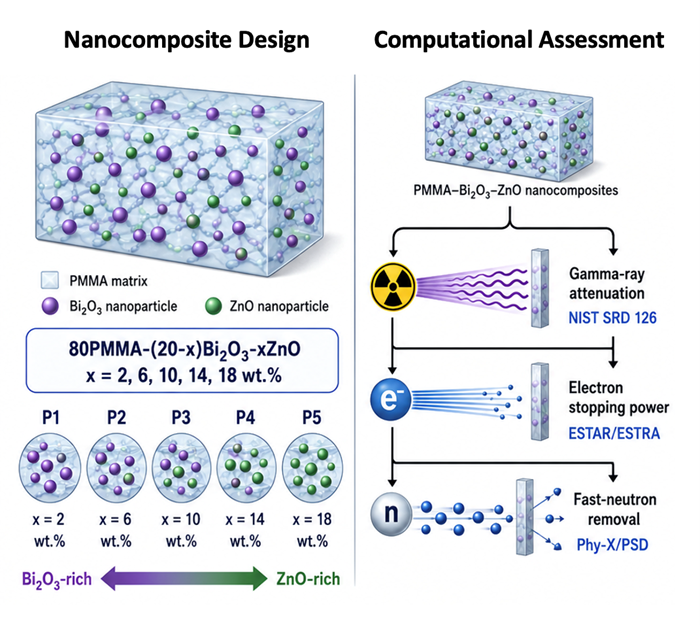
This computational study determined the radiation-shielding properties of five theoretically formulated polymethyl methacrylate (PMMA)-based nanocomposites, denoted as P1 to P5 reinforced with varying concentrations of bismuth oxide (Bi₂O₃) and zinc oxide (ZnO) nanopowders. The proposed nanocomposites followed the formula as 80PMMA-(20-x)Bi₂O₃-xZnO, with x = 2, 6, 10, 14, and 18 wt.%. The attenuation properties of these materials were theoretically evaluated against diverse ionizing radiations, including gamma rays, beta particles, and fast neutrons across a broad energy spectrum. The mass attenuation and mass energy absorption coefficients of the nanocomposites were determined within the gamma-ray energy range of 1 keV to 20 MeV. The radiation shielding efficiency, specific gamma-ray constant, and irradiation dose rate were obtained through the NIST Standard Reference Database 126. The electron stopping power of the nanocomposites was computed by the ESTRA code for electron energies between 0.1 and 100 MeV, while the neutron shielding potential was evaluated via the fast neutron removal cross-section. Comparative analysis was conducted with conventional shielding materials such as boron carbide, graphite, and polyethylene using the Phy-X/PSD online program. The calculations demonstrated that the nanocomposite with the highest Bi₂O₃ content exhibited superior shielding efficiency against gamma rays, particularly in low and medium energy ranges. Furthermore, all nanocomposites showed effective attenuation of high-energy electrons, while the highest ZnO content revealed the highest shielding effectiveness against fast neutrons. These findings indicate that the significant potential of PMMA-based Bi₂O₃/ZnO nanocomposites as advanced materials has considerable value for the development of high-performance radiation shielding in a variety of applications involving ionizing radiation.
References
[1] S. Gupta, G. S. Sidhu, Int. J. Sci. Res. 2 (2012) 1.
[2] M. J. Aldhuhaibat, M. S. Amana, N. J. Jubier, A. A. Salim, Radiat. Phys. Chem. 179 (2021) 109183.
[3] M. S. Amana, M. J. R. Aldhuhaibat, A. A. Salim, SCIOL Biomed. 4 (2021) 191.
[4] M. S. Al‐Buriahi, C. Eke, S. Alomairy, A. Yildirim, H. I. Alsaeedy, C. Sriwunkum, Polym. Adv. Technol. 32 (2021) 2386.
[5] M. S. Al-Buriahi, M. Hessien, F. Alresheedi, A. M. Al-Baradi, Z. A. Alrowaili, I. Kebaili, I. O. Olarinoye, Ceram. Int. 48 (2022) 3464.
[6] J. S. Alzahrani, Z. A. Alrowaili, H. H. Saleh, A. Hammoud, S. Alomairy, C. Sriwunkum, M. S. Al-Buriahi, Prog. Nucl. Energy 142 (2021) 103992.
[7] A. E. S. Abdo, M. A. M. Ali, M. R. Ismail, Radiat. Phys. Chem. 66 (2003) 185.
[8] M. J. Aldhuhaibat, M. S. Amana, H. Aboud, A. A. Salim, Ceram. Int. 48 (2022) 25011.
[9] M. Sheela, V. A. Kamat, K. U. Kiran, K. M. Eshwarappa, Radiat. Prot. Environ. 42 (2019) 180.
[10] N. M. Aowd, H. S. Hussain, Eng. Technol. J. 33 (2015) 1.
[11] Z. Li, S. Chen, S. Nambiar, Y. Sun, M. Zhang, W. Zheng, J. T. Yeow, Nanotechnology 27 (2016) 234001.
[12] T. Bel, C. Arslan, N. Baydogan, Mater. Chem. Phys. 221 (2019) 58.
[13] D. Cao, G. Yang, M. Bourham, D. Moneghan, Nucl. Eng. Technol. 52 (2020) 2613.
[14] H. Gümüş, F. Köksal, Radiat. Eff. Defects Solids 157 (2002) 445.
[15] S. Tanuma, C. J. Powell, D. R. Penn, Surf. Interface Anal. 37 (2005) 978.
[16] Z. Tan, Y. Xia, Appl. Radiat. Isot. 70 (2012) 296.
[17] M. O. El-Ghossain, Int. J. Phys. 5 (2017) 92.
[18] M. O. El-Ghossain, Int. J. Sci. Technol. Res. 6 (2017) 114.
[19] M. J. Aldhuhaibat, H. S. Farhan, R. H. Hassani, H. M. Tuma, H. Bakhtiar, A. A. Salim, Appl. Phys. A 128 (2022) 1058.
[20] H. K. Yasser, M. J. Aldhuhaibat, A. J. Farhan, in: AIP Conference Proceedings, AIP Publishing, Melville, NY, 2024, p. 190001.
[21] N. J. AbuAlRoos, M. N. Azman, N. A. B. Amin, R. Zainon, Phys. Med. 78 (2020) 48.
[22] L. Gerward, N. Guilbert, K. B. Jensen, H. Levring, Radiat. Phys. Chem. 60 (2001) 23.
[23] L. M. Unger, D. K. Trubey, Specific Gamma-Ray Dose Constants for Nuclides Important to Dosimetry and Radiological Assessment, Oak Ridge National Lab., Oak Ridge, TN, 1982, p. 1.
[24] S. F. Hathot, N. J. Jubier, R. H. Hassani, A. A. Salim, Optik 247 (2021) 167941.
[25] H. Aboud, M. J. Aldhuaibata, Y. Alajermi, J. Phys. Chem. Solids 164 (2022) 110597.
[26] G. Dutta, D. Bose, Int. J. Emerg. Technol. Adv. Eng. 2 (2012) 121.
[27] E. Şakar, Ö. F. Özpolat, B. Alım, M. I. Sayyed, M. Kurudirek, Radiat. Phys. Chem. 166 (2020) 108496.
[28] N. Y. M. Isa, E. S. Sazali, R. Hisam, S. K. Ghoshal, S. K. M. Zain, N. H. Juma’In, A. Awang, in: Journal of Physics: Conference Series, IOP Publishing, Bristol, UK, 2021, p. 012027.
[29] H. C. Manjunatha, L. Seenappa, B. M. Chandrika, C. Hanumantharayappa, Ann. Nucl. Energy 109 (2017) 310.
[30] M. J. Berger, ESTAR, PSTAR, ASTAR: A PC Package for Calculating Stopping Powers and Ranges of Electrons, Protons and Helium Ions, International Atomic Energy Agency, Vienna, 1993, p. 1.
[31] National Research Council, Health Effects of Exposure to Low Levels of Ionizing Radiation: BEIR V, National Academies Press, Washington, DC, 1990, p. 1.
[32] S. N. Ahmed, Physics and Engineering of Radiation Detection, Academic Press, San Diego, CA, 2007, p. 1.
[33] A. A. Salim, S. K. Ghoshal, H. Bakhtiar, Optik 226 (2021) 165879.
[34] Y. H. Song, Y. N. Wang, Nucl. Instrum. Methods Phys. Res. Sect. B 135 (1998) 124.
[35] F. A. Mettler, Medical Effects of Ionizing Radiation, W.B. Saunders, Philadelphia, PA, 1985, p. 1.
[36] Y. Elmahroug, B. Tellili, C. Souga, Int. J. Phys. Res. 3 (2013) 7.
[37] J. Wood, Computational Methods in Reactor Shielding, Elsevier, Oxford, 2013, p. 1.
[38] M. U. Khan, S. Ahmad, A. A. Naqvi, H. J. Al-Gahtani, Prog. Nucl. Energy 130 (2020) 103550.
[39] M. S. Amana, N. J. Jubier, M. J. Aldhuhaibat, A. A. Salim, Radiat. Detect. Technol. Methods 5 (2021) 633.
[40] Ö. F. Özpolat, B. Alım, E. Şakar, M. Büyükyıldız, M. Kurudirek, Radiat. Environ. Biophys. 59 (2020) 321.
[41] J. H. Hubbell, S. M. Seltzer, Tables of X-Ray Mass Attenuation Coefficients and Mass Energy-Absorption Coefficients 1 keV to 20 MeV for Elements Z=1 to 92 and 48 Additional Substances of Dosimetric Interest, National Institute of Standards and Technology, Gaithersburg, MD, 1995, p. 1.
[42] H. C. Manjunatha, L. Seenappa, B. M. Chandrika, K. N. Sridhar, C. Hanumantharayappa, Appl. Radiat. Isot. 139 (2018) 187.
[43] M. J. Berger, J. S. Coursey, M. A. Zucker, J. Chang, Stopping-Power and Range Tables for Electrons, Protons, and Helium Ions, National Institute of Standards and Technology, Gaithersburg, MD, 2017, p. 1.
[44] F. Fernandez-Alonso, D. L. Price, Neutron Scattering, Academic Press, Boston, MA, 2013, p. 1.
[45] P. Kaur, K. J. Singh, S. Thakur, in: Journal of Physics: Conference Series, IOP Publishing, Bristol, UK, 2020, p. 012043.
Downloads
Published
Issue
Section
License
Copyright (c) 2026 Oday J. K. Kadhim, Najlaa Jerjack Abdullah, N Nadia, Mohammed J. R. Aldhuhaibat, Ali Aqeel Salim

This work is licensed under a Creative Commons Attribution-NonCommercial 4.0 International License.