
Crack Healing and Structural Recovery of Concrete Using Cytobacillus horneckiae-Induced Carbonate Precipitation
DOI:
https://doi.org/10.11113/mjfas.v21n6.4752Keywords:
Microbially Induced Carbonate Precipitation, Cytobacillus horneckiae, Crack Healing, Sustainable Concrete, Structural RestorationAbstract
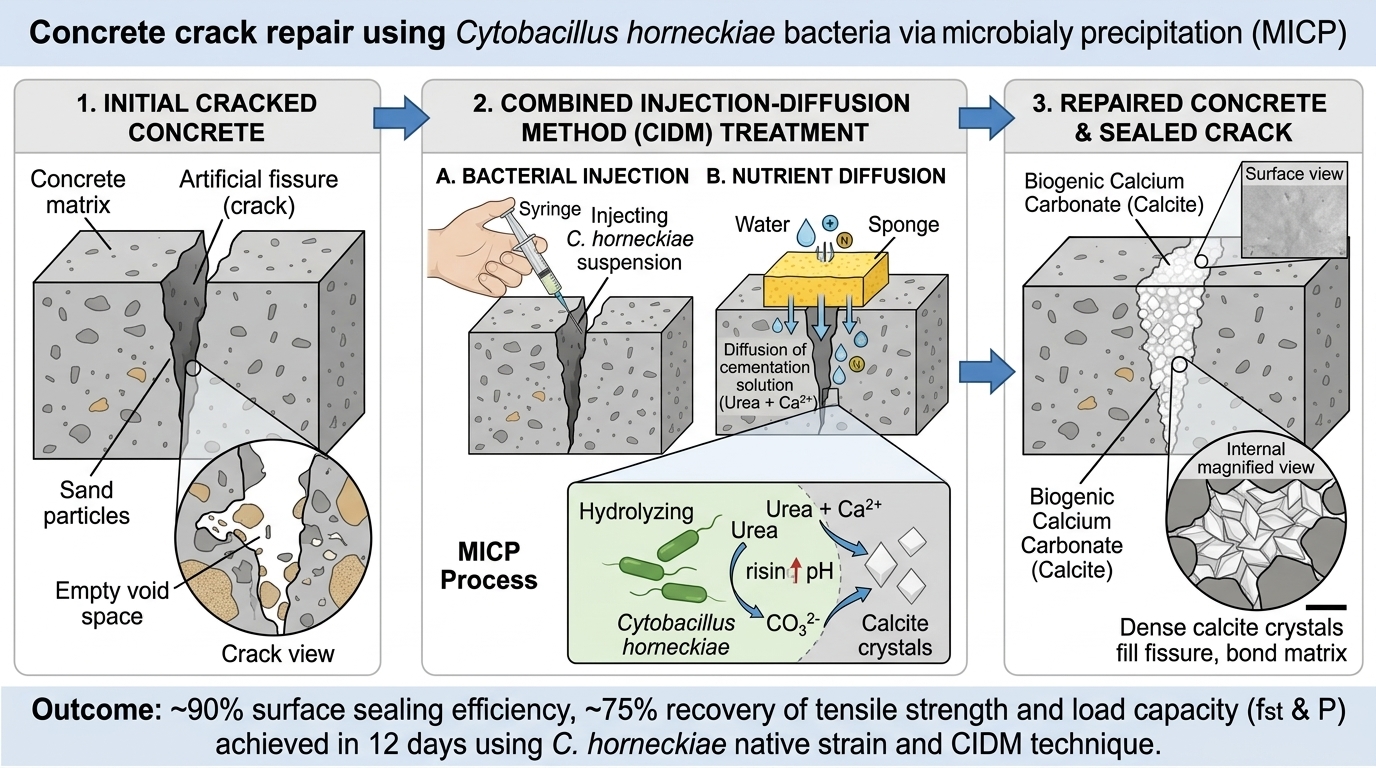
Concrete cracking poses a major durability challenge, accelerating reinforcement corrosion and reducing service life. Conventional repair methods such as epoxy injection and cementitious grouting are costly, unsustainable, and often ineffective for microcracks. This study evaluates the potential of Cytobacillus horneckiae, a resilient ureolytic bacterium, to promote microbially induced calcium carbonate precipitation (MICP) for sustainable crack remediation. Laboratory experiments assessed carbonate precipitation efficiency under varying conditions of pH, urea concentration, and temperature, alongside controlled crack-healing trials using a combined injection–diffusion method (CIDM). Results showed optimal CaCO₃ formation at pH 9, 0.75 M urea, and 35 °C, conditions consistent with concrete pore environments. Image analysis revealed a 90% reduction in surface crack area within 12 days, demonstrating accelerated healing compared with conventional injection methods. Mechanical testing indicated 75% recovery of tensile strength and ultimate load capacity, confirming partial restoration of structural integrity. FTIR spectra identified carbonate functional groups and calcite polymorphs, while SEM–EDX analyses confirmed the presence of Ca and O as dominant elements, validating biogenic CaCO₃ deposition within crack voids. Silicon traces reflected interactions with the concrete matrix, while negligible carbon detection was attributed to EDX limitations for light elements. Collectively, the findings highlight the effectiveness of C. horneckiae-mediated MICP in sealing cracks and restoring mechanical performance, offering an environmentally friendly alternative to chemical repair agents. However, incomplete depth sealing suggests that further optimization of bacterial delivery strategies is required to achieve long-term durability. This work expands the scope of MICP research beyond the conventional Sporosarcina pasteurii, providing new insights into the application of native bacterial strains for sustainable concrete self-healing technologies.
References
Jiang, L., Xia, H., Wang, W., et al. (2023). Applications of microbially induced calcium carbonate precipitation in civil engineering practice: A state-of-the-art review. Construction and Building Materials, 404, 133227. https://doi.org/10.1016/j.conbuildmat.2023.133227.
Zhang, W., Li, J., Chen, Z., & Tan, Y. (2024). Durability evaluation of MICP-repaired concrete exposed to the freeze–thaw process. Journal of Materials in Civil Engineering, 36, 04024420. https://doi.org/10.1061/JMCEE7.MTENG-16296.
Shen, D., Kang, J., Shao, H., et al. (2023). Cracking failure behavior of high strength concrete containing nano-CaCO₃ at early age. Cement and Concrete Composites, 139, 104996. https://doi.org/10.1016/j.cemconcomp.2023.104996.
De Muynck, W., De Belie, N., & Verstraete, W. (2010). Microbial carbonate precipitation in construction materials: A review. Ecological Engineering, 36, 118–136. https://doi.org/10.1016/j.ecoleng.2009.02.006.
Min, J., Son, Y., Jang, I., et al. (2024). Managing two simultaneous issues in concrete repair: Healing microcracks and controlling pathogens. Construction and Building Materials, 416, 135125. https://doi.org/10.1016/j.conbuildmat.2024.135125.
Omoregie, A. I., Wong, C. S., Rajasekar, A., et al. (2025). Bio-based solutions for concrete infrastructure: A review of microbial-induced carbonate precipitation in crack healing. Buildings, 15, 1052. https://doi.org/10.3390/buildings15071052.
Chen, Y., Chen, Y., Wang, S., et al. (2025). Research progress and application prospects of microbial mineralization for repairing cracks in recycled concrete. Biochemical Engineering Journal, 219, 109733. https://doi.org/10.1016/j.bej.2025.109733.
Gunsur, E., Mumcu, H., Demir, C., et al. (2023). Biogenic material design by stone waste treatment with biologically induced mineralization. Journal of Bio- and Infrastructural Materials, 12, 70–81. https://doi.org/10.1680/jbibn.21.00007.
Zhao, H., Zhao, Y., & Tong, Y. (2025). Crack repair in existing concrete structures: Progress in research and applications. Journal of Asian Concrete Federation, 11, 15–30. https://doi.org/10.18702/ACF.2024.11.1.15.
Kulkarni, P. B., Nemade, P. D., & Wagh, P. (2020). Healing of generated cracks in cement mortar using MICP. Civil Engineering Journal, 6. https://doi.org/10.28991/cej-2020-03091500.
Gao, R., & Wang, J. (2023). The influence of repair technique on the distribution of biogenic CaCO₃ in a mimic vertical crack. Construction and Building Materials, 402, 133021. https://doi.org/10.1016/j.conbuildmat.2023.133021.
Limpaninlachat, P., Noppakun, N., Chindasiriphan, P., et al. (2025). Investigation of chloride resistance in self-healing mortars using vegetative cell and spore-based MICP methods. Construction and Building Materials, 493, 143081. https://doi.org/10.1016/j.conbuildmat.2025.143081.
Fan, Q., Fan, L., Quach, W. M., et al. (2023). Application of microbial mineralization technology for marine concrete crack repair: A review. Journal of Building Engineering, 69, 106299. https://doi.org/10.1016/j.jobe.2023.106299.
Zou, K., Wang, L., & Ueda, T. (2025). A time-varying model for predicting crack closure in microbial self-healing concrete after incorporating encapsulated agent. Journal of Building Engineering, 107, 112748. https://doi.org/10.1016/j.jobe.2025.112748.
Li, L., Liu, T., Jiang, G., et al. (2025). Microbiological mineralization for self-healing cement sheath in oil and gas wells: Integrity and sealing mechanisms of interface cracks. Case Studies in Construction Materials, 22, e04546. https://doi.org/10.1016/j.cscm.2025.e04546.
Hasan Saleh, A., Raja, M. S., & History, A. (2023). Innovative engineering strategies for evaluating and repairing concrete cracks: An applied perspective. Mesopotamian Journal of Civil Engineering, 2023, 64–76. https://doi.org/10.58496/MJCE/2023/009.
Omoregie, A. I., Ouahbi, T., Kan, F. K., et al. (2025). Advancing slope stability and hydrological solutions through biocementation: A bibliometric review. Hydrology, 12, 14. https://doi.org/10.3390/hydrology12010014.
Moqsud, M. A., & Gochi, T. (2023). Biocementation of slope soil using native Cytobacillus horneckiae. Bioresource Technology Reports, 23, 101520. https://doi.org/10.1016/j.biteb.2023.101520.
Carter, M. S., Tuttle, M. J., Mancini, J. A., et al. (2023). Microbially induced calcium carbonate precipitation by Sporosarcina pasteurii: Optimizing biological CaCO₃ precipitation. Applied and Environmental Microbiology, 89. https://doi.org/10.1128/AEM.01794-22.
Intarasoontron, J., Pungrasmi, W., Nuaklong, P., et al. (2021). Comparing performances of MICP bacterial vegetative cell and microencapsulated bacterial spore methods on concrete crack healing. Construction and Building Materials, 302, 124227. https://doi.org/10.1016/j.conbuildmat.2021.124227.
Choi, S. G., Wang, K., Wen, Z., & Chu, J. (2017). Mortar crack repair using microbial induced calcite precipitation. Cement and Concrete Composites, 83, 209–221. https://doi.org/10.1016/j.cemconcomp.2017.07.013.
Lu, C., Li, Z., Wang, J., et al. (2023). Repairing vertical concrete cracks using microbial carbonate precipitation driven by ion diffusion. Journal of Building Engineering, 73, 106798. https://doi.org/10.1016/j.jobe.2023.106798.
Soleimanbeigi, A., Hayati, P., Sobhani, J., & Saffarian, P. (2025). Synergistic effects of Sporosarcina ureae and silica fume on self-healing and plastic shrinkage cracks in green concrete pavement. Results in Engineering, 26, 105526. https://doi.org/10.1016/j.rineng.2025.105526.
Kho, Y. S., Wong, K. S., Pauzi, N. N. M., et al. (2024). Self-healing concrete utilizing ureolysis-based MICP: A review. Iranian Journal of Science and Technology, Transactions of Civil Engineering, 49(4), 3189–3210. https://doi.org/10.1007/s40996-024-01660-x.
Xiong, Y. M., Zhan, Q. W., Fu, C. H., & Pan, Z. H. H. (2025). Self-repairing and anti-corrosion performance of potassium magnesium phosphate cement coating based on microbial mineralization. Construction and Building Materials, 489, 142340. https://doi.org/10.1016/j.conbuildmat.2025.142340.
Huang, P., Yang, X., & Dai, Y. (2025). Effect evaluation of repairing cement-mortar microbeams by microbial induced carbonate precipitation. AMB Express, 15, 1–15. https://doi.org/10.1186/s13568-025-01881-x.
Basri, H. F., Omoregie, A. I., & Mokhter, M. A. (2023). Influence of enriched urease-producing bacteria from leachate and restaurant wastewater on heavy metal removal. Malaysian Journal of Fundamental and Applied Sciences, 19, 956–969. https://doi.org/10.11113/mjfas.v19n6.3130.
Omoregie, A. I., Ouahbi, T., Basri, H. F., et al. (2024). Heavy metal immobilisation with microbial-induced carbonate precipitation: A review. Geotechnical Research, 11, 188–212. https://doi.org/10.1680/jgere.23.00066.
Cui, Z., He, X., Dai, F., et al. (2025). Influence of bacterial concentration and fissure aperture on dynamic mechanical properties of MICP-repaired fissured sandstone. Journal of Rock Mechanics and Geotechnical Engineering. https://doi.org/10.1016/j.jrmge.2025.03.064.
Hamdan, M. D., Basri, H. F., Omoregie, A. I., et al. (2024). Cd²⁺ sequestration by ureolytic bacteria isolated from goat faeces and nursery wastewater. Malaysian Journal of Fundamental and Applied Sciences, 20, 1017–1031. https://doi.org/10.11113/mjfas.v20n5.3425.
Sun, X., & Miao, L. (2020). Application of bioremediation with Bacillus megaterium for crack repair at low temperature. Journal of Advanced Concrete Technology, 18, 307–319. https://doi.org/10.3151/jact.18.307.
Chen, D., Wang, L., Wang, S., et al. (2025). A creep damage model and microscopic characteristics of fractured sandstone repaired by microbial induction. Computers and Geotechnics, 187, 107494. https://doi.org/10.1016/j.compgeo.2025.107494.
Dong, Z. H., Pan, X. H., Tang, C. S., et al. (2025). Microbially induced magnesia carbonation for crack healing of sandstone relics: Improving interfacial bonding strength. Rock Mechanics and Rock Engineering, 58, 557–573. https://doi.org/10.1007/s00603-024-04149-1.
Jiang, L., Xia, H., Hu, S., et al. (2024). Crack-healing ability of concrete enhanced by aerobic–anaerobic bacteria and fibers. Cement and Concrete Research, 183, 107585. https://doi.org/10.1016/j.cemconres.2024.107585.
Liu, J., Xu, H., Dong, M., et al. (2025). Adaptive evolution of Sporosarcina pasteurii enhances saline–alkali resistance for concrete crack repair. Microorganisms, 13, 1526. https://doi.org/10.3390/microorganisms13071526.
Huang, H., Du, C., Yi, F., et al. (2025). Optimization of multicomponent microbial systems for concrete crack repair. Structures, 73, 108487. https://doi.org/10.1016/j.istruc.2025.108487.
Jongvivatsakul, P., Janprasit, K., Nuaklong, P., et al. (2019). Crack healing performance of mortar using MICP. Construction and Building Materials, 212, 737–744. https://doi.org/10.1016/j.conbuildmat.2019.04.035.
Zheng, Y., Li, R., Wang, J., et al. (2024). Environmentally friendly MICP surface curing: Enhancing mechanical and durability properties. Journal of Cleaner Production, 478, 143962. https://doi.org/10.1016/j.jclepro.2024.143962.
Soleimanbeigi, A., Hayati, P., Sobhani, J., & Saffarian, P. (2025). Bio-FM-Spray restoration of concrete pavement. Case Studies in Construction Materials, 23, e05100. https://doi.org/10.1016/j.cscm.2025.e05100.
Wang, J., Zhu, J., Li, Y., et al. (2025). Optimal width ratio selection for microbial mineralization in repairing lining cracks in desert channels. Scientific Reports, 15, 1–16. https://doi.org/10.1038/s41598-025-01582-2.
Fan, Q., Fan, L., Quach, W. M., & Duan, J. (2025). Bio-gel for concrete crack repair and corrosion inhibition. Corrosion Science, 256, 113228. https://doi.org/10.1016/j.corsci.2025.113228.
Ojha, A., Bandyopadhyay, T. K., Das, D., & Dey, P. (2025). Microbial carbonate mineralization: Mechanisms and applications. Molecular Biotechnology, 1–27. https://doi.org/10.1007/s12033-025-01433-5.
Dhami, N. K., Mukherjee, A., & Watkin, E. L. J. (2018). Microbial diversity and mineralogical-mechanical properties of calcitic cave speleothems. Frontiers in Microbiology, 9, 40. https://doi.org/10.3389/fmicb.2018.00040.
Krajewska, B. (2018). Urease-aided calcium carbonate mineralization for engineering applications: A review. Journal of Advanced Research, 13, 59–67. https://doi.org/10.1016/j.jare.2017.10.009.
Wong, P. Y., Mal, J., Sandak, A., et al. (2024). Advances in microbial self-healing concrete. Science of the Total Environment, 947, 174553. https://doi.org/10.1016/j.scitotenv.2024.174553.
Castro-Alonso, M. J., Montañez-Hernandez, L. E., Sanchez-Muñoz, M. A., et al. (2019). MICP and bioconcrete: Microbiological and molecular concepts. Frontiers in Materials, 6, 126. https://doi.org/10.3389/fmats.2019.00126.
Fan, Q., Fan, L., Quach, W. M., et al. (2023). Application of microbial mineralization technology for marine concrete crack repair. Journal of Building Engineering, 69, 106299. https://doi.org/10.1016/j.jobe.2023.106299.
Chen, Y., Han, Y., Zhang, X., et al. (2023). Permeability and strength characteristics of MICP-treated calcareous sand. Biogeotechnics, 1, 100034. https://doi.org/10.1016/j.bgtech.2023.100034.
Lekundayo, A. (2024). The influence of crystalline admixtures on the mechanical and durability properties of cracked and uncracked concrete. [Incomplete reference: missing journal/publisher details]
Niu, Y. Q., Liu, J. H., Aymonier, C., et al. (2022). Calcium carbonate: Controlled synthesis, surface functionalization, and nanostructured materials. Chemical Society Reviews, 51, 7883–7943. https://doi.org/10.1039/d1cs00519g.
Zhang, G. Z., Liu, C., Zhang, J., et al. (2025). Enhanced MICP efficacy for cracks repair of marine mortar with coral sand. Construction and Building Materials, 470, 140647. https://doi.org/10.1016/j.conbuildmat.2025.140647.
Downloads
Published
Issue
Section
License
Copyright (c) 2025 hazlami fikri Basri

This work is licensed under a Creative Commons Attribution-NonCommercial 4.0 International License.