
Sustainable Concrete Restoration Using Microbial-Induced Carbonate Precipitation Technology: Insights from Laboratory and Field Applications
DOI:
https://doi.org/10.11113/mjfas.v21n6.4746Keywords:
Microbially-Induced Calcium Carbonate Precipitation, Sporosarcina pasteurii, Concrete Crack Repair, Water Absorption Rate, Structural RestorationAbstract
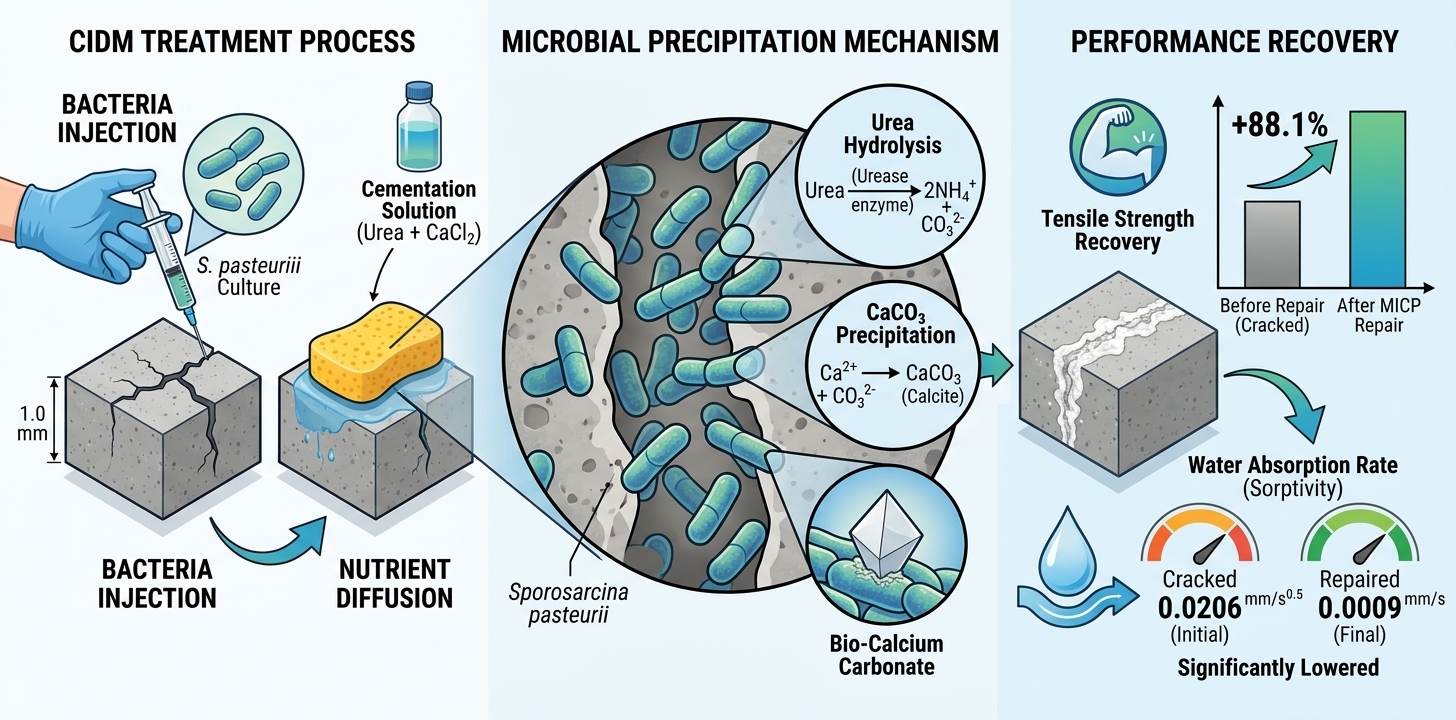
Concrete structures are vulnerable to cracking from mechanical, chemical, and environmental stresses, which compromise durability and increase maintenance costs. Conventional repair methods, such as epoxy injection and cementitious grouting, often depend on non-renewable materials and contribute to environmental waste. This study explores Microbially Induced Calcium Carbonate Precipitation (MICP) using Sporosarcina pasteurii as a sustainable approach for repairing cracks in cement-based materials. Laboratory experiments were conducted on mortar samples with 1.0 mm predefined cracks, while in-situ trials were performed on cracked cement surfaces at UTMSPACE. Treated samples recovered up to 88.1% of their original tensile strength (19.59 kN compared to 22.24 kN for controls), confirming the structural reinforcement potential of MICP. SEM–EDX analysis showed uniform calcium carbonate deposition along the crack surfaces, while FTIR spectroscopy confirmed biomolecular signatures linked to calcite formation. Water absorption tests revealed a significant reduction in permeability, with secondary absorption rates decreasing from 0.0206 mm/√s to 0.0009 mm/√s, indicating enhanced durability. Field application validated the practicality of the method, achieving visible crack sealing and mineral deposition within one working day per treated area. These results highlight MICP as a viable, eco-friendly alternative to conventional repair strategies, offering both mechanical and environmental benefits. The findings support the integration of MICP into sustainable infrastructure maintenance practices.
References
Zhang, Y. S., Liu, Y., Sun, X. D., et al. (2024). Application of microbially induced calcium carbonate precipitation (MICP) technique in concrete crack repair: A review. Construction and Building Materials, 411, 134313. https://doi.org/10.1016/j.conbuildmat.2023.134313.
Abu Bakr, M., Singh, B. K., & Hussain, A. (2024). Experimental investigations on MICP-based autonomous crack-healing recycled aggregate concrete: A sustainable approach for enhancing the strength and durability. Sustainable and Resilient Infrastructure. https://doi.org/10.1080/23789689.2024.2329390.
Hasan Saleh, A., Raja, M. S., & History, A. (2023). Innovative engineering strategies for evaluating and repairing concrete cracks: An applied perspective. Mesopotamian Journal of Civil Engineering, 2023, 64–76. https://doi.org/10.58496/mjce/2023/009.
Zheng, Y., Li, R., Wang, J., et al. (2024). Innovative and environmentally friendly MICP surface curing: Enhancing mechanical and durability properties of concrete. Journal of Cleaner Production, 478, 143962. https://doi.org/10.1016/j.jclepro.2024.143962.
Wang, W., Fu, P., Wang, S., et al. (2025). Research on MICP for repairing small cracks in concrete. In Sustainable Civil Infrastructures (pp. 303–311). https://doi.org/10.1007/978-3-031-82722-8_28.
Huang, W., Zheng, J., Fan, L., et al. (2024). Application and environmental sustainability assessment of microbial induced calcite precipitation in asphalt concrete crack repair. International Journal of Pavement Engineering, 25. https://doi.org/10.1080/10298436.2024.2430751.
Jiang, L., Li, P., Wang, W., et al. (2024). A self-healing method for concrete cracks based on microbial-induced carbonate precipitation: Bacteria, immobilization, characterization, and application. Journal of Sustainable Cement-Based Materials, 13, 222–242. https://doi.org/10.1080/21650373.2023.2263447.
Kulkarni, P. B., Nemade, P. D., & Wagh, P. (2020). Healing of generated cracks in cement mortar using MICP. Civil Engineering Journal, 6. https://doi.org/10.28991/cej-2020-03091500.
Gao, R., & Wang, J. (2023). The influence of repair technique on the distribution of biogenic CaCO₃ in a mimic vertical crack. Construction and Building Materials, 402, 133021. https://doi.org/10.1016/j.conbuildmat.2023.133021.
Zhang, W., Li, J., Chen, Z., & Tan, Y. (2024). Durability evaluation of MICP-repaired concrete exposed to the freeze–thaw process. Journal of Materials in Civil Engineering, 36, 04024420. https://doi.org/10.1061/jmcee7.mteng-16296.
De Muynck, W., De Belie, N., & Verstraete, W. (2010). Microbial carbonate precipitation in construction materials: A review. Ecological Engineering, 36, 118–136. https://doi.org/10.1016/j.ecoleng.2009.02.006.
Kevin, L., Tchamou, Y., & Caihong, X. (2025). Effect of MICP on reinforcement corrosion of cement concrete exposed to the marine environment. Discover Civil Engineering, 2(1), 1–16. https://doi.org/10.1007/s44290-025-00200-4.
Anand, K., Goyal, S., & Reddy, M. S. (2023). Development of field applicable remediation procedure using bio-cementitious grout for concrete cracks in variable orientations. Journal of Building Engineering, 67, 106024. https://doi.org/10.1016/j.jobe.2023.106024.
Lu, C., Li, Z., Wang, J., et al. (2023). An approach of repairing concrete vertical cracks using microbially induced carbonate precipitation driven by ion diffusion. Journal of Building Engineering, 73, 106798. https://doi.org/10.1016/j.jobe.2023.106798.
Carter, M. S., Tuttle, M. J., Mancini, J. A., et al. (2023). Microbially induced calcium carbonate precipitation by Sporosarcina pasteurii: A case study in optimizing biological CaCO₃ precipitation. Applied and Environmental Microbiology, 89. https://doi.org/10.1128/aem.01794-22.
Li, W., Fishman, A., & Achal, V. (2022). Whole cell evaluation and enzymatic kinetic study of urease from ureolytic bacteria affected by potentially toxic elements. Microbiological Research, 265, 127208. https://doi.org/10.1016/j.micres.2022.127208.
Intarasoontron, J., Pungrasmi, W., Nuaklong, P., et al. (2021). Comparing performances of MICP bacterial vegetative cell and microencapsulated bacterial spore methods on concrete crack healing. Construction and Building Materials, 302, 124227. https://doi.org/10.1016/j.conbuildmat.2021.124227.
Shen, D., Kang, J., Shao, H., et al. (2023). Cracking failure behavior of high-strength concrete containing nano-CaCO₃ at early age. Cement and Concrete Composites, 139, 104996. https://doi.org/10.1016/j.cemconcomp.2023.104996.
Xiang, J., Qiu, J., Yuan, J., et al. (2022). Study on denitrifying biogrout to immobilize heavy metals in bottom ash in an anaerobic environment and its immobilization mechanism. Journal of Environmental Chemical Engineering, 10, 108084. https://doi.org/10.1016/j.jece.2022.108084.
Xiao, G., Zhang, J., & Cheng, X. (2023). Review on the application of biogeotechnology in the restoration of masonry structures. Geomicrobiology Journal, 40, 719–732. https://doi.org/10.1080/01490451.2023.2255595.
Gunsur, E., Mumcu, H., Demir, C., et al. (2023). Biogenic material design by stone waste treatment with biologically induced mineralization. Journal of Bio- and Inorganic Engineering, 12, 70–81. https://doi.org/10.1680/jbibn.21.00007.
Nasser, A. A., Sorour, N. M., Saafan, M. A., & Abbas, R. N. (2022). Microbially induced calcite precipitation (MICP): A biotechnological approach to enhance the durability of concrete using Bacillus pasteurii and Bacillus sphaericus. Heliyon, 8, e09879. https://doi.org/10.1016/j.heliyon.2022.e09879.
Shi, W., Wang, M., Wu, L., et al. (2022). Study of concrete crack repair using Bacillus megaterium. Advances in Materials Science and Engineering, 2022, 6188680. https://doi.org/10.1155/2022/6188680.
Omoregie, A. I., Wong, C. S., Rajasekar, A., et al. (2025). Bio-based solutions for concrete infrastructure: A review of microbial-induced carbonate precipitation in crack healing. Buildings, 15, 1052. https://doi.org/10.3390/buildings15071052.
Bandyopadhyay, A., Saha, A., Ghosh, D., et al. (2023). Microbial repairing of concrete and its role in CO₂ sequestration: A critical review. Beni-Suef University Journal of Basic and Applied Sciences, 12, 1–13. https://doi.org/10.1186/s43088-023-00344-1.
Yehya, A., & Rice, J. R. (2020). Influence of fluid-assisted healing on fault permeability structure. Journal of Geophysical Research: Solid Earth, 125, e2020JB020553. https://doi.org/10.1029/2020JB020553.
Chen, Y., Han, Y., Zhang, X., et al. (2023). Experimental study on permeability and strength characteristics of MICP-treated calcareous sand. Biogeotechnics, 1, 100034. https://doi.org/10.1016/j.bgtech.2023.100034.
Lekundayo, A. (2024). The influence of crystalline admixtures on the mechanical and durability properties of cracked and uncracked concrete. [Unpublished manuscript].
Jongvivatsakul, P., Janprasit, K., Nuaklong, P., et al. (2019). Investigation of the crack healing performance in mortar using microbially induced calcium carbonate precipitation (MICP) method. Construction and Building Materials, 212, 737–744. https://doi.org/10.1016/j.conbuildmat.2019.04.035.
Gao, R., Ma, J., Liu, G., et al. (2023). Optimization of deposition process for a productive and cohesive bio-CaCO₃ to repair concrete existing cracks. Applied Microbiology and Biotechnology, 107, 3479–3494. https://doi.org/10.1007/s00253-023-12531-2.
Chang, J., Yang, D., Lu, C., et al. (2024). Application of MICP in concrete self-healing and environmental restoration to facilitate carbon neutrality: A critical review. Environmental Science and Pollution Research, 31, 38083–38098. https://doi.org/10.1007/s11356-024-33824-7.
Zhang, Y. S., Liu, Y., Sun, X. D., et al. (2024). Application of microbially induced calcium carbonate precipitation (MICP) technique in concrete crack repair: A review. Construction and Building Materials, 411, 134313. https://doi.org/10.1016/j.conbuildmat.2023.134313.
Wong, P. Y., Mal, J., Sandak, A., et al. (2024). Advances in microbial self-healing concrete: A critical review of mechanisms, developments, and future directions. Science of the Total Environment, 947, 174553. https://doi.org/10.1016/j.scitotenv.2024.174553.
Castro-Alonso, M. J., Montañez-Hernandez, L. E., Sanchez-Muñoz, M. A., et al. (2019). Microbially induced calcium carbonate precipitation (MICP) and its potential in bioconcrete: Microbiological and molecular concepts. Frontiers in Materials, 6. https://doi.org/10.3389/fmats.2019.00126.
Fan, Q., Fan, L., Quach, W. M., et al. (2023). Application of microbial mineralization technology for marine concrete crack repair: A review. Journal of Building Engineering, 69, 106299. https://doi.org/10.1016/j.jobe.2023.106299.
Ojha, A., Bandyopadhyay, T. K., Das, D., & Dey, P. (2025). Microbial carbonate mineralization: A comprehensive review of mechanisms, applications, and recent advancements. Molecular Biotechnology, 1–27. https://doi.org/10.1007/s12033-025-01433-5.
Krajewska, B. (2018). Urease-aided calcium carbonate mineralization for engineering applications: A review. Journal of Advanced Research, 13, 59–67. https://doi.org/10.1016/j.jare.2017.10.009.
Niu, Y. Q., Liu, J. H., Aymonier, C., et al. (2022). Calcium carbonate: Controlled synthesis, surface functionalization, and nanostructured materials. Chemical Society Reviews, 51, 7883–7943. https://doi.org/10.1039/d1cs00519g.
Zhang, J., Zhao, C., Zhou, A., et al. (2019). Aragonite formation induced by open cultures of microbial consortia to heal cracks in concrete: Insights into healing mechanisms and crystal polymorphs. Construction and Building Materials, 224, 815–822. https://doi.org/10.1016/j.conbuildmat.2019.07.129.
Wang, J., Ji, S., Huang, S., et al. (2024). Crack sealing in concrete with biogrout: Sustainable approach to enhancing mechanical strength and water resistance. Materials, 17, 6283. https://doi.org/10.3390/ma17246283.
Huang, P., Yang, X., & Dai, Y. (2025). Effect evaluation of repairing cement-mortar microbeams by microbial induced carbonate precipitation. AMB Express, 15, 1–15. https://doi.org/10.1186/s13568-025-01881-x.
Dong, Z. H., Pan, X. H., Tang, C. S., et al. (2024). A microbially induced magnesia carbonation (MIMC) method with potential application for crack healing of sandstone cultural relics: Improving interfacial bonding strength. Rock Mechanics and Rock Engineering, 58, 557–573. https://doi.org/10.1007/s00603-024-04149-1.
Pianfuengfoo, S., Kongtunjanphuk, S., Zhang, H., & Sukontasukkul, P. (2024). Use of buffer treatment to utilize local non-alkali tolerant bacteria in MICP sedimentation for concrete crack repair. Heliyon, 10, e26776. https://doi.org/10.1016/j.heliyon.2024.e26776.
Jiang, L., Xia, H., Hu, S., et al. (2024). Crack-healing ability of concrete enhanced by aerobic–anaerobic bacteria and fibers. Cement and Concrete Research, 183, 107585. https://doi.org/10.1016/j.cemconres.2024.107585.
Min, J., Son, Y., Jang, I., et al. (2024). Managing two simultaneous issues in concrete repair: Healing microcracks and controlling pathogens. Construction and Building Materials, 416, 135125. https://doi.org/10.1016/j.conbuildmat.2024.135125.
Yin, X., Weitzel, F., Griesshaber, E., et al. (2020). Bacterial EPS in agarose hydrogels directs mineral organization in calcite precipitates: Species-specific biosignatures. Crystal Growth and Design, 20, 4402–4417. https://doi.org/10.1021/acs.cgd.0c00231.
Dhami, N. K., Mukherjee, A., & Watkin, E. L. J. (2018). Microbial diversity and mineralogical–mechanical properties of calcitic cave speleothems under natural and in vitro biomineralization conditions. Frontiers in Microbiology, 9. https://doi.org/10.3389/fmicb.2018.00040.
Teoh, H. J. (2024). Optimizing temperature parameters for enhanced mineralization process: Maximizing CO₂ conversion efficiency and stability of formed carbonate minerals. [Unpublished manuscript].
Sun, X., & Miao, L. (2020). Application of bio-remediation with Bacillus megaterium for crack repair at low temperature. Journal of Advanced Concrete Technology, 18, 307–319. https://doi.org/10.3151/jact.18.307.
Huang, H., Du, C., Yi, F., et al. (2024). Enhancing concrete crack healing: Revealing the synergistic impacts of multicomponent microbial repair systems. Case Studies in Construction Materials, 21, e03402. https://doi.org/10.1016/j.cscm.2024.e03402.
Ighodalo Omoregie, A., Khoshdelnezamiha, G., Ong, D. E. L., & Morin Nissom, P. (2017). Microbial-induced carbonate precipitation using a sustainable treatment technique. International Journal of Service Management and Sustainability, 2. https://doi.org/10.24191/ijsms.v2i1.6045.
Liu, S., Yu, J., Peng, X., et al. (2020). Preliminary study on repairing tabia cracks using microbially induced carbonate precipitation. Construction and Building Materials, 248, 118611. https://doi.org/10.1016/j.conbuildmat.2020.118611.
Zheng, Y., Li, R., Wang, J., et al. (2024). Innovative and environmentally friendly MICP surface curing: Enhancing mechanical and durability properties of concrete. Journal of Cleaner Production, 478, 143962. https://doi.org/10.1016/j.jclepro.2024.143962.
Kolawole, O., Assaad, R. H., Adams, M. P., et al. (2023). Coupled experimental assessment and machine learning prediction of mechanical integrity of MICP and cement paste as underground plugging materials. Biogeotechnics, 1, 100020. https://doi.org/10.1016/j.bgtech.2023.100020.
Jiang, L., Xia, H., Wang, W., et al. (2023). Applications of microbially induced calcium carbonate precipitation in civil engineering practice: A state-of-the-art review. Construction and Building Materials, 404, 133227. https://doi.org/10.1016/j.conbuildmat.2023.133227.
Downloads
Published
Issue
Section
License
Copyright (c) 2025 hazlami fikri Basri

This work is licensed under a Creative Commons Attribution-NonCommercial 4.0 International License.