
In Vitro and In Silico Study of the Anticancer Activity of Benalu batu (Begonia medicinalis Ardi & D.C. Thomas) an Endemic Plant of Sulawesi Against A549 Lung Cancer Cells
DOI:
https://doi.org/10.11113/mjfas.v22n3.4699Keywords:
Begonia medicinalis, anticancer, GC-MS, A549 cells, molecular docking.Abstract
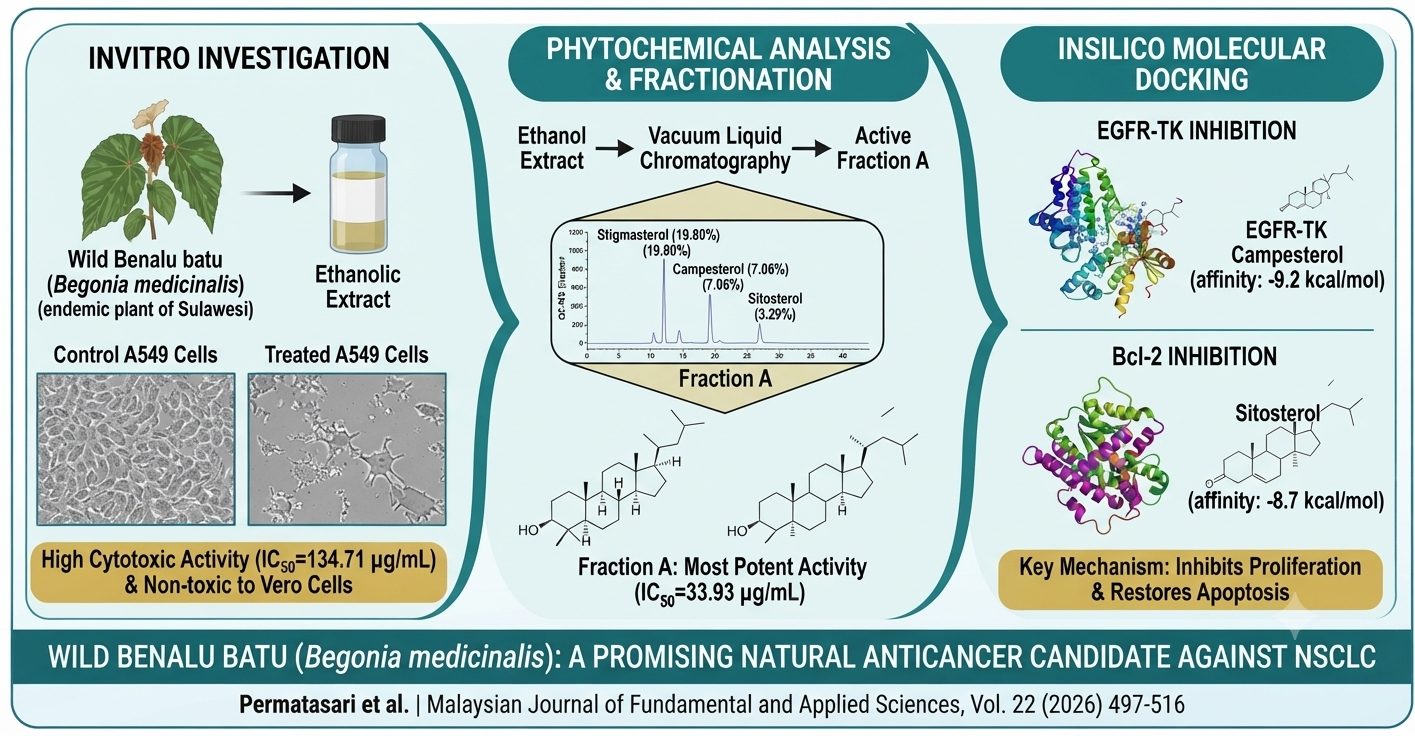
Lung cancer is one the leading causes of cancer related deaths worldwide. Standard therapies such as cisplatin are commonly used however, their long-term use can lead toxic effects on normal cells. Consequently, the search for alternative herbal based therapies has gained increasing attention. One potential candidate is Benalu batu (Begonia medicinalis), an endemic plant from Sulawesi that has been traditionally used as remedy for various ailments, including tumors and cancer. This study aims to evaluate the anticancer potential of ethanolic extract and fraction of Benalu batu both in vitro A549 lung cancer cells and Vero cells, and in silico against EGFR-TK and Bcl-2 proteins, which are involved in the progression of Non-Small Cell Lung Cancer (NSCLC). Cytotoxicity was assessed using the MTT assay, while compound identification was performed using Thin Layer Chromatography (TLC) and Gas Chromatography-Mass Spectrometry (GC-MS). Druglikeness feasibility was evaluated through Lipinski’s Rule of Five using SwissADME, and molecular docking studies were conducted using PyRx and Visualized with Discovery Studio. The results demonstrated that the ethanolic extract of wild Benalu batu exhibited higher cytotoxic activity compared to the cultivated plant extract, with an IC50 value of 134.71 µg/mL, and was nontoxic to Vero cells (IC50 = 517.24 µg/mL). Thin Layer Chromatography profiling indicated that the compounds in the wild Benalu batu extract are predominantly non-polar. Cytotoxicity testing of the active fractions revealed that fraction A exhibited the most potent activity with an IC50 of 33.93 µg/mL and high selectivity index of 24.52, surpassing that of cisplatin. Gas Chromatography-Mass Spectrometry analysis identified eight bioactive compounds suspected to have anticancer potential, these compounds are stigmasterol (19.80%), campesterol (7.06%), neophytadiene (4.83%), sitosterol (3.29%), squalene (2.73%), phytol (2.39%), phytol acetate (1.22%), hexadecenoic acid ethyl ester (1.22%), and α-tocopheryl acetate (1.10%). Molecular docking against the EGFR-TK protein showed that campesterol (-9.2 kcal/mol), stigmasterol ((-9.1 kcal/mol), and sitosterol (-8.2 kcal/mol), had more favorable binding affinity values compared to the control drug gefitinib (-7.7 kcal/mol). Sitosterol exhibited the highest binding affinity
(-8.7 kcal/mol) against Bcl-2 protein, followed by squalene and stigmasterol (-8.5 kcal/mol), and campesterol (-8.4 kcal/mol).
References
Provencio, M., Nadal, E., Gonzalez-Larriba, J. L., Martinez-Marti, A., Bernabé, R., Bosch-Barrera, J., ... & Romero, A. (2023). Perioperative nivolumab and chemotherapy in stage III non–small-cell lung cancer. New England Journal of Medicine, 389(6), 504-513. https://doi.org/10.1056/NEJMoa2215530
Ciardiello, F., Hirsch, F. R., Pirker, R., Felip, E., Valencia, C., & Smit, E. F. (2024). The role of anti-EGFR therapies in EGFR-TKI-resistant advanced non-small cell lung cancer. Cancer Treatment Reviews, 122, 102664. https://doi.org/10.1016/j.ctrv.2023.102664
Prabhakar, C. N. (2015). Epidermal growth factor receptor in non-small cell lung cancer. Translational lung cancer research, 4(2), 110. https://doi.org/10.3978/j.issn.2218-6751.2014.09.15
Qian, S., Wei, Z., Yang, W., Huang, J., Yang, Y., & Wang, J. (2022). The role of BCL-2 family proteins in regulating apoptosis and cancer therapy. Frontiers in oncology, 12, 985363. https://doi.org/10.3389/fonc.2022.985363
Alduais, Y., Zhang, H., Fan, F., Chen, J., & Chen, B. (2023). Non-small cell lung cancer (NSCLC): A review of risk factors, diagnosis, and treatment. Medicine, 102(8), e32899. https://doi.org/10.1097/MD.0000000000032899
Bahuguna, A., Khan, I., Bajpai, V. K., & Kang, S. C. (2017). MTT assay to evaluate the cytotoxic potential of a drug. Bangladesh Journal of Pharmacology, 12(2), 115–118. https://doi.org/10.3329/bjp.v12i2.28686
Aldossary, S. A. (2019). Review on pharmacology of cisplatin: clinical use, toxicity and mechanism of resistance of cisplatin. Biomedical and Pharmacology Journal, 12(1), 7-15 https://doi.org/10.13005/bpj/1608
Zubair, M. S., Alarif, W. M., Ghandourah, M. A., Anam, S., & Jantan, I. (2020). Cytotoxic activity of 2-o-β-glucopyranosil cucurbitacin d from benalu batu (Begonia sp.) growing in Morowali, Central Sulawesi.
Indonesian Journal of Chemistry, 20(4), 766–772 https://doi.org/10.22146/ijc.48421
Anam, S., Ritna, A., Dwimurti, F., Rismayanti, D., & Sulaiman Zubair, M. (2014). Aktivitas Sitotoksik Ekstrak Metanol Benalu Batu (Begonia sp.): Ethnomedicine Suku Wana Sulawesi Tengah (Cytotoxic Activity of Benalu Batu (Begonia sp.) Methanolic Extract: An Ethnomedicine of Wana Tribe Central Sulawesi). Jurnal Ilmu Kefarmasian Indonesia, 9(1), 10–16 https://doi.org/10.33376/ikfi.v9i1.10
Prihardina, B., & Fatmawati, S. (2021, November). Cytotoxicity of Begonia medicinalis aqueous extract in three cancer cell line. In IOP Conference Series: Earth and Environmental Science (Vol. 913, No. 1, p. 012084). IOP Publishing. https://doi.org/10.1088/1755-1315/913/1/012084
Zubair, M. S., Khairunisa, S. Q., Sulastri, E., Ihwan, Widodo, A., Nasronudin, & Pitopang, R. (2021). Antioxidant and antiviral potency of Begonia medicinalis fractions. Journal of Basic and Clinical Physiology and Pharmacology, 32(4), 845-851. https://doi.org/10.1515/jbcpp-2020-0435
Khumaidi, A., Widodo, A., Nugrahani, A. W., Sasmito, E., & Fakhrudin, N. (2020). Profil Proliferasi Sel Limfosit Benalu Batu (Begonia medicinalis) Asal Kabupaten Morowali Utara Provinsi Sulawesi Tengah (Lymphocyte Cell Proliferation Profi le of Begonia medicinalis from North Morowali Regency Central Sulawesi Province). Jurnal Ilmu Kefarmasian Indonesia, 18(1), 61–67. https://doi.org/10.33376/ikfi.v18i1.40
Guli, M., Ardiputra, M. A., Pitopang, R., Sari, R., Hatta, M., Prawiro, S. R., ... & Rahmawati, N. D. (2025). The Anticancer Activity of Ethanol Extract of Begonia medicinalis on Colorectal Cancer Rat Model Induced With 7, 12-Dimethylbenz [A] Anthracene. Journal of Health and Nutrition Research, 4(2), 518-526.
Prayong, P., Barusrux, S., & Weerapreeyakul, N. (2008). Cytotoxic activity screening of some indigenous Thai plants. Fitoterapia, 79(7–8), 598–601. https://doi.org/10.1016/j.fitote.2008.06.007
Widiyastuti, Y., Pratiwi, R., Riyanto, S., & Wahyuono, S. (2018). Cytotoxic activity and apoptosis induction of avocado Persea americana Mill. Seed extract on MCF-7 cancer cell line. Indonesian Journal of Biotechnology, 23(2), 61–67. https://doi.org/10.22146/ijbiotech.32141
Dasari, S., & Bernard Tchounwou, P. (2014). Cisplatin in cancer therapy: Molecular mechanisms of action.
European Journal of Pharmacology, 740, 364–378. https://doi.org/10.1016/j.ejphar.2014.07.025
Caldwell, G. W., Yan, Z., Lang, W., & Masucci, J. A. (2012). The IC 50 Concept Revisited. Curr. Top. Med.
Chem., 12, 1282–1290. https://doi.org/10.2174/156802612800673327
Nguyen, N. H., Ta, Q. T. H., Pham, Q. T., Luong, T. N. H., Van Trung Phung, T., Duong, H.-H., & Vo, V. G. (2020). Anticancer Activity of Novel Plant Extracts and. Molecules, 25(2912), 1–16. https://doi.org/10.3390/molecules25122912
Da'i, M., Meilinasary, K. A., Suhendi, A., & Haryanti, S. (2019). Selectivity index of alpinia galanga extract and 1’-acetoxychavicol acetate on cancer cell lines. Indonesian Journal of Cancer Chemoprevention, 10(2), 95-100. https://doi.org/10.14499/indonesianjcanchemoprev10iss2pp95-100
Dahham, S. S., Tabana, Y. M., Iqbal, M. A., Ahamed, M. B. K., Ezzat, M. O., Majid, A. S. A., & Majid, A. M.
S. A. (2015). The anticancer, antioxidant and antimicrobial properties of the sesquiterpene β-caryophyllene from the essential oil of Aquilaria crassna. Molecules, 20(7), 11808–11829 https://doi.org/10.3390/molecules200711808
Indrayanto, G., Putra, G. S., & Suhud, F. (2021). Validation of in-vitro bioassay methods: Application in herbal drug research. In Profiles of Drug Substances, Excipients and Related Methodology (1st ed., Vol. 46). Elsevier Inc. https://doi.org/10.1016/bs.podrm.2020.07.005
Poojar, B., Ommurugan, B., Adiga, S., Thomas, H., Sori, R. K., Poojar, B., Hodlur, N., Tilak, A., Korde, R.,
Gandigawad, P., In, M., Sleep, R., Albino, D., Rats, W., Article, O., Schedule, P., Injury, C. C., Sori, R. K., Poojar, B., Gandigawad, P. (2017). Methodology Used in the Study. Asian Journal of Pharmaceutical and Clinical Research, 7(10), 1–5.
Maurya, A. (2018). Vacuum Liquid Chromatography: Simple, Efficient and Versatile Separation Technique for Natural Products. Organic & Medicinal Chemistry International Journal, 7(2), 1–3.
Bele, A. A., & Khale., A. (2011). An Overview on Thin Layer Chromatography Archana A. Bele* and Anubha Khale H. K. College of Pharmacy, Jogeshwari (W), Mumbai, Maharashtra, India. Journal of Pharmaceutical Sciences, 2(2), 256–267 https://doi.org/10.19080/OMCIJ.2018.07.555708
Katrin, K., & Bendra, A. (2015). Aktivitas Antioksidan Ekstrak, Fraksi dan Golongan SenyawaKimia Daun Premna oblongata Miq. Pharmaceutical Sciences and Research, 2(1), 21-31. https://doi.org/10.7454/psr.v2i1.3323
Eslaminejad, T., Pourshojaei, Y., Naghizadeh, M., Eslami, H., Daneshpajouh, M., & Hassanzadeh, A. (2022). Synthesis of some benzylidene thiosemicarbazide derivatives and evaluation of their cytotoxicity on U87, MCF-7, A549, 3T3 and HUVEC cell lines. Journal of the Serbian Chemical Society, 87(10), 1125-1142. https://doi.org/10.2298/JSC220203038E
Peña-Morán, O. A., Villarreal, M. L., Álvarez-Berber, L., Meneses-Acosta, A., & Rodríguez-López, V. (2016). Cytotoxicity, post-treatment recovery, and selectivity analysis of naturally occurring podophyllotoxins from Bursera fagaroides var. fagaroides on breast cancer cell lines. Molecules, 21(8), 1013. https://doi.org/10.3390/molecules21081013
Choi, M., Park, S. M., & Cho, K. H. (2022). Evaluating a therapeutic window for precision medicine by integrating genomic profiles and p53 network dynamics. Communications Biology, 5(1), 924. https://doi.org/10.1038/s42003-022-03893-w
Gutbrod, P., Yang, W., Grujicic, G. V., Peisker, H., Gutbrod, K., Du, L. F., & Dörmann, P. (2021). Phytol derived from chlorophyll hydrolysis in plants is metabolized via phytenal. Journal of Biological Chemistry, 296, 100530. https://doi.org/10.1016/j.jbc.2021.100530.
Tang, C., Wan, Z., Chen, Y., Tang, Y., Fan, W., Cao, Y., Song, M., Qin, J., Xiao, H., Guo, S., & Tang, Z. (2022). Structure and Properties of Organogels Prepared from Rapeseed Oil with Stigmasterol. Foods, 11(7), 1–14. https://doi.org/10.3390/foods11071001
Aboobucker, S. I., & Suza, W. P. (2019). Why do plants convert sitosterol to stigmasterol?. Frontiers in plant science, 10, 354. https://doi.org/10.3389/fpls.2019.00354
Zhang, X., Wang, J., Zhu, L., Wang, X., Meng, F., Xia, L., & Zhang, H. (2022). Advances in Stigmasterol on its anti-tumor effect and mechanism of action. Frontiers in oncology, 12, 1101289. https://doi.org/10.3389/fonc.2022.1101289
Nazir, S., Chaudhary, W. A., Mobashar, A., Anjum, I., Hameed, S., & Azhar, S. (2023). Campesterol: A Natural Phytochemical with Anti Inflammatory Properties as Potential Therapeutic Agent for Rheumatoid Arthritis: A Systematic Review. Pakistan Journal of Health Sciences
Bae, H., Park, S., Yang, C., Song, G., & Lim, W. (2021). Disruption of endoplasmic reticulum and ROS production in human ovarian cancer by campesterol. Antioxidants, 10(3), 379. https://doi.org/10.3390/antiox10030379
Altaf, A., Maqbool, T., Hassan, A., Nasreen, G., Summan, M., Tahir, A., ... & Koser, N. Campesterol induces apoptosis and inhibits proliferation in HepG2 liver cancer cells. Clinical and Experimental Hepatology, 11(1).
Dias, V., Uqueio, M., Nhaca, A., & Salência, H. (2020). Qualitative Analysis of Phytocompounds of Liagora divaricata and Trematocarpus flabellatus. Journal of Drug Delivery and Therapeutics, 10(5), 75–81 https://doi.org/10.22270/jddt.v10i5.4367
Selmy, A. H., Hegazy, M. M., El-Hela, A. A., Saleh, A. M., & El-Hamouly, M. M. (2023). In Vitroand in Silico studies of Neophytadiene; A Diterpene Isolated Fromaeschynomene Elaphroxylon (Guill. &Perr.) Taub. as Apoptotic Inducer. Egyptian Journal of Chemistry, 66(10), 149-161. https://doi.org/10.21608/ejchem.2023.180252.7314
De-Eknamkul, W., & Potduang, B. (2003). Biosynthesis of β-sitosterol and stigmasterol in Croton sublyratus proceeds via a mixed origin of isoprene units. Phytochemistry, 62(3), 389-398
Shahbaz, M., Momal, U., Perween, A., Naeem, H., Hussain, M., Imran, M., ... & Mohamed, H. M. (2026). Anticancer Molecular Mechanisms of Phytosterols: An Updated Review on Clinical Trials. Food Science & Nutrition, 14(2), e71505.
Senbagalakshmi, P., Muthukrishnan, T., Jebasingh, T., Senthil Kumar, T., & Rao, M. V. (2019). Squalene, biosynthesis and its role in production of bioactive compounds, a proper scientific challenge - A review. Journal of Emerging Technologies and Innovative Research, 6(2), 505–526.
Bidooki, S. H., Quero, J., Sánchez-Marco, J., Herrero-Continente, T., Marmol, I., Lasheras, R., ... & Rodriguez-Yoldi, M. J. (2024). Squalene in Nanoparticles Improves Antiproliferative Effect on Human Colon Carcinoma Cells Through Apoptosis by Disturbances in Redox Balance. International Journal of Molecular Sciences, 25(23), 13048. https://doi.org/10.3390/ijms252313048
Gutbrod, P., Yang, W., Grujicic, G. V., Peisker, H., Gutbrod, K., Du, L. F., & Dörmann, P. (2021). Phytol derived from chlorophyll hydrolysis in plants is metabolized via phytenal. Journal of Biological Chemistry, 296, 100530.
Sakthivel, R., Malar, D. S., & Devi, K. P. (2018). Phytol shows anti-angiogenic activity and induces apoptosis in A549 cells by depolarizing the mitochondrial membrane potential. Biomedicine & Pharmacotherapy, 105, 742-752. https://doi.org/10.1016/j.biopha.2018.06.040
Boadu, A., Karpoormath, R., & Nlooto, M. (2024). Spondias mombin: biosafety and GC–MS analysis of anti-viral compounds from crude leaf extracts. Advances in Traditional Medicine, 24(1), 349–372. https://doi.org/10.1007/s13596-023-00685-9
Arora, S., & Meena, S. (2017). GC-MS Profiling of Ceropegia bulbosa Roxb. var. bulbosa, an endangered plant from Thar Desert, Rajasthan. Pharma Innov J, 6(11), 568-573.
Sunarić, S., Lalić, J., & Spasić, A. (2017). Simultaneous Determination of Alpha-Tocopherol and Alpha-Tocopheryl Acetate in Dairy Products, Plant Milks and Health Supplements by Using SPE and HPLC Method. Food Analytical Methods, 10(12), 3886–3901. https://doi.org/10.1007/s12161-017-0953-3
Ali, H. M., Attia, M. H., Mamdouh, W., Rashed, E. N., & Ali, I. H. (2025). Oxidative degradation of alpha-tocopherol by reactive oxygen species, identifying products, and product anticancer activity. BMC chemistry, 19(1), 306.
Abdullahi, M., & Adeniji, S. E. (2020). In-silico Molecular Docking and ADME/Pharmacokinetic Prediction Studies of Some Novel Carboxamide Derivatives as Anti-tubercular Agents. Chemistry Africa, 3(4), 989–1000 https://doi.org/10.1007/s42250-020-00171-w
Pattanayak, P. (2022). SwissADME Predictions of Drug-Likeness of 5-Nitro Imidazole Derivatives as Potential Antimicrobial and Antifungal Agents. Russian Journal of Bioorganic Chemistry, 48(5), 949–957. https://doi.org/10.1134/S106816202205018X
Ivanović, V., Rančić, M., Arsić, B., & Pavlović, A. (2020). Lipinski’s rule of five, famous extensions and famous exceptions. Chemia Naissensis, 3(1), 171–181
Schweiker, S. S., & Levonis, S. M. (2020). Navigating the intricacies of molecular docking. Future Medicinal Chemistry, 12(6), 469–471. https://doi.org/10.4155/fmc-2019-0335
Yusuf, D., Davis, A. M., Kleywegt, G. J., & Schmitt, S. (2008). An alternative method for the evaluation of docking performance: RSR vs RMSD. Journal of Chemical Information and Modeling, 48(7), 1411–1422. https://doi.org/10.1021/ci800084x
Tamirat, M. Z., Kurppa, K. J., Elenius, K., & Johnson, M. S. (2021). Structural basis for the functional changes by EGFR exon 20 insertion mutations. Cancers, 13(5), 1–21. https://doi.org/10.3390/cancers13051146
Bello, M. (2018). Binding mechanism of kinase inhibitors to EGFR and T790M, L858R and L858R/T790M mutants through structural and energetic analysis. International Journal of Biological Macromolecules, 118, 1948–1962. https://doi.org/10.1016/j.ijbiomac.2018.07.054
Li, Z., Jiang, J., Ficarro, S. B., Beyett, T. S., To, C., Tavares, I., Zhu, Y., Li, J., Eck, M. J., Jänne, P. A., Marto, J. A., Zhang, T., Che, J., & Gray, N. S. (2024). Molecular Bidents with Two Electrophilic Warheads as a New Pharmacological Modality. ACS Central Science, 10(6), 1156–1166. https://doi.org/10.1021/acscentsci.4c00222
Truong, T. H., Ung, P. M. U., Palde, P. B., Paulsen, C. E., Schlessinger, A., & Carroll, K. S. (2016). Molecular Basis for Redox Activation of Epidermal Growth Factor Receptor Kinase. Cell Chemical Biology, 23(7), 837–848 https://doi.org/10.1016/j.chembiol.2016.06.006
Nie, W., Tang, L., Zhang, H., Shao, J., Wang, Y., Chen, L., Li, D., & Guan, X. (2012). Structural analysis of the EGFR TK domain and potential implications for EGFR targeted therapy. International Journal of Oncology, 40(6), 1763–1769. https://doi.org/10.3892/ijo.2012.1384
Pandey, Pankaja, Priyanka Joshi, Shilpi Rawat, and Subhash Chandra. 2024. “Computational Analysis Identifies Withastramonolide and Kaempferol as Highly Potent Compounds from Datura Stramonium Targeting EGFR-TK in Non-Small Cell Lung Cancer ( NSCLC ).” 9(10): 1–7. https://doi.org/10.33263/BRIAC143.030
Yonar, D., Baba, B., & Karayel, A. (2023). Evaluation of zerumbone as an egfr tyrosine kinase inhibitor by molecular docking method. Journal of Faculty of Pharmacy of Ankara University, 47(1), 196-207. https://doi.org/10.33483/jfpau.1171442
Danjolli-Hashani, D., Isbilir, S. S., & Yılmaz, A. Ş. (2025). Punica granatum L. Peel: Anticancer Activity on Hep3B, Drug-likeness, ADMET Prediction, and Molecular Docking with EGFR-TK. ChemistrySelect, 10(3), e202403976
Sora, V., & Papaleo, E. (2022). Structural Details of BH3 Motifs and BH3-Mediated Interactions: an Updated Perspective. Frontiers in Molecular Biosciences, 9(May), 1–20. https://doi.org/10.3389/fmolb.2022.904329
Chen, Y., Wang, J., Zhang, J., & Wang, W. (2018). Binding modes of Bcl-2 homology 3 (BH3) peptides with anti-apoptotic protein A1 and redesign of peptide inhibitors: a computational study. Journal of Biomolecular Structure and Dynamics, 36(15), 3967–3977. https://doi.org/10.1080/07391102.2017.1406859
Gyebi, G., M. Ogunyemi, O., M. Ibrahim, I., O. Afolabi, S., J. Ojo, R., D.I. Ejike, U., & O. Adebayo, J. (2022). Inhibitory potentials of phytocompounds from Ocimum gratissimum against anti-apoptotic BCL-2 proteins associated with cancer: an integrated computational study. Egyptian Journal of Basic and Applied Sciences, 9(1), 588–608. https://doi.org/10.1080/2314808X.2022.2120023
Abd Ghani, M. F., Othman, R., & Nordin, N. (2020). Molecular docking study of naturally derived flavonoids with antiapoptotic BCL-2 and BCL-XL proteins toward ovarian cancer treatment. Journal of Pharmacy and Bioallied Sciences, 12(Suppl 2), S676-S680. https://doi.org/10.4103/jpbs.JPBS_166_20
Gowtham, H. G., Ahmed, F., Anandan, S., Shivakumara, C. S., Bilagi, A., Pradeep, S., ... & Kollur, S. P. (2023). In silico computational studies of bioactive secondary metabolites from Wedelia trilobata against anti-apoptotic B-cell lymphoma-2 (Bcl-2) protein associated with cancer cell survival and resistance. Molecules, 28(4), 1588. https://doi.org/10.3390/molecules28041588
Downloads
Published
Issue
Section
License
Copyright (c) 2026 Ni Kadek Dewi Permatasari, Rarastoeti Pratiwi

This work is licensed under a Creative Commons Attribution-NonCommercial 4.0 International License.