
Identification of the Subsurface Structure of Gamalama Volcano (Ternate City) Using HVSR Inversion Methods
DOI:
https://doi.org/10.11113/mjfas.v21n6.4590Keywords:
Gamalama mt, HVSR inversion, layer thickness, microtremor, faultAbstract
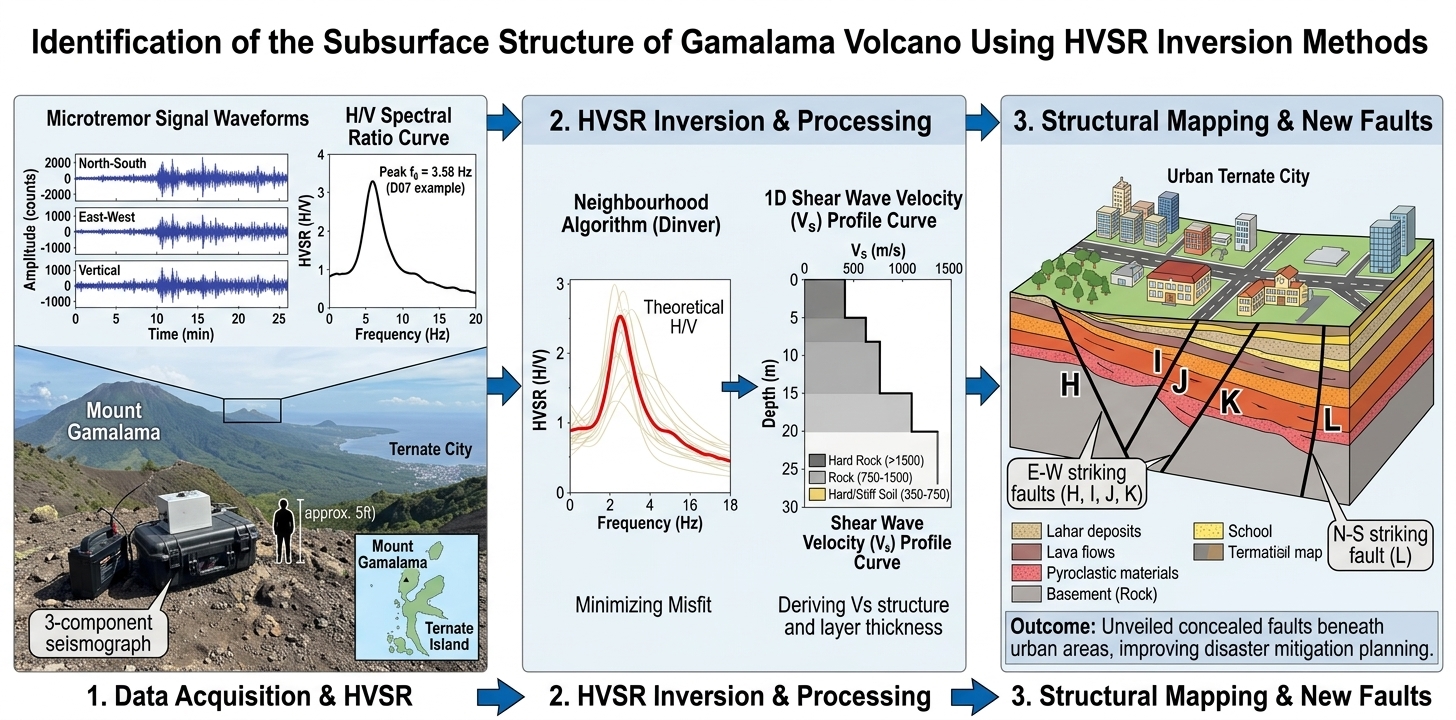
The Gamalama volcano slopes and coastal regions, inhabited by 90% of Ternate City's 200,000 residents have been designated as strategically vital for housing North Maluku's administrative, economic, and cultural core, creating compounded risks during volcanic activity. To quantify these risks, the volcanic subsurface was systematically profiled using passive seismic methods, with microtremor-derived Horizontal to Vertical Signal Ratio (HVSR)inversions being utilized to detect (1) sediment-basement interfaces and (2) concealed fault systems relevant for mitigation measures in Ternate's urban sector. The sediment thickness variations revealed the presence of previously unidentified fault structures, designated as H, I, J, K, and L, which were detected beneath densely populated urban areas.
References
Clor, L. E., Fischer, T. P., Hilton, D. R., Sharp, Z. D., & Hartono, U. (2005). Volatile and N isotope chemistry of the Molucca Sea collision zone: Tracing source components along the Sangihe Arc, Indonesia. Geochemistry, Geophysics, Geosystems, 6(3). https://doi.org/10.1029/2004GC000825.
Kunrat, S., Bani, P., Haerani, N., Saing, U. B., Aiuppa, A., & Syahbana, D. K. (2020). First gas and thermal measurements at the frequently erupting Gamalama volcano (Indonesia) reveal a hydrothermally dominated magmatic system. Journal of Volcanology and Geothermal Research, 407, 107096. https://doi.org/10.1016/j.jvolgeores.2020.107096.
Obermann, A., Planès, T., Larose, E., & Campillo, M. (2013). Imaging preeruptive and coeruptive structural and mechanical changes of a volcano with ambient seismic noise. Journal of Geophysical Research: Solid Earth, 118(12), 6285–6294. https://doi.org/10.1002/2013JB010399.
Venzke, E. (Comp.). (2024). Volcanoes of the world (Version 5.2.8; May 6, 2025). Smithsonian Institution. https://doi.org/10.5479/si.GVP.VOTW5-2024.5.2.
Bronto, S., Hadisantoso, R. D., & Lockwood, J. P. (1982). Peta Geologi Gunungapi Gamalama, Ternate, Maluku Utara. Direktorat Vulkanologi, Indonesia.
Montanaro, C., et al. (2022). Phreatic and hydrothermal eruptions: From overlooked to looking over. Bulletin of Volcanology, 84(6). https://doi.org/10.1007/s00445-022-01571-7.
Stix, J., & de Moor, J. M. (2018). Understanding and forecasting phreatic eruptions driven by magmatic degassing. Earth, Planets and Space, 70(1). https://doi.org/10.1186/s40623-018-0855-z.
Ceballo, R. M., González Herrera, R., Paz Tenorio, J. A., Aguilar Carboney, J. A., & Del Carpio Penagos, C. U. (2019). Effects of sediment thickness upon seismic amplification in the urban area of Chiapa de Corzo, Chiapas, Mexico. Earth Sciences Research Journal, 23(2), 111–117. https://doi.org/10.15446/esrj.v23n2.72623.
Hutchison, W., et al. (2023). Gas emissions and subsurface architecture of fault‐controlled geothermal systems: A case study of the North Abaya geothermal area. Geochemistry, Geophysics, Geosystems, 24(4), e2022GC010822. https://doi.org/10.1029/2022GC010822.
Malusà, M. G., Brandmayr, E., Panza, G. F., Romanelli, F., Ferrando, S., & Frezzotti, M. L. (2022). An explosive component in a December 2020 Milan earthquake suggests outgassing of deeply recycled carbon. Communications Earth & Environment, 3(5), 5. https://doi.org/10.1038/s43247-021-00336-y.
Oliva, S. J., et al. (2019). Insights into fault‐magma interactions in an early‐stage continental rift from source mechanisms and correlated volcano‐tectonic earthquakes. Geophysical Research Letters, 46, 2065–2074. https://doi.org/10.1029/2018GL080866
Nakamura, Y. (1989). Method for dynamic characteristics estimation of subsurface using microtremor on the ground surface.
Sokolov, V. Y., Loh, C.-H., & Jean, W.-Y. (2007). Application of horizontal-to-vertical (H/V) Fourier spectral ratio for analysis of site effect on rock (NEHRP-class B) sites in Taiwan. Soil Dynamics and Earthquake Engineering, 27(4), 314–323. https://doi.org/10.1016/j.soildyn.2006.09.001.
Arai, H., & Tokimatsu, K. (2005). S-wave velocity profiling by joint inversion of microtremor dispersion curve and horizontal-to-vertical (H/V) spectrum. Bulletin of the Seismological Society of America, 95(5), 1766–1778. https://doi.org/10.1785/0120040243.
Okada, H. (2003). The microtremor survey method. Society of Exploration Geophysicists. https://books.google.co.id/books?id=aj1NAQAAIAAJ.
Picotti, S., Francese, R., Giorgi, M., Pettenati, F., & Carcione, J. M. (2017). Estimation of glacier thicknesses and basal properties using the horizontal-to-vertical component spectral ratio (HVSR) technique. Journal of Glaciology, 63(238), 229–248. https://doi.org/10.1017/JOG.2016.135.
Tian, B., Du, Y., You, Z., & Zhang, R. (2019). Measuring the sediment thickness in urban areas using revised H/V spectral ratio method. Engineering Geology, 105223. https://doi.org/10.1016/j.enggeo.2019.105223.
Thein, P., Pramumijoyo, S., Brotopuspito, K. S., Kiyono, J., Wilopo, W., & Setianto, A. (2014). Microtremors HVSR correlation with sub surface geology and ground shear strain at Palu City, Central Sulawesi Province, Indonesia. International Journal of Innovation in Science and Mathematics, 2(5).
Sambridge, M. (1999). Geophysical inversion with a neighbourhood algorithm—I. Searching a parameter space. Geophysical Journal International, 138(2), 479–494. https://doi.org/10.1046/j.1365-246X.1999.00876.x.
SESAME Project. (2004). Guidelines for the implementation of the H/V spectral ratio technique on ambient vibrations: Measurements, processing, and interpretations. http://sesame.geopsy.org/Delivrables/Del-D23-HV_User_Guidelines.pdf.
Konno, K., & Ohmachi, T. (1998). Ground-motion characteristics estimated from spectral ratio between horizontal and vertical components of microtremor. Bulletin of the Seismological Society of America, 88(1), 228–241. https://doi.org/10.1785/bssa0880010228.
Wathelet, M., et al. (2020). Geopsy: A user‐friendly open‐source tool set for ambient vibration processing. Seismological Research Letters, 91(3), 1878–1889. https://doi.org/10.1785/0220190360.
Schön, J. H. (2011). Physical properties of rocks: A workbook (Vol. 8). Elsevier.
Badan Standardisasi Nasional. (2012). SNI 1726:2012: Tata cara perencanaan ketahanan gempa untuk struktur bangunan gedung dan non gedung. http://www.bsn.go.id.
Tarantola, A. (2005). Inverse problem theory and methods for model parameter estimation. Society for Industrial and Applied Mathematics.
Sanchez-Brea, L. M., & Bernabeu, E. (2005). Effect of noise in the estimation of magnitudes with spatial dependence: A spatial statistics technique based on kriging. AIP Conference Proceedings, 780, 811–814. https://doi.org/10.1063/1.2036872.
Riyanto, D. P., Dhanardono, B., Suhardi, Prasetyo, W., Apriyoga, W., & Yulianto, G. (2025). The HVSR analysis for determining the seismic vulnerability and soil characteristics of the Randugunting Dam. IOP Conference Series: Earth and Environmental Science, 12011. https://doi.org/10.1088/1755-1315/1467/1/012011.
Browning, J., Meredith, P., & Gudmundsson, A. (2016). Cooling-dominated cracking in thermally stressed volcanic rocks. https://doi.org/10.1002/2016GL070532.
Lamur, A., et al. (2018). Disclosing the temperature of columnar jointing in lavas. Nature Communications, 9(1), 1432. https://doi.org/10.1038/s41467-018-03842-4.
Sutherland, R., et al. (2017). Extreme hydrothermal conditions at an active plate-bounding fault. Nature, 546(7656), 137–140. https://doi.org/10.1038/nature22355.
Yamashita, T. (1999). Pore creation due to fault slip in a fluid-permeated fault zone and its effect on seismicity. In M. Wyss, K. Shimazaki, & A. Ito (Eds.), Seismicity patterns, their statistical significance and physical meaning (pp. 625–647). Birkhäuser Basel. https://doi.org/10.1007/978-3-0348-8677-2_19.
Aoki, Y. (2022). Earthquake focal mechanisms as a stress meter of active volcanoes. Geophysical Research Letters, 1–5. https://doi.org/10.1029/2022GL100482.
Di, F., Matteo, T., Alessandro, R., & Felix, B. (2020). Editorial: Flank dynamics, sector collapses, lahars, and rockfalls: Analysis, monitoring, and modelling of volcanic slope instability. Frontiers, 2615–2618.
Downloads
Published
Issue
Section
License
Copyright (c) 2025 andri wijaya bidang, Safri Burhanuddin, Adi

This work is licensed under a Creative Commons Attribution-NonCommercial 4.0 International License.